

There is a simple problem at the center of explosive ordnance disposal: someone has to get close enough to understand what the threat actually is. A suspicious package may look harmless from fifty meters away, an unexploded artillery shell can remain unstable decades after it was fired, and an improvised explosive device may contain anti-handling mechanisms specifically intended to punish anyone who approaches it. Historically, that distance had to be closed by a human. EOD robots changed that equation by allowing the first physical interaction with an explosive threat to take place without immediately exposing the technician.

They do not remove danger from bomb disposal, and they certainly do not replace the expertise of an EOD team. What they provide is distance, visibility and a degree of physical access that would otherwise require somebody to enter the hazard area. In a profession where a few additional meters can matter enormously, that alone makes them one of the most practical applications of ground robotics.
The First Look Matters
Before anything can be rendered safe, technicians need information. What is the object? Where is it positioned? Is anything connected to it? Has the surrounding environment been disturbed? Can it be approached from another angle? A remotely operated EOD robot allows teams to begin answering those questions while the operator remains farther away from the suspected device.
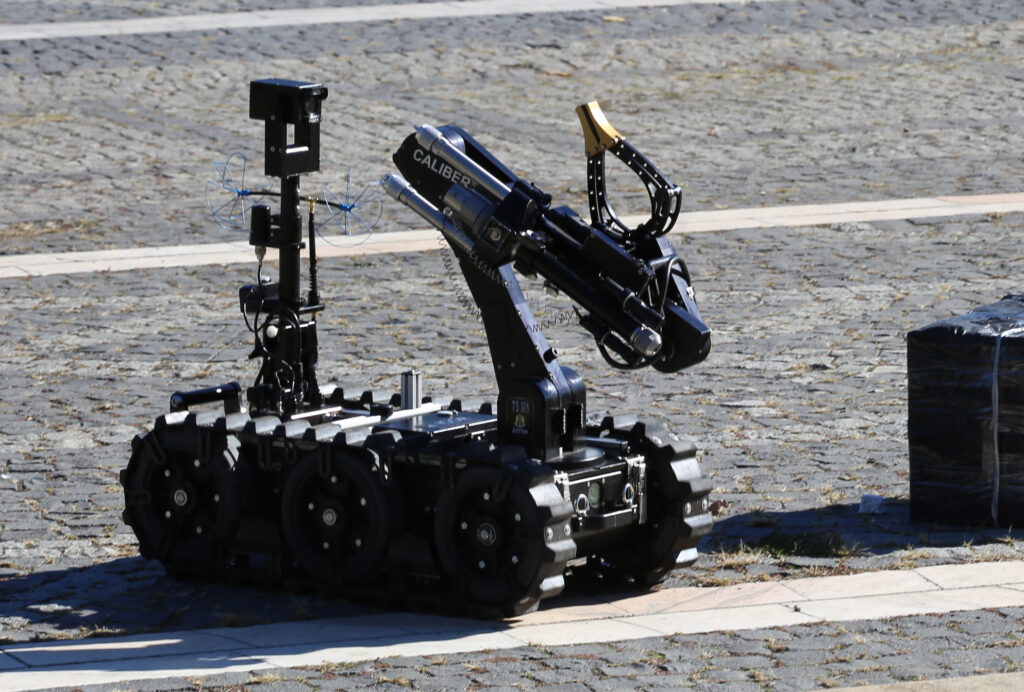
Modern systems can provide multiple camera views and carry lighting, sensors and other equipment while moving around suspicious objects, underneath vehicles or through structures. That sounds relatively straightforward until the environment becomes difficult. Broken pavement, stairs, curbs, rubble, narrow corridors and damaged buildings can quickly turn mobility into one of the most important characteristics of the entire system.
This is one reason tracked platforms remain common. They can provide stability and useful obstacle-crossing capability while maintaining enough traction for rough terrain. Smaller robots, meanwhile, are often designed around portability and access to confined spaces. There is no single ideal EOD robot for every situation. A machine capable of manipulating heavy ordnance may be too large for certain interiors, while a compact system that can be carried quickly by a team may lack the reach or lifting capacity required for another mission.
The trade-off between size, mobility, strength and portability is therefore not a secondary design issue. It defines where the robot can actually be useful.
The Arm Changes the Mission
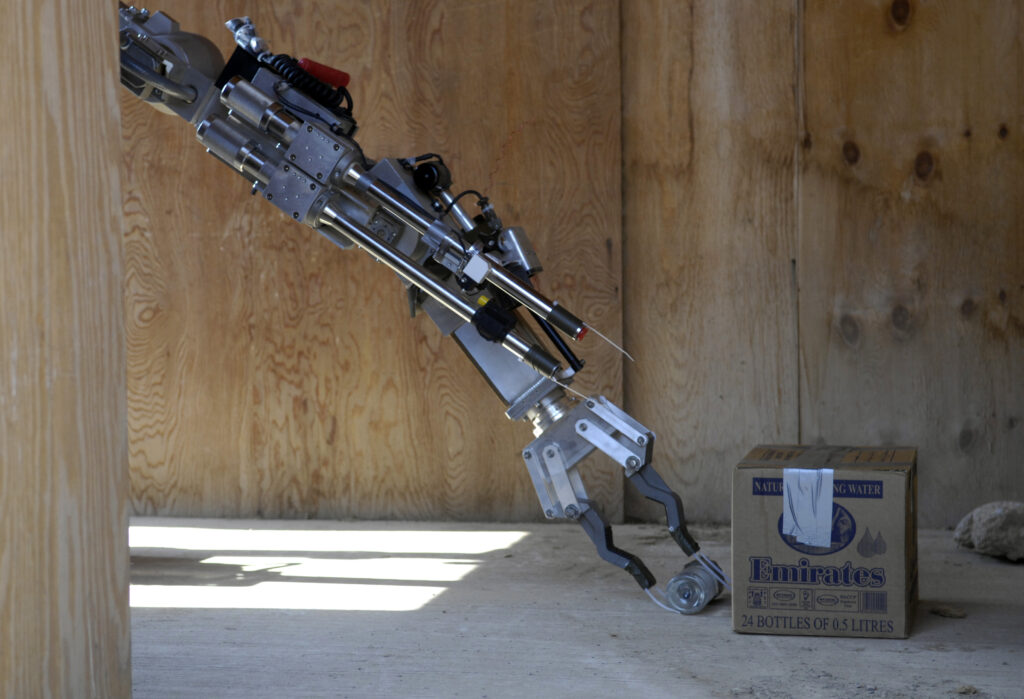
The manipulator arm is probably the feature most people associate with an EOD robot, and for good reason. Observation alone is not always enough. An operator may need to move an object, inspect underneath it, open a compartment, position equipment or interact with something from a very specific angle.
What makes this difficult is that strength is only part of the equation. Precision matters just as much. Imagine trying to pick up or reposition a fragile object while watching your own hands through several camera feeds. Now replace those hands with a mechanical arm and add the possibility that one incorrect movement could have serious consequences.
That is why developments in cameras, control interfaces, manipulator design and force feedback are so important. The goal is not simply to create a stronger robotic arm. It is to make remote manipulation more predictable and intuitive for the person controlling it. Newer heavy EOD platforms increasingly reflect this philosophy, turning the robot into something closer to an extension of the technician rather than just a small vehicle with a claw attached to it.
Distance Creates Another Problem
Keeping personnel farther away from the threat is the entire point, but greater distance creates its own technical challenge: communication. A robot operating across an open area is one thing. Sending it behind reinforced walls, into underground spaces or deeper into a damaged structure is another.
Signal reliability becomes part of the mission. If the connection degrades at the wrong moment, a highly capable manipulator and excellent sensors suddenly matter much less. Military EOD programs have consequently placed increasing emphasis on secure communications, extended-range control and operation in complex urban or subterranean environments.
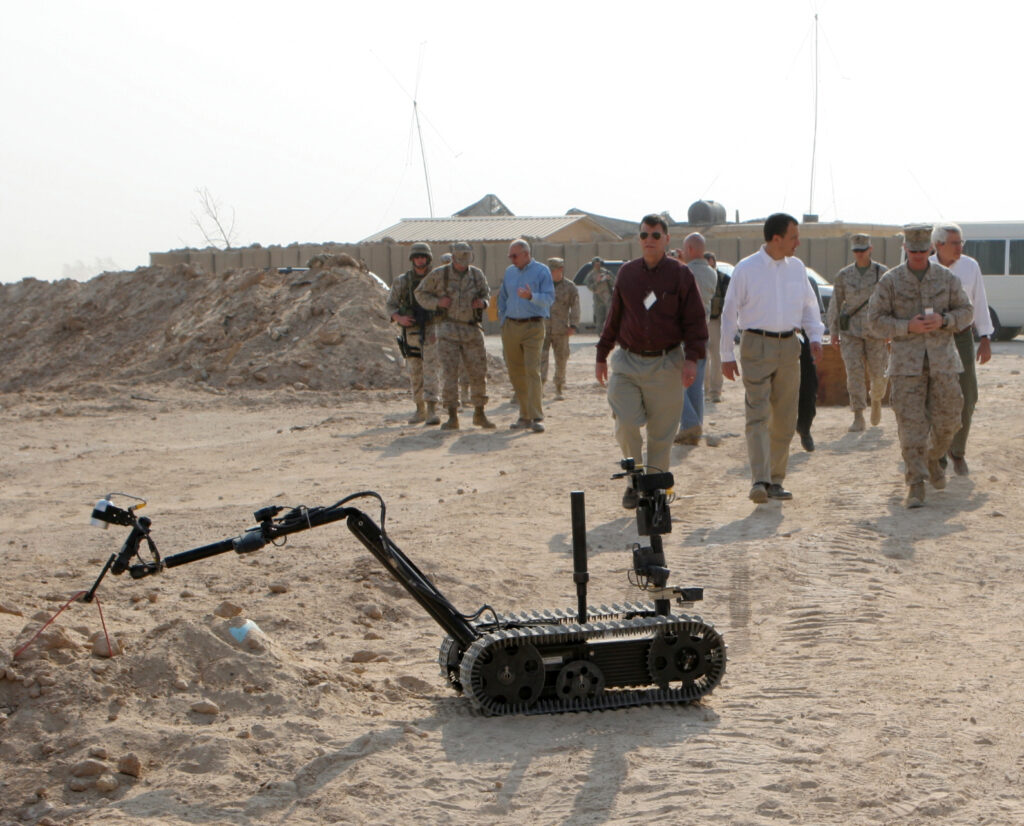
This is particularly relevant because modern EOD teams do not always work in clean, predictable spaces. Recent U.S. military exercises have included robotic systems in IED identification, subterranean clearance and multinational explosive-ordnance scenarios. NATO research has also examined tele-manipulation and robotics specifically for EOD applications. The technology is no longer experimental in the broad sense. The real development is happening in how capable and adaptable these systems can become.
From Bomb Robot to Robotic Platform
An interesting shift is also taking place around the role of the platform itself. Larger EOD robots are increasingly capable of carrying different sensors and payloads rather than serving one narrowly defined purpose.
L3Harris, for example, demonstrated a counter-small-UAS capability integrated with its T7 robotic system in 2025. A platform associated primarily with explosive ordnance disposal was effectively being used as a mobile carrier for drone detection and defeat equipment. That does not mean EOD robots are suddenly becoming dedicated counter-drone vehicles, but it does illustrate the value of a robotic platform that already has mobility, communications, electrical power and payload capacity.
Once those elements are available, other mission packages become easier to integrate. Chemical detection, reconnaissance equipment, specialized cameras or other sensors can potentially be carried without creating an entirely new robotic vehicle for every task.
EOD may therefore be helping to push ground robotics toward a broader modular model. The robot still has a core mission, but the platform itself becomes more useful when different threats appear.
The Human Still Makes the Decision
Robotics inevitably leads to questions about autonomy, especially as computer vision and artificial intelligence improve. Explosive ordnance disposal, however, is not an area where that conversation can be reduced to whether a machine can recognize an object.
Explosives can be improvised, damaged, concealed, degraded or intentionally designed to behave unpredictably. A device may look familiar while containing something entirely different. Context, experience and judgment remain critical, and the consequences of a wrong interpretation are far more serious than in many other robotic applications.
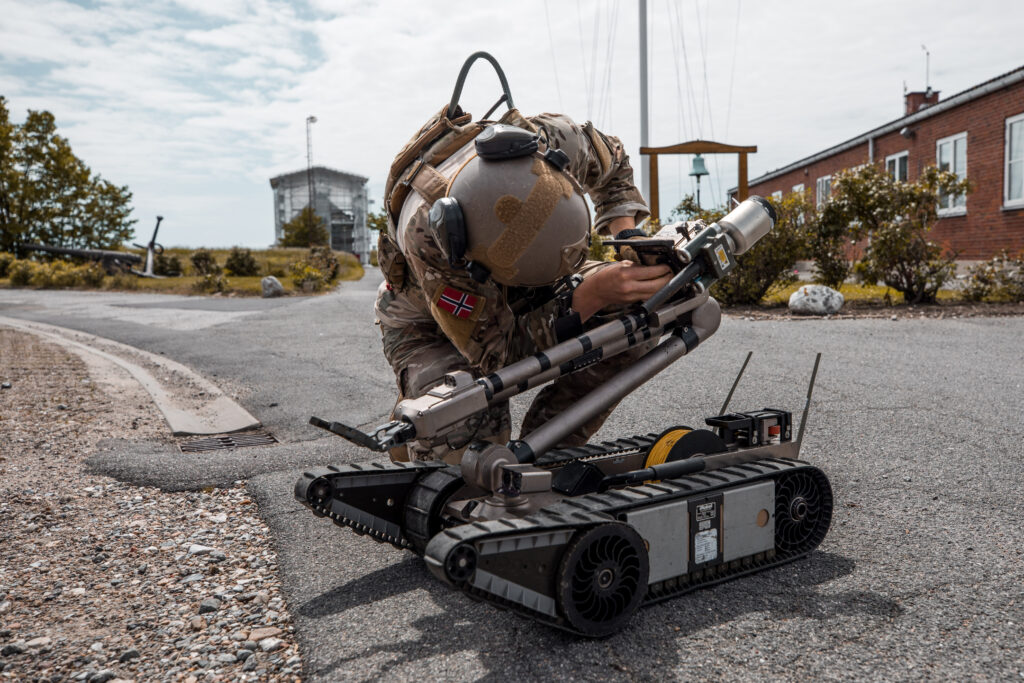
For that reason, the most useful way to understand an EOD robot is not as a replacement for the technician. It is the technician’s reach. The machine crosses the dangerous ground, the cameras provide the first close view, and the manipulator becomes the first hand near the object. The expertise stays with the operator behind it.
That distinction is worth keeping in mind when looking at these machines. They may appear relatively simple beside more futuristic unmanned systems, but their value comes from solving a very specific problem extremely well. When the alternative is sending a person into the blast radius simply to find out what is there, putting the robot first makes considerable sense.
Sources:
- U.S. Army. “Army Explosive Ordnance Disposal Soldiers Train to Field New Robots on Fort Stewart.”.
- L3Harris Technologies. “US Navy and Marines Select L3Harris T7 Robots to Enhance Ordnance Disposal Capabilities.”.
- U.S. Army. “US Army Explosive Ordnance Disposal Techs Participate in Interagency IED Exercise.”.
- U.S. Army. “New Robot to Bolster Protection for EOD Soldiers.”.
- NATO Science and Technology Organization. Collaborative Programme of Work 2024, EOD Tele-manipulation Robot Technology Roadmap Development.
- L3Harris Technologies. “L3Harris Showcases Robotic Drone Detection Capability for US Army.”.