
Drill & Defense
Advertisement
  • Defense Industry
    • Industry News
    • Defense Companies
    • Defense Technologies
    • Market Analysis
  • Military Systems
    • Land Systems
    • Air Systems
    • Naval Systems
    • Electronic & Cyber Systems
  • Firearms
    • Pistols
    • Rifles
    • SMGs & Machine Guns
    • Ammunition
    • Optics & Accessories
  • Geopolitics
    • Global Security
    • Defense & Energy Strategy
    • Tech & Innovation Crossover
    • Trade & Export Controls
  • Energy & Security
    • Oil & Gas News
    • Energy Technologies
    • Market Trends & Analysis
  • History
    • Military History
    • Doctrines & Concepts
    • Strategic Turning Points
    • Legacy Systems & Structures
  • Knowledge Base
    • Firearms Basics
    • Defense Know-How
    • Energy Fundamentals
    • Regulations & Frameworks
  • About
  • Contact
  • Login
  • Register
No Result
View All Result
Drill & Defense
No Result
View All Result
Home Defense Industry

M3E1 MAAWS – Why the U.S. Military Still Relies on an 84mm Recoilless Rifle

October 30, 2026
in Defense Industry, Defense Technologies
M3E1 Multi-Role Anti-Armor Anti-Personnel Weapons System (MAAWS).jpg

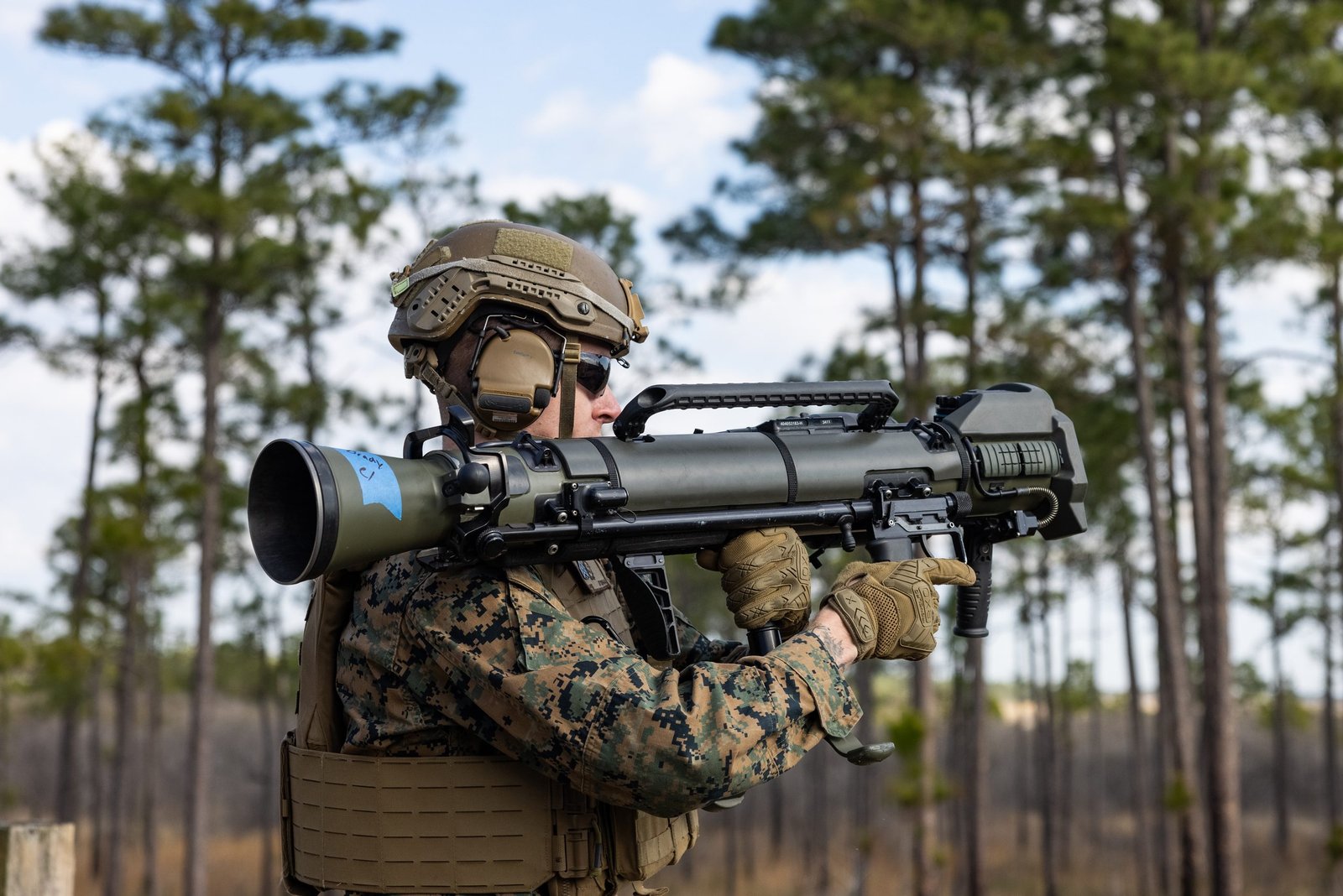
U.S. Marine Corps Sgt. Kyle Tennison, a Maryland native and combat engineer with 2d Combat Engineer Battalion, 2d Marine Division (MARDIV), shoulders an M3E1 Multi-Role Anti-Armor Anti-Personnel Weapons System (MAAWS) during a live-fire range as part of the Division Leaders Assessment Program (DLAP) on Camp Lejeune, North Carolina, Feb. 24, 2024. DLAP is a rigorous course that tests and improves the warfighting abilities of leaders across 2d MARDIV. (U.S. Marine Corps photo by Lance Cpl. Dmochowski)

Share on LinkedInShare on Twitter

The M3E1 Multi-Role Anti-Armor Anti-Personnel Weapon System (MAAWS) raises an interesting question about modern infantry warfare. With guided missiles, loitering munitions, and increasingly sophisticated battlefield sensors available, why does the U.S. military continue investing in a recoilless rifle whose origins stretch back nearly eight decades?

Part of the answer lies in what infantry units actually encounter. Not every target requires an expensive guided missile, and not every engagement involves a heavily armored vehicle. Buildings, field fortifications, exposed personnel, and lightly protected vehicles present different challenges. Developed by Sweden’s Saab, the M3E1 belongs to the Carl-Gustaf family, offering a reusable 84mm weapon capable of firing several ammunition types.

Its appeal comes from flexibility rather than any single performance figure.

An Older Weapon With a Different Purpose

The original Carl-Gustaf entered service in 1948, but the current system incorporates substantial changes in materials, ergonomics, and fire control.

American special operations forces adopted the M3 during the 1990s, with conventional Army formations subsequently expanding their use of the weapon. The M3E1, also fielded under the M3A1 designation, represents the fourth-generation Carl-Gustaf M4 configuration.

Weighing approximately 6.7 kg (14.8 pounds) without its sighting system, the M3E1 is roughly 28% lighter than the previous M3. Its overall length is approximately 950 mm, compared with around 1,065 mm for its predecessor.
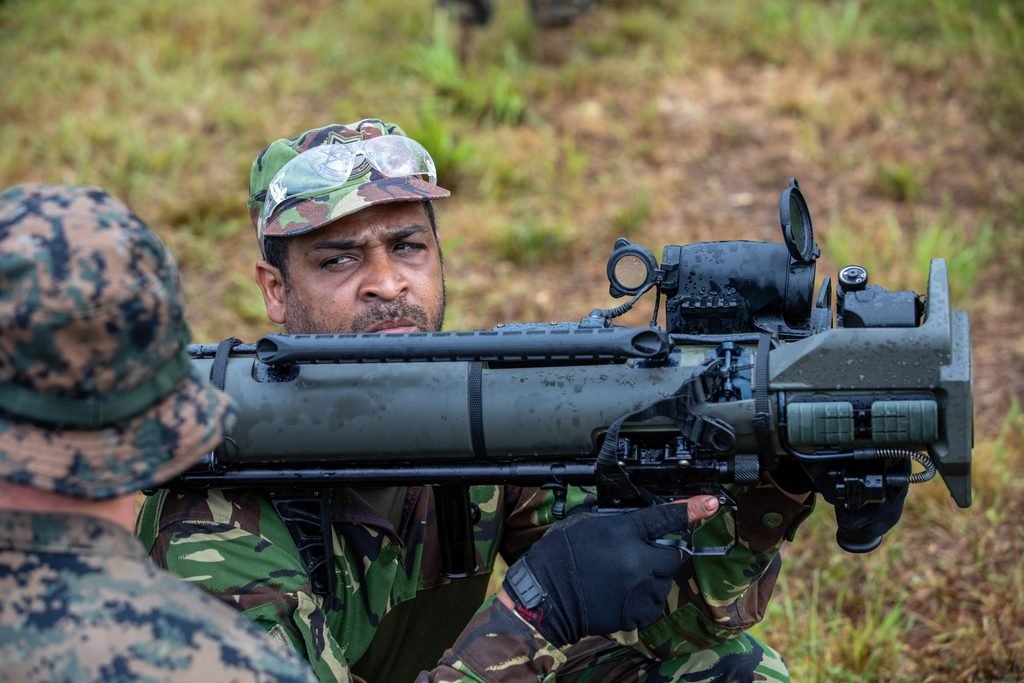
Trinidad and Tobago Defence Force Lance Cpl. Mark Brooks, infantryman assigned to 2nd Infantry Battalion, Trinidad and Tobago Regiment, prepares to fire a Sub Caliber Adapter (SCA) in an M3E1 Multi-role Anti-armor Anti-personnel Weapon System (MAAWS) at the Tucker Valley shooting range in Chaguaramas, Trinidad and Tobago, during TRADEWINDS 25 (TW25) May 3, 2025. TW25 is a U.S. Southern Command-sponsored and Chairman of the Joint Chiefs of Staff-approved annual exercise that bolsters regional stability and demonstrates U.S. Joint Force coordination and interoperability with Allies and partners. (U.S. Army photo by Sgt. John Russell)

These improvements involve more than convenience. The carbon-fiber construction, titanium liner, adjustable shoulder rest, and integrated shot counter address durability, handling, and maintenance requirements.

Weight matters when infantry personnel already carry body armor, ammunition, communications equipment, and other essential supplies. A lighter launcher makes an additional support weapon more manageable, although the ammunition still adds considerably to the load.

More Than an Anti-Armor Weapon

Calling the M3E1 an anti-tank weapon alone overlooks much of its intended role.

Its ammunition family includes high-explosive anti-tank, dual-purpose, anti-structure, smoke, illumination, and airburst rounds. The U.S. Army identifies a maximum effective range of approximately 1,300 meters for the M3A1 against certain targets, although practical engagement distances vary considerably by ammunition.

Consider the distinction between a lightly armored vehicle and a reinforced position. Both may require something more capable than an ordinary infantry rifle, but their vulnerabilities are different.

The HEAT 751 provides dedicated anti-armor capability, while the HEDP 502 addresses lighter protection and structural targets. The HE 448 introduces programmable airburst functionality, extending the system’s usefulness against personnel in exposed or partially concealed positions.

Saab’s newer HEAT 758 takes anti-armor development further. Introduced in 2026, its tandem-charge design is intended to counter explosive reactive armor, with the manufacturer claiming penetration of up to 700 mm of armor by its main charge.
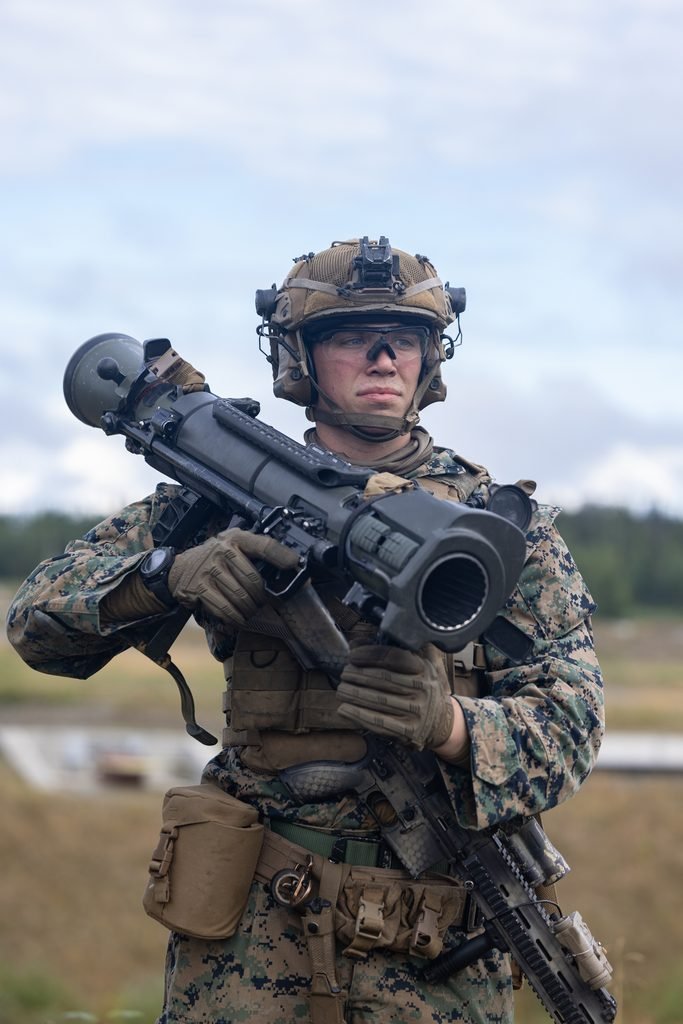
U.S. Marine Corps Lance Cpl. Cody Kimball, a rifleman with Kilo Company, 3rd Battalion, 4th Marine Regiment, 1st Marine Division, holds an M3E1 Multi-purpose Anti-armor Anti-personnel Weapon System (MAAWS) during ARCTIC EDGE 2025 (AE25) at Joint Base Elmendorf-Richardson, Alaska, Aug. 20, 2025. The ranges conducted during AE25 are designed to enhance the lethality of participating units and improve warfighting capabilities in austere environments. AE25 is a NORAD and U.S. Northern Command-led homeland defense exercise designed to improve readiness, demonstrate capabilities, and enhance Joint and Allied Force interoperability in the Arctic. Kimball is a native of Nevada. (U.S. Marine Corps photo by Cpl. Earik Barton)

However, manufacturer specifications should not be confused with guaranteed battlefield performance. Target protection, ammunition availability, and engagement conditions remain decisive, and the introduction of a new round does not establish its adoption by every MAAWS operator.

Fire Control Changes the Equation

Perhaps the more significant improvement is found above the launcher rather than inside it.

The U.S. configuration incorporates an electronic fire-control system weighing approximately 1.9 kg (4.2 pounds), bringing the combined launcher and sight weight to around 8.6 kg (19 pounds).

Laser ranging and ballistic calculations assist engagements against stationary and moving targets. Compatible Carl-Gustaf configurations can also use Saab’s FCD 558, which supports communication with Firebolt-enabled ammunition.

Still, electronic assistance does not transform an unguided projectile into a guided missile. Operator proficiency, environmental conditions, and accurate target identification remain important.
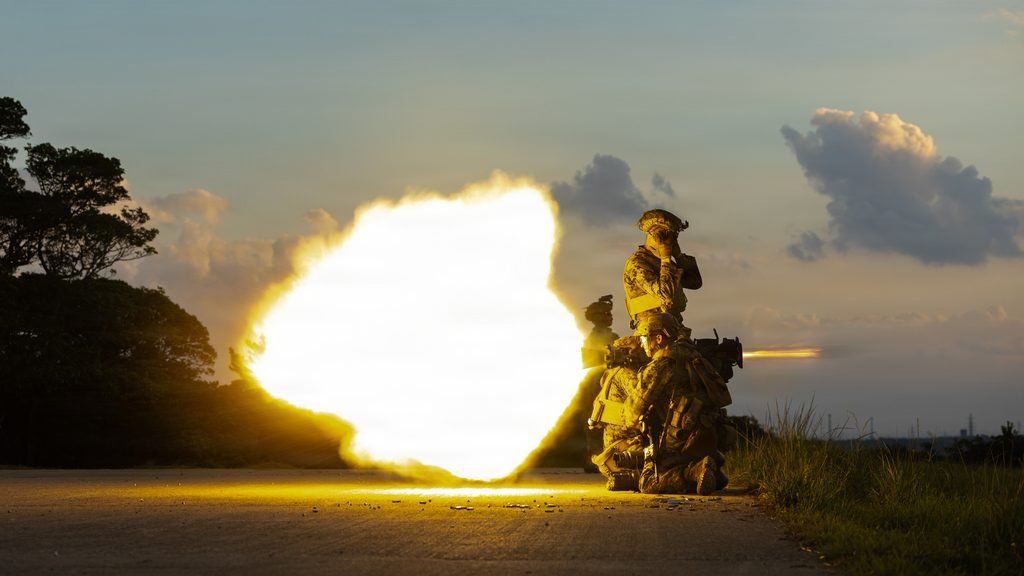
U.S. Marines with 12th Littoral Combat Team, 12th Marine Littoral Regiment, 3rd Marine Division, fire an M3E1 Multi-Role Anti-Armor Anti-Personnel Weapon System during a weapons exercise at Camp Schwab, Okinawa, Japan, Sept. 21, 2026. The unit executed the weapons exercise to enhance capabilities on multiple weapons and improve lethality throughout the ranks. (U.S. Marine Corps photo by Cpl. Rodney Frye)

The Reusable Advantage Comes With Responsibilities

Unlike the disposable AT4, the M3E1 can be reloaded and fired repeatedly.

That distinction creates logistical advantages, particularly when several ammunition types are available. Instead of consuming an entire launcher with each shot, a unit retains the weapon and carries additional rounds.

But how much flexibility does that provide in practice?

The MAAWS normally operates with a two-person team, dividing responsibility between the gunner and assistant. Ammunition weight, backblast restrictions, maintenance requirements, and training all influence its practical employment.
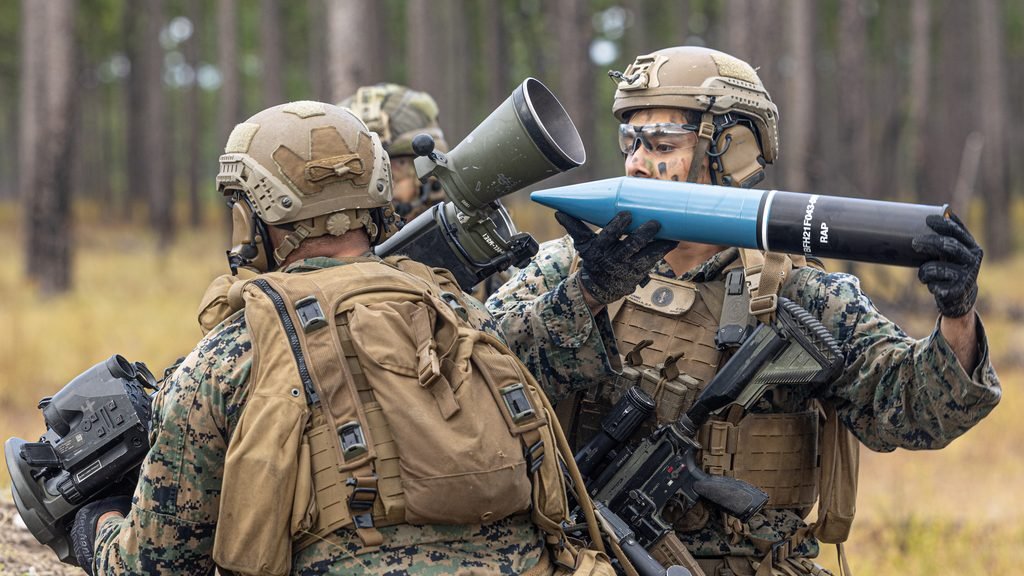
U.S. Marines with 2nd Battalion, 8th Marines, 2nd Marine Division load a M3E1 Multi-Role Anti-Personnel Weapons System (MAAWS) during a live fire exercise as part of a Marine Corps Combat Readiness Evaluation on Marine Corps Base Camp Lejeune, North Carolina, Nov. 3, 2025. Marines and Sailors with 2nd Marine Regiment, 2nd MARDIV conducted the MCCRE in order to demonstrate combat proficiency through the combined use of modern infantry tactics and technology, ensuring readiness for any future conflict or operation. (U.S. Marine Corps photo by Lance Cpl. Dominic Trujillo)

Reusability offers clear benefits, but it does not eliminate operational limitations.

Where the M3E1 Stands Today

The MAAWS remains part of the U.S. military’s infantry support capabilities, with the Carl-Gustaf family serving across multiple American military branches.

Development is continuing beyond the launcher itself. The introduction of HEAT 758 in 2026 illustrates how ammunition technology can extend the capabilities of an established weapon without requiring an entirely new platform.

The broader question concerns specialization. Should infantry forces rely increasingly on dedicated weapons, or preserve systems capable of addressing several battlefield problems?

The M3E1 demonstrates why both approaches can coexist. Guided missiles provide capabilities an unguided recoilless rifle cannot replicate, while the Carl-Gustaf offers reusable, ammunition-dependent flexibility.

Its continued relevance reflects something more practical than technological novelty: a mature weapon system can remain useful when its ammunition, fire control, and design evolve alongside operational requirements.


Sources:

  • 1. U.S. Army Combat Capabilities Development Command. Lightweight M3A1 Multi-Role Anti-Armor Anti-Personnel Weapon System (MAAWS).
  • 2. U.S. Army Acquisition Support Center. Weapon Systems Handbook 2020–2021, M3E1 MAAWS.
  • 3. Saab. (2026). Ground Combat Systems Handbook.
  • 4. Saab. (May 7, 2026). Saab Launches New Carl-Gustaf Anti-Tank Round.
  • 5. Saab. Carl-Gustaf Recoilless Multi-Purpose Weapon System.
  • 6. U.S. Army Operational Environment Data Integration Network (ODIN). (2025). Carl Gustaf M4 (M3-E1) Swedish 84mm Man-Portable Anti-Tank Recoilless Rifle.

Previous Post

RIPSAW M5: Rethinking the Role of Armored Vehicles Without Crews

Related Posts

Kratos XQ-58A Valkyrie
Defense Industry

Airbus and Kratos Bring the XQ-58 Valkyrie Into European Airspace

October 12, 2026
Falcon Peak 26.2 and the Changing Approach to Drone Defense
Defense Industry

Falcon Peak 26.2 and the Changing Approach to Drone Defense

October 10, 2026
A U.S. Marine with Weapons Company, 1st Battalion, 5th Marine Regiment, Marine Rotational Force – Darwin 26, prepares 7.62 mm ammunition before a reaction-to-contact live-fire range
Defense Industry

The Rifle Is Only the Beginning: The Industrial Problem Behind Small Arms Ammunition

October 2, 2026
Why EOD Robots Go First
Defense Industry

Into the Blast Radius: Why EOD Robots Go First

August 24, 2026
USAFE launches inaugural Combat Ammunition Production exercise
Defense Industry

Why Modern Armies Need More Ammunition, Not Only More Advanced Weapons

July 13, 2026
Official photo of NATO Heads of State and Government - 2026 NATO Summit in Ankara.
Defense Industry

NATO’s $50 Billion Defense Push: Production Will Decide What the Announcements Are Really Worth

July 10, 2026
  • Trending
  • Latest
Heckler_&_Koch_G3_Holzschaft_Display_noBG

HK G3: A Rifle That Stayed Longer Than Expected

April 29, 2026
FN FAL: The Right Arm of the Free World

FN FAL: The Right Arm of the Free World

March 31, 2026
MG42-1

MG42 Machine Gun: WWII History, Specifications and Battlefield Impact

April 21, 2026
C-RAM System in Support of Coalition Defense

C-RAM: The Last Seconds of Defense

April 1, 2026
M3E1 Multi-Role Anti-Armor Anti-Personnel Weapons System (MAAWS).jpg

M3E1 MAAWS – Why the U.S. Military Still Relies on an 84mm Recoilless Rifle

October 30, 2026
Ripsaw M5

RIPSAW M5: Rethinking the Role of Armored Vehicles Without Crews

October 26, 2026
Yemen-Houthi-Weapons

How Did the Houthis Build Such a Powerful Military Arsenal?

October 24, 2026
HK416 A5

HK416: How One Rifle Evolved into the A5, N, and F Variants

October 21, 2026

Recent Articles

M3E1 Multi-Role Anti-Armor Anti-Personnel Weapons System (MAAWS).jpg

M3E1 MAAWS – Why the U.S. Military Still Relies on an 84mm Recoilless Rifle

October 30, 2026
Ripsaw M5

RIPSAW M5: Rethinking the Role of Armored Vehicles Without Crews

October 26, 2026
Yemen-Houthi-Weapons

How Did the Houthis Build Such a Powerful Military Arsenal?

October 24, 2026
HK416 A5

HK416: How One Rifle Evolved into the A5, N, and F Variants

October 21, 2026
Drill & Defense

Drill & Defense is an independent defense and security platform covering firearms, military technology, geopolitics, energy security, and industry developments. We provide clear, structured, and practical insight for professionals, companies, and readers following the evolving defense landscape worldwide.

Follow Us

Browse by Category

  • Air Systems
  • Defense & Energy Strategy
  • Defense Companies
  • Defense Industry
  • Defense Know-How
  • Defense Technologies
  • Doctrines & Concepts
  • Electronic & Cyber Systems
  • Energy & Security
  • Energy Fundamentals
  • Energy Technologies
  • Firearms
  • Geopolitics
  • Global Security
  • History
  • Industry News
  • Knowledge Base
  • Land Systems
  • Legacy Systems & Structures
  • Market Analysis
  • Market Trends & Analysis
  • Military History
  • Military Systems
  • Naval Systems
  • Oil & Gas News
  • Pistols
  • Regulations & Frameworks
  • Rifles
  • SMGs & Machine Guns
  • Strategic Turning Points
  • Tech & Innovation Crossover
  • Trade & Export Controls

Recent Articles

M3E1 Multi-Role Anti-Armor Anti-Personnel Weapons System (MAAWS).jpg

M3E1 MAAWS – Why the U.S. Military Still Relies on an 84mm Recoilless Rifle

October 30, 2026
Ripsaw M5

RIPSAW M5: Rethinking the Role of Armored Vehicles Without Crews

October 26, 2026

© 2026 Drill & Defense. All rights reserved. Independent insights on firearms, defense, and energy. For business inquiries: info@drillanddefense.com | PRIVACY POLICY | COOKIE POLICY | TERMS AND CONDITIONS

Manage Consent

We use cookies to improve your experience. You can accept or refuse cookies; however, some features may not function properly without your consent.

Functional Always active
The technical storage or access is strictly necessary for the legitimate purpose of enabling the use of a specific service explicitly requested by the subscriber or user, or for the sole purpose of carrying out the transmission of a communication over an electronic communications network.
Preferences
The technical storage or access is necessary for the legitimate purpose of storing preferences that are not requested by the subscriber or user.
Statistics
The technical storage or access that is used exclusively for statistical purposes. The technical storage or access that is used exclusively for anonymous statistical purposes. Without a subpoena, voluntary compliance on the part of your Internet Service Provider, or additional records from a third party, information stored or retrieved for this purpose alone cannot usually be used to identify you.
Marketing
The technical storage or access is required to create user profiles to send advertising, or to track the user on a website or across several websites for similar marketing purposes.
  • Manage options
  • Manage services
  • Manage {vendor_count} vendors
  • Read more about these purposes
View preferences
  • {title}
  • {title}
  • {title}
No Result
View All Result
  • Defense Industry
    • Industry News
    • Defense Companies
    • Defense Technologies
    • Market Analysis
  • Military Systems
    • Land Systems
    • Air Systems
    • Naval Systems
    • Electronic & Cyber Systems
  • Firearms
    • Pistols
    • Rifles
    • SMGs & Machine Guns
    • Ammunition
    • Optics & Accessories
  • Geopolitics
    • Global Security
    • Defense & Energy Strategy
    • Tech & Innovation Crossover
    • Trade & Export Controls
  • Energy & Security
    • Oil & Gas News
    • Energy Technologies
    • Market Trends & Analysis
  • History
    • Military History
    • Doctrines & Concepts
    • Strategic Turning Points
    • Legacy Systems & Structures
  • Knowledge Base
    • Firearms Basics
    • Defense Know-How
    • Energy Fundamentals
    • Regulations & Frameworks
  • About
  • Contact
  • Login
  • Register

© 2026 Drill & Defense. All rights reserved. Independent insights on firearms, defense, and energy. For business inquiries: info@drillanddefense.com | PRIVACY POLICY | COOKIE POLICY | TERMS AND CONDITIONS