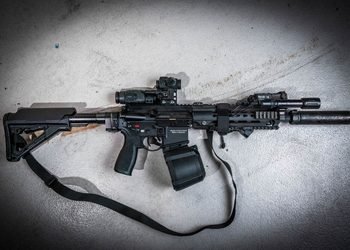

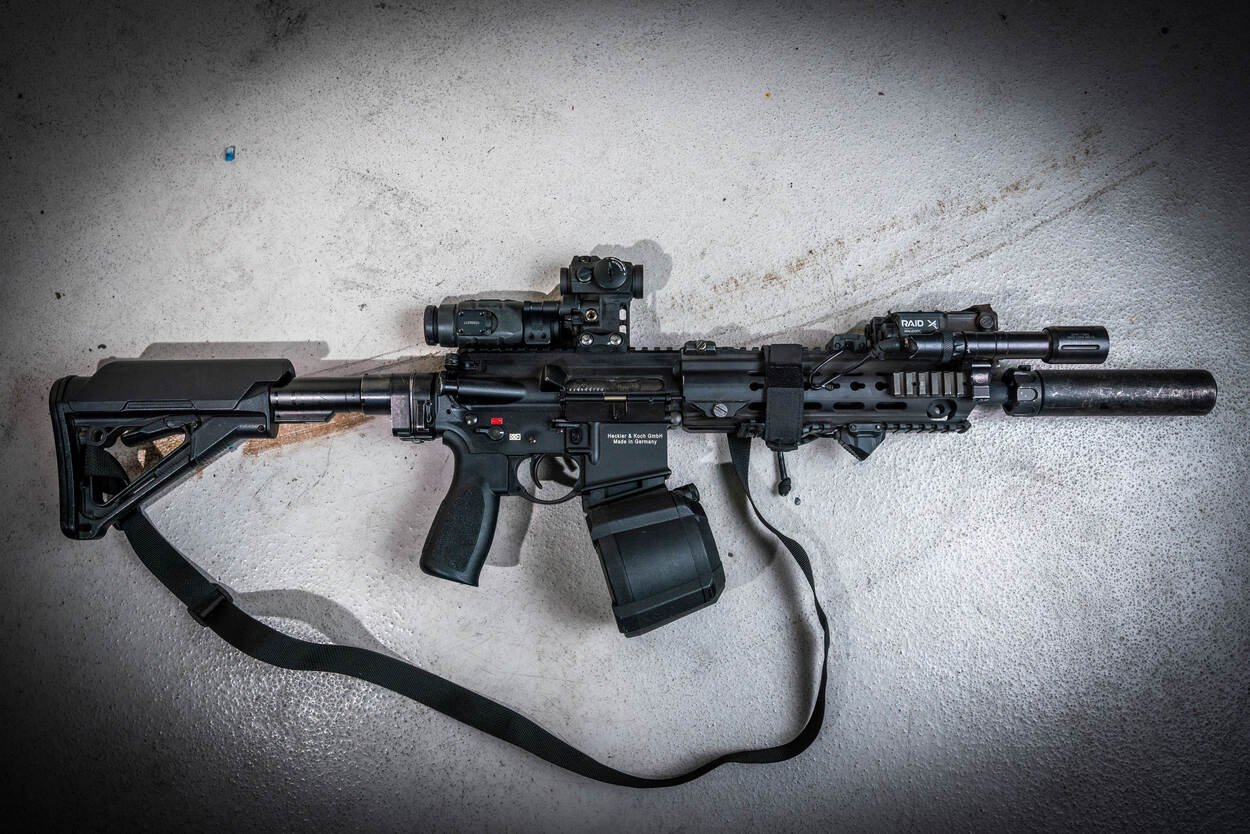
The HK416 is one of those rifles that can look almost ordinary at first glance. Its general appearance is familiar to anyone who knows the AR-15 or M4, and even its different variants can be difficult to distinguish without taking a closer look. Yet behind that familiar design is a weapon platform that has undergone several changes to meet the requirements of different military organizations.

The HK416, HK416A5, HK416N, and HK416F all share the same basic architecture. They use 5.56×45 mm NATO ammunition, operate through a short-stroke gas piston system, and retain much of the handling familiarity associated with AR-pattern rifles.
So why develop several versions of essentially the same rifle? And are the differences significant enough to matter beyond technical specifications?
To understand that, it helps to look at what Heckler & Koch originally wanted to achieve and how military requirements subsequently influenced the platform.
The HK416 Was Never Simply Another M4
When Heckler & Koch developed the HK416 in the early 2000s, the company retained the familiar layout of the American AR platform while introducing a different gas operating system.
Unlike the conventional M4’s direct-gas system, the HK416 uses a short-stroke piston mechanism. Gas acts on a piston assembly, transferring energy to the operating components without routing propellant gas through the carrier in the same manner as a conventional M4.
The intention was to reduce fouling within the receiver and improve reliability under demanding operating conditions.
That does not automatically make every piston-driven rifle superior to every direct-gas design. Reliability depends on ammunition, manufacturing quality, maintenance, environmental conditions, and the complete weapon system. Modern direct-gas rifles have also benefited from decades of development.
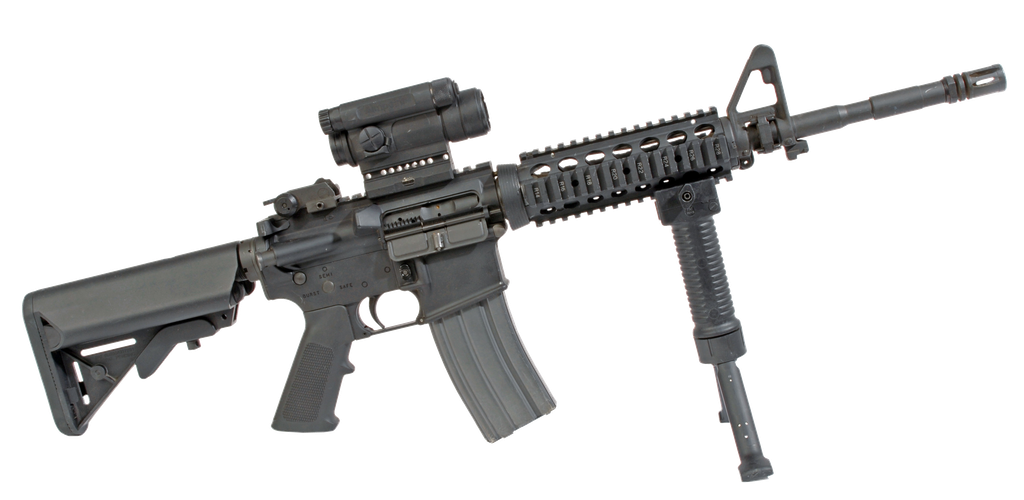
What made the HK416 particularly interesting was its relatively conservative approach. Rather than introducing an entirely unfamiliar weapon layout, Heckler & Koch combined an established ergonomic design with its own operating technology.
It was an engineering decision that also made sense from a training and institutional perspective.
HK416N: Norway’s Approach to a New Service Rifle
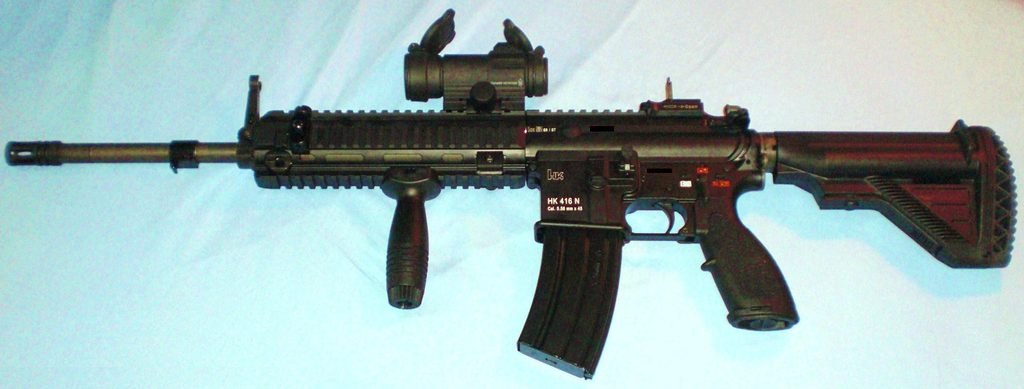
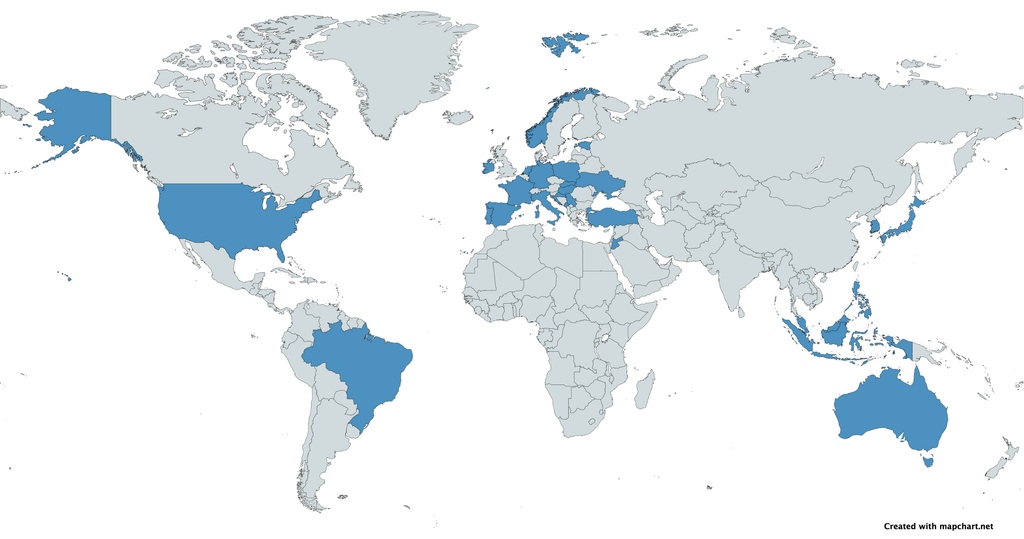
Norway became one of the earliest military adopters of the HK416, selecting the platform in 2007 to replace the AG-3, a licensed version of the Heckler & Koch G3. For a military accustomed to a 7.62×51 mm battle rifle, moving to the HK416 meant adopting a different ammunition standard, a lighter weapon, and a more modular configuration.
The Norwegian designation was HK416N, with the N standing for Norway. Its standard 16.5-inch (419 mm) barrel distinguished it from the shorter HK416K carbine, which used a barrel of approximately 10.5 inches. Both chambered 5.56×45 mm NATO ammunition and accepted 30-round magazines.
According to Norwegian Armed Forces technical information, the standard HK416 weighs approximately 3.4 kg without its magazine and Aimpoint optic, increasing to around 4.0 kg with a loaded magazine and sight. The published muzzle velocity is 902 m/s, while the automatic cyclic rate is approximately 720–900 rounds per minute.
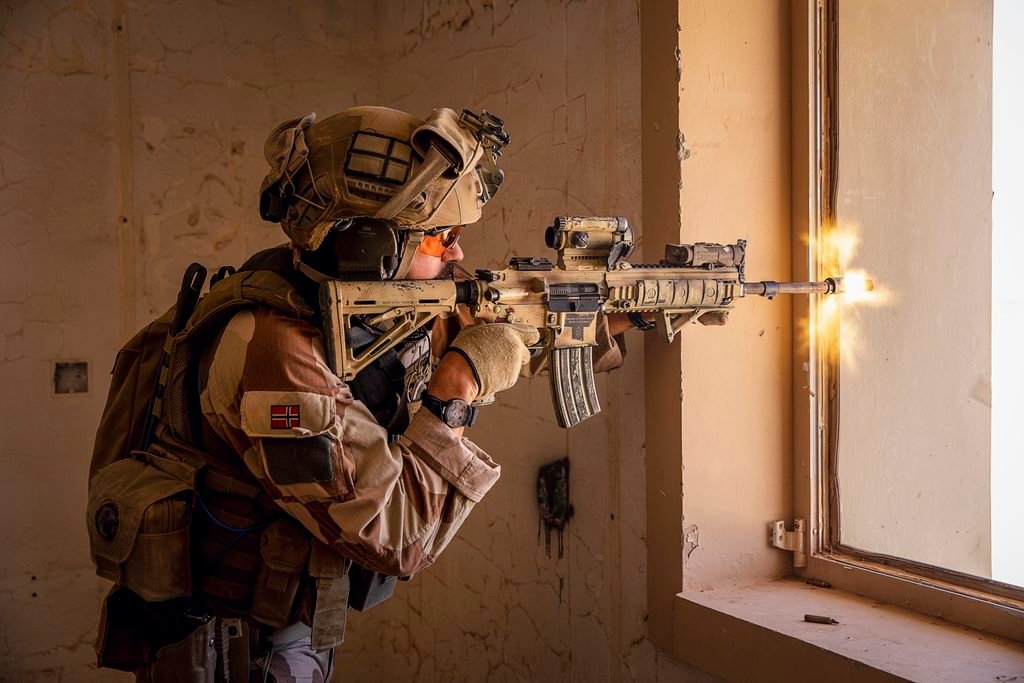
Norway also lists a practical shooting distance of 400 meters with an Aimpoint sight and an effective distance of 500 meters. These figures should not be confused with the absolute distance a projectile can travel, and they depend on the conditions and criteria used to define effective fire.
The difference in barrel length between the HK416N and HK416K is more than a matter of appearance. A longer barrel generally allows the projectile more time to accelerate before leaving the muzzle, although the actual velocity difference depends on ammunition and barrel characteristics. The shorter carbine, meanwhile, reduces the overall dimensions of the weapon.
Beyond those specifications, Norway’s experience illustrates how military rifles continue evolving after entering service. The Norwegian configuration underwent changes over time, including revisions involving gas regulation, rather than remaining identical to the earliest delivered examples.
By December 2018, the Norwegian Defence Materiel Agency had announced an additional order for 11,000 HK416 rifles, including approximately 7,000 intended for the Home Guard. Another supply agreement followed in 2019, valued at approximately €22 million.
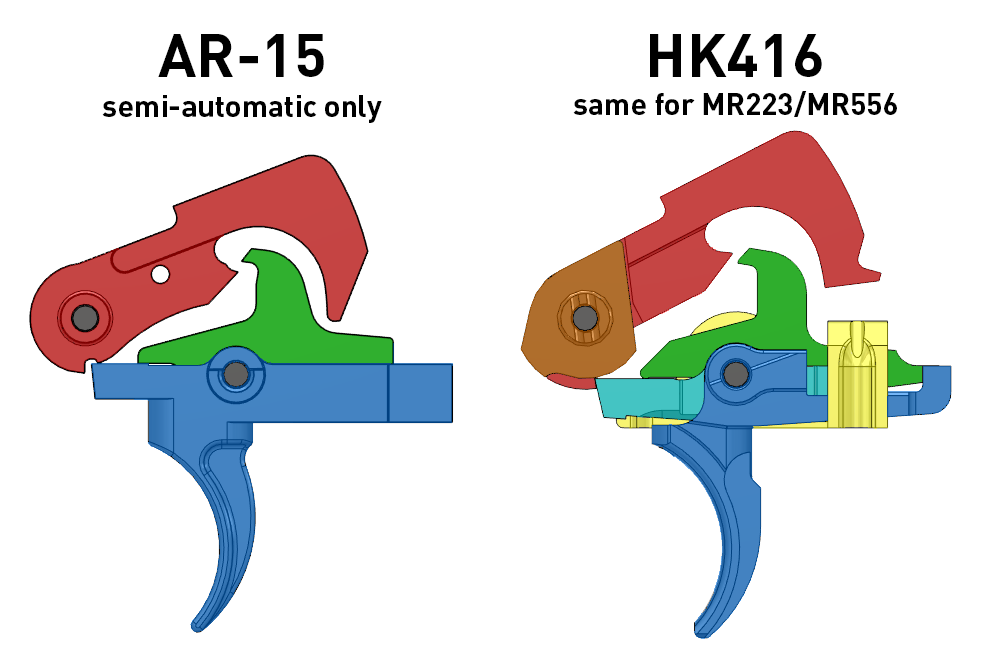
Note that the AR-15 one is a semi-auto trigger group, while HK416 and its semi-auto counterpart MR223 and MR556 uses the same full-auto style trigger group, and achieve semi-auto only function with different a bolt carrier and the lack of an auto sear. Andy Sou, CC BY-SA 4.0 https://creativecommons.org/licenses/by-sa/4.0.
Norway’s relationship with Heckler & Koch has continued well beyond rifle procurement. On September 30, 2026, the manufacturer and Norwegian company Bertel O. Steen Defence & Security signed a Letter of Intent aimed at strengthening long-term maintenance and technical support for Norwegian customers. Although the agreement does not represent a new rifle order, it highlights another important aspect of military procurement: keeping existing weapons operational over decades. Nearly twenty years after Norway first selected the HK416, attention is extending beyond deliveries to lifecycle management, maintenance expertise, and equipment availability.
The procurement history is worth considering alongside the technical specifications. Norway was not simply acquiring a different rifle for individual soldiers; it was gradually standardizing equipment across military formations, reducing reliance on the older AG-3 and simplifying parts of its ammunition and maintenance infrastructure.
HK416A5: What Actually Changed?
The HK416A5 represents a more substantial development of the original platform. While its operating principle remained unchanged, Heckler & Koch introduced modifications to the lower receiver, controls, gas regulation, and component interfaces.
One of the clearest differences concerns ergonomics. Earlier HK416 models largely retained conventional AR-style controls, whereas the A5 introduced a fully ambidextrous arrangement. The magazine release, bolt catch, safety selector, and charging handle were redesigned to accommodate operation from either side.
Its magazine well was also modified to improve compatibility with different AR-pattern magazines. This may seem insignificant compared with barrel length or muzzle velocity, but magazine compatibility is a practical consideration for military organizations using equipment from several manufacturers.
The A5’s two-position gas regulator is another important development. Designed for suppressed and unsuppressed operation, it allows the operating characteristics of the rifle to be adjusted without tools. Suppressor compatibility has become increasingly relevant in modern military small-arms programs, although the exact effects of suppressor use depend on the complete weapon and ammunition configuration.
Heckler & Koch has offered the A5 in several barrel lengths, including 11, 12.5, 14.5, 16.5, and 20 inches. These correspond to approximately 279, 318, 368, 419, and 508 mm, giving customers considerably different configurations within the same rifle family.
Published HK416 family specifications list a cyclic rate of approximately 850 rounds per minute, with a muzzle velocity of 790 m/s and muzzle energy of 1,250 joules for the manufacturer’s specified DM11 ammunition configuration. The manufacturer also identifies a principal effective combat range of 450 meters and an accurate suppressive-fire range of 600 meters. These values are configuration-dependent and should not be interpreted as identical performance figures for every A5 barrel length.
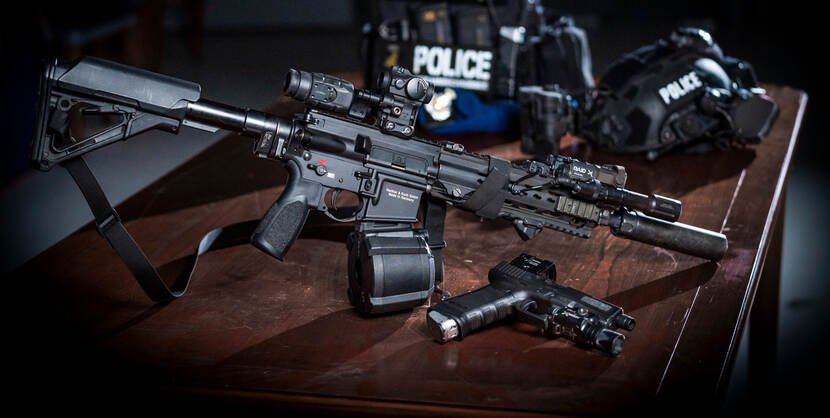
Additional changes included reinforced receiver interfaces, an enlarged trigger guard, and improvements to the handguard arrangement. None individually transforms the rifle’s fundamental design, but together they represent a meaningful technical revision.
Would these improvements make the A5 automatically superior to every earlier HK416 in military service? Not necessarily. Some changes address flexibility and compatibility rather than directly increasing accuracy or reducing mechanical failures. The distinction matters when evaluating weapon development beyond manufacturer specifications.
HK416F: France’s Replacement for the FAMAS
France approached the HK416 from an entirely different starting point. Its existing FAMAS was a bullpup rifle chambered in 5.56 mm, with a distinctive layout and operating mechanism. Replacing it involved abandoning a familiar national design in favor of a conventional rifle architecture manufactured by Germany’s Heckler & Koch.
Selected in September 2016 under the Arme Individuelle Future program, the HK416F entered French military service beginning in 2017. Two primary versions were specified: the standard HK416F-S and the compact HK416F-C.
The standard configuration uses a 14.5-inch (368 mm) barrel, while the compact model has an 11-inch (279 mm) barrel. According to the French Ministry of the Armed Forces, the standard weapon measures approximately 83–93 cm with its adjustable stock, while the shorter model measures 74–84 cm. Their published weights are approximately 4.0 kg and 3.7 kg respectively.
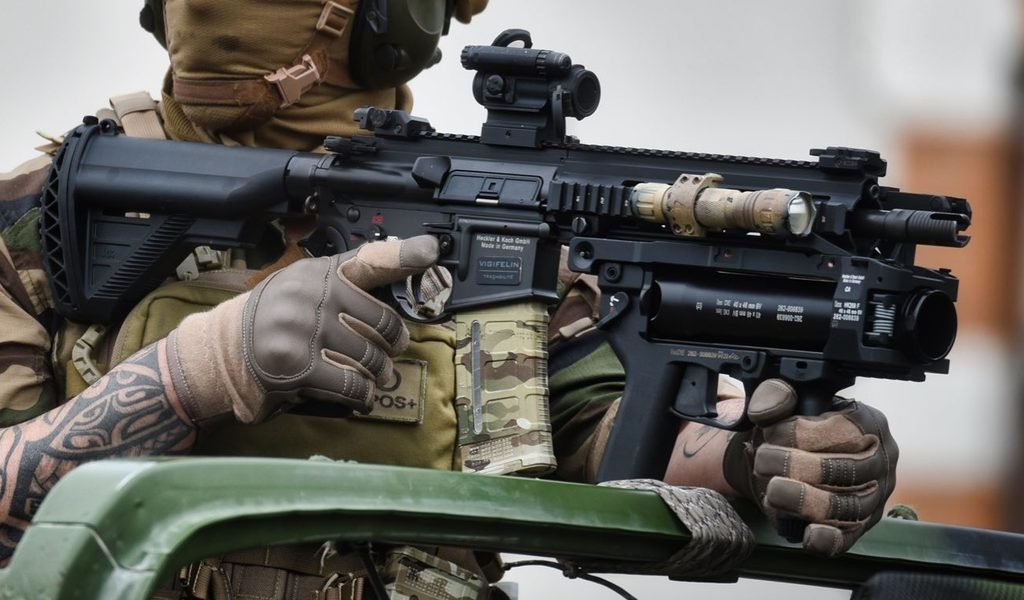
Those figures are not directly comparable with every manufacturer’s unloaded-weight specification, since measurement conventions and fitted equipment can differ.
One notable distinction from the FAMAS is the cyclic rate. French military testing described the HK416F as firing at approximately 850 rounds per minute, compared with roughly 1,100 rounds per minute for the FAMAS configuration used in the comparison. Cyclic rate alone, however, does not establish accuracy or practical effectiveness.
France also established demanding durability and reliability requirements. Official program documentation identifies a service-life objective of 30,000 rounds without deterioration in accuracy. That is an important technical benchmark, although it should be understood as a program requirement rather than proof that every individual rifle will perform identically throughout its service life.
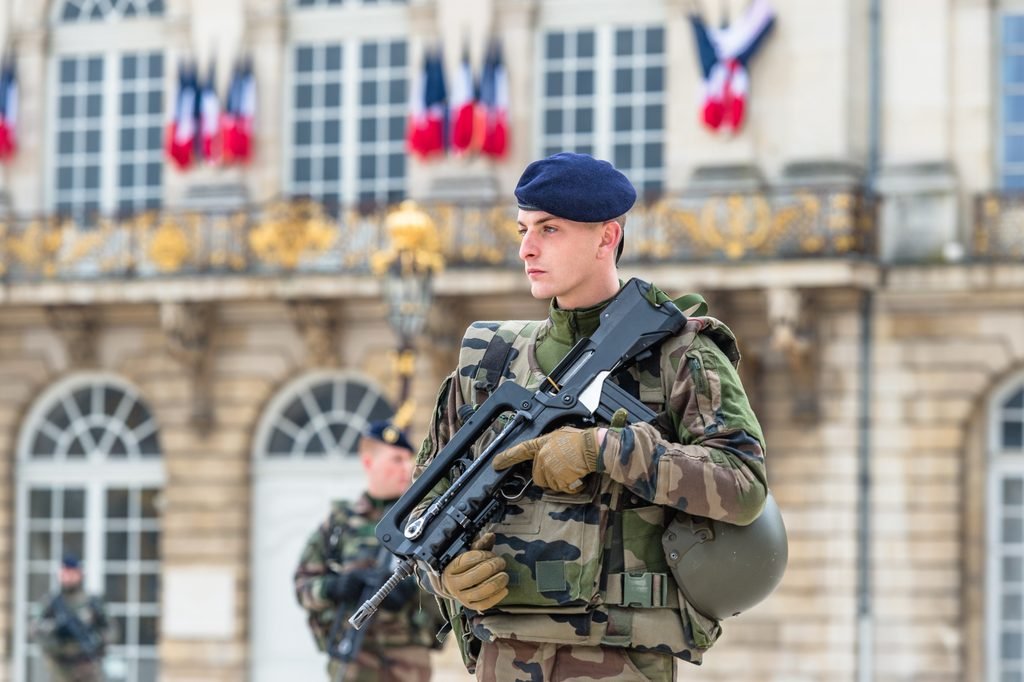
The evaluation process was extensive. Between 2015 and 2016, French military testing involved 54 days of firing and more than 190,000 rounds of 5.56×45 mm ammunition. The assessments covered reliability, accuracy, endurance, ergonomics, and compatibility with existing equipment.
Beyond the rifle itself, the HK416F can accommodate the HK269F 40 mm grenade launcher, firing 40×46 mm low-velocity ammunition. French military documentation gives the launcher a maximum range of approximately 350 meters.
The program also addressed integration with optical sights, accessories, and the FÉLIN soldier equipment system. By March 2022, France had received 59,340 HK416F rifles as part of a broader procurement program targeting approximately 117,000 weapons.

France’s selection therefore cannot be explained through rifle specifications alone. It involved replacing an established weapon across a large military organization while adapting existing equipment, training arrangements, and logistical systems.
How Much Do These Variants Really Differ?
Looking at the specifications side by side reveals both the similarities and the limits of comparison.
The HK416N’s 16.5-inch barrel and Norway’s published 902 m/s muzzle velocity provide one useful reference point. The HK416F, meanwhile, is supplied with 14.5-inch and 11-inch barrels, and the A5 family extends from compact 11-inch versions to a 20-inch configuration.
Yet comparing muzzle velocity figures from different military publications without accounting for ammunition would be misleading. Projectile weight, propellant characteristics, measurement methods, and barrel length can all affect the results.
Mechanically, the differences are less dramatic than the designations might suggest. These rifles continue to use a rotating bolt and a short-stroke piston operating system, with selective-fire capability in military configurations.
The greater distinctions lie in their controls, dimensions, equipment interfaces, gas regulation, and customer-specific requirements.
For instance, the A5’s ambidextrous operating controls and adjustable gas system represent identifiable design changes from earlier configurations. The HK416N reflects Norway’s initial requirements and subsequent service revisions, while the HK416F incorporates features and equipment arrangements specified by the French military.
It would therefore be inaccurate to describe the N, A5, and F as three successive generations in a straightforward technical hierarchy. They emerged from overlapping development programs and were shaped by different procurement decisions.
Why the HK416 Family Remains Relevant
The HK416 offers an example of how an established rifle architecture can support multiple military programs without requiring a completely new weapon design for each customer.
Its underlying mechanism remained broadly consistent, even as Heckler & Koch introduced different barrel lengths, control arrangements, gas-system configurations, and accessory interfaces. Norway adopted the platform as a replacement for a 7.62 mm battle rifle, while France selected it to replace a domestic 5.56 mm bullpup design. The A5, meanwhile, reflected continued refinement of the rifle itself.
Recent developments in Germany provide another example of the platform’s evolution. In December 2025, Heckler & Koch delivered the first 300 G95KA1 rifles to the Bundeswehr, marking the beginning of Germany’s transition toward a new standard service rifle. Based on the HK416A8, the G95 family includes a standard version with a 16.5-inch (419 mm) barrel and a shorter configuration with a 14-inch (355 mm) barrel. Germany initially expanded its procurement framework from 118,718 to 250,000 rifle systems in December 2025.
That program advanced further on July 6, 2026, when Heckler & Koch announced that Germany’s Federal Office for Equipment, Information Technology, and Utilization of the Bundeswehr had fully exercised the framework agreement covering 250,000 G95A1/KA1 rifles. This was a procurement commitment, not an announcement that all 250,000 rifles had already been delivered. The HK416A8 is a separate development from the A5, but its adoption demonstrates the platform’s continued relevance in major military modernization programs more than two decades after its introduction.
Standardization can offer logistical advantages, but sharing the HK416 designation does not mean every component is interchangeable between national configurations. Military organizations must still account for specific parts, accessories, maintenance documentation, and training requirements.
There is also a difference between impressive published specifications and demonstrated performance under identical conditions. Without comparative testing using consistent ammunition, environmental conditions, and evaluation methods, assigning an overall winner among these variants would be difficult to justify.
Perhaps the more interesting question is not whether the HK416A5 is better than the HK416N or whether the French version offers superior performance. It is why different military requirements produced rifles that remain mechanically similar but differ in so many details.
The answer lies in the nature of military procurement itself. Small-arms development is influenced not only by mechanical performance, but also by logistics, compatibility, training, national requirements, and the costs of supporting equipment over decades.
The HK416 family has developed around those realities. Its evolution is less a story of one rifle replacing another than of a common platform being repeatedly adapted to different military demands.
Sources:
- Heckler & Koch. (n.d.). HK416: Product Overview and Technical Specifications. Official manufacturer documentation.
- Heckler & Koch. (2013). HK416 A5: Technical Data. Official manufacturer technical documentation.
- Norwegian Armed Forces. (2021, May 26). Våpenkjennskap – HK416. Official weapon familiarization and technical specifications.
- Norwegian Armed Forces. (2013). Heimevernsbladet, Issue 4. Technical information on the HK416N and HK416K.
- Norwegian Defence Materiel Agency. (2018, December 18). Nye håndvåpen til Forsvaret.
- Heckler & Koch. (2019, August 1). HK416 Assault Rifles to the Norwegian Armed Forces. Official press release.
- French Ministry of the Armed Forces. (n.d.). HK 416 F. French Army equipment specifications and procurement information.
- French Ministry of the Armed Forces. (2017, February 15). On a testé pour vous : HK 416, le nouveau fusil d’assaut.
- French Ministry of the Armed Forces. (2017, March 13). HK416 F : Munitions compatibles.
- Heckler & Koch. (2022). MR223 Operator’s Manual. Manufacturer technical documentation.
- Heckler & Koch. (2026, September 30). Heckler & Koch and Bertel O. Steen Defence & Security Sign Letter of Intent to Strengthen Lifecycle Support in Norway.
- Heckler & Koch. (2025, December 4). Heckler & Koch Delivers First G95A1 Assault Rifles to the Bundeswehr.
- Heckler & Koch. (2026). First Quarter 2026 Financial Report.
- Heckler & Koch. (2026, July 6). The Bundeswehr Is Consistently Advancing Its Modernization Efforts: BAAINBw Has Fully Invoked the Framework Contract for 250,000 G95A1/KA1 Assault Rifles.