
Drill & Defense
Advertisement
  • Defense Industry
    • Industry News
    • Defense Companies
    • Defense Technologies
    • Market Analysis
  • Military Systems
    • Land Systems
    • Air Systems
    • Naval Systems
    • Electronic & Cyber Systems
  • Firearms
    • Pistols
    • Rifles
    • SMGs & Machine Guns
    • Ammunition
    • Optics & Accessories
  • Geopolitics
    • Global Security
    • Defense & Energy Strategy
    • Tech & Innovation Crossover
    • Trade & Export Controls
  • Energy & Security
    • Oil & Gas News
    • Energy Technologies
    • Market Trends & Analysis
  • History
    • Military History
    • Doctrines & Concepts
    • Strategic Turning Points
    • Legacy Systems & Structures
  • Knowledge Base
    • Firearms Basics
    • Defense Know-How
    • Energy Fundamentals
    • Regulations & Frameworks
  • About
  • Contact
  • Login
  • Register
No Result
View All Result
  • Defense Industry
    • Industry News
    • Defense Companies
    • Defense Technologies
    • Market Analysis
  • Military Systems
    • Land Systems
    • Air Systems
    • Naval Systems
    • Electronic & Cyber Systems
  • Firearms
    • Pistols
    • Rifles
    • SMGs & Machine Guns
    • Ammunition
    • Optics & Accessories
  • Geopolitics
    • Global Security
    • Defense & Energy Strategy
    • Tech & Innovation Crossover
    • Trade & Export Controls
  • Energy & Security
    • Oil & Gas News
    • Energy Technologies
    • Market Trends & Analysis
  • History
    • Military History
    • Doctrines & Concepts
    • Strategic Turning Points
    • Legacy Systems & Structures
  • Knowledge Base
    • Firearms Basics
    • Defense Know-How
    • Energy Fundamentals
    • Regulations & Frameworks
  • About
  • Contact
  • Login
  • Register
No Result
View All Result
Drill & Defense
No Result
View All Result
Home Knowledge Base

Maritime Security: The Human Layer Behind Modern Naval Operations

September 16, 2026
in Knowledge Base, Defense Know-How
Maritime Security: The Human Layer Behind Modern Naval Operations

Master-at-Arms 3rd Class Allen Hahn, assigned to the Nimitz-class aircraft carrier USS George H. W. Bush.

Share on LinkedInShare on Twitter

Modern maritime security relies on increasingly capable ships, sensors and unmanned systems, but the effectiveness of those technologies still depends heavily on the crews operating around them. Bridge teams, watchstanders, small-boat crews, boarding personnel, engineers and damage-control teams all perform different parts of the same security mission.

That becomes especially clear in congested waters. Radar may detect a contact, AIS may provide identification data and electro-optical systems may offer a visual picture, but none of those systems automatically explains intent. A vessel can change speed, alter course, stop transmitting or behave differently from surrounding traffic. Someone still has to interpret what those changes mean.

How much does a sophisticated sensor suite actually achieve if the crew cannot turn information into a timely decision?

Bridge Crews and Situational Awareness

Bridge teams work with several layers of information at once. Radar provides range and bearing, AIS can display vessel identity and movement data, while electro-optical systems add visual confirmation. These systems are complementary rather than interchangeable.

AIS is useful, but it has limitations. Participation and transmitted information can vary, and not every contact will provide a complete or reliable picture. Visual observation therefore remains relevant, particularly close to ports, anchorages and narrow routes.
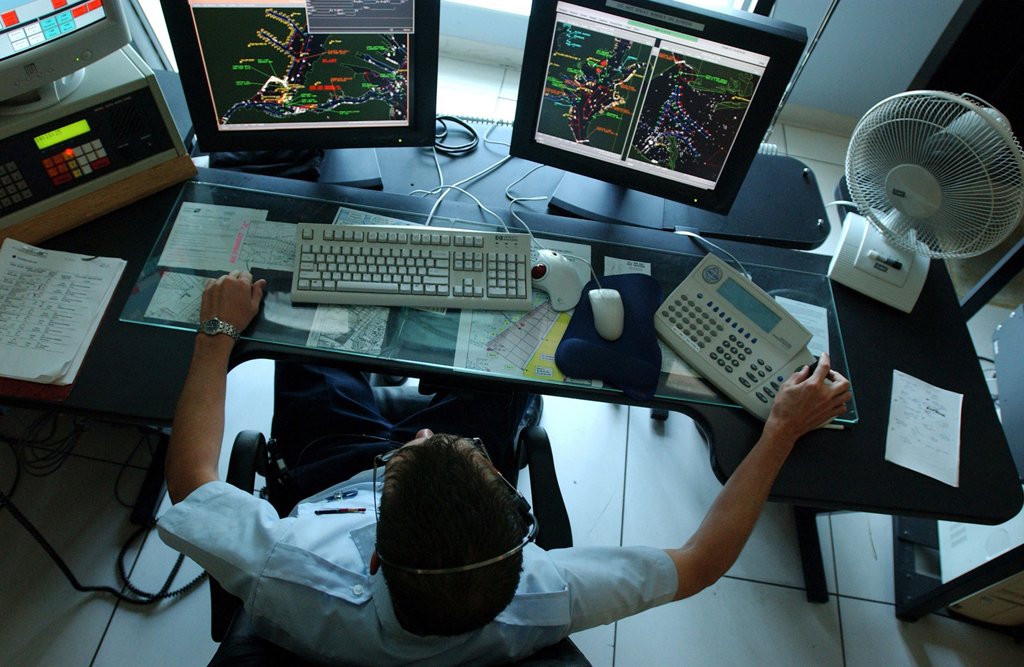
U.S. Coast Guard monitoring vessel traffic.

Watchstanders also perform a role that is difficult to automate completely. They monitor patterns rather than isolated contacts. A fishing vessel behaving normally for an hour may become more significant if it suddenly accelerates toward a restricted area or begins operating differently from similar vessels nearby.

Small Boats Extend the Ship

Many maritime security tasks cannot be completed from the deck of a large vessel.

RHIBs and response boats are used for boarding operations, patrol, interception and personnel transfer. NATO maritime interdiction training includes the use of 9.5-metre RHIBs for approaches to target vessels and boarding through pilot ladders or caving ladders. The U.S. Coast Guard’s Response Boat-Small II can exceed 40 knots and has a range of around 150 nautical miles.

Those numbers matter because small-boat crews often operate independently from the larger ship for part of the mission.

The coxswain must control speed and position near another moving vessel, while the crew manages communications, observation and the boarding team’s transfer. Sea state, wake, vessel height and limited visibility can all complicate what appears from a distance to be a simple approach.
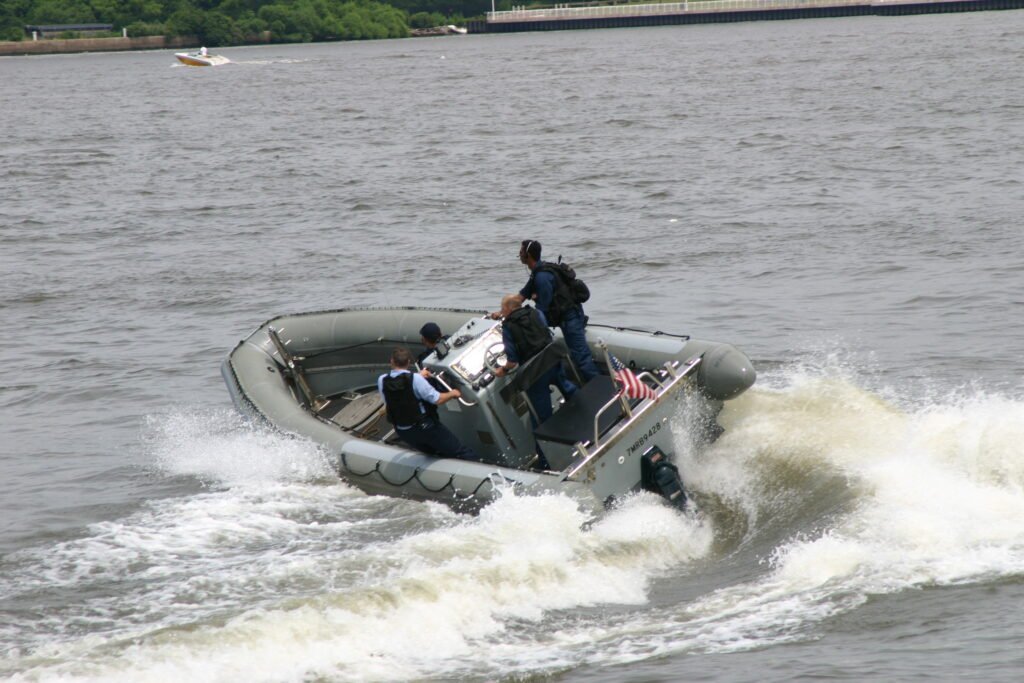
photo by: andrew aiello.

Boarding Teams Add Physical Access

Surveillance can tell a crew where a vessel is. Boarding determines what is actually onboard.

Maritime interdiction can involve document checks, cargo inspection, vessel identification and crew questioning. Boarding personnel may also have to inspect compartments or containers that cannot be assessed from a sensor display.

NATO training reflects this by combining insertion, vessel control and practical inspection procedures rather than treating boarding as a single action.

The physical environment creates its own technical problems. Personnel may have to climb several metres from a moving RHIB onto a vessel using a ladder, carry equipment and then operate inside narrow compartments with limited visibility.

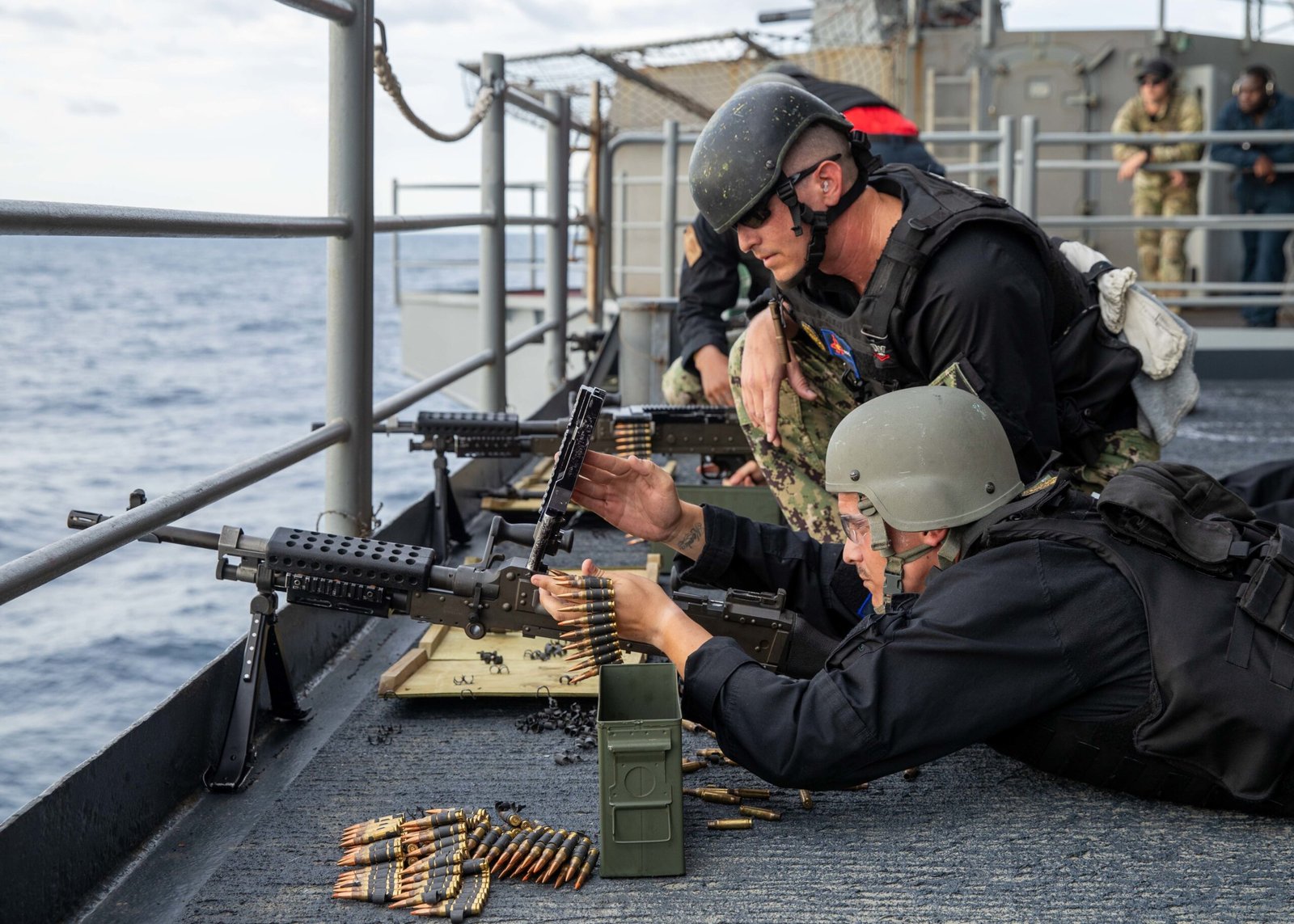
Machine-gun operators and other force-protection personnel can support these missions, but they are only one part of a much larger crew structure.
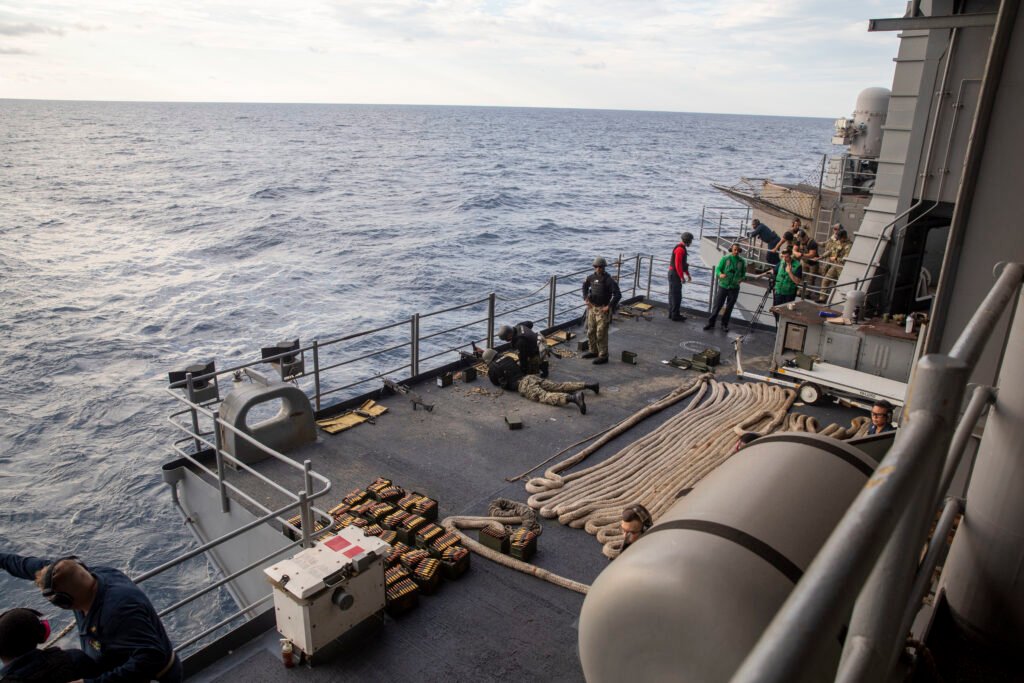
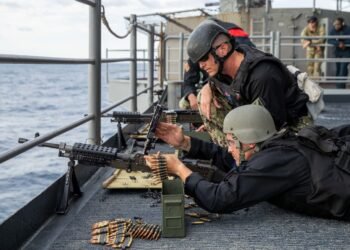
Sailors assigned to the Nimitz-class aircraft carrier USS George H. W. Bush (CVN 77) shoots an M240B machine gun during a live-fire exercise.

Engineering and Damage Control Are Security Functions Too

Propulsion, electrical power and internal systems are sometimes separated from discussions about maritime security, but a ship that loses mobility or power rapidly loses operational options.

Engineering crews maintain propulsion, generators, pumps, cooling systems and other equipment required to keep sensors and communications operating. Damage-control teams deal with fire, flooding and structural damage, often under conditions where normal shipboard access becomes difficult.
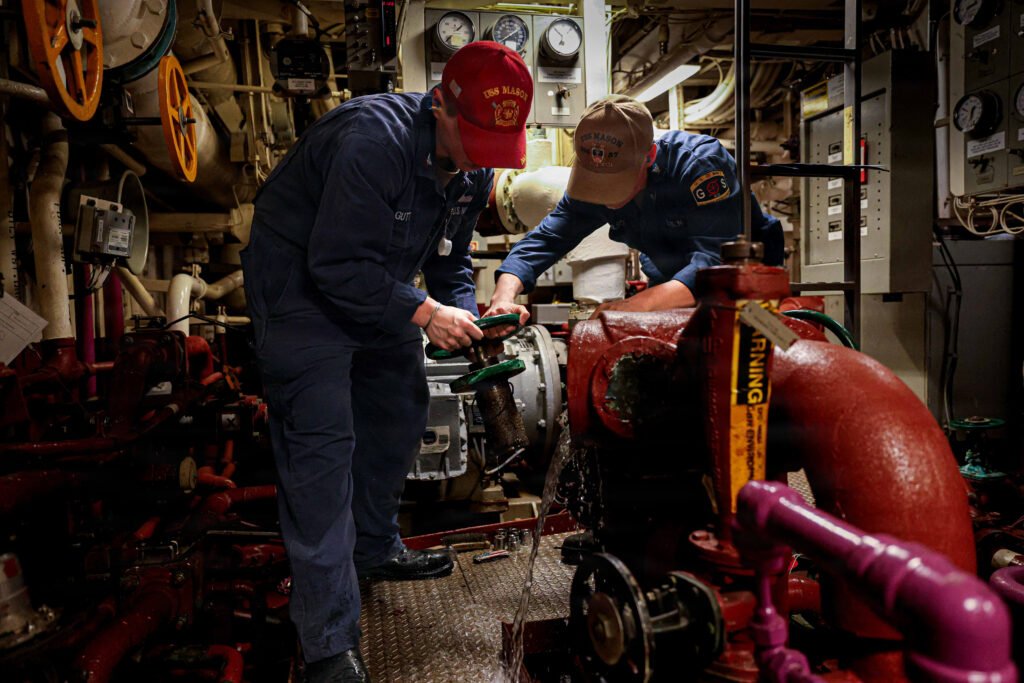
U.S. Sailors conduct maintenance in the generator room aboard Arleigh Burke-class guided-missile destroyer USS Mason (DDG 87), July 31, 2026. Mason is deployed to the U.S. 5th Fleet area of operations to support maritime security and stability in the Middle East. (U.S. Navy photo).

Modern vessels include increasing levels of automation, but engineering casualties still require people who understand how systems interact.

A power failure can affect much more than lighting. Radar, communications, navigation, pumps and weapon systems may depend on the same electrical architecture. Keeping the platform operational therefore becomes part of maintaining security.

Oil Routes Increase the Consequences

The commercial side of maritime security adds another scale to these responsibilities.

More than 80 percent of global merchandise trade by volume moves by sea. Energy transportation is particularly dependent on major maritime routes.

Around 20 million barrels per day of petroleum passed through the Strait of Hormuz in 2024, equivalent to roughly one fifth of global petroleum liquids consumption. Traffic through areas like Hormuz therefore includes tankers carrying cargo with consequences far beyond the immediate shipping lane.

Protecting this traffic is not only a question of escorting tankers with major naval assets.

Port personnel, patrol crews, merchant mariners, engineers and watch teams all contribute to continuity of movement. A disruption affecting a single vessel can remain local. Repeated disruptions in a major chokepoint can influence insurance rates, freight costs, refinery supply and energy markets.

Automation Changes Where the Crew Works

Unmanned surface vessels, automated identification tools and AI-supported surveillance are likely to reduce some repetitive workloads.

They may also move personnel away from constant manual observation toward supervision, verification and response. That does not make crews less important. It changes the type of expertise required.

A future maritime security team may spend less time manually searching a sector and more time evaluating alerts produced by multiple systems. Boarding personnel will still have to physically interact with vessels. Engineers will still have to manage failures that do not follow software models. Bridge crews will still have to combine incomplete information into operational decisions.

Modern maritime security therefore depends on both hardware and people, but their relationship is changing. Larger platforms may attract most of the attention, while many of the decisions that keep them effective continue to be made by comparatively small teams across the ship.

Sources:

  • UN Trade and Development (UNCTAD), Shipping Data: UNCTAD Releases New Seaborne Trade Statistics, 23 April 2025.
  • International Maritime Organization (IMO), Piracy and Armed Robbery Against Ships.
  • NATO Maritime Interdiction Operational Training Centre, Boarding Team Practical Issues.
  • U.S. Coast Guard, Response Boat-Small II Program Profile.

Previous Post

MQ-1 Predator: From ISR Platform to Armed UAV

Related Posts

The movement of a Russian column of tanks, infantry fighting vehicles and other vehicles during the war in Ukraine. Mil.ru, CC BY 4.0 .
Knowledge Base

Why Military Logistics Fails Before the Shooting Starts: Russia’s Road to Kyiv

August 17, 2026
How Regulation Shapes Defense Trade Before the Contract Is Signed
Knowledge Base

How ITAR, EAR and Global Defense Trade Regulations Shape Military Exports

July 29, 2026
A photo of an F-35 flying during the Wings Over Houston 2023 Airshow
Knowledge Base

From Titanium to Tungsten: Critical Minerals in Modern Defense

June 30, 2026
Ukraine War
Knowledge Base

Ukraine’s Ground War: Rifles, Machine Guns, Trenches, and the Soldier Still Holding the Line

June 4, 2026
EU Dual Use
Knowledge Base

EU Dual-Use Regulation: How Civilian Technology Becomes a Matter of Export Control

May 13, 2026
Erik Prince
Knowledge Base

Too Big to Win — Scale, Structure, and the Limits of Military Power

April 23, 2026
  • Trending
  • Latest
Heckler_&_Koch_G3_Holzschaft_Display_noBG

HK G3: A Rifle That Stayed Longer Than Expected

April 29, 2026
FN FAL: The Right Arm of the Free World

FN FAL: The Right Arm of the Free World

March 31, 2026
MG42-1

MG42 Machine Gun: WWII History, Specifications and Battlefield Impact

April 21, 2026
Operation Enduring Freedom

What Exactly Is a Private Military Company (PMC)?

September 6, 2025
Maritime Security: The Human Layer Behind Modern Naval Operations

Maritime Security: The Human Layer Behind Modern Naval Operations

September 16, 2026
General Atomics MQ-1 Predator

MQ-1 Predator: From ISR Platform to Armed UAV

September 8, 2026
Unmanned Boats

The Next Problem for Unmanned Boats: How Do You Refuel Them?

September 5, 2026
Challenger_1MBT_Mk_3_(7527916878)

Beyond Steel: Five Critical Minerals Behind Modern Armored Warfare

September 3, 2026

Recent Articles

Maritime Security: The Human Layer Behind Modern Naval Operations

Maritime Security: The Human Layer Behind Modern Naval Operations

September 16, 2026
General Atomics MQ-1 Predator

MQ-1 Predator: From ISR Platform to Armed UAV

September 8, 2026
Unmanned Boats

The Next Problem for Unmanned Boats: How Do You Refuel Them?

September 5, 2026
Challenger_1MBT_Mk_3_(7527916878)

Beyond Steel: Five Critical Minerals Behind Modern Armored Warfare

September 3, 2026
Drill & Defense

Drill & Defense is an independent defense and security platform covering firearms, military technology, geopolitics, energy security, and industry developments. We provide clear, structured, and practical insight for professionals, companies, and readers following the evolving defense landscape worldwide.

Follow Us

Browse by Category

  • Air Systems
  • Defense & Energy Strategy
  • Defense Industry
  • Defense Know-How
  • Defense Technologies
  • Doctrines & Concepts
  • Energy & Security
  • Energy Fundamentals
  • Energy Technologies
  • Firearms
  • Geopolitics
  • Global Security
  • History
  • Industry News
  • Knowledge Base
  • Land Systems
  • Legacy Systems & Structures
  • Market Analysis
  • Market Trends & Analysis
  • Military History
  • Military Systems
  • Naval Systems
  • Oil & Gas News
  • Pistols
  • Regulations & Frameworks
  • Rifles
  • SMGs & Machine Guns
  • Strategic Turning Points
  • Tech & Innovation Crossover
  • Trade & Export Controls

Recent Articles

Maritime Security: The Human Layer Behind Modern Naval Operations

Maritime Security: The Human Layer Behind Modern Naval Operations

September 16, 2026
General Atomics MQ-1 Predator

MQ-1 Predator: From ISR Platform to Armed UAV

September 8, 2026

© 2026 Drill & Defense. All rights reserved. Independent insights on firearms, defense, and energy. For business inquiries: info@drillanddefense.com | PRIVACY POLICY | COOKIE POLICY | TERMS AND CONDITIONS

Manage Consent

We use cookies to improve your experience. You can accept or refuse cookies; however, some features may not function properly without your consent.

Functional Always active
The technical storage or access is strictly necessary for the legitimate purpose of enabling the use of a specific service explicitly requested by the subscriber or user, or for the sole purpose of carrying out the transmission of a communication over an electronic communications network.
Preferences
The technical storage or access is necessary for the legitimate purpose of storing preferences that are not requested by the subscriber or user.
Statistics
The technical storage or access that is used exclusively for statistical purposes. The technical storage or access that is used exclusively for anonymous statistical purposes. Without a subpoena, voluntary compliance on the part of your Internet Service Provider, or additional records from a third party, information stored or retrieved for this purpose alone cannot usually be used to identify you.
Marketing
The technical storage or access is required to create user profiles to send advertising, or to track the user on a website or across several websites for similar marketing purposes.
  • Manage options
  • Manage services
  • Manage {vendor_count} vendors
  • Read more about these purposes
View preferences
  • {title}
  • {title}
  • {title}
No Result
View All Result
  • Defense Industry
    • Industry News
    • Defense Companies
    • Defense Technologies
    • Market Analysis
  • Military Systems
    • Land Systems
    • Air Systems
    • Naval Systems
    • Electronic & Cyber Systems
  • Firearms
    • Pistols
    • Rifles
    • SMGs & Machine Guns
    • Ammunition
    • Optics & Accessories
  • Geopolitics
    • Global Security
    • Defense & Energy Strategy
    • Tech & Innovation Crossover
    • Trade & Export Controls
  • Energy & Security
    • Oil & Gas News
    • Energy Technologies
    • Market Trends & Analysis
  • History
    • Military History
    • Doctrines & Concepts
    • Strategic Turning Points
    • Legacy Systems & Structures
  • Knowledge Base
    • Firearms Basics
    • Defense Know-How
    • Energy Fundamentals
    • Regulations & Frameworks
  • About
  • Contact
  • Login
  • Register

© 2026 Drill & Defense. All rights reserved. Independent insights on firearms, defense, and energy. For business inquiries: info@drillanddefense.com | PRIVACY POLICY | COOKIE POLICY | TERMS AND CONDITIONS