
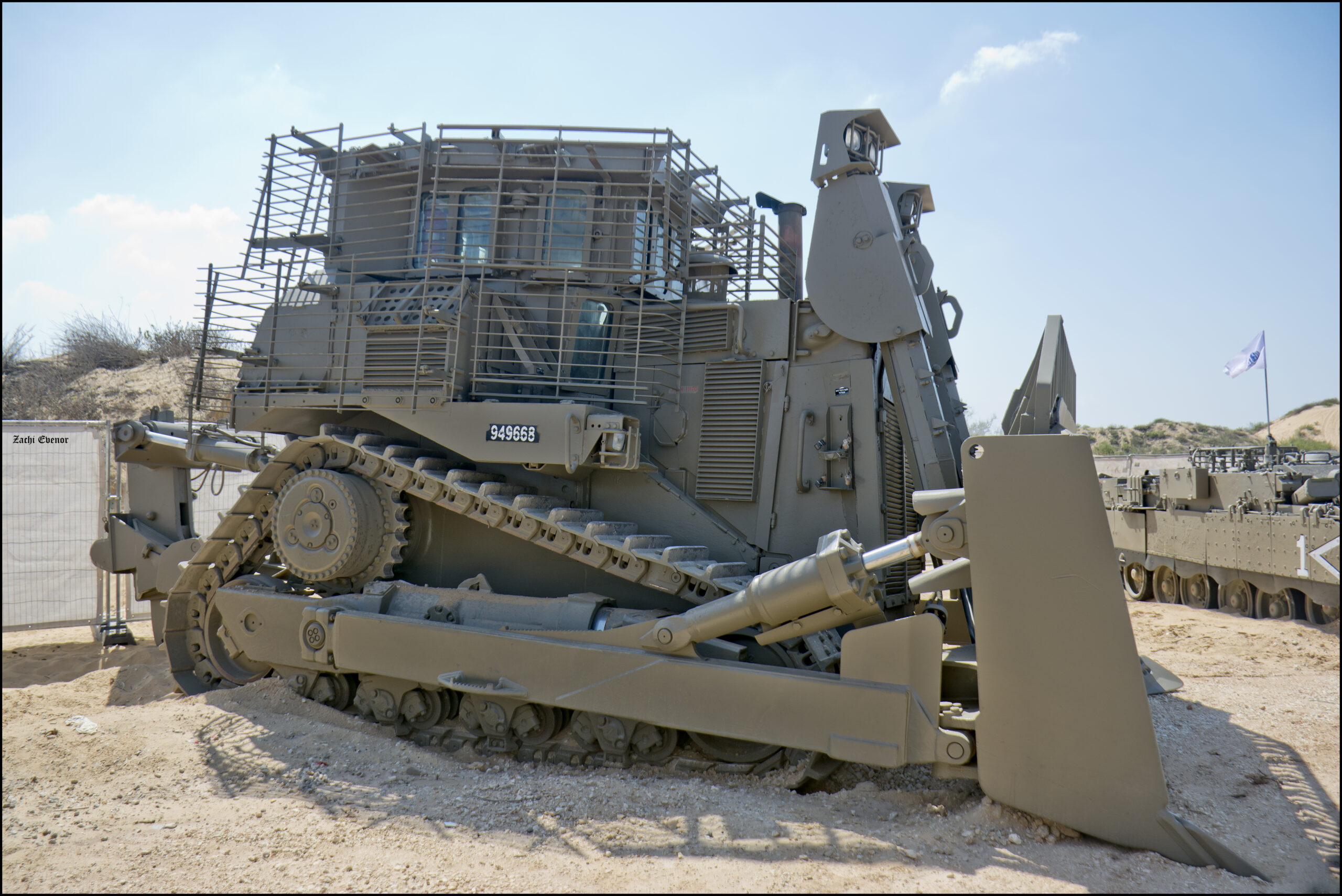
A blocked road can stop an armored unit as effectively as an anti-tank weapon. Rubble, mines, concrete barriers, collapsed buildings, and deep earthworks do not need sophisticated technology to delay an advancing force. They simply need to remain in place. Israel’s armored Caterpillar D9 was developed around that basic reality.

Originally designed as a civilian bulldozer, the D9 became one of the most recognizable combat engineering vehicles in Israeli service. Its role is not to replace a tank or infantry fighting vehicle. Instead, it creates the physical conditions that allow those platforms to move. In many operations, mobility begins long before the first vehicle crosses an obstacle.
From Construction Site to Combat Zone
Caterpillar designed the D9 as a heavy track-type tractor for mining, construction, quarry work, and large-scale earthmoving. Industrial operators valued it for its high tractive force, durable undercarriage, powerful blade, and ability to work on unstable ground.
Israeli military planners saw the same qualities from a different perspective. A machine capable of pushing rock, soil, and debris could also remove barricades, widen routes, fill defensive ditches, and clear damaged urban areas. By adding armor, military communications, reinforced windows, and other protective systems, a commercial platform was transformed into a combat engineering asset.
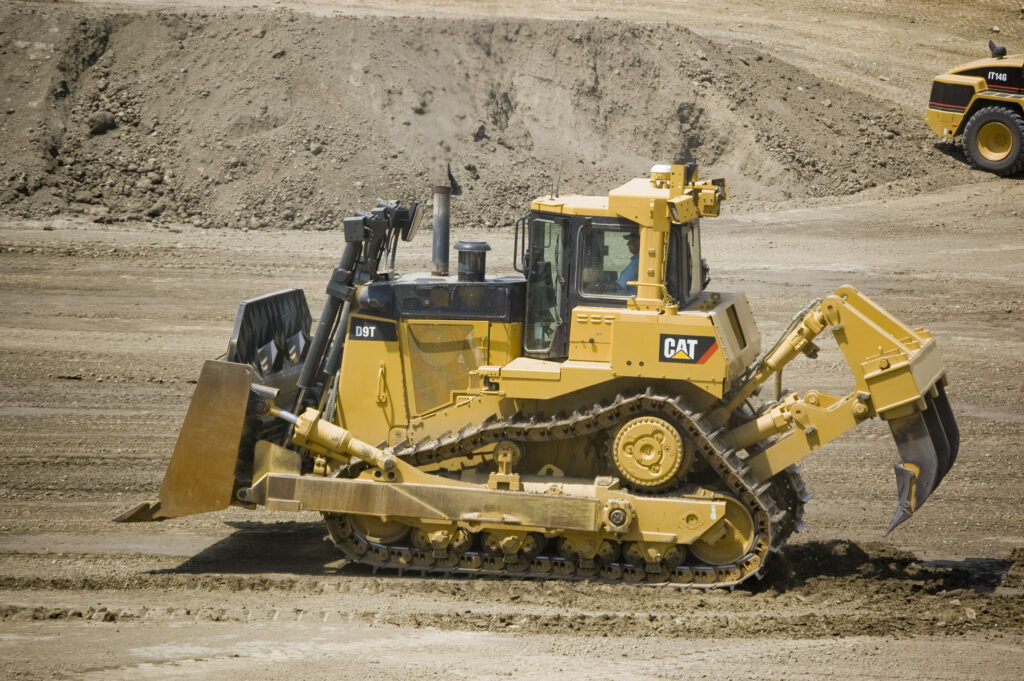
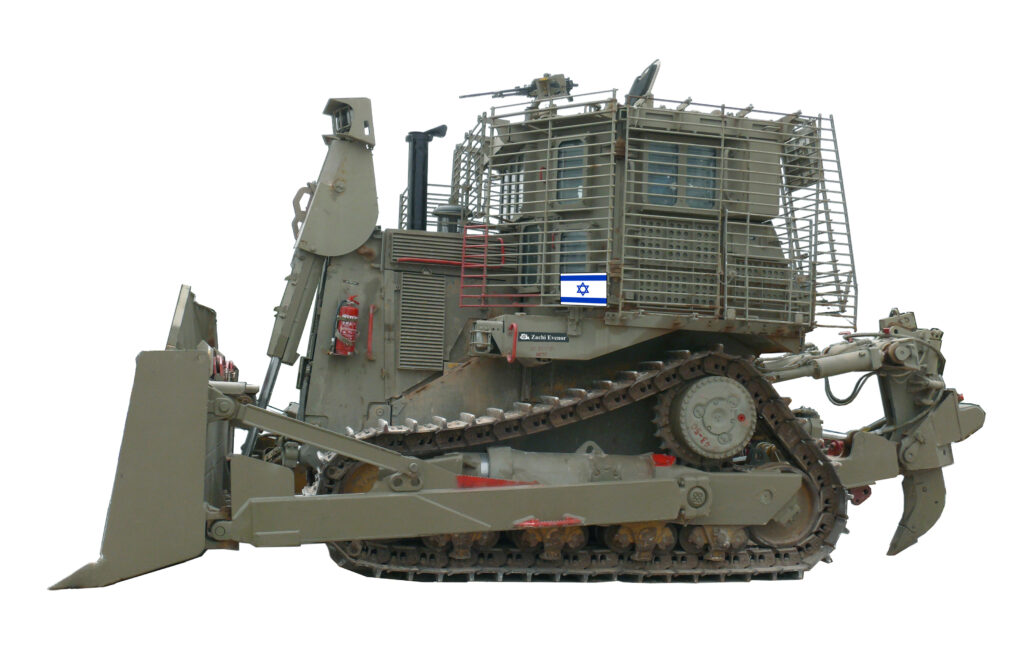
Several generations have been used, including D9R and D9T-based variants. Military configurations differ depending on armor packages, mission equipment, and operational requirements, so there is no single universal Israeli D9 specification.
Power Matters More Than Speed
Speed is not the point of a machine like this. Commercial D9 variants move slowly compared with armored fighting vehicles, with maximum travel speeds generally around 11 kilometers per hour depending on the model and transmission.
What matters is torque and pushing force.
The D9R is commonly associated with the Caterpillar 3408C diesel engine, producing roughly 410 horsepower in standard configurations. Later D9T versions use the Caterpillar C18 ACERT engine, offering more advanced electronic control and higher output. Power is delivered through a heavy-duty transmission and tracked undercarriage designed to maintain traction under significant load.
An armored D9 may weigh more than 60 tons once protective systems and military equipment are installed. That mass is not simply a burden. Combined with wide tracks and low-speed torque, it allows the machine to push through material that would stop lighter engineering vehicles.
Still, weight creates logistical consequences. Heavy transporters are required for long-distance movement. Bridges must support the load. Fuel consumption is considerable, and recovery operations become difficult if the machine is damaged or immobilized.
The Blade Defines the Mission
Most of the D9’s work begins with its front blade. Caterpillar offers several blade designs for civilian models, including universal and semi-universal configurations. Each arrangement balances penetration, capacity, and the ability to retain material during a push.
On military operations, the blade can remove rubble, move abandoned vehicles, create protective berms, fill trenches, open routes, and reshape defensive positions. It may also be used to clear access around damaged structures or widen narrow passages for armored units.
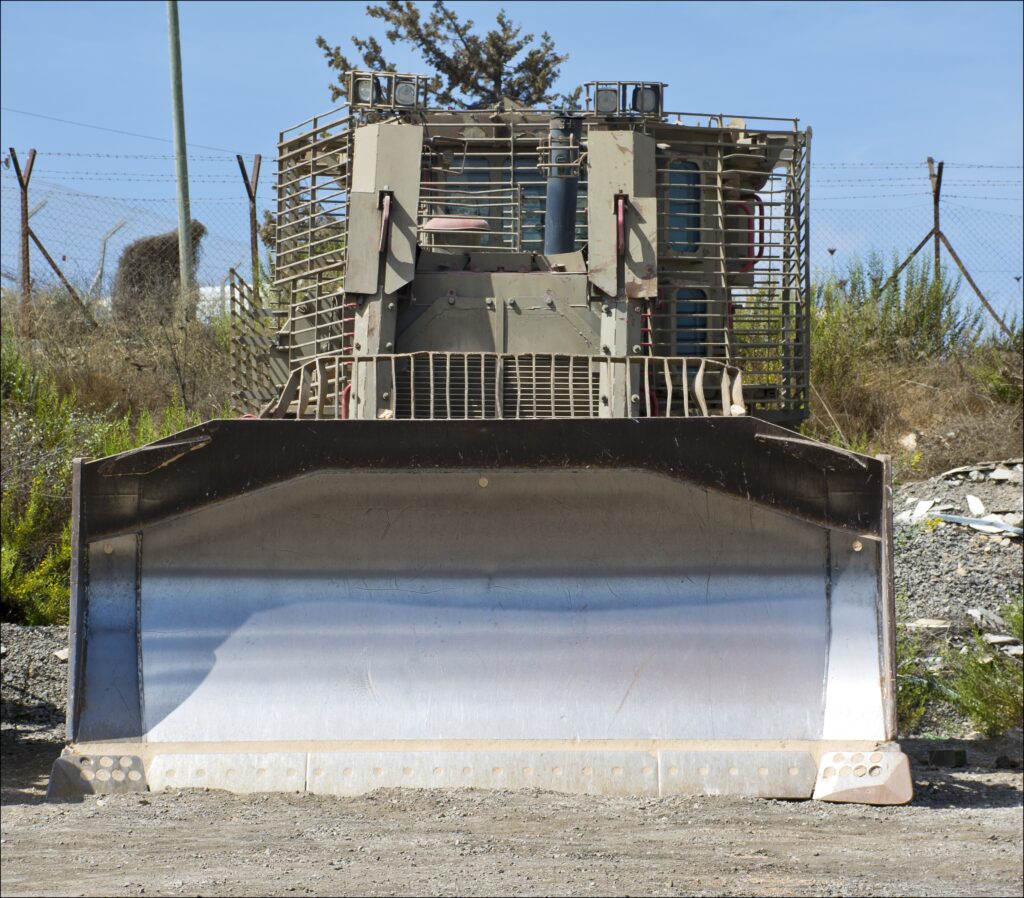
Imagine a street covered by collapsed masonry after sustained fighting. A wheeled loader may struggle for traction, while an unprotected bulldozer would expose its operator to direct fire and fragmentation. An armored D9 offers both physical power and a protected working compartment.
That does not make the environment safe. It makes the task possible.
Why the Rear Ripper Matters
Attention usually stays on the blade, yet the rear ripper adds another layer of capability. Caterpillar D9 variants can be fitted with single-shank or multi-shank ripping systems designed to break compacted soil, pavement, rock, and other hard surfaces.
Instead of pushing an obstacle immediately, the operator can first weaken or fracture it. Roads can be disrupted, reinforced ground can be opened, and hard material can be loosened before being moved by the blade.
Such flexibility is valuable in military engineering because obstacles are rarely identical. One route may contain loose debris, while another may involve concrete, hardened soil, or damaged infrastructure. A platform able to both break and move material provides commanders with more options.
Protection Has Limits
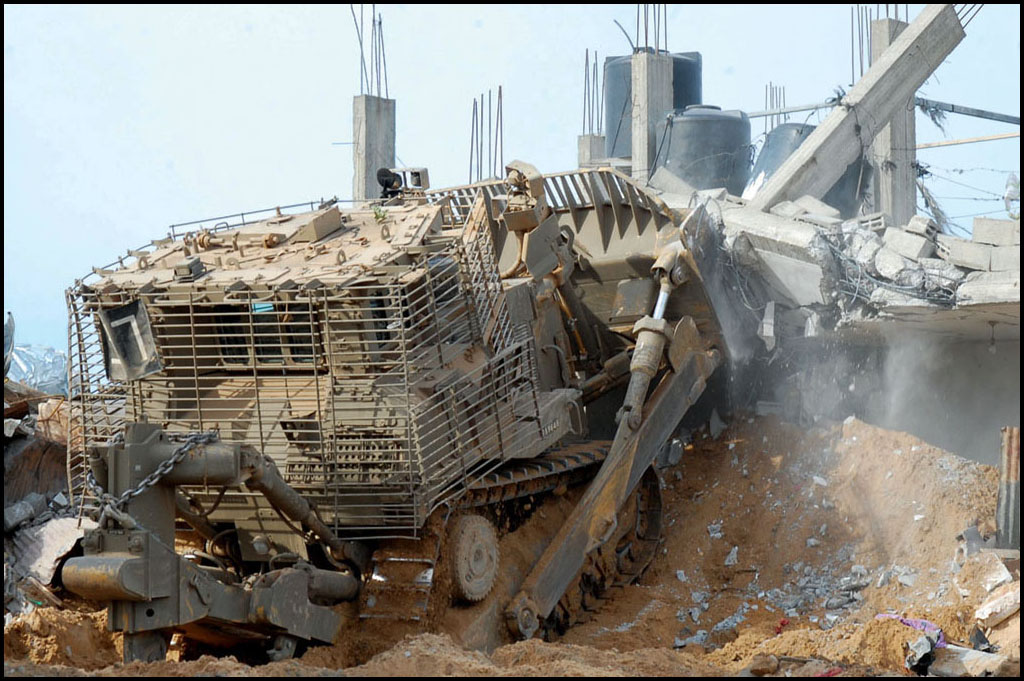
Armor is the most visible difference between a civilian D9 and the Israeli military version. Modifications have included a protected cabin, ballistic windows, reinforcement around mechanical systems, fire-suppression equipment, and additional armor for vulnerable sections.
Some variants have also been fitted with slat or cage armor intended to reduce the effectiveness of certain rocket-propelled grenade warheads. Protection packages have evolved over time as battlefield threats changed.
Even so, describing the D9 as indestructible would be inaccurate. It remains a large, slow vehicle that can be exposed to anti-armor weapons, mines, explosive devices, and mechanical damage. Its survivability depends not only on steel but also on route planning, infantry support, intelligence, and coordination with explosive ordnance teams.
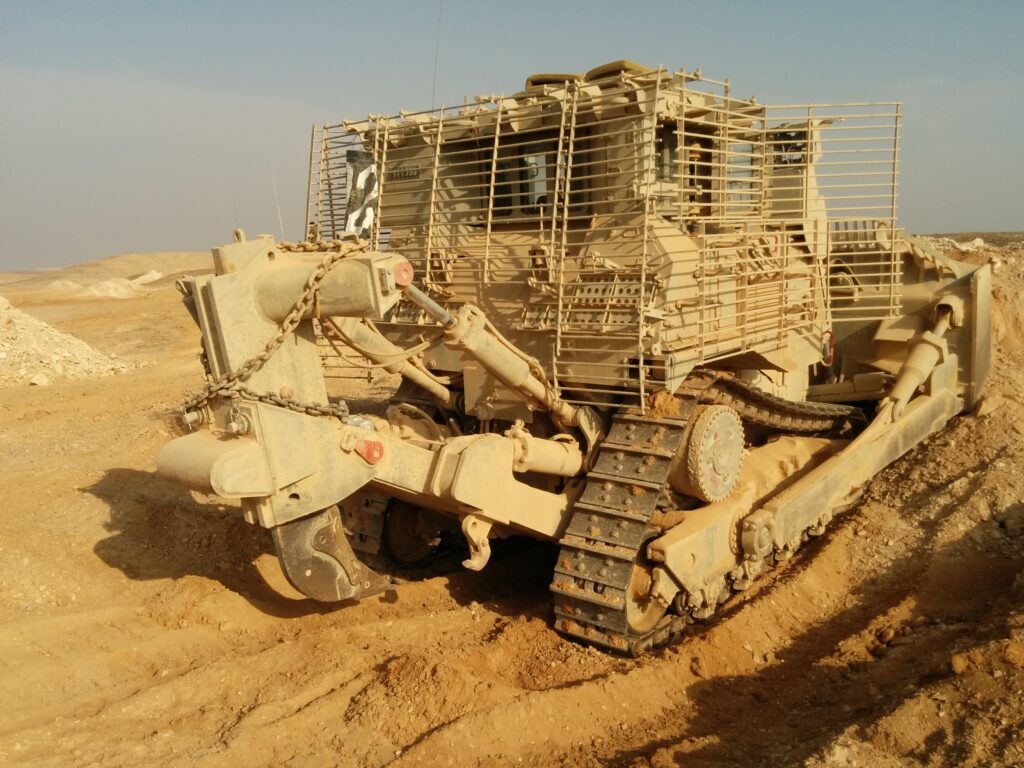
Caterpillar’s elevated drive sprocket design offers a mechanical advantage by lifting important drivetrain components away from direct ground contact. Mud, debris, and impacts are less likely to affect certain parts of the system, while maintenance access can also be improved.
Urban Warfare Increased Its Value
Cities create some of the most demanding conditions for military engineers. Narrow streets restrict maneuver, buildings block visibility, underground spaces complicate threat detection, and debris can quickly turn a road into an unusable corridor.
Under such conditions, engineering vehicles do more than remove obstacles. They may create alternative routes, prepare protected positions, clear damaged infrastructure, and support access for logistics or evacuation teams.
Size becomes both an advantage and a limitation. The D9 can move enormous quantities of material, but its dimensions reduce maneuverability in confined spaces. Effective employment therefore requires careful coordination with nearby units.
Would another tank solve a blocked street? It might provide fire support, but it cannot remove several tons of concrete. Would a drone solve the problem? It could identify the obstacle, but not physically change it. Battlefield awareness and firepower are important, yet neither can replace heavy engineering.
Panda and Remote Operation
One of the most important developments has been the Panda remote-controlled variant. Designed for dangerous engineering missions, Panda allows operators to control the bulldozer from a more protected location.
Remote operation is particularly useful when a route may contain mines, improvised explosive devices, or direct-fire threats. Removing the crew from the cabin reduces exposure, although it does not eliminate operational risk.
Cameras, communications links, sensors, and control systems become essential. Dust, smoke, damaged optics, electronic interference, and restricted visibility may reduce effectiveness. Remote control should also not be confused with full autonomy. Human operators still make the critical decisions.
Panda nevertheless reflects a wider military trend. Uncrewed ground systems do not always need to be small robots. Some may be heavy industrial platforms designed to perform dangerous physical work.
Why a Civilian Platform Still Makes Sense
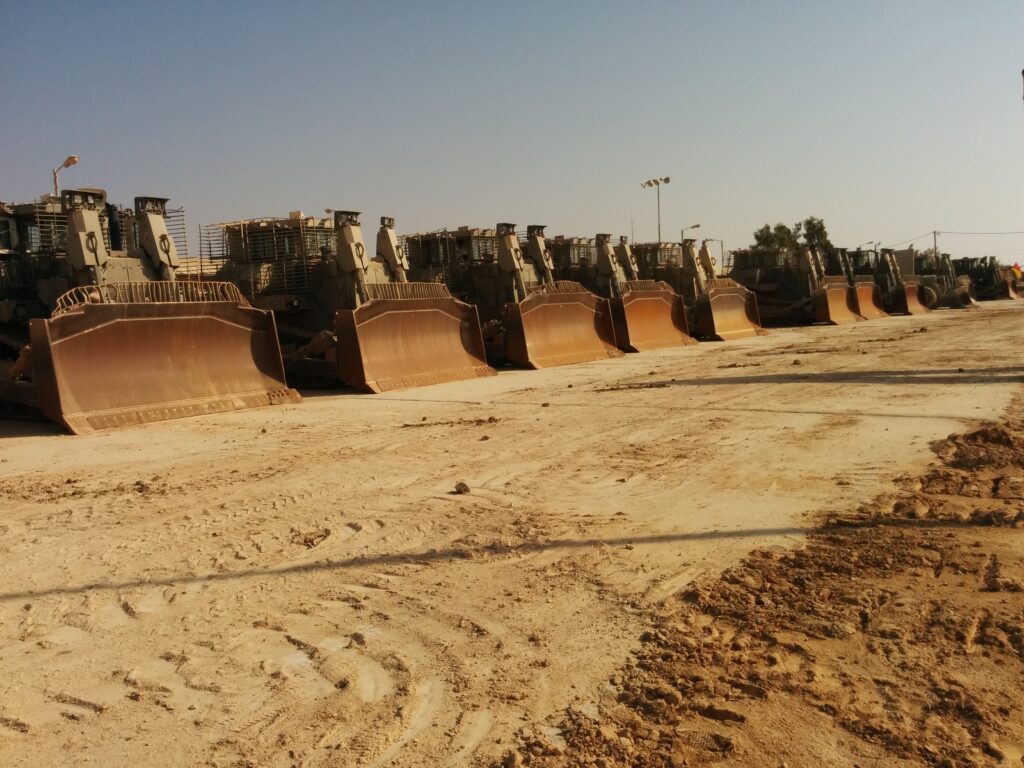
Building a completely new combat engineering vehicle would offer greater design freedom, but it would also increase development cost and technical risk. Adapting the D9 provides access to a mature platform supported by decades of industrial use.
Caterpillar’s global supply chain, experienced maintenance network, and established engineering standards offer practical advantages. Military armor and electronics require specialized support, but the basic engine, transmission, hydraulics, and undercarriage come from a proven family of machines.
Innovation does not always mean inventing something unfamiliar. Sometimes it means recognizing that an existing platform can solve a military problem more effectively than a complex new design.
Clearing the Path Forward
Caterpillar’s D9 does not represent futuristic warfare in the usual sense. It is large, slow, mechanically demanding, and based on industrial technology. Yet its operational value remains clear.
Armored units cannot advance through impassable terrain. Logistics vehicles cannot deliver supplies through blocked roads. Rescue teams cannot reach damaged areas without access. Before any of those missions can continue, someone has to move the obstacle.
That is why the D9 remains relevant. It does not dominate through range, speed, or firepower. It changes the battlefield itself, one push at a time.
Sources:
- Caterpillar Inc. D9 Dozer: Product Specifications and Equipment Information.
- Caterpillar Inc. D9 GC Dozer: Powertrain, Undercarriage, Blades and Rear Attachments.
- Israel Defense Forces. Innovation on the Modern Battlefield: Meet the IDF’s New Panda Bulldozer.
- Army Technology. Armoured D9R Dozer.
- United States Army. Earth-Moving and Combat Engineering Operations.