
Drill & Defense
Advertisement
  • Defense Industry
    • Industry News
    • Defense Companies
    • Defense Technologies
    • Market Analysis
  • Military Systems
    • Land Systems
    • Air Systems
    • Naval Systems
    • Electronic & Cyber Systems
  • Firearms
    • Pistols
    • Rifles
    • SMGs & Machine Guns
    • Ammunition
    • Optics & Accessories
  • Geopolitics
    • Global Security
    • Defense & Energy Strategy
    • Tech & Innovation Crossover
    • Trade & Export Controls
  • Energy & Security
    • Oil & Gas News
    • Energy Technologies
    • Market Trends & Analysis
  • History
    • Military History
    • Doctrines & Concepts
    • Strategic Turning Points
    • Legacy Systems & Structures
  • Knowledge Base
    • Firearms Basics
    • Defense Know-How
    • Energy Fundamentals
    • Regulations & Frameworks
  • About
  • Contact
  • Login
  • Register
No Result
View All Result
  • Defense Industry
    • Industry News
    • Defense Companies
    • Defense Technologies
    • Market Analysis
  • Military Systems
    • Land Systems
    • Air Systems
    • Naval Systems
    • Electronic & Cyber Systems
  • Firearms
    • Pistols
    • Rifles
    • SMGs & Machine Guns
    • Ammunition
    • Optics & Accessories
  • Geopolitics
    • Global Security
    • Defense & Energy Strategy
    • Tech & Innovation Crossover
    • Trade & Export Controls
  • Energy & Security
    • Oil & Gas News
    • Energy Technologies
    • Market Trends & Analysis
  • History
    • Military History
    • Doctrines & Concepts
    • Strategic Turning Points
    • Legacy Systems & Structures
  • Knowledge Base
    • Firearms Basics
    • Defense Know-How
    • Energy Fundamentals
    • Regulations & Frameworks
  • About
  • Contact
  • Login
  • Register
No Result
View All Result
Drill & Defense
No Result
View All Result
Home Military Systems

HUMVEE: The Vehicle That Outlived the Battlefield It Was Built For

August 31, 2026
in Military Systems, Land Systems
HUMVEE

Salah Ad Din Province, Iraq (March 22, 2006) – U.S. Army soldiers assigned to the Bravo Battery 3rd Battalion 320th Field Artillery Regiment along with Iraq Army soldiers from the 1st Battalion 1st Brigade 4th Division perform a routine patrol. U.S. Navy photo By Photographers Mate 3rd Class Shawn Hussong (RELEASED). U.S. Navy photo By Photographers Mate 3rd Class Shawn Hussong, Public domain.

Share on LinkedInShare on Twitter

Few military vehicles have remained relevant for as long as the HMMWV. Introduced into U.S. military service during the 1980s, the High Mobility Multipurpose Wheeled Vehicle eventually became so closely associated with American ground forces that its nickname, HUMVEE, became more recognizable than its official designation.

Its longevity, however, is more interesting than its appearance. The HUMVEE was never designed to be a heavily armored patrol vehicle capable of absorbing the kind of explosive threats encountered decades later in Iraq and Afghanistan. It began as a highly mobile utility platform, and much of its history can be understood as an attempt to stretch that original concept into roles the designers could not reasonably have anticipated.

Mobility Was Built Into the Architecture

The basic HMMWV layout is unusually well suited to off-road mobility. Later M1100-series vehicles illustrate the engineering philosophy particularly well. An M1165 uses a 6.5-liter turbocharged V8 diesel producing 190 horsepower and 380 lb-ft of torque, connected to a four-speed automatic transmission and a two-speed transfer case with a 2.72:1 low-range ratio.

Those figures appear modest today, particularly beside modern commercial pickups, but tactical mobility cannot be reduced to horsepower. The M1165 combines a 130-inch wheelbase with 18.2 inches of ground clearance, 37-inch tires and independent double A-frame suspension at both ends. Geared hubs allow the drivetrain to remain higher in the chassis while transferring power down to the wheels, contributing to the vehicle’s substantial ground clearance. It can negotiate a 48-degree approach angle, a 40-degree departure angle and an 18-inch vertical obstacle. Standard fording depth is approximately 30 inches, increasing to 60 inches with the appropriate kit.

There is a reason HUMVEEs often look surprisingly comfortable in terrain where conventional road vehicles would quickly encounter problems underneath the chassis.

Even the dimensions tell part of the story. The M1165 is roughly 4.93 meters long and 2.21 meters wide, with a 3.30-meter wheelbase. Maximum speed is listed at around 70 mph, while a 25-gallon fuel tank provides approximately 250 miles of cruising range in the referenced configuration. Run-flat capability allows continued movement for around 30 miles at 30 mph after tire damage.
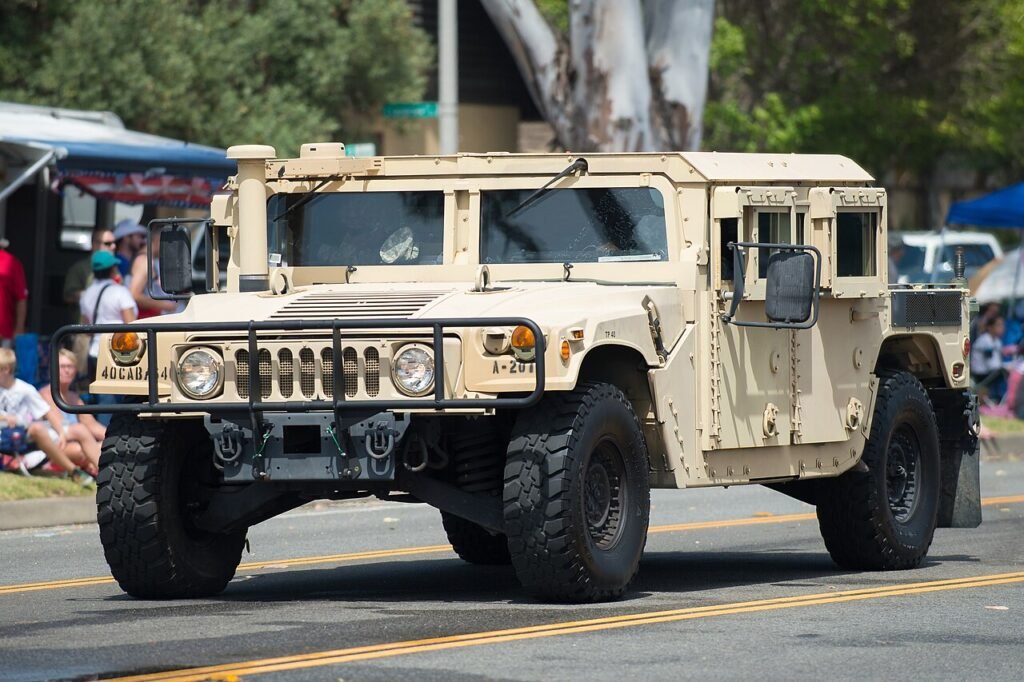
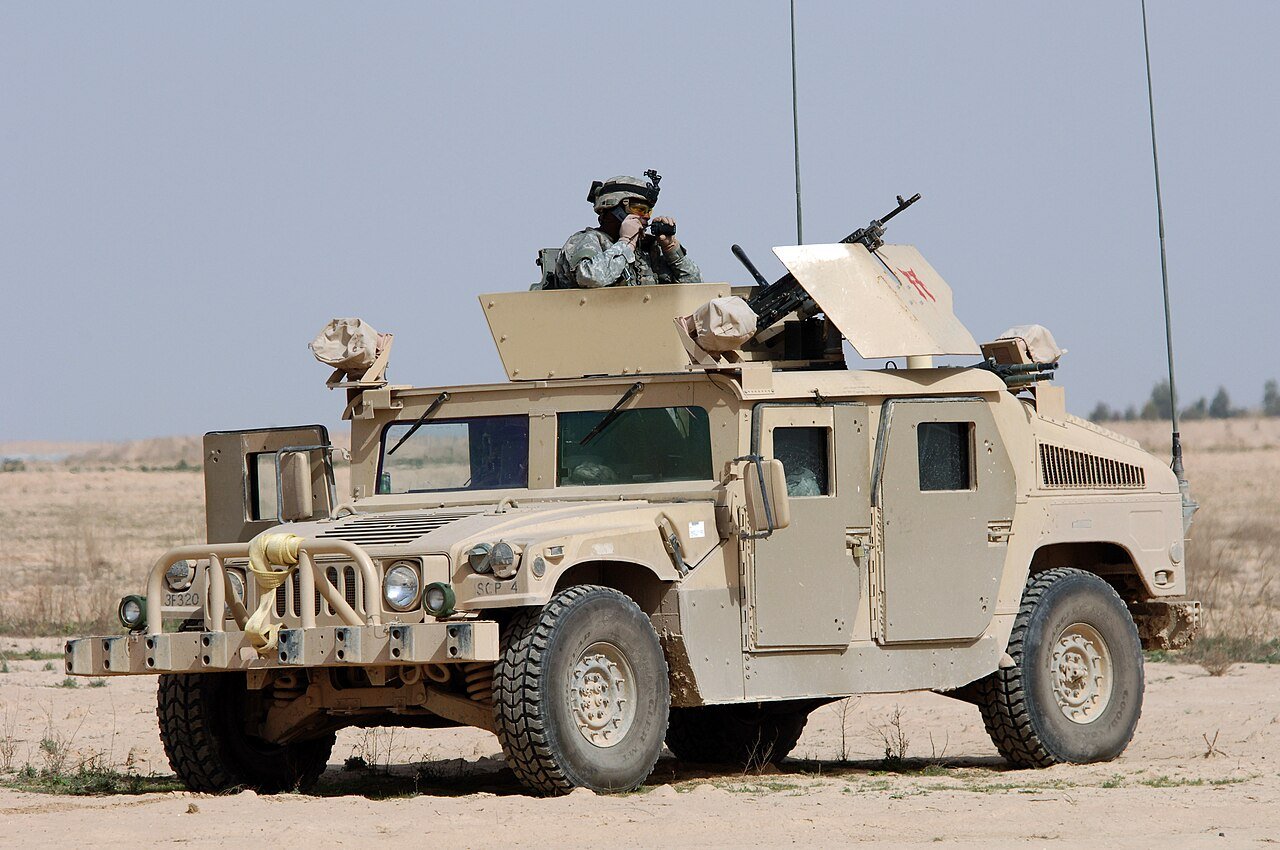
U.S. Marine Expeditionary Force, Camp Pendleton CA. mark6mauno, CC BY 2.0 https://creativecommons.org/licenses/by/2.0.

None of these features makes the HUMVEE extraordinary individually. Together, however, they produced a platform that could travel off-road, carry significant equipment and still be moved by highway, rail, ship or aircraft.

The Payload Story Is More Important Than It Looks

One of the HUMVEE’s greatest strengths has always been what could be placed on top of the chassis.

Command equipment, communications systems, TOW missile launchers, machine guns, ambulances and cargo bodies appeared across different variants. Current M1165-based configurations demonstrate how flexible the platform remains, with versions configured for command-and-control duties, general-purpose transport and armed patrols.

A base U.S.-specification HUMVEE 4-CT has a listed gross vehicle weight of 12,100 pounds and payload capacity of approximately 4,950 pounds. That sounds generous until armor enters the equation. An older M1165 technical sheet demonstrates the relationship clearly: curb weight could rise from roughly 6,550 pounds in an unarmored M1165 to approximately 9,870 pounds in an M1165A1 with the B3 armor configuration, reducing available payload from 4,950 pounds to about 2,230 pounds.

This is where the HUMVEE story becomes more complicated.

Protection is never free. Every additional armor plate consumes part of the same weight budget needed for ammunition, weapons, communications equipment, crew gear and other mission systems.
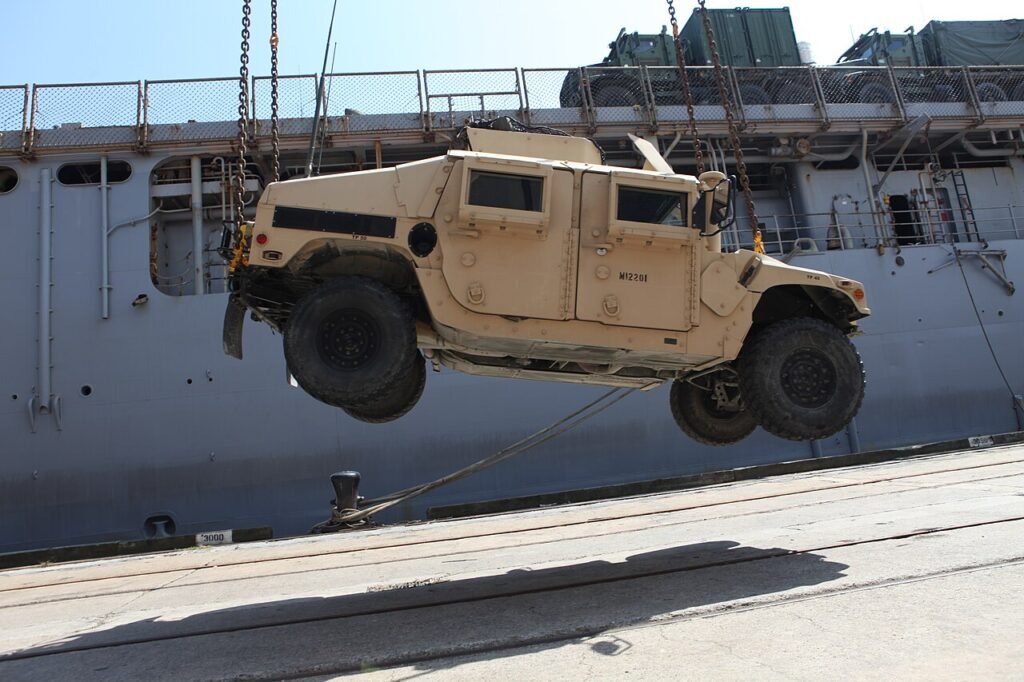
CAMP LEJEUNE, N.C. (Aug. 29, 2010) A crane lifts an M998 high mobility multi-purpose wheeled vehicle onto the flight deck of the amphibious dock landing ship USS Carter Hall (LSD) at the Morehead City port. Marines assigned to 26th Marine Expeditionary Unit (26th MEU) are deployed aboard the ships of the Kearsarge Amphibious Ready Group responding to an order by the Secretary of Defense to support Pakistan flood relief efforts. (U.S. Marine Corps photo by Staff Sgt. Danielle M. Bacon/Released).

Iraq Changed What Was Expected From a HUMVEE

The insurgencies in Iraq and Afghanistan placed the HMMWV into an environment dominated by ambushes, roadside bombs and increasingly powerful improvised explosive devices.

Armor packages improved survivability, but the HUMVEE architecture had not originally been designed around carrying such levels of protection. The M1114, for example, incorporated steel armor, ballistic-resistant windows, underbody protection, a more powerful turbocharged engine and strengthened suspension. Its standard protection package alone added roughly 2,000 pounds compared with lighter HMMWV configurations. Additional Armor Survivability Kits added still more weight.
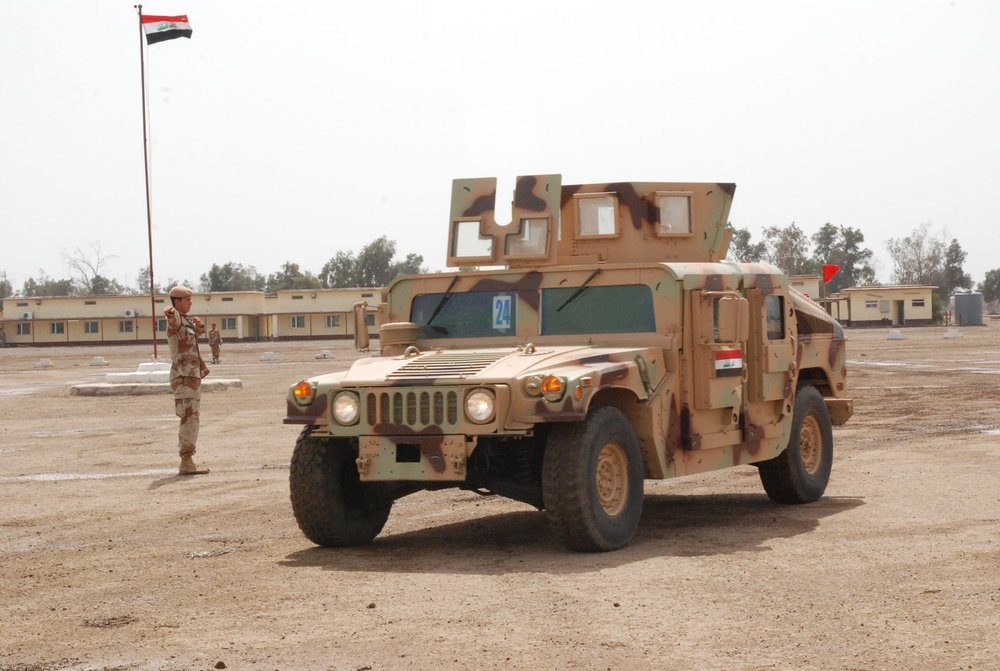
Two Iraqi soldiers drive off in an M1114 Humvee that was transferred from the U.S. Army to the Iraqi security forces after their graduation from the three day drivers training course at the Iraqi army service support institute on Taji, March 18. The drivers training program at IASSI is part of the U.S. Army’s initiative to field 8,500 Humvees to the ISF in the next two years. So far, about 100 vehicles have been fielded.

The consequences were mechanical as well as tactical. Heavier vehicles placed additional stress on suspension components, reduced available payload and altered handling characteristics. Armor added around the upper body and turret could also raise the center of gravity, increasing rollover concerns. The Army consequently introduced suspension upgrades and extensive rollover and emergency-egress training as up-armored HUMVEEs became common during operations in Iraq and Afghanistan.

Seen from this perspective, the HUMVEE’s problems in the IED era were partly the result of success. A highly adaptable light vehicle had been adapted so aggressively that it was eventually being asked to perform missions approaching those of a purpose-built protected vehicle.

Why JLTV Was Necessary

There eventually comes a point where modification becomes less efficient than designing another vehicle around a new threat environment.

JLTV emerged from that reality. Rather than continuing to add armor, electronics and payload requirements to an architecture originating in the early 1980s, the newer vehicle could incorporate survivability, electrical capacity, payload and modern battlefield systems from the beginning.

That does not make every HUMVEE immediately useless.

A vehicle used to transport communications equipment around a relatively secure installation does not require the same protection as one conducting patrols through an area with a significant mine or IED threat. Ambulance, command, utility and support requirements also create different compromises between weight, protection and mobility.

The existence of scalable armor packages on modern HUMVEE configurations reflects exactly this problem. A vehicle can operate in a lighter configuration when maximum protection is unnecessary and accept additional armor when the threat environment demands it.
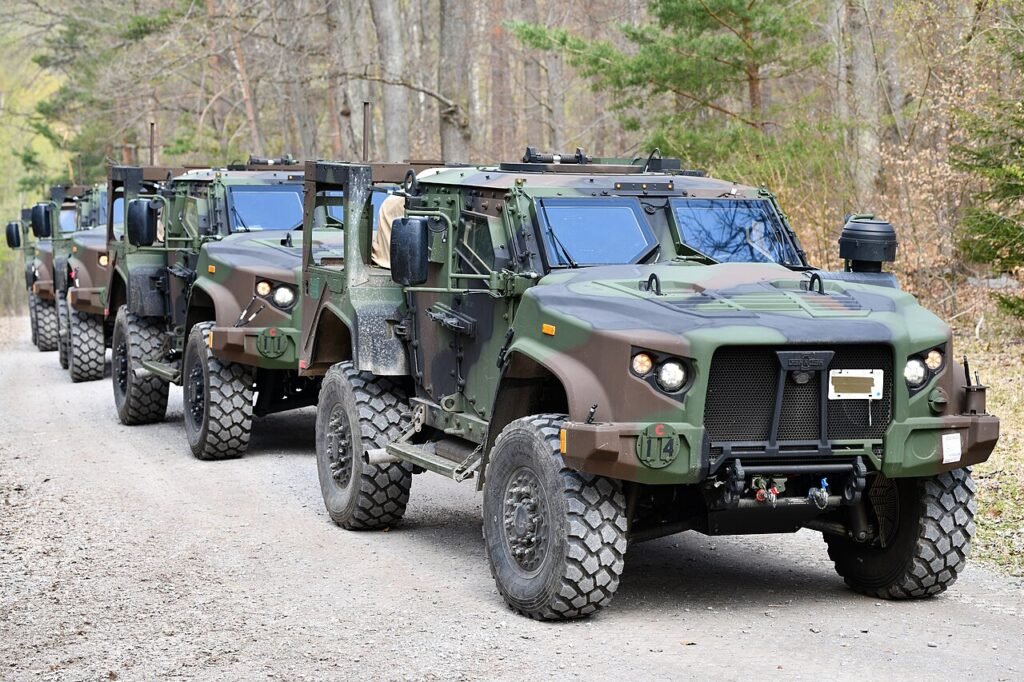
Joint Light Tactical Vehicles (JLTVs) are staged in preparation of entering the driver’s mobility course in the Boeblingen Local Training Area, Germany, April 22, 2021. A team of instructors with Oshkosh Defense trained Soldiers on the capabilities and operation of JLTVs to enhance their capability and prepare the force for the next generation of military vehicle. (U.S. Army photo by Jason Johnston).

Ask Instead: Obsolete for What?

Calling the HUMVEE obsolete without defining the mission does not tell us very much.

Against modern mines, sophisticated IEDs and heavily contested front-line environments, newer protected platforms offer advantages the original HMMWV architecture cannot simply acquire through another round of bolt-on upgrades. But for transport, command-and-control, weapons carriage, support duties and numerous lower-threat missions, replacing every functioning HUMVEE with a substantially heavier and more expensive vehicle would create its own logistical and financial questions.

Perhaps this explains the platform better than any specification sheet.

The HUMVEE was not built to dominate every battlefield that followed its introduction. It lasted because the chassis could be altered repeatedly as those battlefields changed. Eventually that adaptability reached practical limits, but reaching them after several decades of service is itself a significant engineering achievement.

Sources:

  • AM General. “HUMVEE 4-CT.” HMMWV M1165 Technical Specifications.
  • AM General. “M1100 Series HMMWV: M1165A1 Special Ops.” Technical Data Sheet.
  • U.S. Army. “Out on a Limb.” Army Research Laboratory.
  • AM General. “M1100 Series HMMWV: M1165.” Performance, Payload and Protection Technical Data.
  • U.S. Army. “Army Rushes FRAG 7 to the Field.” Army.mil.

Previous Post

What Happens to European Security If America Steps Back?

Related Posts

IDF Caterpillar D9R armored bulldozer
Military Systems

Caterpillar D9: The Armored Bulldozer That Clears the Way

August 5, 2026
M88A2 Hercules Recovery Vehicle
Military Systems

M88A2 HERCULES: Recovering the Machines That Cannot Be Left Behind

July 27, 2026
Hughes_OH-6A_Cayuse
Military Systems

Hughes OH-6 Cayuse: A Small Helicopter Built for Dangerous Work

July 22, 2026
Rockwell_MBB_X31
Military Systems

Rockwell-MBB X-31 and the Problem of Control Beyond the Stall

July 20, 2026
United_States_Air_Force_Lockheed_U-2S_Dragon_Lady_80-1094_Royal_International_Air_Tattoo_2025_01
Military Systems

Lockheed Martin U-2: The Aircraft That Refused to Become Old

July 3, 2026
YAL-1A_Airborne_Laser_unstowed
Military Systems

YAL-1A Airborne Laser: The 747 That Tried to Kill Missiles With Light

June 26, 2026
  • Trending
  • Latest
Heckler_&_Koch_G3_Holzschaft_Display_noBG

HK G3: A Rifle That Stayed Longer Than Expected

April 29, 2026
FN FAL: The Right Arm of the Free World

FN FAL: The Right Arm of the Free World

March 31, 2026
MG42-1

MG42 Machine Gun: WWII History, Specifications and Battlefield Impact

April 21, 2026
Operation Enduring Freedom

What Exactly Is a Private Military Company (PMC)?

September 6, 2025
HUMVEE

HUMVEE: The Vehicle That Outlived the Battlefield It Was Built For

August 31, 2026
U.S. military NATO

What Happens to European Security If America Steps Back?

August 28, 2026
Why EOD Robots Go First

Into the Blast Radius: Why EOD Robots Go First

August 24, 2026
The movement of a Russian column of tanks, infantry fighting vehicles and other vehicles during the war in Ukraine. Mil.ru, CC BY 4.0 .

Why Military Logistics Fails Before the Shooting Starts: Russia’s Road to Kyiv

August 17, 2026

Recent Articles

HUMVEE

HUMVEE: The Vehicle That Outlived the Battlefield It Was Built For

August 31, 2026
U.S. military NATO

What Happens to European Security If America Steps Back?

August 28, 2026
Why EOD Robots Go First

Into the Blast Radius: Why EOD Robots Go First

August 24, 2026
The movement of a Russian column of tanks, infantry fighting vehicles and other vehicles during the war in Ukraine. Mil.ru, CC BY 4.0 .

Why Military Logistics Fails Before the Shooting Starts: Russia’s Road to Kyiv

August 17, 2026
Drill & Defense

Drill & Defense is an independent defense and security platform covering firearms, military technology, geopolitics, energy security, and industry developments. We provide clear, structured, and practical insight for professionals, companies, and readers following the evolving defense landscape worldwide.

Follow Us

Browse by Category

  • Air Systems
  • Defense & Energy Strategy
  • Defense Industry
  • Defense Know-How
  • Defense Technologies
  • Doctrines & Concepts
  • Energy & Security
  • Energy Fundamentals
  • Energy Technologies
  • Firearms
  • Geopolitics
  • Global Security
  • History
  • Industry News
  • Knowledge Base
  • Land Systems
  • Legacy Systems & Structures
  • Market Analysis
  • Market Trends & Analysis
  • Military History
  • Military Systems
  • Naval Systems
  • Oil & Gas News
  • Pistols
  • Regulations & Frameworks
  • Rifles
  • SMGs & Machine Guns
  • Strategic Turning Points
  • Tech & Innovation Crossover
  • Trade & Export Controls

Recent Articles

HUMVEE

HUMVEE: The Vehicle That Outlived the Battlefield It Was Built For

August 31, 2026
U.S. military NATO

What Happens to European Security If America Steps Back?

August 28, 2026

© 2026 Drill & Defense. All rights reserved. Independent insights on firearms, defense, and energy. For business inquiries: info@drillanddefense.com | PRIVACY POLICY | COOKIE POLICY | TERMS AND CONDITIONS

Manage Consent

We use cookies to improve your experience. You can accept or refuse cookies; however, some features may not function properly without your consent.

Functional Always active
The technical storage or access is strictly necessary for the legitimate purpose of enabling the use of a specific service explicitly requested by the subscriber or user, or for the sole purpose of carrying out the transmission of a communication over an electronic communications network.
Preferences
The technical storage or access is necessary for the legitimate purpose of storing preferences that are not requested by the subscriber or user.
Statistics
The technical storage or access that is used exclusively for statistical purposes. The technical storage or access that is used exclusively for anonymous statistical purposes. Without a subpoena, voluntary compliance on the part of your Internet Service Provider, or additional records from a third party, information stored or retrieved for this purpose alone cannot usually be used to identify you.
Marketing
The technical storage or access is required to create user profiles to send advertising, or to track the user on a website or across several websites for similar marketing purposes.
  • Manage options
  • Manage services
  • Manage {vendor_count} vendors
  • Read more about these purposes
View preferences
  • {title}
  • {title}
  • {title}
No Result
View All Result
  • Defense Industry
    • Industry News
    • Defense Companies
    • Defense Technologies
    • Market Analysis
  • Military Systems
    • Land Systems
    • Air Systems
    • Naval Systems
    • Electronic & Cyber Systems
  • Firearms
    • Pistols
    • Rifles
    • SMGs & Machine Guns
    • Ammunition
    • Optics & Accessories
  • Geopolitics
    • Global Security
    • Defense & Energy Strategy
    • Tech & Innovation Crossover
    • Trade & Export Controls
  • Energy & Security
    • Oil & Gas News
    • Energy Technologies
    • Market Trends & Analysis
  • History
    • Military History
    • Doctrines & Concepts
    • Strategic Turning Points
    • Legacy Systems & Structures
  • Knowledge Base
    • Firearms Basics
    • Defense Know-How
    • Energy Fundamentals
    • Regulations & Frameworks
  • About
  • Contact
  • Login
  • Register

© 2026 Drill & Defense. All rights reserved. Independent insights on firearms, defense, and energy. For business inquiries: info@drillanddefense.com | PRIVACY POLICY | COOKIE POLICY | TERMS AND CONDITIONS