
Drill & Defense
Advertisement
  • Defense Industry
    • Industry News
    • Defense Companies
    • Defense Technologies
    • Market Analysis
  • Military Systems
    • Land Systems
    • Air Systems
    • Naval Systems
    • Electronic & Cyber Systems
  • Firearms
    • Pistols
    • Rifles
    • SMGs & Machine Guns
    • Ammunition
    • Optics & Accessories
  • Geopolitics
    • Global Security
    • Defense & Energy Strategy
    • Tech & Innovation Crossover
    • Trade & Export Controls
  • Energy & Security
    • Oil & Gas News
    • Energy Technologies
    • Market Trends & Analysis
  • History
    • Military History
    • Doctrines & Concepts
    • Strategic Turning Points
    • Legacy Systems & Structures
  • Knowledge Base
    • Firearms Basics
    • Defense Know-How
    • Energy Fundamentals
    • Regulations & Frameworks
  • About
  • Contact
  • Login
  • Register
No Result
View All Result
  • Defense Industry
    • Industry News
    • Defense Companies
    • Defense Technologies
    • Market Analysis
  • Military Systems
    • Land Systems
    • Air Systems
    • Naval Systems
    • Electronic & Cyber Systems
  • Firearms
    • Pistols
    • Rifles
    • SMGs & Machine Guns
    • Ammunition
    • Optics & Accessories
  • Geopolitics
    • Global Security
    • Defense & Energy Strategy
    • Tech & Innovation Crossover
    • Trade & Export Controls
  • Energy & Security
    • Oil & Gas News
    • Energy Technologies
    • Market Trends & Analysis
  • History
    • Military History
    • Doctrines & Concepts
    • Strategic Turning Points
    • Legacy Systems & Structures
  • Knowledge Base
    • Firearms Basics
    • Defense Know-How
    • Energy Fundamentals
    • Regulations & Frameworks
  • About
  • Contact
  • Login
  • Register
No Result
View All Result
Drill & Defense
No Result
View All Result
Home Military Systems

Rockwell-MBB X-31 and the Problem of Control Beyond the Stall

July 20, 2026
in Military Systems, Air Systems
Rockwell_MBB_X31

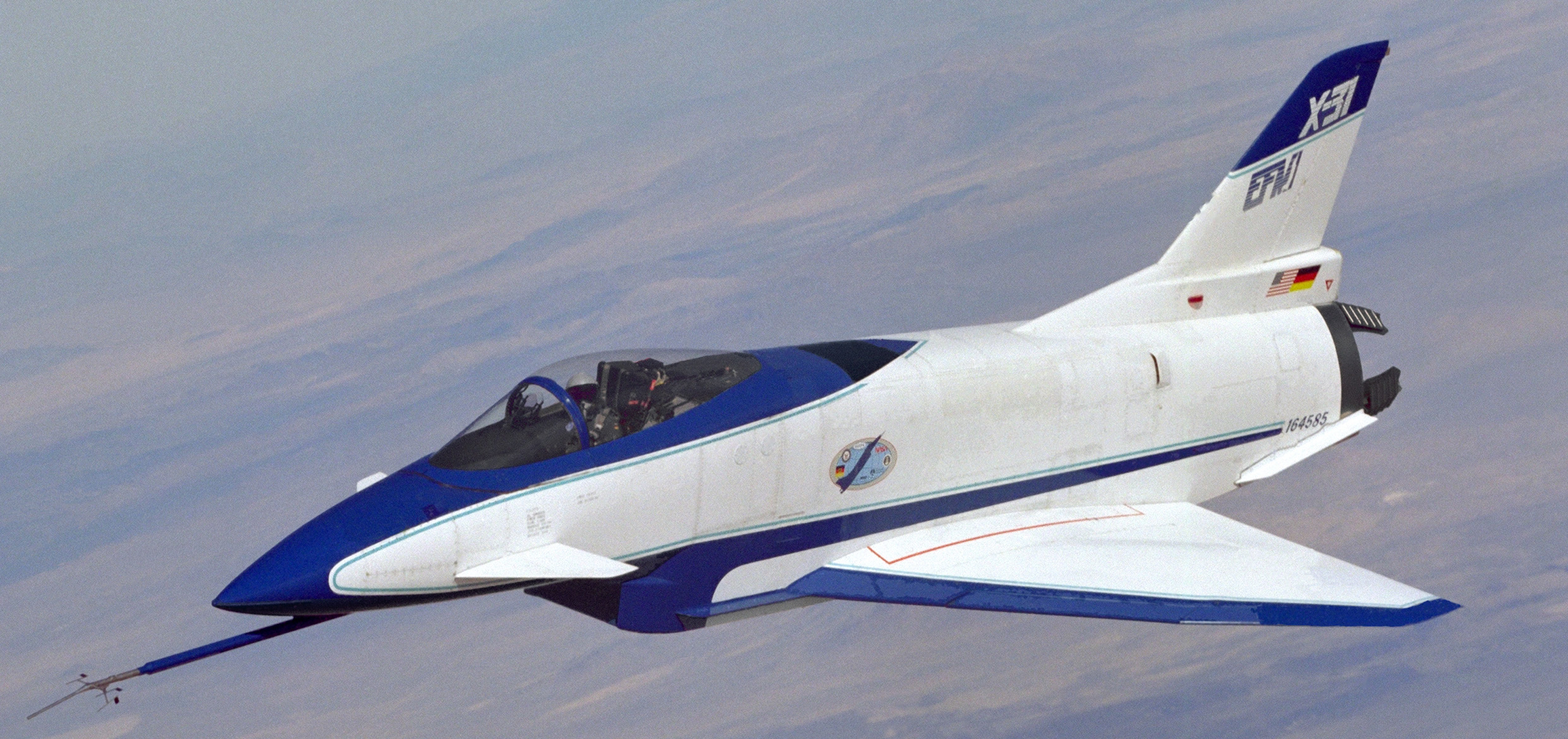
One of two Rockwell-MBB X-31 Enhanced Fighter Maneuverability Demonstrator aircraft (top), flown by an international test organization at NASA's Dryden Flight Research Center, Edwards Air Force Base, California, is seen here during a research flight over the desert floor. The X-31 had a three-axis thrust vectoring system, coupled with advanced flight controls, to allow it to maneuver tightly at very high angles of attack.

Share on LinkedInShare on Twitter

Fighter aircraft are normally designed to remain inside a predictable aerodynamic envelope. Speed must be preserved, airflow must continue over the control surfaces and the pilot must avoid attitudes that could lead to a stall or departure from controlled flight.

Rockwell-MBB X-31 was developed to spend much of its time near the opposite end of that logic.

Created through cooperation between Rockwell International and Germany’s Messerschmitt-Bölkow-Blohm, the aircraft was part of the Enhanced Fighter Maneuverability program. Two demonstrators were built, with the first flight taking place on October 11, 1990.

X-31 was not intended to become a production fighter. It had no operational radar, no complete weapons system and no requirement to meet the everyday demands of squadron service. Its purpose was narrower: to investigate whether a fighter could remain controllable at extremely high angles of attack and whether that capability had any practical value.

What Happens When Airflow Stops Being Reliable?

Angle of attack describes the relationship between the aircraft and the airflow moving around it. As this angle increases, airflow over the wings and control surfaces becomes more disturbed. Eventually, separation occurs and conventional aerodynamic controls begin to lose effectiveness.

For most aircraft, this is the point where the pilot is expected to recover.

X-31 attempted to continue operating.

Three carbon-carbon paddles were mounted around the exhaust of its General Electric F404 engine. By moving into the exhaust stream, they redirected thrust and generated control forces in pitch and yaw. Carbon-carbon materials were selected because the paddles had to survive the intense temperature and pressure behind the engine.
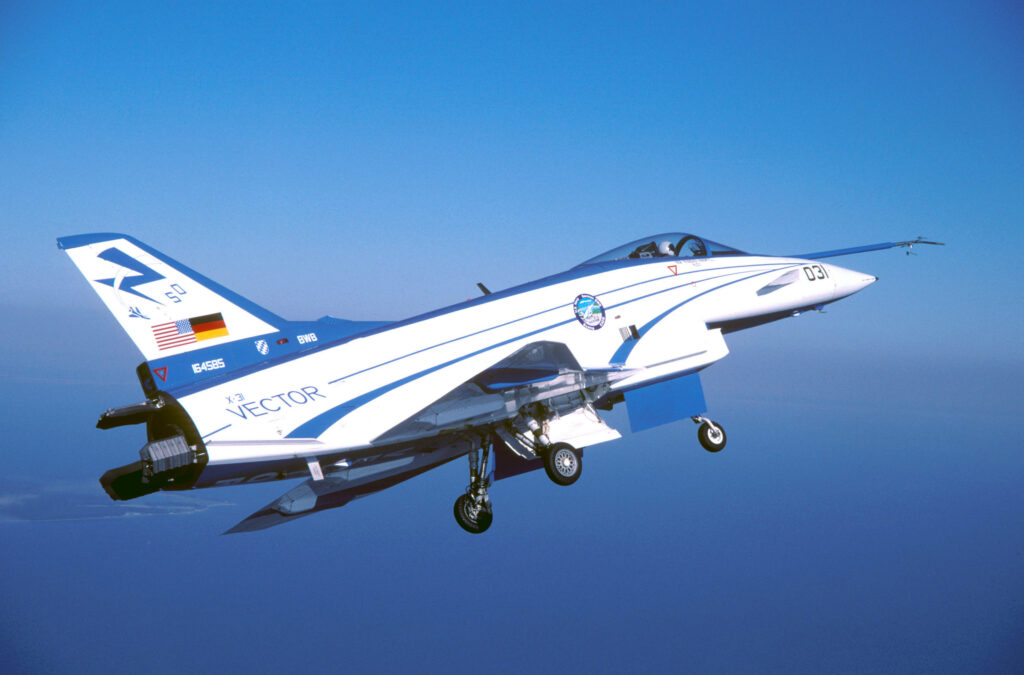
Naval Air Station Patuxent River, Md. (Nov. 14, 2002) — The X-31 aircraft returns from a test flight for the VECTOR (Vectoring Extremely Short Takeoff and Landing Control Tailless Operation Research) program. The X-31 uses thrust vectoring – controlling the direction of its engine exhaust with paddle-like vanes – to maintain control at high angles of attack and reduced speeds, well below the typical landing speed for an aircraft of its type. U.S. Marine Corps photo by Maj. Cody Allee. (RELEASED)

The design was effective for experimentation, but not without cost. Paddles placed inside the exhaust reduced propulsive efficiency, experienced heavy thermal loading and introduced additional mechanical complexity. A production aircraft would need to balance those disadvantages against any maneuverability gained.

More Than an Engine With Moving Paddles

Thrust vectoring alone did not make X-31 controllable. Its canards, trailing-edge surfaces, rudder and exhaust paddles were managed by a digital flight-control system that continuously selected the most useful combination of control inputs.

At lower angles of attack, conventional aerodynamic surfaces carried most of the workload. As airflow became separated, the system increasingly relied on vectored thrust.
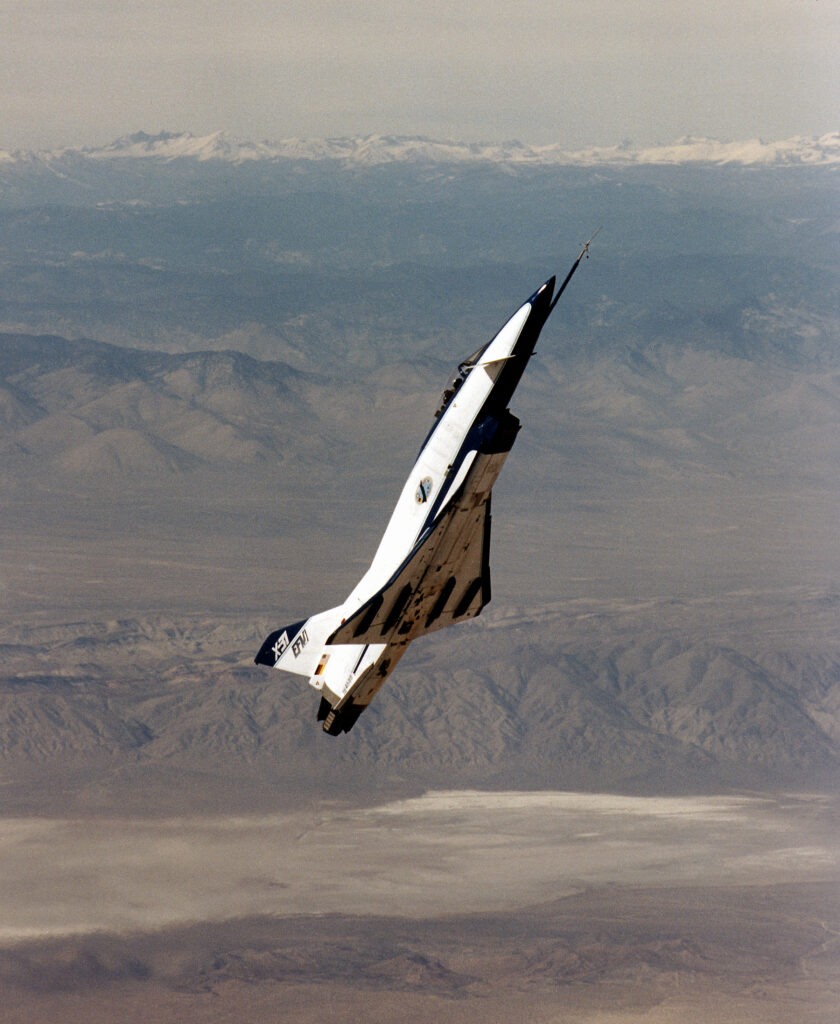
The Rockwell-MBB X-31 aircraft on a research mission from NASA’s Dryden Flight Research Facility, Edwards, California, is flying nearly perpendicular to the flight path while performing the Herbst maneuver. Effectively using the entire airframe as a speed brake and using the aircraft’s unique thrust vectoring system to maintain control, the pilot rapidly rolls the aircraft to reverse the direction of flight, completing the maneuver with acceleration back to high speed in the opposite direction. This type of turning capability could reduce the turning time of a fighter aircraft by 30 percent. The Herbst maneuver was first conducted in an X-31 on April 29, 1993, in the No. 2 aircraft by German test pilot Karl-Heinz Lang.

The transition had to occur smoothly. Control effectiveness changed with airspeed, engine power, sideslip and aircraft attitude. A surface that worked well in one part of the envelope could become weak or unpredictable only seconds later.

High-angle aerodynamics are also difficult to model. Separated airflow does not always behave in a stable or linear manner. Engineers therefore used wind tunnels, simulation, computer modelling and gradual flight-envelope expansion to refine the aircraft’s control laws.

X-31 eventually demonstrated stabilized flight at an angle of attack of around 70 degrees. At such an attitude, the nose could point in a direction that differed significantly from the aircraft’s actual movement through the air.

The Herbst Maneuver and Its Tactical Meaning

One of the best-known demonstrations was the Herbst maneuver, named after German engineer Wolfgang Herbst. During the maneuver, the aircraft rapidly increased its angle of attack, changed direction with the help of thrust vectoring and then attempted to regain speed on a new heading.

In April 1993, X-31 completed a minimum-radius 180-degree turn beyond the normal aerodynamic limits of a conventional fighter.

Visually, the maneuver was dramatic. Tactically, the meaning was more complicated.

Rapid nose pointing could help a pilot create a brief weapons opportunity without completing a conventional sustained turn. However, extreme post-stall maneuvers also consumed energy quickly. An aircraft might point toward an opponent for a few seconds and then find itself slow, exposed and unable to disengage.
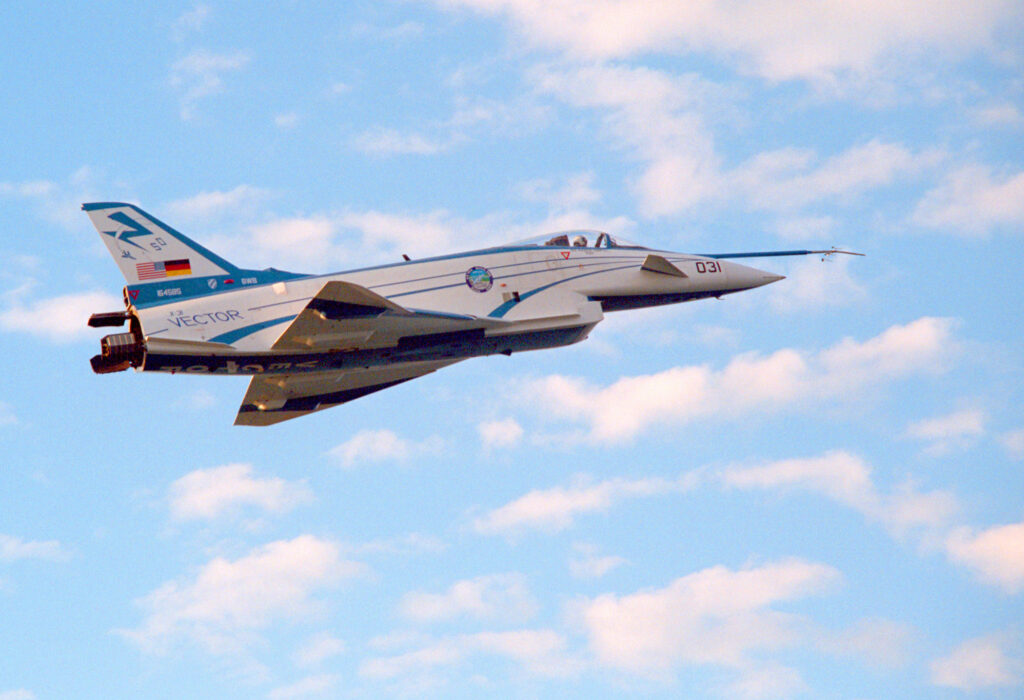
Naval Air Station Patuxent River, Md. (Mar. 1, 2003) – The Vector X-31 races through the clouds during a test flight of the extremely short takeoff and landing (ESTOL) “up-and-away” test phase. The X-31 is equipped with three paddle-like tail vanes that, when activated, redirect the engine’s exhaust plume in response to pilot input. This “thrust vectoring” can provide control and lift at dramatically low speeds and high angles. The X-31 will begin flying ESTOL approaches to the ground in April 2003. U.S. Marine Corps photo by Maj. Cody Allee. (RELEASED)

Post-stall maneuvering therefore did not replace energy management. It offered an additional option, but one that could become dangerous if used at the wrong moment.

The Frequently Quoted 30-to-1 Result

Simulated close-range engagements were conducted against aircraft without thrust-vectoring capability. NASA later reported a potential exchange ratio of approximately 30 to 1 during selected tactical evaluations.

That number requires context.

Test results depend on engagement rules, starting positions, pilot experience, missile assumptions and restrictions placed on each aircraft. X-31 was also a specialized demonstrator operating in scenarios designed to investigate post-stall capability.

The trials nevertheless indicated that thrust vectoring could change close-range engagement geometry. X-31 pilots were sometimes able to generate firing opportunities from positions where a conventional fighter remained limited by its turn radius.

Researchers also found that technical capability alone was not enough. Pilots needed clear information about energy, flight path and recovery options. A maneuver had little tactical value if the pilot could not understand what the aircraft would do immediately afterward.

Rockwell-MBB X-31. Vestman from Helsinki, Finland, CC BY 2.0 https://creativecommons.org/licenses/by/2.0.

Exploring a Fighter With Less Tail

Another phase of the program examined whether thrust vectoring could reduce dependence on the vertical stabilizer.

A smaller tail could reduce drag, structural weight and radar reflections. It would also reduce natural directional stability, particularly during high-speed or high-angle flight.

Instead of physically removing the vertical tail, engineers modified the flight-control software to simulate progressive reductions in tail effectiveness. Rudder authority was reduced while the thrust-vectoring system assumed more directional control.

After being flown in the Paris Air Show in June 1995, the X-31 Enhanced Fighter Maneuverability Technology Demonstrator Aircraft, based at the NASA Dryden Flight Research Center, Edwards, CA, was off-loaded from an Air Force Reserve C-5 transport after the ferry flight back to Edwards.

Tests eventually simulated a complete loss of vertical-tail effectiveness during selected flight conditions, including portions of supersonic flight.

Results suggested that reduced-tail or quasi-tailless fighter designs were possible. Yet the research also revealed an important trade-off. Removing aerodynamic surfaces did not eliminate complexity. It transferred responsibility to engines, computers, sensors, actuators and software.

A tailless aircraft might have lower drag or radar signature, but it could also become more dependent on systems that were difficult to repair or replace in combat conditions.

The Crash That Exposed the System’s Weakness

On January 19, 1995, the first X-31 crashed near Edwards Air Force Base. Ice blocked an unheated nose-mounted air-data probe, causing incorrect information to reach the flight-control computers.

The pilot eventually lost control and ejected safely.

Because X-31 depended heavily on accurate air-data measurements, corrupted sensor information had serious consequences. The software responded to an aircraft condition that did not accurately reflect reality.

The accident was not simply a case of ice forming on a probe. Configuration management, communication between test teams, cockpit information and assumptions about the installed equipment all contributed to the sequence.

Modern aircraft rely even more heavily on connected sensors and computers. X-31 demonstrated that advanced control systems could expand the flight envelope, but also that their authority was limited by the quality of the information they received.

Valder137, CC BY 2.0 https://creativecommons.org/licenses/by/2.0.

VECTOR and the High-Angle Landing Tests

The surviving aircraft later returned to flight under the German-American VECTOR program. Research expanded beyond post-stall combat maneuvering and included reduced-tail control, precise navigation and extremely short takeoff and landing concepts.

Landing trials used thrust vectoring to maintain control at unusually high angles of attack and lower approach speeds. Differential GPS supported the precision required during the approach.

X-31 eventually landed at approximately 24 degrees of angle of attack, roughly twice its conventional landing value.

A slower and steeper approach could reduce landing distance, which had possible relevance to carrier operations, damaged runways and dispersed air bases. Yet such a system would also increase dependence on engine response, control software and accurate guidance close to the ground.

VECTOR showed what was technically possible. It did not prove that the same arrangement would be economical or reliable enough for every operational aircraft.

A Program That Produced Questions Rather Than a New Fighter

X-31 did not lead directly to a production order, and its unusual configuration was never intended to enter service unchanged.

Its value came from the data it generated.

The program examined thrust-vector control, nonlinear aerodynamics, post-stall handling, reduced-tail designs, high-angle landings and the relationship between sensors and digital flight-control systems. It also provided a more realistic understanding of the limits of supermaneuverability.

Modern air combat increasingly depends on missiles, electronic warfare, low observability and networked sensors. Extreme agility may never compensate for poor situational awareness or weak survivability.

Close-range engagements can still occur, however, and aircraft may be forced into situations that were not planned. Under those conditions, retaining control beyond the normal aerodynamic envelope could provide an additional option.

X-31 did not prove that every future fighter required post-stall maneuverability. It showed what such capability could offer, what it could cost and where its limits began.

Sources:

  • NASA, “X-31 Enhanced Fighter Maneuverability Demonstrator.”
  • NASA, “Flying Beyond the Stall: The X-31 and the Advent of Supermaneuverability.”
  • German Aerospace Center, “X-31 VECTOR ESTOL to the Ground Flight Test Results and Lessons Learned.”
  • NASA Technical Reports Server, “X-31A Tactical Utility Flight Testing.”
  • German Aerospace Center, “Global Model Approach for X-31 VECTOR System Identification.”
  • NASA Technical Reports Server, “The X-31A Quasi-Tailless Flight Test Results.”
  • NASA Technical Reports Server, “A Discussion of the Last Flight of X-31A Aircraft No. 1.”

Previous Post

Why Modern Armies Need More Ammunition, Not Only More Advanced Weapons

Related Posts

United_States_Air_Force_Lockheed_U-2S_Dragon_Lady_80-1094_Royal_International_Air_Tattoo_2025_01
Military Systems

Lockheed Martin U-2: The Aircraft That Refused to Become Old

July 3, 2026
YAL-1A_Airborne_Laser_unstowed
Military Systems

YAL-1A Airborne Laser: The 747 That Tried to Kill Missiles With Light

June 26, 2026
Oshkosh M1070 HET
Military Systems

Oshkosh M1070 HET: Heavy Mobility Behind Armored Operations

June 22, 2026
Panzerschnellbrücke LEGUAN auf Leopard 2-Fahrgestell
Military Systems

Panzerschnellbrücke LEGUAN auf Leopard 2-Fahrgestell: The Bridge That Keeps Armoured Forces Moving

June 17, 2026
Boeing CH-47 Chinook
Military Systems

CH-47 Chinook: Heavy-Lift Aviation With a Practical Reputation

June 11, 2026
USS Dwight D. Eisenhower (CVN-69): The Enduring Weight of a Nuclear Aircraft Carrier
Military Systems

USS Dwight D. Eisenhower (CVN-69): The Enduring Weight of a Nuclear Aircraft Carrier

June 8, 2026
  • Trending
  • Latest
Operation Enduring Freedom

What Exactly Is a Private Military Company (PMC)?

September 6, 2025
MG42-1

MG42 Machine Gun: WWII History, Specifications and Battlefield Impact

April 21, 2026
FN FAL: The Right Arm of the Free World

FN FAL: The Right Arm of the Free World

March 31, 2026
Beretta 92FS vs Beretta M9: Is There a Real Difference?

Beretta 92FS vs Beretta M9: Is There a Real Difference?

July 19, 2025
Rockwell_MBB_X31

Rockwell-MBB X-31 and the Problem of Control Beyond the Stall

July 20, 2026
USAFE launches inaugural Combat Ammunition Production exercise

Why Modern Armies Need More Ammunition, Not Only More Advanced Weapons

July 13, 2026
Official photo of NATO Heads of State and Government - 2026 NATO Summit in Ankara.

NATO’s $50 Billion Defense Push: Production Will Decide What the Announcements Are Really Worth

July 10, 2026
Dragunov SVD

Dragunov SVD: The Logic Behind the Squad Marksman Rifle

July 8, 2026

Recent Articles

Rockwell_MBB_X31

Rockwell-MBB X-31 and the Problem of Control Beyond the Stall

July 20, 2026
USAFE launches inaugural Combat Ammunition Production exercise

Why Modern Armies Need More Ammunition, Not Only More Advanced Weapons

July 13, 2026
Official photo of NATO Heads of State and Government - 2026 NATO Summit in Ankara.

NATO’s $50 Billion Defense Push: Production Will Decide What the Announcements Are Really Worth

July 10, 2026
Dragunov SVD

Dragunov SVD: The Logic Behind the Squad Marksman Rifle

July 8, 2026
Drill & Defense

Drill & Defense is an independent defense and security platform covering firearms, military technology, geopolitics, energy security, and industry developments. We provide clear, structured, and practical insight for professionals, companies, and readers following the evolving defense landscape worldwide.

Follow Us

Browse by Category

  • Air Systems
  • Defense & Energy Strategy
  • Defense Industry
  • Defense Know-How
  • Defense Technologies
  • Doctrines & Concepts
  • Energy & Security
  • Energy Fundamentals
  • Energy Technologies
  • Firearms
  • Geopolitics
  • Global Security
  • History
  • Industry News
  • Knowledge Base
  • Land Systems
  • Legacy Systems & Structures
  • Market Analysis
  • Market Trends & Analysis
  • Military History
  • Military Systems
  • Naval Systems
  • Oil & Gas News
  • Pistols
  • Regulations & Frameworks
  • Rifles
  • SMGs & Machine Guns
  • Strategic Turning Points
  • Tech & Innovation Crossover

Recent Articles

Rockwell_MBB_X31

Rockwell-MBB X-31 and the Problem of Control Beyond the Stall

July 20, 2026
USAFE launches inaugural Combat Ammunition Production exercise

Why Modern Armies Need More Ammunition, Not Only More Advanced Weapons

July 13, 2026

© 2026 Drill & Defense. All rights reserved. Independent insights on firearms, defense, and energy. For business inquiries: info@drillanddefense.com | PRIVACY POLICY | COOKIE POLICY | TERMS AND CONDITIONS

Manage Consent

We use cookies to improve your experience. You can accept or refuse cookies; however, some features may not function properly without your consent.

Functional Always active
The technical storage or access is strictly necessary for the legitimate purpose of enabling the use of a specific service explicitly requested by the subscriber or user, or for the sole purpose of carrying out the transmission of a communication over an electronic communications network.
Preferences
The technical storage or access is necessary for the legitimate purpose of storing preferences that are not requested by the subscriber or user.
Statistics
The technical storage or access that is used exclusively for statistical purposes. The technical storage or access that is used exclusively for anonymous statistical purposes. Without a subpoena, voluntary compliance on the part of your Internet Service Provider, or additional records from a third party, information stored or retrieved for this purpose alone cannot usually be used to identify you.
Marketing
The technical storage or access is required to create user profiles to send advertising, or to track the user on a website or across several websites for similar marketing purposes.
  • Manage options
  • Manage services
  • Manage {vendor_count} vendors
  • Read more about these purposes
View preferences
  • {title}
  • {title}
  • {title}
No Result
View All Result
  • Defense Industry
    • Industry News
    • Defense Companies
    • Defense Technologies
    • Market Analysis
  • Military Systems
    • Land Systems
    • Air Systems
    • Naval Systems
    • Electronic & Cyber Systems
  • Firearms
    • Pistols
    • Rifles
    • SMGs & Machine Guns
    • Ammunition
    • Optics & Accessories
  • Geopolitics
    • Global Security
    • Defense & Energy Strategy
    • Tech & Innovation Crossover
    • Trade & Export Controls
  • Energy & Security
    • Oil & Gas News
    • Energy Technologies
    • Market Trends & Analysis
  • History
    • Military History
    • Doctrines & Concepts
    • Strategic Turning Points
    • Legacy Systems & Structures
  • Knowledge Base
    • Firearms Basics
    • Defense Know-How
    • Energy Fundamentals
    • Regulations & Frameworks
  • About
  • Contact
  • Login
  • Register

© 2026 Drill & Defense. All rights reserved. Independent insights on firearms, defense, and energy. For business inquiries: info@drillanddefense.com | PRIVACY POLICY | COOKIE POLICY | TERMS AND CONDITIONS