
Drill & Defense
Advertisement
  • Defense Industry
    • Industry News
    • Defense Companies
    • Defense Technologies
    • Market Analysis
  • Military Systems
    • Land Systems
    • Air Systems
    • Naval Systems
    • Electronic & Cyber Systems
  • Firearms
    • Pistols
    • Rifles
    • SMGs & Machine Guns
    • Ammunition
    • Optics & Accessories
  • Geopolitics
    • Global Security
    • Defense & Energy Strategy
    • Tech & Innovation Crossover
    • Trade & Export Controls
  • Energy & Security
    • Oil & Gas News
    • Energy Technologies
    • Market Trends & Analysis
  • History
    • Military History
    • Doctrines & Concepts
    • Strategic Turning Points
    • Legacy Systems & Structures
  • Knowledge Base
    • Firearms Basics
    • Defense Know-How
    • Energy Fundamentals
    • Regulations & Frameworks
  • About
  • Contact
  • Login
  • Register
No Result
View All Result
  • Defense Industry
    • Industry News
    • Defense Companies
    • Defense Technologies
    • Market Analysis
  • Military Systems
    • Land Systems
    • Air Systems
    • Naval Systems
    • Electronic & Cyber Systems
  • Firearms
    • Pistols
    • Rifles
    • SMGs & Machine Guns
    • Ammunition
    • Optics & Accessories
  • Geopolitics
    • Global Security
    • Defense & Energy Strategy
    • Tech & Innovation Crossover
    • Trade & Export Controls
  • Energy & Security
    • Oil & Gas News
    • Energy Technologies
    • Market Trends & Analysis
  • History
    • Military History
    • Doctrines & Concepts
    • Strategic Turning Points
    • Legacy Systems & Structures
  • Knowledge Base
    • Firearms Basics
    • Defense Know-How
    • Energy Fundamentals
    • Regulations & Frameworks
  • About
  • Contact
  • Login
  • Register
No Result
View All Result
Drill & Defense
No Result
View All Result
Home Geopolitics

The Logistics Layer of War: The Power That Decides What Can Be Fought

February 12, 2026
in Geopolitics, Defense & Energy Strategy
The Logistics Layer of War: The Power That Decides What Can Be Fought

Soldiers of the 40th Transportation Company from Fort Lewis, Wash., conduct final checks and inspections on their M915 trucks in the COL Q-West Convoy Support Center yard before a, Nov. 9, convoy mission to COB Speicher. The Transportation Soldiers were hauling Armored Security Vehicles and other equipment for the Mississippi Army National Guard's 2nd Battalion, 198th Combined Arms, out of Senatobia, Miss., and received security from A Co., 2/198th CAB, out of Hernando, Miss., the force protection company for Q-West.

Share on LinkedInShare on Twitter

Strategy can be brilliant on paper, platforms can look unstoppable in brochures, and operational concepts can sound airtight in briefing rooms. But there is a quieter reality that keeps returning in every major conflict: combat power is not just generated, it is sustained. And sustainment is not a background function. It is the layer that determines whether “capability” becomes “effect.”

If you are reading Drill & Defense, you already understand that hardware alone does not define strength. Still, it is worth stating clearly: armies do not run on intention. They run on fuel, parts, transport capacity, repair cycles, inventory discipline, and the ability to move and protect all of it under pressure.

This is why logistics is often the most decisive form of warfare that rarely gets framed as warfare.

Logistics Is a Warfighting System, Not a Service

Modern doctrine treats logistics as an integrated system that supports planning and execution across levels, not as a warehouse problem. The value is not simply “having stock,” but delivering the right support at the right time, in the right condition, to the right unit, while the environment actively attempts to disrupt that outcome.

There is a useful mental shift here: stop picturing logistics as a tail following a tooth. In reality, logistics shapes the tooth.
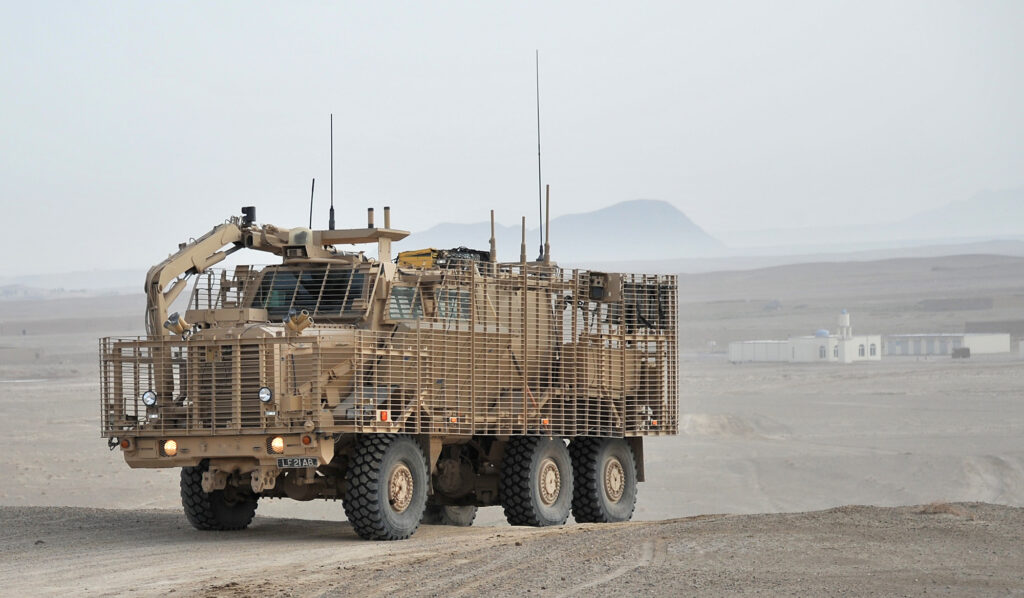
A Talisman suite of vehicles is pictured in convoy to Forward Operating Base(FOB) Khar Nikha in the northern part of Nahr-e Seraj District in Helmand Province, Afghanistan. Photo: Sgt Wes Calder RLC/MOD, OGL v1.0OGL v1.0, via Wikimedia Commons

When doctrine emphasizes sustainment as the foundation for building and maintaining combat power in multi-domain contexts, that is not abstract phrasing. It reflects operational reality. If you cannot sustain tempo, you cannot sustain options. And if you cannot sustain options, you do not truly control escalation.

Stockpiles Versus Throughput

Many discussions focus on stockpiles, and stockpiles do matter. Yet stockpiles alone do not win a prolonged contest. Throughput wins.

Throughput refers to the system’s ability to continuously replenish consumption in real conditions. That includes production capacity and surge ability, transportation networks that can absorb disruption, maintenance cycles that return damaged equipment to service quickly, protection of key nodes such as ports and depots, and accurate forecasting under uncertainty.

Conflicts that stretch beyond initial planning assumptions punish any system that confuses initial readiness with sustained readiness. High-intensity fighting compresses timelines and accelerates wear, and the consumption curve often rises faster than pre-conflict models predicted.
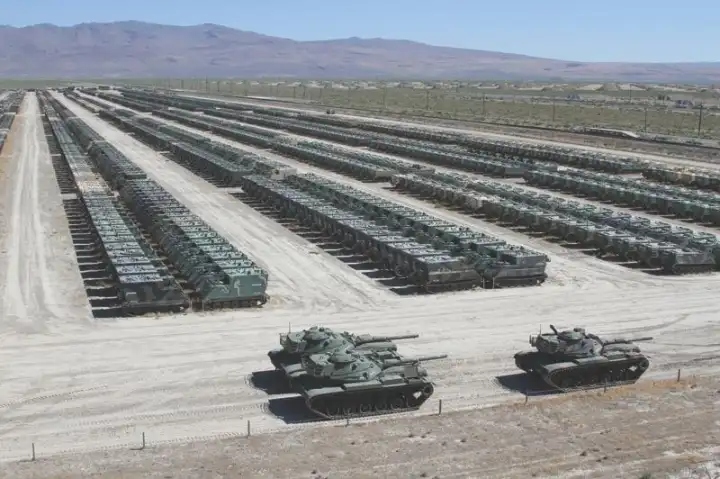
The Long-Term Storage section of Sierra Army Depot. Hundreds of M113 variants seem to stretch to the horizon. In the foreground are M60 main battle tanks. U.S. Army photo

If you want a practical test of whether a force can endure, ask whether it can maintain its rate of fire and maneuver without degrading its ability to rotate units, repair systems, and protect its supply routes. That answer reveals far more than ceremonial displays of hardware.

Ammunition as a Strategic Indicator

Nothing reveals the logistics layer faster than ammunition.

Ammunition is heavy, storage-sensitive, and transportation-intensive. It depends on specialized industrial inputs, regulated facilities, and reliable supply chains. It also disappears quickly in high-tempo combat. That combination makes it an unforgiving indicator of structural strength.

Public reporting from established Western research bodies has repeatedly emphasized that the challenge in prolonged support operations is not merely access to inventory, but the ability to scale production, manage contracting, coordinate delivery timelines, and integrate outputs into operational demand cycles. Access to global markets is not the same as converting contracts into delivered rounds at scale.
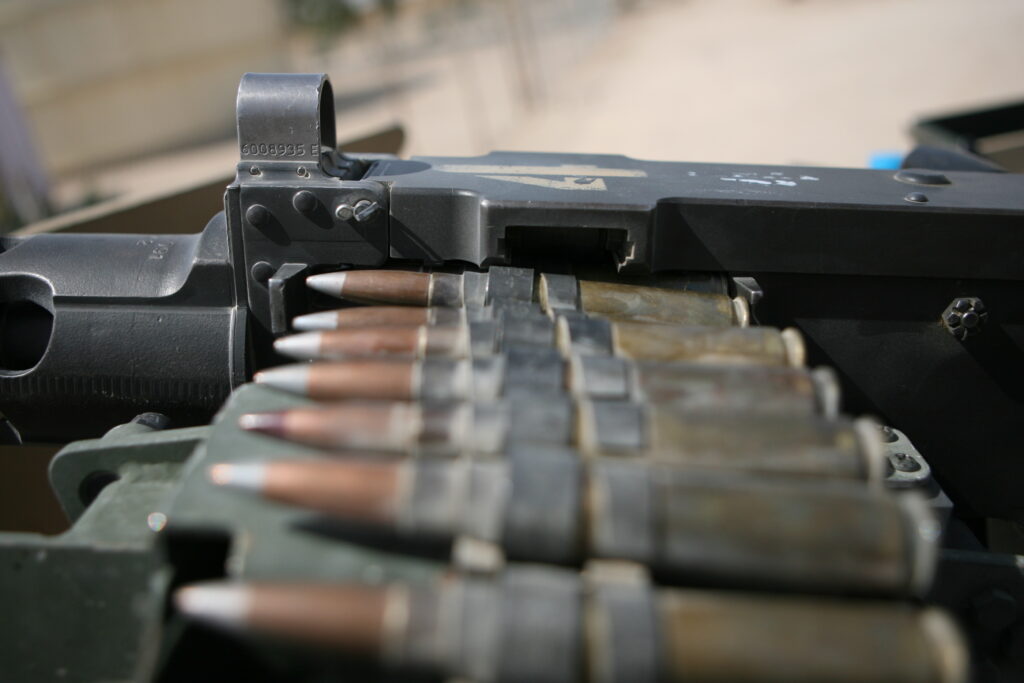
Fifty-caliber machinegun rounds are set to be fired in case of an insurgent attack June 2, 2006 during a re-supply convoy. Crucial to the success of Combat Logistics Battalion 5’s convoys, Security Company is responsible for making sure the battalion’s supplies get to their destination safely. The unit also provides security for explosive ordnance disposal teams and vehicle recovery missions.

The Defense Industrial Base as Operational Terrain

The industrial base used to feel like a separate domain: industry produces, the military consumes. That separation no longer holds in sustained, high-consumption environments.

Government and parliamentary research organizations have underscored the structural characteristics of defense production, including government-owned facilities operated by contractors, specialized supply chains, and the constraints involved in expanding output rapidly. Scaling production is not simply a financial question. It involves skilled labor pipelines, supplier dependencies, tooling lead times, quality assurance standards, and regulatory compliance.
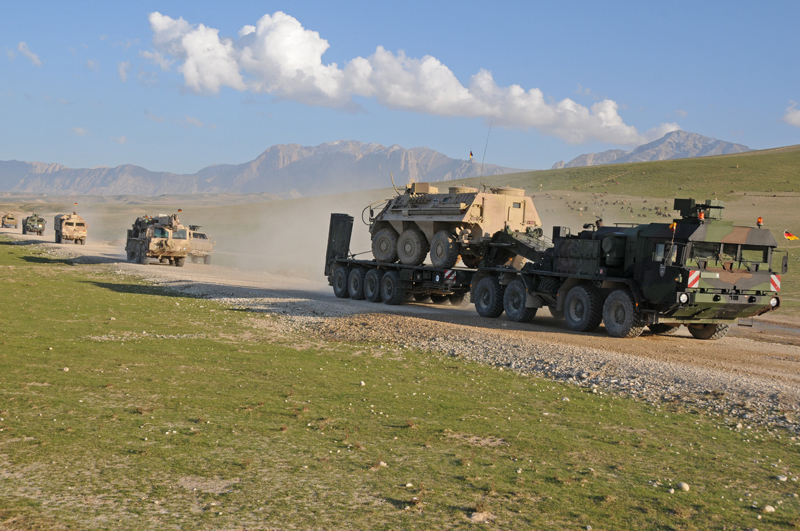
International Security Assistance Force soldiers with the German Logistics Support Battalion 172 conduct a recovery task force training exercise outside Camp Marmal

Time, in this context, becomes a strategic variable. Industrial expansion cannot be improvised overnight. In prolonged competition, the side that shortens the cycle between requirement identification and delivered capability gains operational freedom.

Energy and Sustainment

It is tempting to separate energy security from military logistics. In practice, energy is one of logistics’ core currencies.

Fuel determines mobility, endurance, and reach. It shapes sortie generation rates, operational tempo, and the ability to maintain communications, repair facilities, and forward positions. When supply routes tighten or markets fluctuate sharply, energy resilience directly influences military continuity.

International energy institutions have long emphasized strategic reserves and coordinated response mechanisms as stabilizers in times of disruption. From a defense perspective, these systems are not abstract economic tools. They provide continuity buffers that allow operational planning to proceed without immediate collapse under external shock.

For readers evaluating national preparedness, the way a country manages strategic reserves, refinery resilience, and transportation corridors offers a meaningful indicator of military depth.
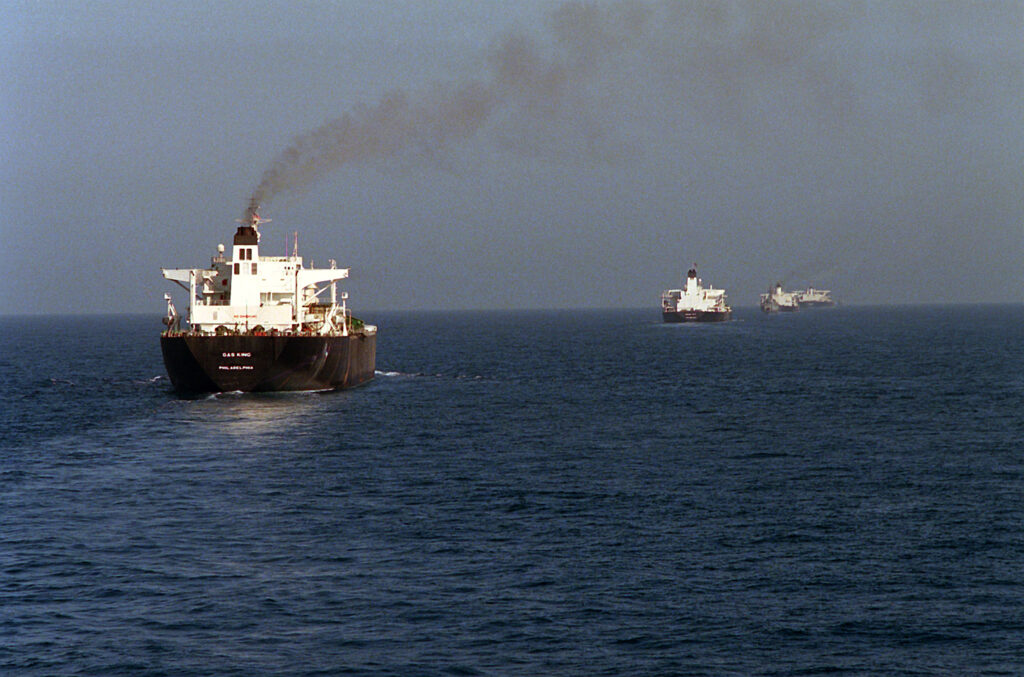
Reflagged Kuwaiti tankers move through Persian Gulf waters escorted by U.S. Navy ships. The convoy includes, from front to back: the GAS KING, OCEAN CITY, SEA ISLE CITY, and BRIDGETON. U.S. Navy ships are serving as protection against possible attack from hostile forces until the tankers reach open waters.

Multinational Operations and the Logistics Challenge

In coalition environments, logistics becomes both a multiplier and a source of friction.

Interoperability is often discussed in terms of communications systems and tactical compatibility. Yet sustainment interoperability is equally decisive. Shared standards, compatible supply classifications, host-nation support structures, reception capacity at ports and airfields, and coordinated operational-level logistics planning determine whether multinational forces can function cohesively.

Alliance doctrine has increasingly stressed structures designed to synchronize logistics across multiple national systems. The objective is unity of effort across supply networks that were never designed to be identical.

Alliances frequently align politically faster than they align logistically. When sustainment coordination lags, operational plans lose credibility. Effective coalition warfare requires that logistics planning be integrated at the same level of seriousness as operational design.

Logistics Under Denial Conditions

Historically, logistics was threatened. Today, it is systematically targeted.

Ports, rail infrastructure, depots, fuel storage sites, repair facilities, and even the digital systems that manage inventory are potential objectives. In denial environments, efficiency yields to resilience. Redundancy, dispersal, protection of nodes, deception, and faster repair cycles become central principles.

Research communities focused on defense resilience have highlighted supply chain robustness as a layered capability. It requires diversified sourcing, adaptable routing, secure digital management systems, and rapid damage recovery capacity. The modern logistics network is not merely a line; it is an ecosystem that must function under persistent pressure.

Evaluating Capability Through the Logistics Lens

For policymakers, analysts, and industry leaders, logistics offers a practical framework for evaluation.

When assessing a new platform or doctrinal shift, it is worth examining the sustainment concept behind it, the industrial and maintenance realities supporting it, the chokepoints embedded in its supply chain, its energy dependency profile, and its assumptions regarding coalition and host-nation support.

A platform can be impressive. A force that can sustain, rotate, repair, and supply at scale is formidable.

The logistics layer is where intent meets physical constraint. It is where strategy is translated into measurable endurance. For serious observers of defense and security, this layer deserves the same scrutiny as the systems it enables.

Sources

  • North Atlantic Treaty Organization (NATO). Logistics Handbook. 2012.
  • NATO Standardization Office. Allied Joint Doctrine for Logistics (AJP-4). 2018.
  • North Atlantic Treaty Organization (NATO). Russian War Against Ukraine: Lessons Learned – Curriculum Guide. 2023.
  • UK Ministry of Defence. Joint Doctrine Publication 4-00: Logistics for Joint Operations. 4th ed., 2015.
  • U.S. Joint Chiefs of Staff. JP 4-0: Joint Logistics. Doctrine Series.
  • U.S. Army Combined Arms Support Command (CASCOM). FM 4-0: Sustainment Operations. 2024 doctrinal update materials.

Previous Post

Stealth Technology’s Mathematics: How Low Observability Is Actually Engineered

Next Post

When Prevention Fails – What Remains Is You

Related Posts

T-80U_ROKA_제3기갑여단
Geopolitics

Brown Bear Project : How Republic of Korea added Russian weapons into its inventory?

April 14, 2026
DESERT STORM
Geopolitics

Iraq: A Preview of the Region’s Future

April 6, 2026
The Architecture of Global Power: Chokepoints, Energy Corridors, and Global Trade
Geopolitics

The Architecture of Global Power: Chokepoints, Energy Corridors, and Global Trade

March 12, 2026
Strategic Deception and Covert Warfare: The Logic Behind the Hezbollah Pager Operation
Geopolitics

Strategic Deception and Covert Warfare: The Logic Behind the Hezbollah Pager Operation

March 10, 2026
The Warfare Doctrine of Eliminations inthe Opening Strikes of Military Conflicts
Geopolitics

The Warfare Doctrine of Eliminations inthe Opening Strikes of Military Conflicts

March 3, 2026
Mexican cartels and the shifting landscape of Mexico’s energy supply chain
Geopolitics

Mexican cartels and the shifting landscape of Mexico’s energy supply chain

February 24, 2026
Next Post
When Prevention Fails – What Remains Is You

When Prevention Fails – What Remains Is You

  • Trending
  • Latest
Operation Enduring Freedom

What Exactly Is a Private Military Company (PMC)?

September 6, 2025
Blackwater PMC

After Blackwater: How PMCs Evolved, Professionalized, and Fragmented

September 13, 2025
MG42-1

MG42 Machine Gun: WWII History, Specifications and Battlefield Impact

April 21, 2026
Blackwater PMC

Inside Iraq’s Security Market: How Private Power Shapes a Fragile State

October 6, 2025
1280px-5-4_ADAR_Supports_Formidable_Shield_25_

SGT Stout: M-SHORAD and Mobile Air Defense

May 16, 2026
HEL_MD_Beam_Director

Laser Weapons: The New Layer in Modern Air Defense

May 14, 2026
EU Dual Use

EU Dual-Use Regulation: How Civilian Technology Becomes a Matter of Export Control

May 13, 2026
Barrett M82 DESERT SHIELD

Barrett M82A1: The Heavy Rifle That Redefined Anti-Materiel Firepower

May 12, 2026

Recent Articles

1280px-5-4_ADAR_Supports_Formidable_Shield_25_

SGT Stout: M-SHORAD and Mobile Air Defense

May 16, 2026
HEL_MD_Beam_Director

Laser Weapons: The New Layer in Modern Air Defense

May 14, 2026
EU Dual Use

EU Dual-Use Regulation: How Civilian Technology Becomes a Matter of Export Control

May 13, 2026
Barrett M82 DESERT SHIELD

Barrett M82A1: The Heavy Rifle That Redefined Anti-Materiel Firepower

May 12, 2026
Drill & Defense

Drill & Defense is an independent defense and security platform covering firearms, military technology, geopolitics, energy security, and industry developments. We provide clear, structured, and practical insight for professionals, companies, and readers following the evolving defense landscape worldwide.

Follow Us

Browse by Category

  • Air Systems
  • Defense & Energy Strategy
  • Defense Industry
  • Defense Know-How
  • Defense Technologies
  • Doctrines & Concepts
  • Energy & Security
  • Energy Fundamentals
  • Energy Technologies
  • Firearms
  • Geopolitics
  • Global Security
  • History
  • Industry News
  • Knowledge Base
  • Land Systems
  • Legacy Systems & Structures
  • Market Analysis
  • Market Trends & Analysis
  • Military History
  • Military Systems
  • Naval Systems
  • Oil & Gas News
  • Pistols
  • Regulations & Frameworks
  • Rifles
  • SMGs & Machine Guns
  • Strategic Turning Points
  • Tech & Innovation Crossover

Recent Articles

1280px-5-4_ADAR_Supports_Formidable_Shield_25_

SGT Stout: M-SHORAD and Mobile Air Defense

May 16, 2026
HEL_MD_Beam_Director

Laser Weapons: The New Layer in Modern Air Defense

May 14, 2026

© 2026 Drill & Defense. All rights reserved. Independent insights on firearms, defense, and energy. For business inquiries: info@drillanddefense.com | PRIVACY POLICY | COOKIE POLICY | TERMS AND CONDITIONS

Manage Consent

We use cookies to improve your experience. You can accept or refuse cookies; however, some features may not function properly without your consent.

Functional Always active
The technical storage or access is strictly necessary for the legitimate purpose of enabling the use of a specific service explicitly requested by the subscriber or user, or for the sole purpose of carrying out the transmission of a communication over an electronic communications network.
Preferences
The technical storage or access is necessary for the legitimate purpose of storing preferences that are not requested by the subscriber or user.
Statistics
The technical storage or access that is used exclusively for statistical purposes. The technical storage or access that is used exclusively for anonymous statistical purposes. Without a subpoena, voluntary compliance on the part of your Internet Service Provider, or additional records from a third party, information stored or retrieved for this purpose alone cannot usually be used to identify you.
Marketing
The technical storage or access is required to create user profiles to send advertising, or to track the user on a website or across several websites for similar marketing purposes.
  • Manage options
  • Manage services
  • Manage {vendor_count} vendors
  • Read more about these purposes
View preferences
  • {title}
  • {title}
  • {title}
No Result
View All Result
  • Defense Industry
    • Industry News
    • Defense Companies
    • Defense Technologies
    • Market Analysis
  • Military Systems
    • Land Systems
    • Air Systems
    • Naval Systems
    • Electronic & Cyber Systems
  • Firearms
    • Pistols
    • Rifles
    • SMGs & Machine Guns
    • Ammunition
    • Optics & Accessories
  • Geopolitics
    • Global Security
    • Defense & Energy Strategy
    • Tech & Innovation Crossover
    • Trade & Export Controls
  • Energy & Security
    • Oil & Gas News
    • Energy Technologies
    • Market Trends & Analysis
  • History
    • Military History
    • Doctrines & Concepts
    • Strategic Turning Points
    • Legacy Systems & Structures
  • Knowledge Base
    • Firearms Basics
    • Defense Know-How
    • Energy Fundamentals
    • Regulations & Frameworks
  • About
  • Contact
  • Login
  • Register

© 2026 Drill & Defense. All rights reserved. Independent insights on firearms, defense, and energy. For business inquiries: info@drillanddefense.com | PRIVACY POLICY | COOKIE POLICY | TERMS AND CONDITIONS