
Drill & Defense
Advertisement
  • Defense Industry
    • Industry News
    • Defense Companies
    • Defense Technologies
    • Market Analysis
  • Military Systems
    • Land Systems
    • Air Systems
    • Naval Systems
    • Electronic & Cyber Systems
  • Firearms
    • Pistols
    • Rifles
    • SMGs & Machine Guns
    • Ammunition
    • Optics & Accessories
  • Geopolitics
    • Global Security
    • Defense & Energy Strategy
    • Tech & Innovation Crossover
    • Trade & Export Controls
  • Energy & Security
    • Oil & Gas News
    • Energy Technologies
    • Market Trends & Analysis
  • History
    • Military History
    • Doctrines & Concepts
    • Strategic Turning Points
    • Legacy Systems & Structures
  • Knowledge Base
    • Firearms Basics
    • Defense Know-How
    • Energy Fundamentals
    • Regulations & Frameworks
  • About
  • Contact
  • Login
  • Register
No Result
View All Result
  • Defense Industry
    • Industry News
    • Defense Companies
    • Defense Technologies
    • Market Analysis
  • Military Systems
    • Land Systems
    • Air Systems
    • Naval Systems
    • Electronic & Cyber Systems
  • Firearms
    • Pistols
    • Rifles
    • SMGs & Machine Guns
    • Ammunition
    • Optics & Accessories
  • Geopolitics
    • Global Security
    • Defense & Energy Strategy
    • Tech & Innovation Crossover
    • Trade & Export Controls
  • Energy & Security
    • Oil & Gas News
    • Energy Technologies
    • Market Trends & Analysis
  • History
    • Military History
    • Doctrines & Concepts
    • Strategic Turning Points
    • Legacy Systems & Structures
  • Knowledge Base
    • Firearms Basics
    • Defense Know-How
    • Energy Fundamentals
    • Regulations & Frameworks
  • About
  • Contact
  • Login
  • Register
No Result
View All Result
Drill & Defense
No Result
View All Result
Home Military Systems

CH-47 Chinook: Heavy-Lift Aviation With a Practical Reputation

June 11, 2026
in Military Systems, Air Systems
Boeing CH-47 Chinook

Al Asad Air Base, Irak, 28 mei 2024, Het eerste helikopter detachement is operationeel en voert vluchten uit voor NMI en OIR. Defensie Nederlands, CC BY-SA 4.0 .

Share on LinkedInShare on Twitter

Across military aviation, few helicopters are as recognizable as the CH-47 Chinook. Its long fuselage, tandem rotors, rear loading ramp, and heavy-lift posture make it immediately different from conventional helicopters. It does not rely on a sleek fighter-like image or the aggressive profile of an attack helicopter. Its identity is built around work.

For a defense-focused reader, that is exactly why the Chinook deserves attention. This aircraft represents one of the least glamorous but most important parts of military power: moving people and equipment when normal routes are limited, damaged, or too slow. A force may have advanced weapons, but it still needs fuel, ammunition, spare parts, food, engineering tools, and casualty evacuation. Without mobility, combat power becomes fragile.

CH-47 Means Cargo Helicopter

CH-47 is not just a model number. In the U.S. military aircraft designation system, “C” identifies a cargo or transport role, while “H” identifies the platform as a helicopter. “Chinook” is the name people remember, but CH-47 explains the aircraft’s purpose.

That distinction matters because military aviation names can be misleading if we only follow the nickname. Apache sounds aggressive because the AH-64 is an attack helicopter. Black Hawk is known as a utility platform because UH-60 belongs to that category. Chinook, by designation and design, belongs to the cargo helicopter family.

Rather than being a large helicopter that can also carry cargo, the CH-47 was shaped around transport from the beginning. Its cabin, ramp, powerplant, rotor system, and external-load capability all support that central mission.
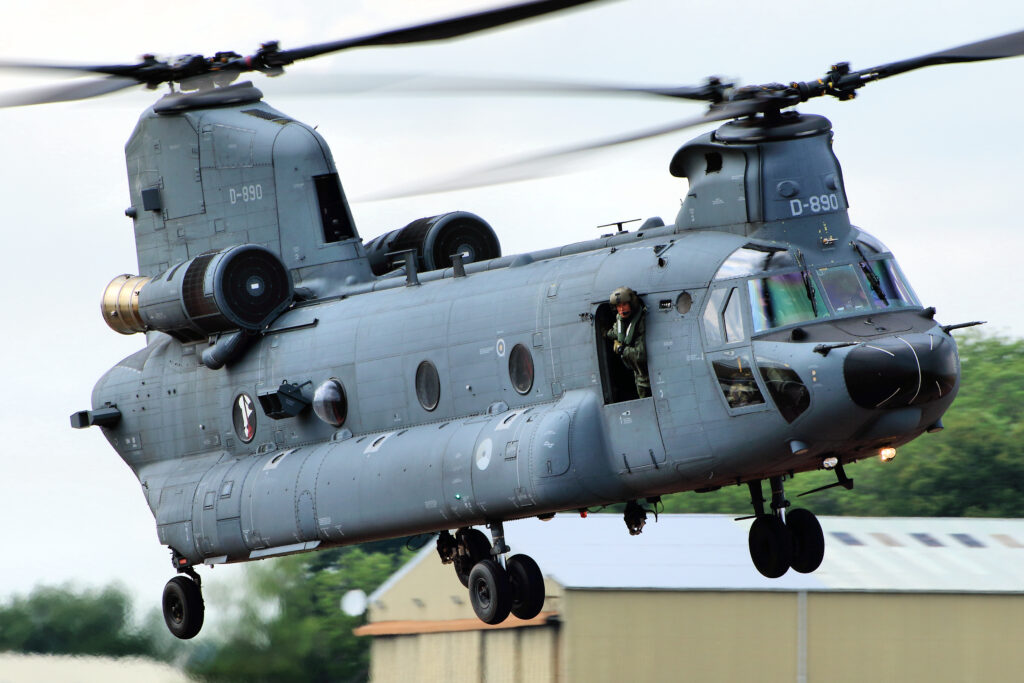
CH-47 Chinook – RIAT 2015. Airwolfhound from Hertfordshire, UK, CC BY-SA 2.0 https://creativecommons.org/licenses/by-sa/2.0.

Engineering Behind Its Shape

Most helicopters use one main rotor and a tail rotor. Chinook uses two large counter-rotating rotors, one at the front and one at the rear. This tandem-rotor arrangement helps manage torque without relying on a tail rotor, allowing more of the aircraft’s power to support lift and movement.

That layout also creates a long and usable internal cabin. The rear ramp is not a small detail here. It allows troops, pallets, vehicles, and mission equipment to be loaded and unloaded faster than through side doors alone. In military logistics, speed at the landing zone can matter as much as speed in the air.
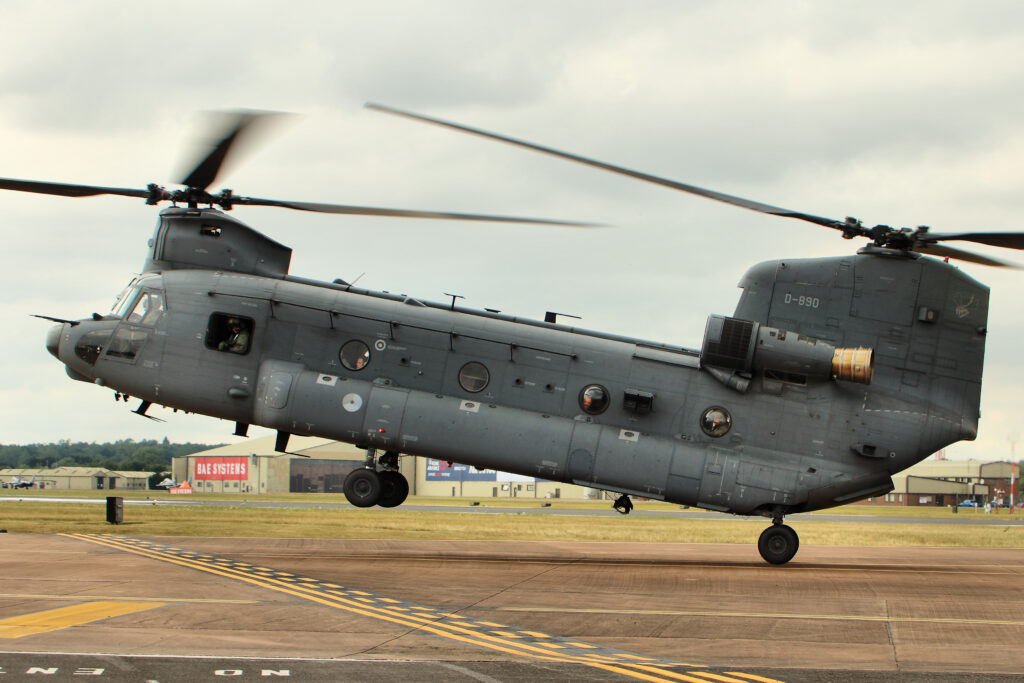
CH-47 Chinook – RIAT 2015. Tim Felce, CC BY-SA 2.0 https://creativecommons.org/licenses/by-sa/2.0.

Visually, the Chinook looks unusual. Technically, the shape is logical. Its design is not about elegance. It is about lift, balance, access, and repeatable transport work.

Power, Payload, and Performance

Modern CH-47F Block II specifications show why the aircraft remains important. Boeing lists the Block II with two Honeywell T55-GA-714A engines, each producing 4,777 shaft horsepower. The aircraft has a rotor diameter of 60 feet, a maximum speed of about 302 km/h, a mission radius of about 306 kilometers, a service ceiling of 20,000 feet, and a maximum gross weight of 54,000 pounds.

Those numbers help explain the aircraft’s role, but they should not be read like a sales brochure. Payload always depends on mission profile, fuel, altitude, temperature, terrain, and configuration. “High and hot” environments are especially demanding for helicopters because thinner air and heat reduce lift performance. That is why heavy-lift performance is not only about the maximum number on paper.

In practical terms, the Chinook can move troops, internal cargo, and underslung external loads. RAF sources describe its ability to carry up to 55 troops or around 10 tonnes of mixed cargo, while also using systems such as a triple-hook external load arrangement, internal cargo winch, and roller conveyor fit. These details show that the aircraft is not simply powerful. It is designed to handle cargo in different forms.
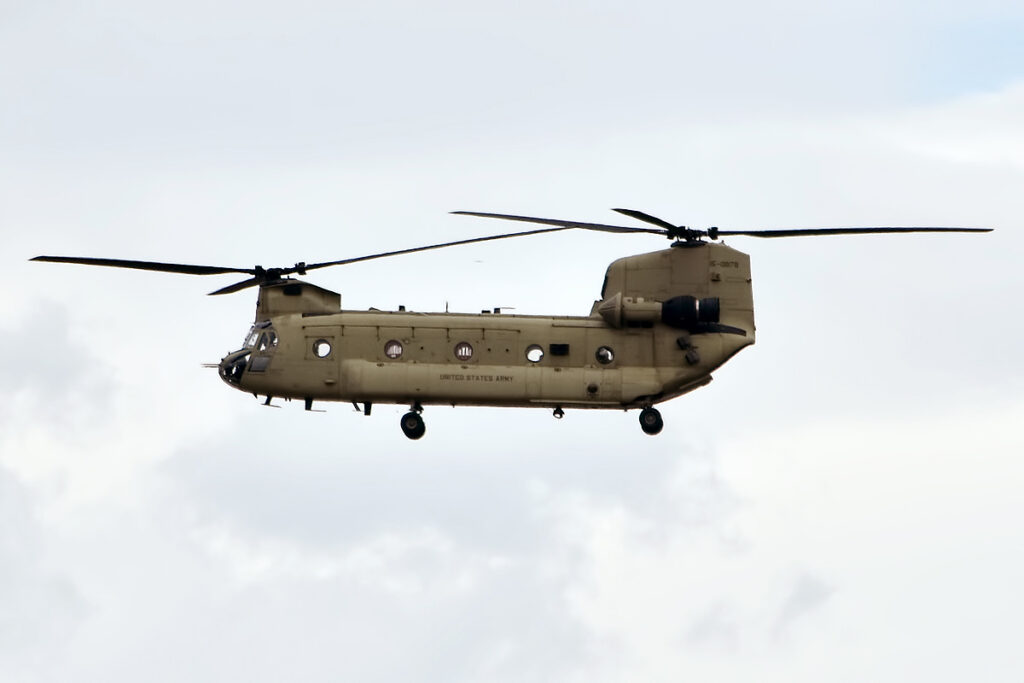
U.S. Army, 15-08176, Boeing CH-47F Chinook. Anna Zvereva, CC BY-SA 2.0 https://creativecommons.org/licenses/by-sa/2.0.

Logistics Is Combat Power

Firepower receives attention because it is visible. Logistics often decides whether that firepower can continue. A unit without ammunition, water, medical evacuation, fuel, or replacement parts loses freedom of action very quickly.

This is where the Chinook becomes more than a transport helicopter. It gives commanders options. A ground convoy may be delayed by damaged roads, terrain, ambush risk, or distance. Fixed-wing aircraft may require a runway or prepared landing area. Smaller helicopters may not have enough useful load for heavier missions. Chinook sits between these limitations and provides a flexible method of movement.

A useful way to understand the aircraft is to ask a simple question: what happens when the road is not available? In many military and disaster-response scenarios, that is exactly when a heavy-lift helicopter becomes essential.

Mission Flexibility Beyond Simple Transport

Chinook is often described as a troop and cargo aircraft, but its mission set is wider than that. It can support resupply, battlefield casualty evacuation, search and rescue, parachute drops, disaster relief, aircraft recovery, and special operations support depending on variant and configuration.
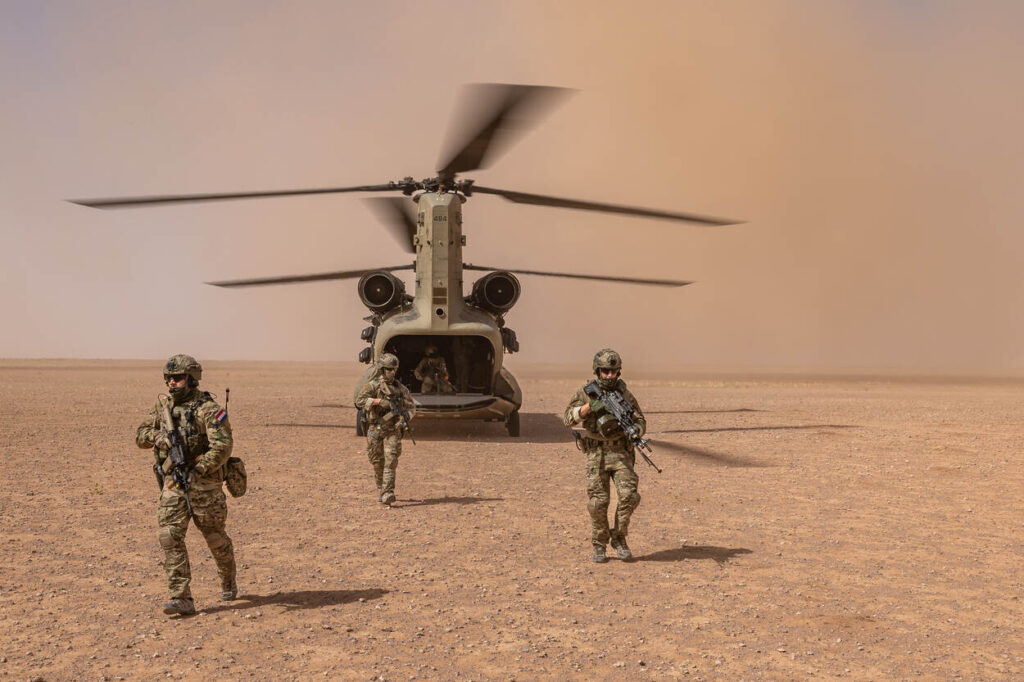
Al Asad Air Base, Irak, 30 mei 2024, Het eerste helikopter detachement is operationeel en voert vluchten uit voor NMI en OIR. Defensie Nederlands, CC BY-SA 4.0 https://creativecommons.org/licenses/by-sa/4.0.

That variety is one reason the aircraft has lasted for decades. A single-purpose platform can become vulnerable to changing doctrine. A flexible transport platform can remain useful because movement, sustainment, and evacuation never disappear from military planning.

There is also an important civilian-facing side to this reputation. During floods, earthquakes, storms, and infrastructure failures, heavy-lift helicopters can help move people and supplies when roads or bridges are unusable. This does not remove the aircraft’s military identity, but it does explain why the Chinook is associated with emergency response as well as battlefield operations.

Why Modernization Matters

Chinook first entered U.S. Army service in the 1960s, yet it continues to receive upgrades. That long service life is not simply nostalgia. It shows that the original architecture still solves a problem modern forces have not escaped.

CH-47F and Block II modernization efforts focus on areas such as payload, range, maintainability, digital systems, drivetrain improvements, fuel system changes, and structural strengthening. Boeing describes Block II as offering increased lift, improved reach at many payloads, and more efficient operations. In other words, modernization is not only about keeping an old aircraft alive. It is about adapting a proven design to current demands.

This is a useful lesson for defense procurement. New platforms are not always automatically better than modernized legacy systems. If the mission remains relevant and the base design still has room to evolve, upgrading can be a rational choice.

Vulnerability in Modern Airspace

A balanced view should not exaggerate the Chinook’s survivability. Large helicopters are vulnerable in contested airspace, especially where air defense systems, drones, surveillance networks, electronic warfare, and precision fires are active. Heavy-lift helicopters cannot be treated as if they can fly anywhere without risk.

Operational planning matters. Route selection, timing, terrain masking, intelligence, escort support, electronic protection, landing zone security, and threat awareness all affect how safely a Chinook can be used. In safer or controlled environments, its value is direct. In higher-threat areas, its value may still be significant, but only if the mission is planned carefully.
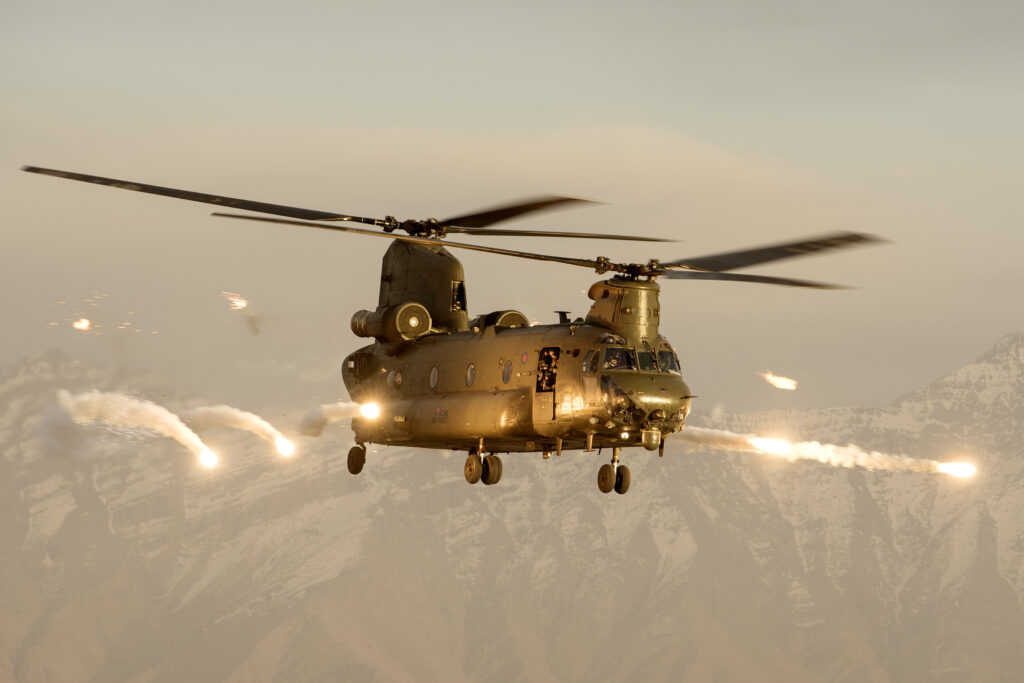
A Royal Air Force (RAF) Chinook helicopter firing flares over Afghanistan. Photo: Cpl Lee Goddard RAF/MOD, OGL 2 http://www.nationalarchives.gov.uk/doc/open-government-licence/version/2.

This does not make the platform obsolete. It makes its employment more complex. Modern warfare has made almost every aviation platform more exposed, not only heavy-lift helicopters.

Why Chinook Still Holds Its Reputation

Chinook became famous because its appearance, mission, and operational history all support the same identity. It looks like a heavy-lift helicopter, it performs as a heavy-lift helicopter, and it has spent decades proving that role across military and crisis-response environments.

Many aircraft are admired for speed, stealth, sensors, or weapons. Chinook is admired for usefulness. That usefulness may look less dramatic, but it is central to how armed forces function. Movement keeps operations alive. Supply keeps units capable. Evacuation keeps forces recoverable. Engineering and cargo lift keep difficult missions possible.

Looking at the CH-47 today, its reputation is not difficult to understand. It is distinctive, powerful, adaptable, and still relevant. More importantly, it reminds us that defense aviation is not only about striking targets. Sometimes the aircraft that matters most is the one that keeps everything else moving.

Sources:

  • Boeing, “H-47 Chinook,” official Boeing defense aircraft page.
  • U.S. Army, “CH-47 Chinook Helicopter,” official U.S. Army article.
  • U.S. Army, “CH-47s support training for Iowa Army engineer troops at Fort McCoy,” official U.S. Army article.
  • Royal Air Force, “Chinook,” official RAF aircraft information page.
  • Royal Air Force, “Chinook Role Demo Team,” official RAF page.
  • Honeywell Aerospace, “T55 Turboshaft Engine,” official Honeywell Aerospace page.

Previous Post

The War Before the War: How Geopolitical Pressure Reaches Daily Life

Next Post

M240 Machine Gun: Why This 7.62mm Platform Still Matters

Related Posts

Hughes_OH-6A_Cayuse
Military Systems

Hughes OH-6 Cayuse: A Small Helicopter Built for Dangerous Work

July 22, 2026
Rockwell_MBB_X31
Military Systems

Rockwell-MBB X-31 and the Problem of Control Beyond the Stall

July 20, 2026
United_States_Air_Force_Lockheed_U-2S_Dragon_Lady_80-1094_Royal_International_Air_Tattoo_2025_01
Military Systems

Lockheed Martin U-2: The Aircraft That Refused to Become Old

July 3, 2026
YAL-1A_Airborne_Laser_unstowed
Military Systems

YAL-1A Airborne Laser: The 747 That Tried to Kill Missiles With Light

June 26, 2026
Oshkosh M1070 HET
Military Systems

Oshkosh M1070 HET: Heavy Mobility Behind Armored Operations

June 22, 2026
Panzerschnellbrücke LEGUAN auf Leopard 2-Fahrgestell
Military Systems

Panzerschnellbrücke LEGUAN auf Leopard 2-Fahrgestell: The Bridge That Keeps Armoured Forces Moving

June 17, 2026
Next Post
M240 Machine Gun

M240 Machine Gun: Why This 7.62mm Platform Still Matters

  • Trending
  • Latest
Operation Enduring Freedom

What Exactly Is a Private Military Company (PMC)?

September 6, 2025
FN FAL: The Right Arm of the Free World

FN FAL: The Right Arm of the Free World

March 31, 2026
MG42-1

MG42 Machine Gun: WWII History, Specifications and Battlefield Impact

April 21, 2026
Beretta 92FS vs Beretta M9: Is There a Real Difference?

Beretta 92FS vs Beretta M9: Is There a Real Difference?

July 19, 2025
Hughes_OH-6A_Cayuse

Hughes OH-6 Cayuse: A Small Helicopter Built for Dangerous Work

July 22, 2026
Rockwell_MBB_X31

Rockwell-MBB X-31 and the Problem of Control Beyond the Stall

July 20, 2026
USAFE launches inaugural Combat Ammunition Production exercise

Why Modern Armies Need More Ammunition, Not Only More Advanced Weapons

July 13, 2026
Official photo of NATO Heads of State and Government - 2026 NATO Summit in Ankara.

NATO’s $50 Billion Defense Push: Production Will Decide What the Announcements Are Really Worth

July 10, 2026

Recent Articles

Hughes_OH-6A_Cayuse

Hughes OH-6 Cayuse: A Small Helicopter Built for Dangerous Work

July 22, 2026
Rockwell_MBB_X31

Rockwell-MBB X-31 and the Problem of Control Beyond the Stall

July 20, 2026
USAFE launches inaugural Combat Ammunition Production exercise

Why Modern Armies Need More Ammunition, Not Only More Advanced Weapons

July 13, 2026
Official photo of NATO Heads of State and Government - 2026 NATO Summit in Ankara.

NATO’s $50 Billion Defense Push: Production Will Decide What the Announcements Are Really Worth

July 10, 2026
Drill & Defense

Drill & Defense is an independent defense and security platform covering firearms, military technology, geopolitics, energy security, and industry developments. We provide clear, structured, and practical insight for professionals, companies, and readers following the evolving defense landscape worldwide.

Follow Us

Browse by Category

  • Air Systems
  • Defense & Energy Strategy
  • Defense Industry
  • Defense Know-How
  • Defense Technologies
  • Doctrines & Concepts
  • Energy & Security
  • Energy Fundamentals
  • Energy Technologies
  • Firearms
  • Geopolitics
  • Global Security
  • History
  • Industry News
  • Knowledge Base
  • Land Systems
  • Legacy Systems & Structures
  • Market Analysis
  • Market Trends & Analysis
  • Military History
  • Military Systems
  • Naval Systems
  • Oil & Gas News
  • Pistols
  • Regulations & Frameworks
  • Rifles
  • SMGs & Machine Guns
  • Strategic Turning Points
  • Tech & Innovation Crossover

Recent Articles

Hughes_OH-6A_Cayuse

Hughes OH-6 Cayuse: A Small Helicopter Built for Dangerous Work

July 22, 2026
Rockwell_MBB_X31

Rockwell-MBB X-31 and the Problem of Control Beyond the Stall

July 20, 2026

© 2026 Drill & Defense. All rights reserved. Independent insights on firearms, defense, and energy. For business inquiries: info@drillanddefense.com | PRIVACY POLICY | COOKIE POLICY | TERMS AND CONDITIONS

Manage Consent

We use cookies to improve your experience. You can accept or refuse cookies; however, some features may not function properly without your consent.

Functional Always active
The technical storage or access is strictly necessary for the legitimate purpose of enabling the use of a specific service explicitly requested by the subscriber or user, or for the sole purpose of carrying out the transmission of a communication over an electronic communications network.
Preferences
The technical storage or access is necessary for the legitimate purpose of storing preferences that are not requested by the subscriber or user.
Statistics
The technical storage or access that is used exclusively for statistical purposes. The technical storage or access that is used exclusively for anonymous statistical purposes. Without a subpoena, voluntary compliance on the part of your Internet Service Provider, or additional records from a third party, information stored or retrieved for this purpose alone cannot usually be used to identify you.
Marketing
The technical storage or access is required to create user profiles to send advertising, or to track the user on a website or across several websites for similar marketing purposes.
  • Manage options
  • Manage services
  • Manage {vendor_count} vendors
  • Read more about these purposes
View preferences
  • {title}
  • {title}
  • {title}
No Result
View All Result
  • Defense Industry
    • Industry News
    • Defense Companies
    • Defense Technologies
    • Market Analysis
  • Military Systems
    • Land Systems
    • Air Systems
    • Naval Systems
    • Electronic & Cyber Systems
  • Firearms
    • Pistols
    • Rifles
    • SMGs & Machine Guns
    • Ammunition
    • Optics & Accessories
  • Geopolitics
    • Global Security
    • Defense & Energy Strategy
    • Tech & Innovation Crossover
    • Trade & Export Controls
  • Energy & Security
    • Oil & Gas News
    • Energy Technologies
    • Market Trends & Analysis
  • History
    • Military History
    • Doctrines & Concepts
    • Strategic Turning Points
    • Legacy Systems & Structures
  • Knowledge Base
    • Firearms Basics
    • Defense Know-How
    • Energy Fundamentals
    • Regulations & Frameworks
  • About
  • Contact
  • Login
  • Register

© 2026 Drill & Defense. All rights reserved. Independent insights on firearms, defense, and energy. For business inquiries: info@drillanddefense.com | PRIVACY POLICY | COOKIE POLICY | TERMS AND CONDITIONS