
Drill & Defense
Advertisement
  • Defense Industry
    • Industry News
    • Defense Companies
    • Defense Technologies
    • Market Analysis
  • Military Systems
    • Land Systems
    • Air Systems
    • Naval Systems
    • Electronic & Cyber Systems
  • Firearms
    • Pistols
    • Rifles
    • SMGs & Machine Guns
    • Ammunition
    • Optics & Accessories
  • Geopolitics
    • Global Security
    • Defense & Energy Strategy
    • Tech & Innovation Crossover
    • Trade & Export Controls
  • Energy & Security
    • Oil & Gas News
    • Energy Technologies
    • Market Trends & Analysis
  • History
    • Military History
    • Doctrines & Concepts
    • Strategic Turning Points
    • Legacy Systems & Structures
  • Knowledge Base
    • Firearms Basics
    • Defense Know-How
    • Energy Fundamentals
    • Regulations & Frameworks
  • About
  • Contact
  • Login
  • Register
No Result
View All Result
  • Defense Industry
    • Industry News
    • Defense Companies
    • Defense Technologies
    • Market Analysis
  • Military Systems
    • Land Systems
    • Air Systems
    • Naval Systems
    • Electronic & Cyber Systems
  • Firearms
    • Pistols
    • Rifles
    • SMGs & Machine Guns
    • Ammunition
    • Optics & Accessories
  • Geopolitics
    • Global Security
    • Defense & Energy Strategy
    • Tech & Innovation Crossover
    • Trade & Export Controls
  • Energy & Security
    • Oil & Gas News
    • Energy Technologies
    • Market Trends & Analysis
  • History
    • Military History
    • Doctrines & Concepts
    • Strategic Turning Points
    • Legacy Systems & Structures
  • Knowledge Base
    • Firearms Basics
    • Defense Know-How
    • Energy Fundamentals
    • Regulations & Frameworks
  • About
  • Contact
  • Login
  • Register
No Result
View All Result
Drill & Defense
No Result
View All Result
Home Military Systems

YAL-1A Airborne Laser: The 747 That Tried to Kill Missiles With Light

June 26, 2026
in Military Systems, Air Systems
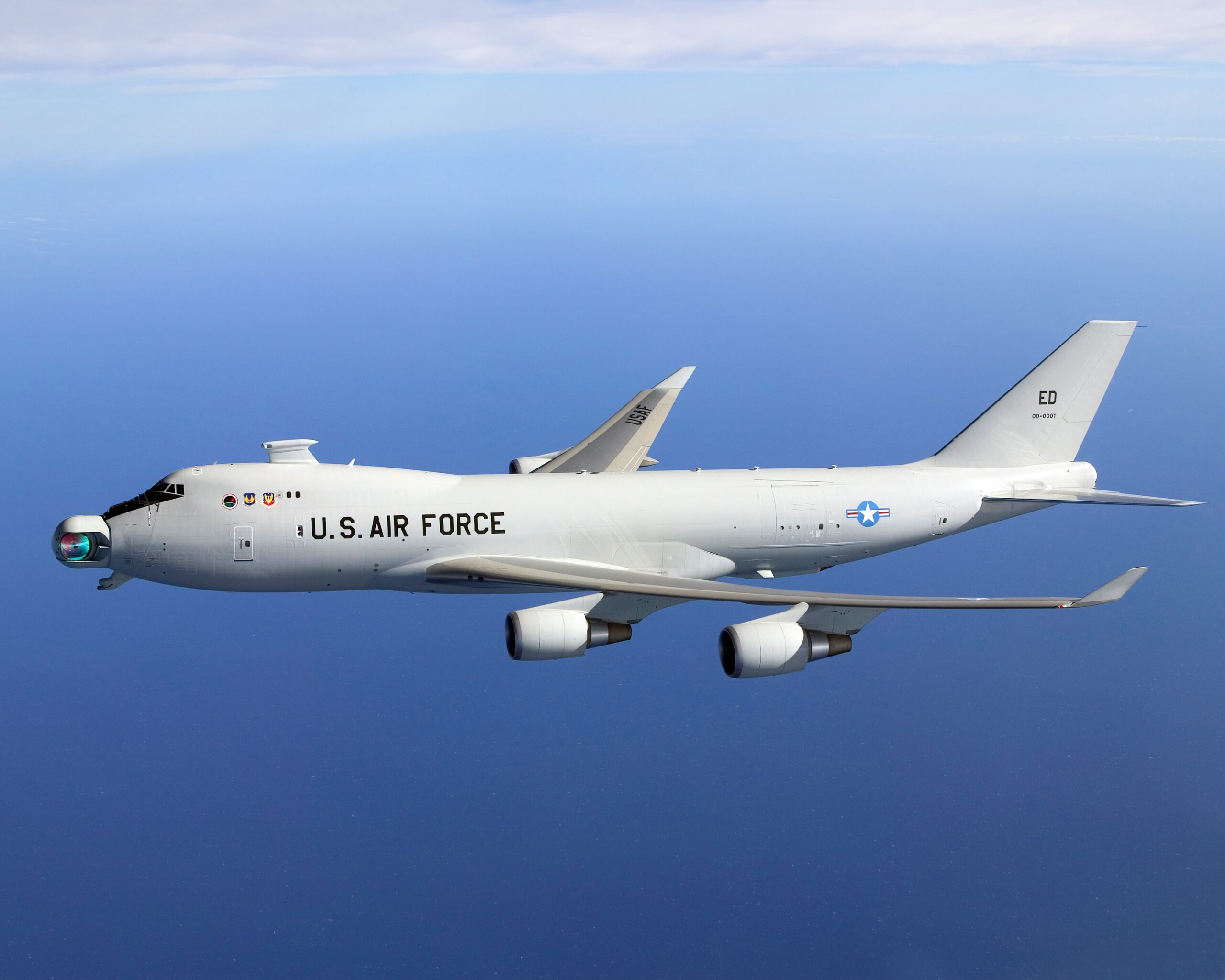
YAL-1A_Airborne_Laser_unstowed

Yal-1A Airborne Laser Aircraft conducts initial ball rotation tests at Western Test Range

Share on LinkedInShare on Twitter

Among Cold War and post-Cold War missile defense ideas, few looked as ambitious as putting a high-energy laser inside a modified Boeing 747. The YAL-1A Airborne Laser was not designed as a symbolic technology demonstrator only. It was built around a serious operational question: could a ballistic missile be destroyed while it was still climbing, before it released warheads, decoys, or countermeasures?

At first glance, it looks almost absurd. A modified Boeing 747-400F carrying a megawatt-class chemical laser, designed to destroy ballistic missiles shortly after launch. Yet the concept was not fantasy. It flew, tracked targets, fired lasers, and in February 2010 destroyed boosting ballistic missile targets during flight testing. For directed-energy weapons, that was a historic moment.

Still, history does not automatically equal practicality. YAL-1A proved that a large airborne laser could work under test conditions. It also proved that making such a system operational is a much harder problem than simply putting a powerful beam into the sky.

Why Boost Phase Was So Attractive

Ballistic missiles are hardest to defeat once they are high, fast, and possibly accompanied by decoys or separated warheads. Boost phase offers a different logic. During this early part of flight, the missile is still under rocket power. It is hot, structurally stressed, and easier to detect with infrared sensors.

YAL-1A was built around this window. The aircraft would detect a missile launch, track the climbing missile, compensate for atmospheric distortion, and then focus a high-energy laser on the missile body long enough to weaken the structure. The goal was not to “zap” the missile in a science-fiction sense. More realistically, the laser heated the outer skin until the missile’s pressurized casing failed.

Original description from the American Air Force Research Laboratory: “An optical engineer evaluates the interaction of multiple lasers that will be used aboard the Airborne Laser, a megawatt-class laser weapons system being developed to defend against ballistic missile attacks. The Directed Energy Directorate conducts research into beam-control technologies.”

That is an important technical point. The kill mechanism was thermal and structural, not explosive magic. If enough energy was held on the right part of the missile for long enough, heating could cause failure. If the beam wandered, atmospheric conditions degraded it, or the missile burned out too quickly, the engagement problem became far more difficult.

The Aircraft and the Laser System

YAL-1A used a Boeing 747-400F airframe because the system needed enormous internal volume. This was not a compact podded laser. The aircraft carried the laser modules, beam-control equipment, tracking systems, battle management equipment, chemical storage, exhaust handling, cooling support, and the large nose-mounted turret.

Its main weapon was a Chemical Oxygen Iodine Laser, usually called COIL. This type of laser produces energy through a chemical reaction rather than drawing all its power from an electrical generator. That allowed very high power levels for the period, reaching the megawatt class. In simple terms, COIL gave YAL-1A the energy needed for long-range missile heating, but it also brought a heavy logistics burden.

A chemical laser is not only a laser. It is also a chemical plant in the air. Reactants must be stored, handled, consumed, and supported on the ground. Hot and corrosive exhaust must be managed safely. GAO reporting noted that the laser exhaust system had to prevent damage to the aircraft structure, with exhaust temperatures reaching around 500 degrees Fahrenheit. This is the kind of detail that makes YAL-1A more impressive, but also more difficult to imagine as a routine operational asset.
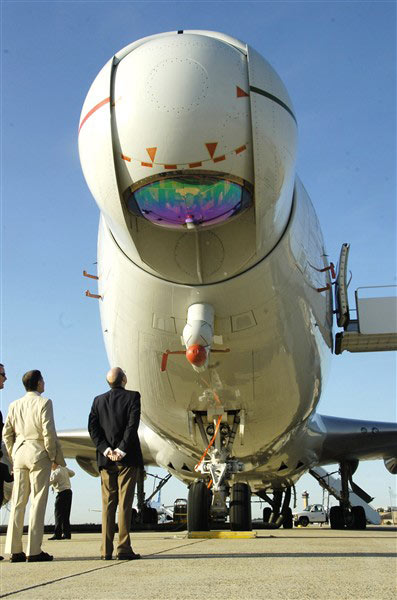
YAL-1 Airborne Laser.

Tracking Was Just as Important as Power

Raw laser power was only one part of the problem. A missile defense laser has to place energy precisely on a moving target at long distance. For YAL-1A, this meant detection, tracking, beam shaping, atmospheric compensation, pointing, stabilization, and fire control all had to work together.

The system used infrared sensors to detect missile launch. Low-energy solid-state lasers then helped track the target and measure atmospheric conditions. These lower-power beams were not the kill mechanism. Their job was to help the aircraft understand the path between the laser and the target. Only after that did the megawatt-class COIL fire through the nose turret.
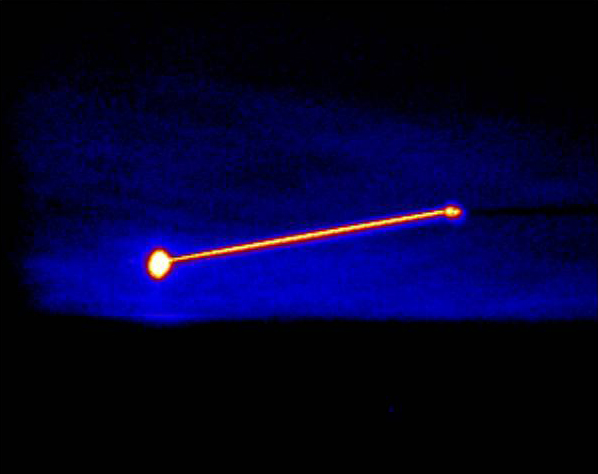
An infrared image of the Missile Defense Agency’s Airborne Laser Testbed (right) destroying a threat representative short-range ballistic missile (left).

Optical turbulence was one of the central technical challenges. Air is not a clean window. Temperature changes, density differences, humidity, dust, weather, and turbulence can distort a beam. The farther the target, the more the atmosphere matters. A laser weapon may travel at the speed of light, but its beam still has to survive the medium between shooter and target.

This is where YAL-1A becomes more than a “747 with a laser.” It was a flying adaptive optics and beam-control experiment. The turret, mirrors, software, sensors, and aircraft structure all had to work together while the aircraft was vibrating and moving.
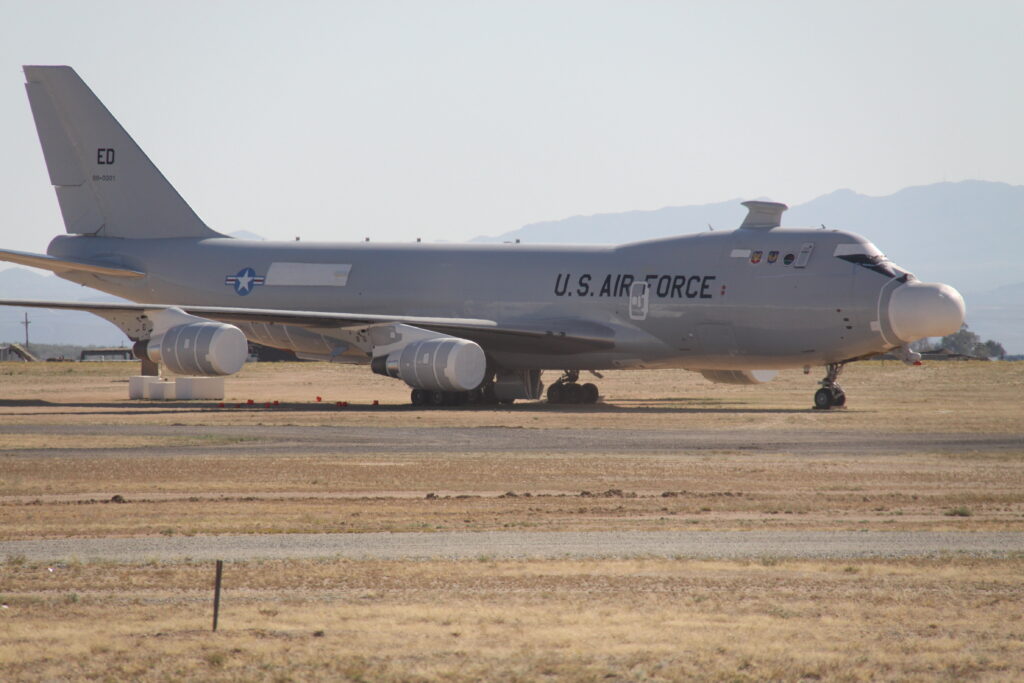
aeroprints.com, CC BY-SA 3.0 https://creativecommons.org/licenses/by-sa/3.0.

The Engagement Timeline Was Brutally Short

Boost phase does not last long. GAO described the engagement opportunity as roughly 30 to 140 seconds, depending on missile type. Within that period, the system had to detect launch, classify and track the target, calculate the engagement, correct for the atmosphere, point the beam, and hold energy on the missile until failure.

This is why the concept was attractive but unforgiving. A successful boost-phase kill could prevent a missile from reaching midcourse, before warheads and countermeasures complicated the defense. But the defender had to be close enough, fast enough, and precise enough. There was very little room for delay.

Readers often focus on the laser itself, but the real question is wider. How many aircraft would be needed to maintain coverage near likely launch areas? Could a large 747 survive in or near contested airspace? How would it be protected? Where would it be based? How often could it refuel, reload chemicals, and fly again?
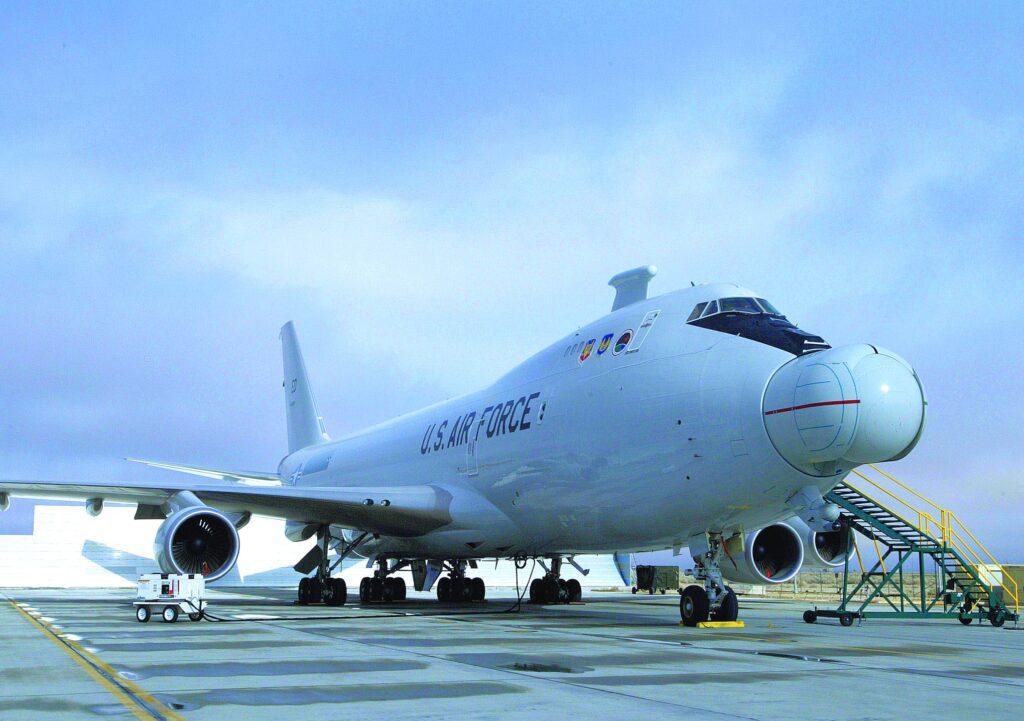
The Airborne Laser program, formerly of the 452nd Flight Test Squadron, now falls under the 417th Flight Test Squadron, which was activated in a ceremony March 16, 2006. The 417th FLTS, comprised of about 750 people, including the contractor workforce and the government workforce, is responsible for flight testing the YAL-1A Airborne Laser aircraft, shown above. The aircraft is currently in Wichita, Kan., receiving modifications to the sub-structure of the aircraft to accommodate the integration of the weapons system. (Photo by Master Sgt. James Graham).

Those questions are not secondary. They decide whether a technology becomes a weapon system.

The February 2010 Test

On February 11, 2010, the Airborne Laser Testbed destroyed a boosting ballistic missile target during a test over the Western Sea Range. Boeing described the event as the first time a laser weapon had engaged and destroyed an in-flight ballistic missile, and the first time any system had achieved such an intercept during boost phase.

Shortly after launch, the aircraft detected the missile, tracked it, used lower-energy lasers for atmospheric measurement and targeting, and then fired the high-energy laser. The missile failed after its surface was heated by the beam.

No one should dismiss that result. It was a major directed-energy milestone. At the same time, one successful test did not erase the operational limitations. Test conditions can be controlled. Combat conditions cannot.
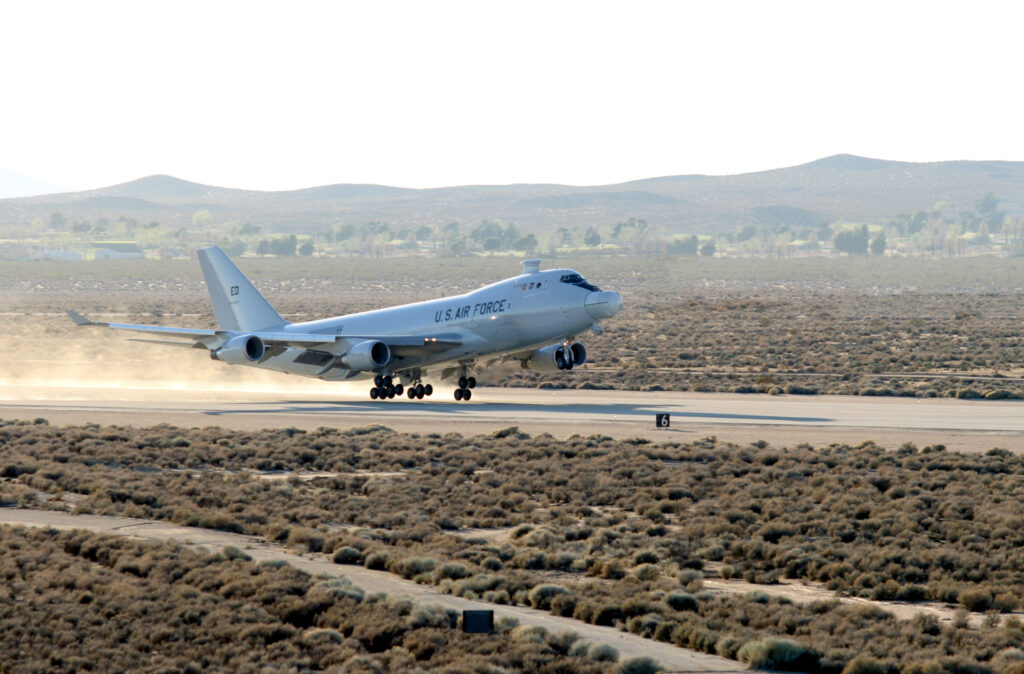
The YAL-1A Airborne Laser, a modified Boeing 747-400F, takes off from Edwards Air Force Base, California, on March 15 for a five-hour test mission. During the flight, the aircraft’s target illuminator laser fired for the first time. The Airborne Laser is undergoing a long-term test phase at the Air Force Flight Test Center here in preparation for the integration later in the year of the chemical oxygen iodine laser, or COIL, a missile-killing, high-energy chemical laser.

Why the Program Did Not Become Operational

YAL-1A was eventually canceled, and that decision was not simply about whether the laser could work. It was about whether the full concept made sense as a deployable missile defense architecture.

Several problems stood out. The aircraft was large and non-stealthy. Boost-phase engagement required proximity to launch areas. Chemical laser logistics were complex. Atmospheric effects limited range and beam quality. Maintenance and support demands were high. Cost also became difficult to justify when compared with other missile defense approaches.

A useful way to look at YAL-1A is this. The technology won an important demonstration, but the operating model lost the argument.

Modern directed-energy programs usually look more modest, but also more practical. Many are focused on drones, rockets, mortars, small boats, or short-range air defense rather than long-range ballistic missile boost-phase kills. Electric solid-state lasers are easier to integrate than chemical lasers, even if they face their own power and cooling problems.

What YAL-1A Still Teaches

YAL-1A should not be treated as a joke or as a simple failure. It was a serious attempt to solve one of missile defense’s hardest problems with a radically different method. Its value was not only in the 2010 intercept, but in the engineering lessons gained from trying to put a megawatt-class directed-energy system into an aircraft.

For defense analysis, the program is a reminder that revolutionary weapons often fail at the system level before they fail at the physics level. A beam can be powerful. A turret can be precise. A test can succeed. Yet the final question remains larger.

Can the system be deployed where it is needed, protected while it operates, supported at scale, and paid for over time?

In YAL-1A’s case, the answer was no. But the aircraft still marked an important point in the evolution of directed-energy weapons. It showed that airborne laser missile defense was possible in a limited sense, while also showing why possibility is not the same as practicality.

The 747 laser did not become the future of missile defense. It became something more useful for today’s discussion. A warning, a milestone, and a technical reference point in the long road toward usable directed-energy weapons.

Sources:

  • U.S. Air Force Test Center
    February 3, 2010 Testing of YAL-1 Airborne Laser Test Bed
  • Boeing
    Boeing Airborne Laser Testbed Team Destroys Boosting Ballistic Missile
  • U.S. Government Accountability Office
    Theater Missile Defense. Significant Technical Challenges Face the Airborne Laser Program
  • U.S. Government Accountability Office
    Science and Tech Spotlight. Directed Energy Weapons

Previous Post

REFORGER and the Technical Problem Behind Military Mobility

Related Posts

Oshkosh M1070 HET
Military Systems

Oshkosh M1070 HET: Heavy Mobility Behind Armored Operations

June 22, 2026
Panzerschnellbrücke LEGUAN auf Leopard 2-Fahrgestell
Military Systems

Panzerschnellbrücke LEGUAN auf Leopard 2-Fahrgestell: The Bridge That Keeps Armoured Forces Moving

June 17, 2026
Boeing CH-47 Chinook
Military Systems

CH-47 Chinook: Heavy-Lift Aviation With a Practical Reputation

June 11, 2026
USS Dwight D. Eisenhower (CVN-69): The Enduring Weight of a Nuclear Aircraft Carrier
Military Systems

USS Dwight D. Eisenhower (CVN-69): The Enduring Weight of a Nuclear Aircraft Carrier

June 8, 2026
Demining_Vehicles_in_Ukraine
Military Systems

Demining Vehicles in Ukraine: Heavy Machines for a War That Stays Underground

June 1, 2026
Sikorsky CH-53E Super Stallion
Military Systems

CH-53E Super Stallion: The Heavy-Lift Aircraft That Keeps Marines Moving

May 30, 2026
  • Trending
  • Latest
Operation Enduring Freedom

What Exactly Is a Private Military Company (PMC)?

September 6, 2025
MG42-1

MG42 Machine Gun: WWII History, Specifications and Battlefield Impact

April 21, 2026
FN FAL: The Right Arm of the Free World

FN FAL: The Right Arm of the Free World

March 31, 2026
Blackwater PMC

After Blackwater: How PMCs Evolved, Professionalized, and Fragmented

September 13, 2025
YAL-1A_Airborne_Laser_unstowed

YAL-1A Airborne Laser: The 747 That Tried to Kill Missiles With Light

June 26, 2026
REFORGER '91

REFORGER and the Technical Problem Behind Military Mobility

June 24, 2026
Oshkosh M1070 HET

Oshkosh M1070 HET: Heavy Mobility Behind Armored Operations

June 22, 2026
U.S. Army Soldiers Conduct Operations in the Middle East - Patriot-Missile-Systems

Patriot Systems: The Geopolitics of Air Defense in an Era of Missile Threats

June 19, 2026

Recent Articles

YAL-1A_Airborne_Laser_unstowed

YAL-1A Airborne Laser: The 747 That Tried to Kill Missiles With Light

June 26, 2026
REFORGER '91

REFORGER and the Technical Problem Behind Military Mobility

June 24, 2026
Oshkosh M1070 HET

Oshkosh M1070 HET: Heavy Mobility Behind Armored Operations

June 22, 2026
U.S. Army Soldiers Conduct Operations in the Middle East - Patriot-Missile-Systems

Patriot Systems: The Geopolitics of Air Defense in an Era of Missile Threats

June 19, 2026
Drill & Defense

Drill & Defense is an independent defense and security platform covering firearms, military technology, geopolitics, energy security, and industry developments. We provide clear, structured, and practical insight for professionals, companies, and readers following the evolving defense landscape worldwide.

Follow Us

Browse by Category

  • Air Systems
  • Defense & Energy Strategy
  • Defense Industry
  • Defense Know-How
  • Defense Technologies
  • Doctrines & Concepts
  • Energy & Security
  • Energy Fundamentals
  • Energy Technologies
  • Firearms
  • Geopolitics
  • Global Security
  • History
  • Industry News
  • Knowledge Base
  • Land Systems
  • Legacy Systems & Structures
  • Market Analysis
  • Market Trends & Analysis
  • Military History
  • Military Systems
  • Naval Systems
  • Oil & Gas News
  • Pistols
  • Regulations & Frameworks
  • Rifles
  • SMGs & Machine Guns
  • Strategic Turning Points
  • Tech & Innovation Crossover

Recent Articles

YAL-1A_Airborne_Laser_unstowed

YAL-1A Airborne Laser: The 747 That Tried to Kill Missiles With Light

June 26, 2026
REFORGER '91

REFORGER and the Technical Problem Behind Military Mobility

June 24, 2026

© 2026 Drill & Defense. All rights reserved. Independent insights on firearms, defense, and energy. For business inquiries: info@drillanddefense.com | PRIVACY POLICY | COOKIE POLICY | TERMS AND CONDITIONS

Manage Consent

We use cookies to improve your experience. You can accept or refuse cookies; however, some features may not function properly without your consent.

Functional Always active
The technical storage or access is strictly necessary for the legitimate purpose of enabling the use of a specific service explicitly requested by the subscriber or user, or for the sole purpose of carrying out the transmission of a communication over an electronic communications network.
Preferences
The technical storage or access is necessary for the legitimate purpose of storing preferences that are not requested by the subscriber or user.
Statistics
The technical storage or access that is used exclusively for statistical purposes. The technical storage or access that is used exclusively for anonymous statistical purposes. Without a subpoena, voluntary compliance on the part of your Internet Service Provider, or additional records from a third party, information stored or retrieved for this purpose alone cannot usually be used to identify you.
Marketing
The technical storage or access is required to create user profiles to send advertising, or to track the user on a website or across several websites for similar marketing purposes.
  • Manage options
  • Manage services
  • Manage {vendor_count} vendors
  • Read more about these purposes
View preferences
  • {title}
  • {title}
  • {title}
No Result
View All Result
  • Defense Industry
    • Industry News
    • Defense Companies
    • Defense Technologies
    • Market Analysis
  • Military Systems
    • Land Systems
    • Air Systems
    • Naval Systems
    • Electronic & Cyber Systems
  • Firearms
    • Pistols
    • Rifles
    • SMGs & Machine Guns
    • Ammunition
    • Optics & Accessories
  • Geopolitics
    • Global Security
    • Defense & Energy Strategy
    • Tech & Innovation Crossover
    • Trade & Export Controls
  • Energy & Security
    • Oil & Gas News
    • Energy Technologies
    • Market Trends & Analysis
  • History
    • Military History
    • Doctrines & Concepts
    • Strategic Turning Points
    • Legacy Systems & Structures
  • Knowledge Base
    • Firearms Basics
    • Defense Know-How
    • Energy Fundamentals
    • Regulations & Frameworks
  • About
  • Contact
  • Login
  • Register

© 2026 Drill & Defense. All rights reserved. Independent insights on firearms, defense, and energy. For business inquiries: info@drillanddefense.com | PRIVACY POLICY | COOKIE POLICY | TERMS AND CONDITIONS