
Drill & Defense
Advertisement
  • Defense Industry
    • Industry News
    • Defense Companies
    • Defense Technologies
    • Market Analysis
  • Military Systems
    • Land Systems
    • Air Systems
    • Naval Systems
    • Electronic & Cyber Systems
  • Firearms
    • Pistols
    • Rifles
    • SMGs & Machine Guns
    • Ammunition
    • Optics & Accessories
  • Geopolitics
    • Global Security
    • Defense & Energy Strategy
    • Tech & Innovation Crossover
    • Trade & Export Controls
  • Energy & Security
    • Oil & Gas News
    • Energy Technologies
    • Market Trends & Analysis
  • History
    • Military History
    • Doctrines & Concepts
    • Strategic Turning Points
    • Legacy Systems & Structures
  • Knowledge Base
    • Firearms Basics
    • Defense Know-How
    • Energy Fundamentals
    • Regulations & Frameworks
  • About
  • Contact
  • Login
  • Register
No Result
View All Result
  • Defense Industry
    • Industry News
    • Defense Companies
    • Defense Technologies
    • Market Analysis
  • Military Systems
    • Land Systems
    • Air Systems
    • Naval Systems
    • Electronic & Cyber Systems
  • Firearms
    • Pistols
    • Rifles
    • SMGs & Machine Guns
    • Ammunition
    • Optics & Accessories
  • Geopolitics
    • Global Security
    • Defense & Energy Strategy
    • Tech & Innovation Crossover
    • Trade & Export Controls
  • Energy & Security
    • Oil & Gas News
    • Energy Technologies
    • Market Trends & Analysis
  • History
    • Military History
    • Doctrines & Concepts
    • Strategic Turning Points
    • Legacy Systems & Structures
  • Knowledge Base
    • Firearms Basics
    • Defense Know-How
    • Energy Fundamentals
    • Regulations & Frameworks
  • About
  • Contact
  • Login
  • Register
No Result
View All Result
Drill & Defense
No Result
View All Result
Home Military Systems

Northrop Grumman X-47B: When Autonomy Reached the Flight Deck

April 8, 2026
in Military Systems, Air Systems
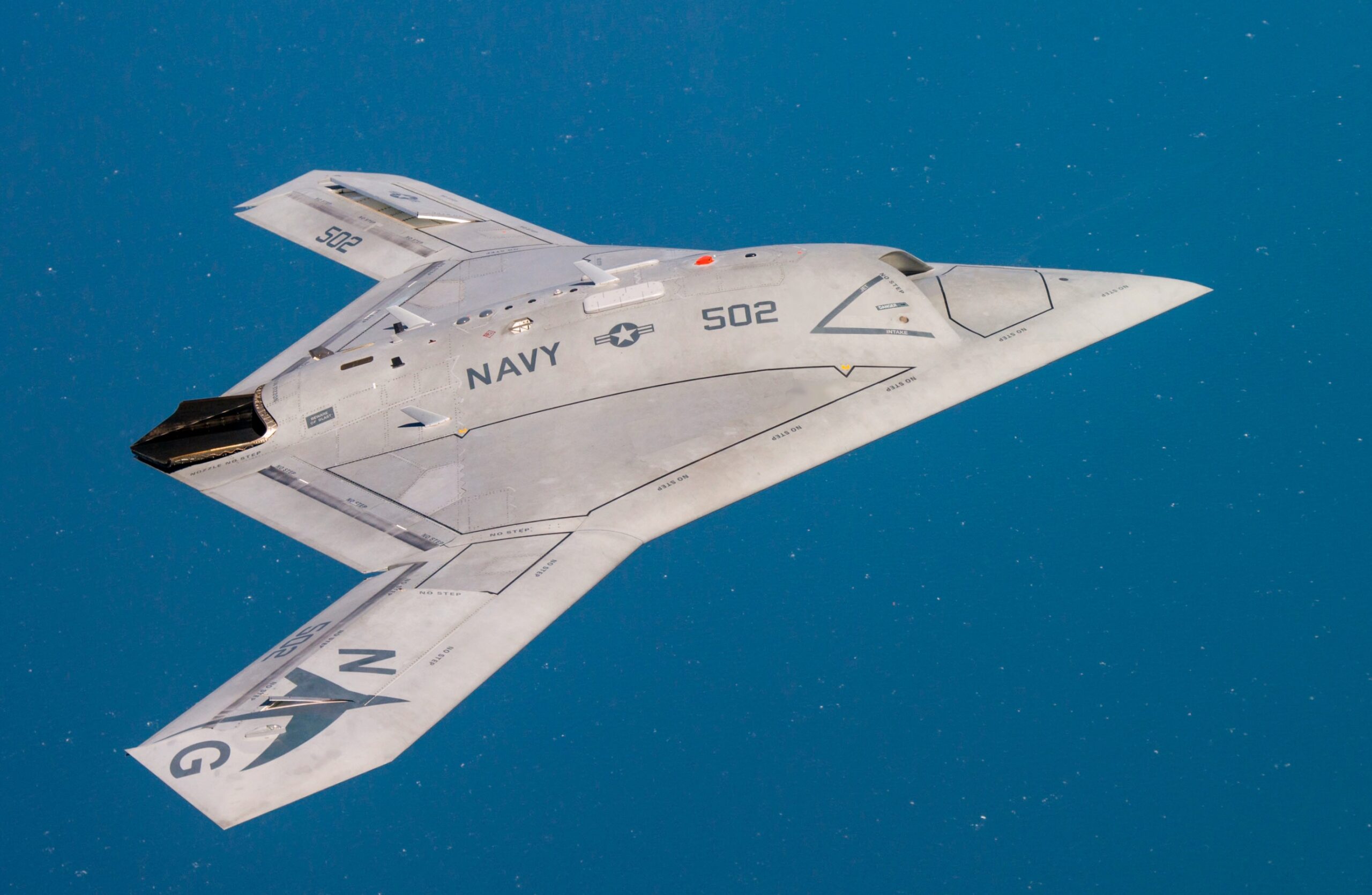
X-47B_operating_in_the_Atlantic_Test_Range_(modified)

A unmanned X-47B operating over the Atlantic Test Range

Share on LinkedInShare on Twitter

Some programs enter service and define their era. Others never reach operational deployment but quietly reshape what comes next. The Northrop Grumman X-47B belongs firmly in the second category. It did not become a frontline asset, yet it altered how naval aviation is understood at a structural level. What makes it particularly relevant is not its performance alone, but the question it was built to answer.

Can an unmanned system operate independently in one of the most complex and unforgiving environments in military aviation?

That environment is not contested airspace. It is the aircraft carrier.

Carrier operations compress time, space, and margin for error into a narrow operational window. Pilots train for years to master it. The X-47B approached that same challenge without a pilot, relying instead on layered systems, sensor fusion, and controlled autonomy. The significance of that shift becomes clearer when viewed not as a technological experiment, but as a redefinition of operational trust.

Design Beyond Familiar Aircraft Logic

The X-47B does not follow conventional aircraft design language, and that is intentional. Its tailless, blended-wing-body structure is not simply a stealth choice but a systems-level decision. The absence of vertical stabilizers reduces radar cross-section, while the overall shape improves aerodynamic efficiency and internal volume allocation.

This configuration allows for greater fuel capacity and optimized endurance without increasing external drag. The aircraft’s internal bays also support a reduced signature profile, aligning with the broader requirement of survivability in contested environments. It operates at high subsonic speeds and is capable of long-range missions, placing it in a category that supports rather than replaces manned strike assets.

More importantly, the design reflects a platform that is not constrained by pilot-related limitations. There is no cockpit, no life support system, and no need to account for human fatigue. These absences are not minor details. They influence every aspect of how the aircraft is structured, from weight distribution to mission duration.
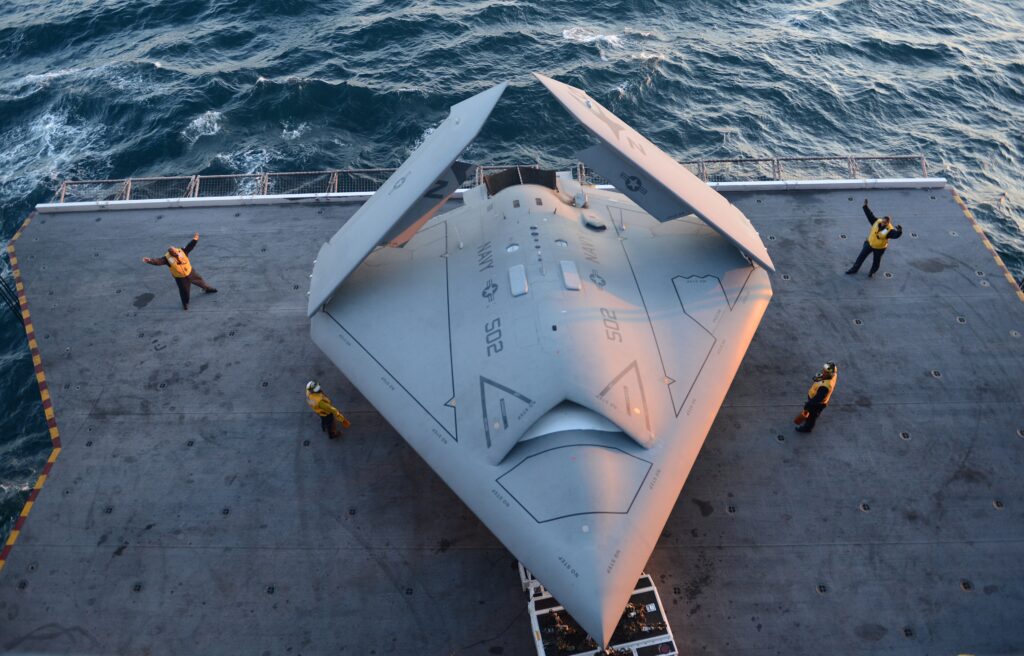
U.S. Sailors move a U.S. Navy X-47B Unmanned Combat Air System demonstrator aircraft onto an aircraft elevator aboard the aircraft carrier USS George H.W. Bush (CVN 77) May 14, 2013, in the Atlantic Ocean. The George H.W. Bush was the first aircraft carrier to successfully catapult-launch an unmanned aircraft from its flight deck. (U.S. Navy photo by Mass Communication Specialist 2nd Class Timothy Walter/Released)

Carrier Operations Without a Pilot

The defining moment for the X-47B came in 2013, when it successfully launched from and landed on a U.S. Navy aircraft carrier at sea. This was not a controlled demonstration in isolation, but a live integration into carrier operations. The aircraft had to respond to a dynamic deck environment, coordinate with manned aircraft, and execute precise timing under constantly shifting conditions.

What makes this particularly notable is the absence of real-time piloting. The system relied on pre-programmed mission parameters, onboard processing, and continuous data inputs. It adjusted its approach, aligned with carrier movement, and executed arresting landings with a level of precision that historically depended on human reflexes.

This was not just a technical milestone. It represented a shift in how operational reliability is defined. Instead of relying on pilot skill alone, the system demonstrated that reliability could be embedded in algorithms and system architecture.
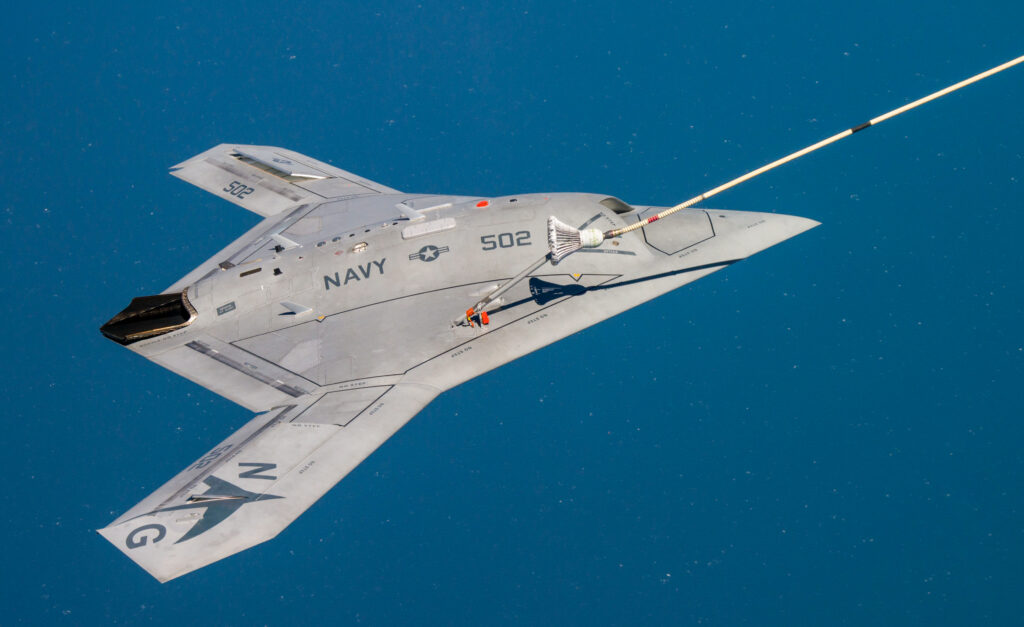
U.S. Sailors move a U.S. Navy X-47B Unmanned Combat Air System demonstrator aircraft onto an aircraft elevator aboard the aircraft carrier USS George H.W. Bush (CVN 77) May 14, 2013, in the Atlantic Ocean. The George H.W. Bush was the first aircraft carrier to successfully catapult-launch an unmanned aircraft from its flight deck.

Autonomy as Operational Capability

The X-47B’s autonomy was not limited to navigation or basic flight control. It extended into mission-critical functions that traditionally require human decision-making. One of the most significant demonstrations occurred in 2015, when the aircraft completed a fully autonomous aerial refueling.

This event is often mentioned as a technical achievement, but its implications are broader. Aerial refueling is a complex process involving precise positioning, real-time adjustments, and continuous coordination. Translating that into an autonomous framework required a level of system integration that goes beyond automation.

The result is not just an aircraft that can fly longer. It is a platform that can remain operational in extended missions without direct human intervention. This directly affects how endurance, persistence, and operational reach are calculated in modern airpower strategies.
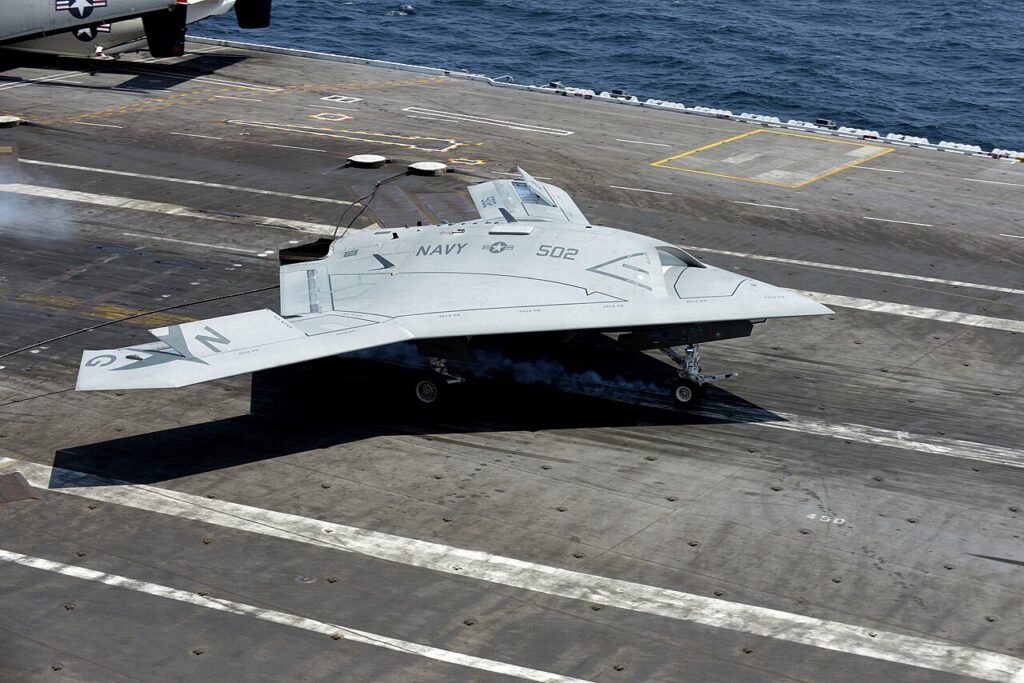
A U.S. Navy X-47B Unmanned Combat Air System makes an arrested landing aboard the aircraft carrier USS George H.W. Bush (CVN 77) as the ship conducts flight operations in the Atlantic Ocean off the coast of Virginia on July 10, 2013. The successful landing marks the first time a tail-less, unmanned autonomous aircraft landed on a modern aircraft carrier.

Working Within a Manned Ecosystem

Another critical aspect of the X-47B program is its integration with existing carrier air wings. During its testing phase, the aircraft operated alongside F/A-18 Hornets, not as a separate system but as part of the operational flow. It launched, recovered, and maneuvered within the same environment as manned aircraft, maintaining timing and spacing without disrupting overall deck operations.

This level of integration is often overlooked, yet it is central to understanding the future of unmanned systems. The objective is not to replace pilots entirely, but to create a layered structure where manned and unmanned assets operate in coordination. The X-47B demonstrated that such coordination is achievable without compromising operational tempo.

In this sense, the program contributed less to platform development and more to operational doctrine. It provided a framework for how unmanned systems can be incorporated into existing military structures without requiring complete redesign.
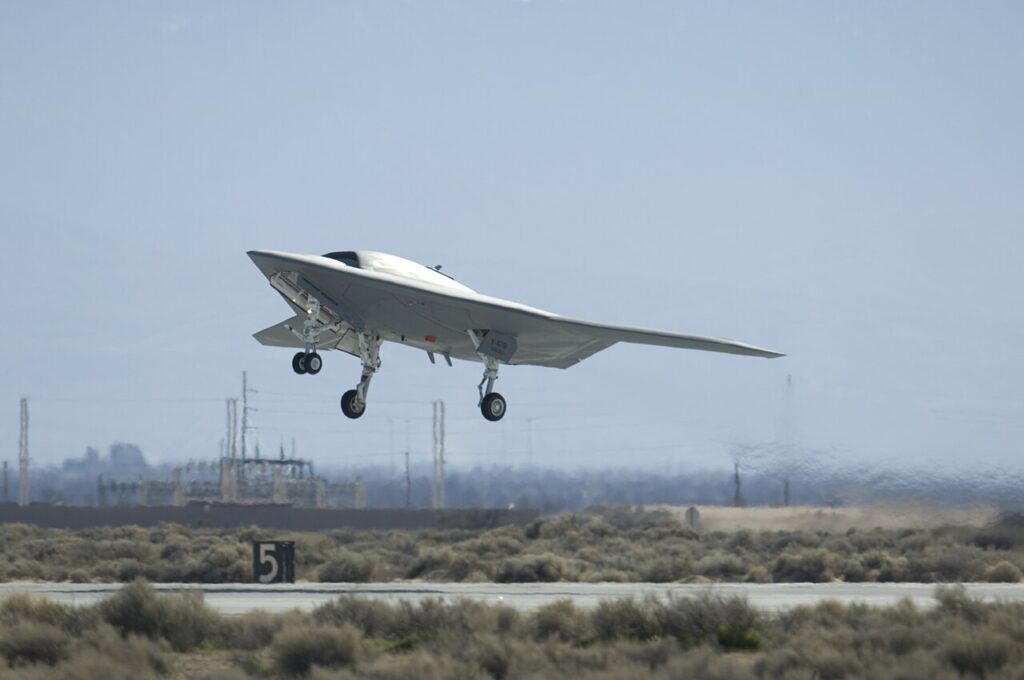
A Navy X-47B Unmanned Combat Air System Demonstration aircraft takes off and flies for the first time Feb. 4, 2011, at Edwards Air Force Base, Calif. The Northrop Grumman-built aircraft flew for 29 minutes during the flight test.

Strategic Implications That Remain Active

Although the X-47B itself did not transition into production, its impact is visible in subsequent programs. The U.S. Navy’s MQ-25 Stingray, for example, builds on concepts validated during the X-47B demonstrations, particularly in the area of carrier-based unmanned refueling.

More broadly, the program reduced uncertainty. It confirmed that autonomous systems can function in high-complexity environments, that carrier integration is feasible, and that endurance limitations can be addressed through automation. These confirmations influence procurement decisions, research priorities, and long-term strategic planning.

It is also worth noting that the X-47B shifted the conversation around unmanned systems. The focus moved from capability validation to application strategy. Instead of asking whether such systems can operate effectively, the discussion now centers on how they should be deployed and integrated.
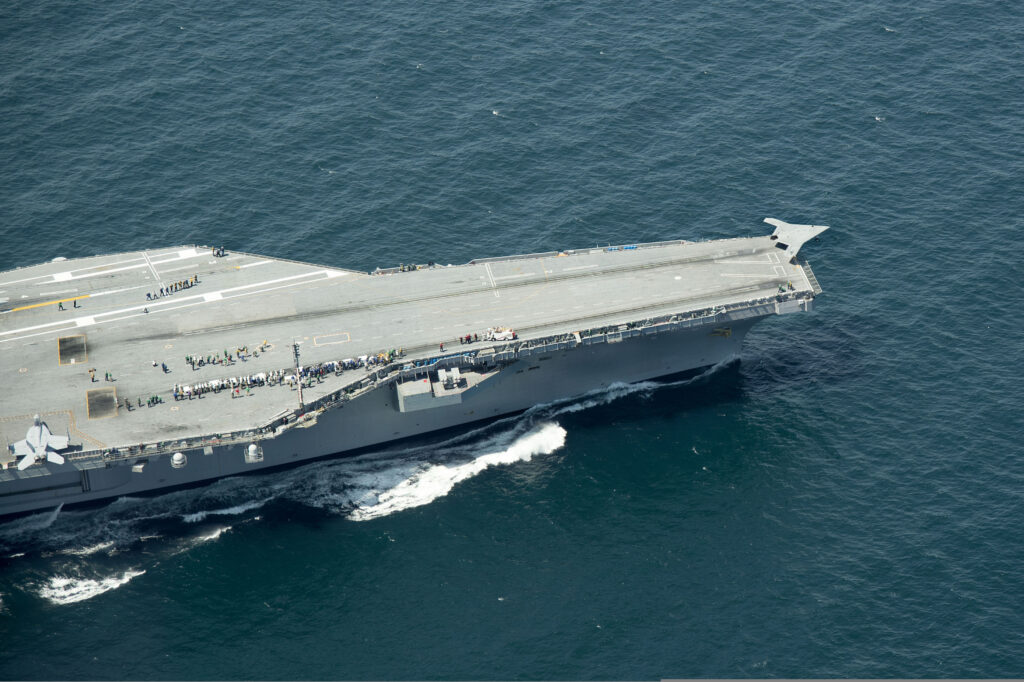
An X-47B Unmanned Combat Air System demonstrator launches from the aircraft carrier USS George H.W. Bush (CVN 77) May 14, 2013, in the Atlantic Ocean. The ship became the first aircraft carrier to successfully catapult launch an unmanned aircraft from its flight deck.

A Structural Change in Perspective

The X-47B did not introduce a single disruptive feature. Instead, it combined multiple capabilities into a coherent system and demonstrated them in an operationally relevant context. That combination is what gives the program its significance. It showed that autonomy is not limited to low-risk environments. It demonstrated that complex coordination can be managed without direct human control. It also highlighted that the limitations traditionally associated with unmanned systems are not fixed, but conditional.

For naval aviation, this represents a structural change. Carrier decks are no longer exclusive to piloted aircraft. Mission endurance is no longer tied to human constraints. And operational flexibility expands when systems can function independently within a coordinated framework. The X-47B did not redefine airpower overnight. It did something more subtle and, in many ways, more important. It made a future concept operationally credible.


Sources

  • Northrop Grumman – X-47B UCAS Program Overview
  • U.S. Navy / DON CIO – UCAS-D Program Description
  • Naval Technology – X-47B UCAS Carrier Program

Previous Post

International Code of Conduct in Private Security

Next Post

The Wassenaar Arrangement: Quiet Rules, Real Consequences

Related Posts

Willys MB Jeep - from 1943
Military Systems

Jeep: The Small Vehicle That Changed Military Mobility

May 25, 2026
1280px-5-4_ADAR_Supports_Formidable_Shield_25_
Military Systems

SGT Stout: M-SHORAD and Mobile Air Defense

May 16, 2026
X-48B_aircraft
Military Systems

X-48B: The Small Experimental Aircraft Behind a Much Bigger Aviation Question

May 6, 2026
Bell Boeing V-22 Osprey
Military Systems

Bell Boeing V-22 Osprey: Between Innovation and Controversy

May 4, 2026
Operation Enduring Freedom M60A1
Military Systems

M60 AVLB Specifications and Combat Role: Bridging Capability in Armored Warfare

April 30, 2026
379th ECES EOD controlled detonation
Military Systems

IED Warfare and the Systems Built to Survive It

April 28, 2026
Next Post
Japan_Air_Self-Defense_Force_MIM-104_Patriot_launcher

The Wassenaar Arrangement: Quiet Rules, Real Consequences

  • Trending
  • Latest
Operation Enduring Freedom

What Exactly Is a Private Military Company (PMC)?

September 6, 2025
Blackwater PMC

After Blackwater: How PMCs Evolved, Professionalized, and Fragmented

September 13, 2025
MG42-1

MG42 Machine Gun: WWII History, Specifications and Battlefield Impact

April 21, 2026
Beretta 92FS vs Beretta M9: Is There a Real Difference?

Beretta 92FS vs Beretta M9: Is There a Real Difference?

July 19, 2025
Willys MB Jeep - from 1943

Jeep: The Small Vehicle That Changed Military Mobility

May 25, 2026
Kosova War

The Kosovo War: A Conflict That Never Fully Left Europe

May 23, 2026
North_American_X-15A-2_with_external_fuel_tanks_(150806-F-IO108-005)

North American X-15: The Aircraft That Did Not Become a Fighter, But Changed High-Speed Flight

May 22, 2026
Drone Gun Anti Drone

Drone Guns: The Rifle-Shaped Tools of the Counter-UAS Era

May 21, 2026

Recent Articles

Willys MB Jeep - from 1943

Jeep: The Small Vehicle That Changed Military Mobility

May 25, 2026
Kosova War

The Kosovo War: A Conflict That Never Fully Left Europe

May 23, 2026
North_American_X-15A-2_with_external_fuel_tanks_(150806-F-IO108-005)

North American X-15: The Aircraft That Did Not Become a Fighter, But Changed High-Speed Flight

May 22, 2026
Drone Gun Anti Drone

Drone Guns: The Rifle-Shaped Tools of the Counter-UAS Era

May 21, 2026
Drill & Defense

Drill & Defense is an independent defense and security platform covering firearms, military technology, geopolitics, energy security, and industry developments. We provide clear, structured, and practical insight for professionals, companies, and readers following the evolving defense landscape worldwide.

Follow Us

Browse by Category

  • Air Systems
  • Defense & Energy Strategy
  • Defense Industry
  • Defense Know-How
  • Defense Technologies
  • Doctrines & Concepts
  • Energy & Security
  • Energy Fundamentals
  • Energy Technologies
  • Firearms
  • Geopolitics
  • Global Security
  • History
  • Industry News
  • Knowledge Base
  • Land Systems
  • Legacy Systems & Structures
  • Market Analysis
  • Market Trends & Analysis
  • Military History
  • Military Systems
  • Naval Systems
  • Oil & Gas News
  • Pistols
  • Regulations & Frameworks
  • Rifles
  • SMGs & Machine Guns
  • Strategic Turning Points
  • Tech & Innovation Crossover

Recent Articles

Willys MB Jeep - from 1943

Jeep: The Small Vehicle That Changed Military Mobility

May 25, 2026
Kosova War

The Kosovo War: A Conflict That Never Fully Left Europe

May 23, 2026

© 2026 Drill & Defense. All rights reserved. Independent insights on firearms, defense, and energy. For business inquiries: info@drillanddefense.com | PRIVACY POLICY | COOKIE POLICY | TERMS AND CONDITIONS

Manage Consent

We use cookies to improve your experience. You can accept or refuse cookies; however, some features may not function properly without your consent.

Functional Always active
The technical storage or access is strictly necessary for the legitimate purpose of enabling the use of a specific service explicitly requested by the subscriber or user, or for the sole purpose of carrying out the transmission of a communication over an electronic communications network.
Preferences
The technical storage or access is necessary for the legitimate purpose of storing preferences that are not requested by the subscriber or user.
Statistics
The technical storage or access that is used exclusively for statistical purposes. The technical storage or access that is used exclusively for anonymous statistical purposes. Without a subpoena, voluntary compliance on the part of your Internet Service Provider, or additional records from a third party, information stored or retrieved for this purpose alone cannot usually be used to identify you.
Marketing
The technical storage or access is required to create user profiles to send advertising, or to track the user on a website or across several websites for similar marketing purposes.
  • Manage options
  • Manage services
  • Manage {vendor_count} vendors
  • Read more about these purposes
View preferences
  • {title}
  • {title}
  • {title}
No Result
View All Result
  • Defense Industry
    • Industry News
    • Defense Companies
    • Defense Technologies
    • Market Analysis
  • Military Systems
    • Land Systems
    • Air Systems
    • Naval Systems
    • Electronic & Cyber Systems
  • Firearms
    • Pistols
    • Rifles
    • SMGs & Machine Guns
    • Ammunition
    • Optics & Accessories
  • Geopolitics
    • Global Security
    • Defense & Energy Strategy
    • Tech & Innovation Crossover
    • Trade & Export Controls
  • Energy & Security
    • Oil & Gas News
    • Energy Technologies
    • Market Trends & Analysis
  • History
    • Military History
    • Doctrines & Concepts
    • Strategic Turning Points
    • Legacy Systems & Structures
  • Knowledge Base
    • Firearms Basics
    • Defense Know-How
    • Energy Fundamentals
    • Regulations & Frameworks
  • About
  • Contact
  • Login
  • Register

© 2026 Drill & Defense. All rights reserved. Independent insights on firearms, defense, and energy. For business inquiries: info@drillanddefense.com | PRIVACY POLICY | COOKIE POLICY | TERMS AND CONDITIONS