
Drill & Defense
Advertisement
  • Defense Industry
    • Industry News
    • Defense Companies
    • Defense Technologies
    • Market Analysis
  • Military Systems
    • Land Systems
    • Air Systems
    • Naval Systems
    • Electronic & Cyber Systems
  • Firearms
    • Pistols
    • Rifles
    • SMGs & Machine Guns
    • Ammunition
    • Optics & Accessories
  • Geopolitics
    • Global Security
    • Defense & Energy Strategy
    • Tech & Innovation Crossover
    • Trade & Export Controls
  • Energy & Security
    • Oil & Gas News
    • Energy Technologies
    • Market Trends & Analysis
  • History
    • Military History
    • Doctrines & Concepts
    • Strategic Turning Points
    • Legacy Systems & Structures
  • Knowledge Base
    • Firearms Basics
    • Defense Know-How
    • Energy Fundamentals
    • Regulations & Frameworks
  • About
  • Contact
  • Login
  • Register
No Result
View All Result
  • Defense Industry
    • Industry News
    • Defense Companies
    • Defense Technologies
    • Market Analysis
  • Military Systems
    • Land Systems
    • Air Systems
    • Naval Systems
    • Electronic & Cyber Systems
  • Firearms
    • Pistols
    • Rifles
    • SMGs & Machine Guns
    • Ammunition
    • Optics & Accessories
  • Geopolitics
    • Global Security
    • Defense & Energy Strategy
    • Tech & Innovation Crossover
    • Trade & Export Controls
  • Energy & Security
    • Oil & Gas News
    • Energy Technologies
    • Market Trends & Analysis
  • History
    • Military History
    • Doctrines & Concepts
    • Strategic Turning Points
    • Legacy Systems & Structures
  • Knowledge Base
    • Firearms Basics
    • Defense Know-How
    • Energy Fundamentals
    • Regulations & Frameworks
  • About
  • Contact
  • Login
  • Register
No Result
View All Result
Drill & Defense
No Result
View All Result
Home Military Systems

USS Dwight D. Eisenhower (CVN-69): The Enduring Weight of a Nuclear Aircraft Carrier

June 8, 2026
in Military Systems, Naval Systems
USS Dwight D. Eisenhower (CVN-69): The Enduring Weight of a Nuclear Aircraft Carrier

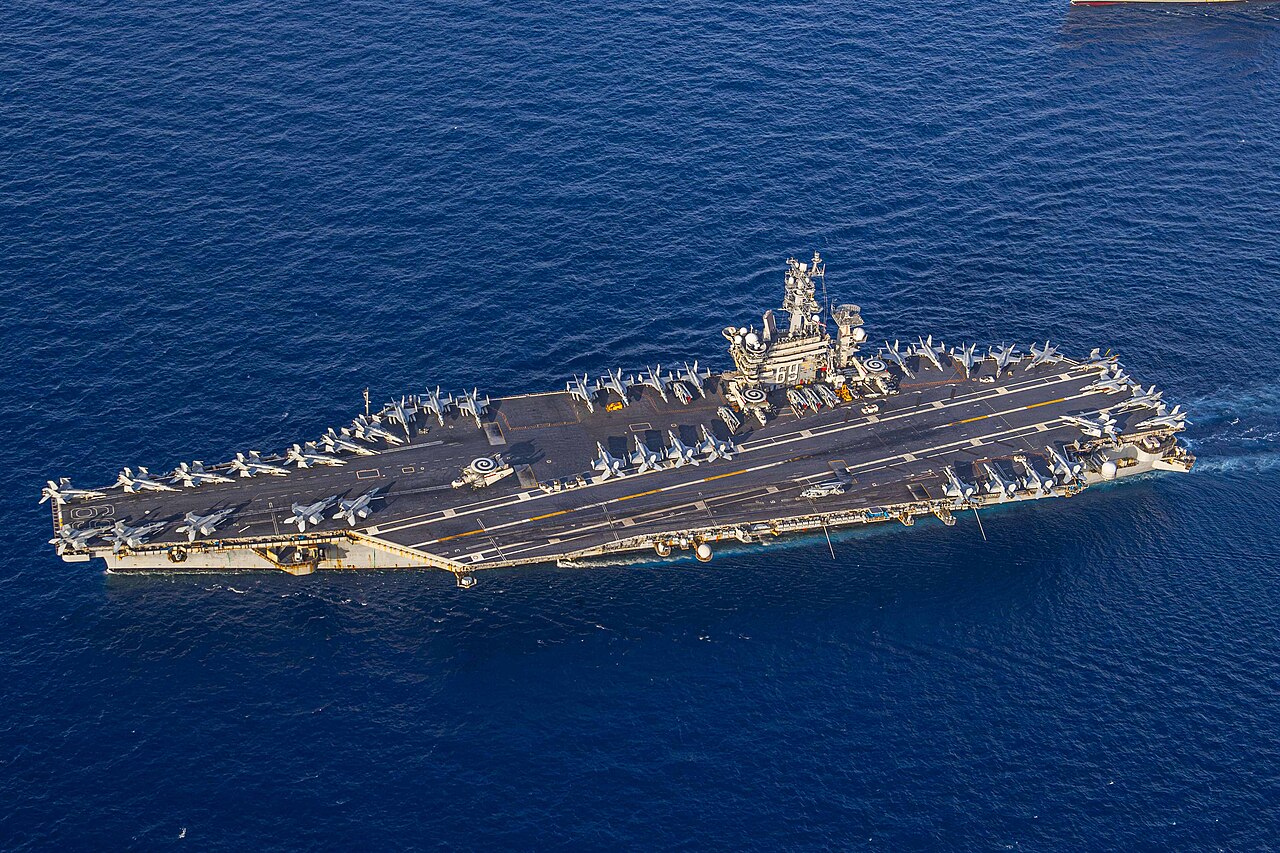
The aircraft carrier USS Dwight D. Eisenhower (CVN-69) in the Mediterranean Sea, Nov. 3, 2023

Share on LinkedInShare on Twitter

USS Dwight D. Eisenhower (CVN-69), widely known as “Ike,” is one of the most important nuclear-powered aircraft carriers in the United States Navy. Commissioned in 1977, it is the second ship of the Nimitz class and was named after Dwight D. Eisenhower, the Supreme Allied Commander in Europe during World War II and later the 34th President of the United States.

For a defense reader, Eisenhower is not interesting only because it is large. Many warships are large. What makes CVN-69 significant is the combination of mobility, aviation capacity, endurance, command capability, and political visibility. It is not simply a ship that carries aircraft. It is a naval aviation system built to move American airpower across oceans.

A Nimitz-Class Carrier with Strategic Reach

Measuring roughly 333 meters in length and displacing close to 100,000 tons at full load, USS Dwight D. Eisenhower ranks among the largest warships ever built. Its flight deck works as a moving runway at sea, allowing naval aircraft to launch and recover far from fixed airbases.

Powered by two nuclear reactors connected to four shafts, the carrier can reach speeds above 30 knots and operate for long periods without refueling for propulsion. Operational independence, however, does not mean complete self-sufficiency. Food, aviation fuel, spare parts, munitions, and other supplies still have to reach the ship through underway replenishment.

Here, the design logic becomes clearer. Nuclear propulsion gives the carrier freedom of movement, while logistics keeps that freedom meaningful. Without replenishment, even a nuclear carrier has limits. With a strong support network, Eisenhower becomes a persistent instrument of naval presence.
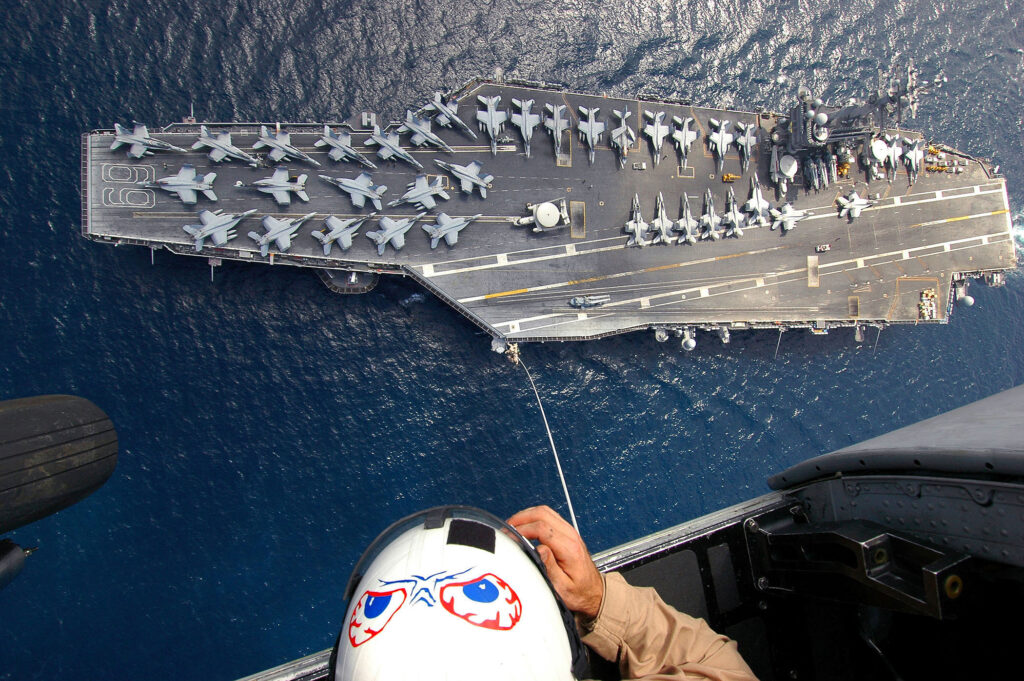
Explosive Ordnance Disposal 1st Class Christopher Courtney assigned to Explosive Ordnance Disposal Mobile Unit Six (EODMU-6), Det. 16 assist his team members during Special Purpose Insertion Extraction (SPIE) training from an SH-60 Seahawk helicopter. The Nimitz-class aircraft carrier USS Dwight D. Eisenhower (CVN-69) is deployed in support of Maritime Security Operations (MSO) and the global war on terrorism.

The Air Wing Is the Real Center of Power

The main combat value of USS Dwight D. Eisenhower comes from its embarked air wing. Depending on the mission, a Nimitz-class carrier can operate dozens of aircraft, including F/A-18E/F Super Hornets, EA-18G Growlers, E-2D Hawkeyes, MH-60 Seahawk helicopters, and support aircraft.

Each type of aircraft brings a different layer of capability. Super Hornets provide strike and air defense. Growlers support electronic warfare. Hawkeyes extend surveillance and command awareness. Seahawks contribute to anti-submarine warfare, search and rescue, logistics, and maritime security.
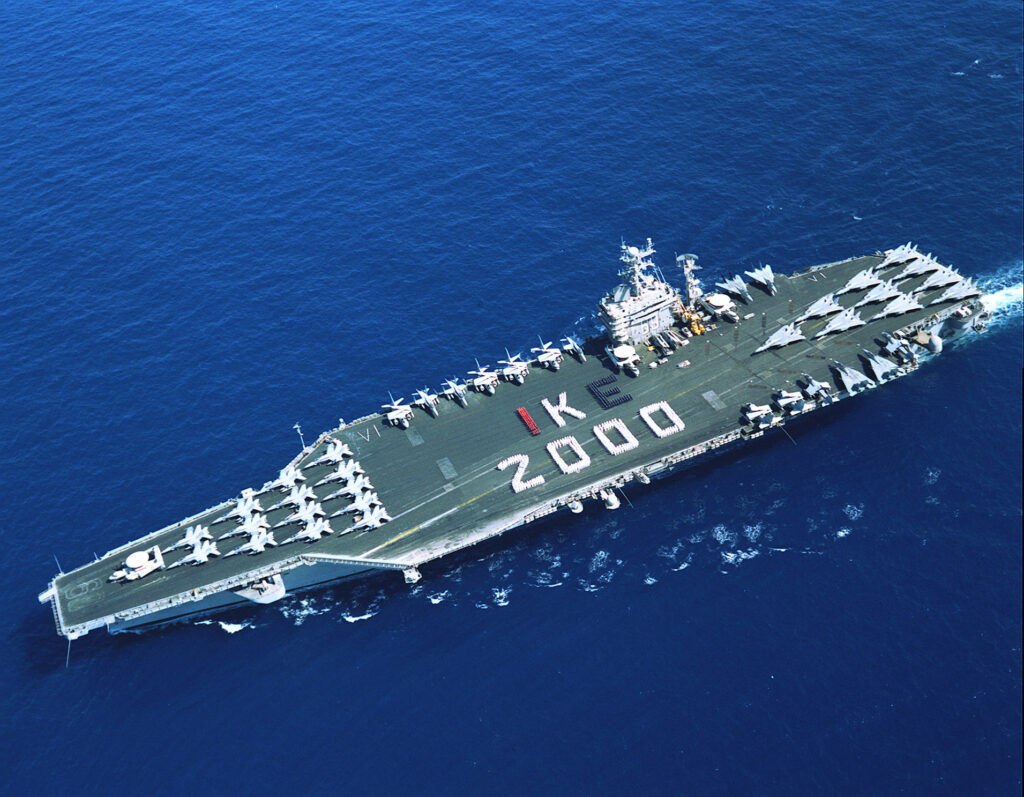
(01 Aug, 2000) While completing their six month deployment and transiting westward towards the mouth of the Atlantic Ocean, the crew of the USS DWIGHT D. EISENHOWER (CVN-69), display their teamwork and pride by strategically falling into ranks to spell out their name and accomplishments for a awesome aerial photograph. The IKE, and CARRIER AIRWING SEVEN are currently heading west toward the Atlantic after completing a successful six month deployment to the Med and Arabian Gulf. (Photo taken by Photographers Mate 2nd Class David E. Carter II)

That mixture matters more than the raw number of aircraft. A carrier air wing is not just a collection of jets parked on a deck. It is an integrated force that can observe, defend, attack, communicate, and adapt.

In a crisis, this flexibility is valuable. A carrier can remain offshore while still influencing events inland, at sea, and in the air. It can support deterrence without immediately requiring a land base. It can also withdraw, reposition, or reinforce depending on political and operational needs.
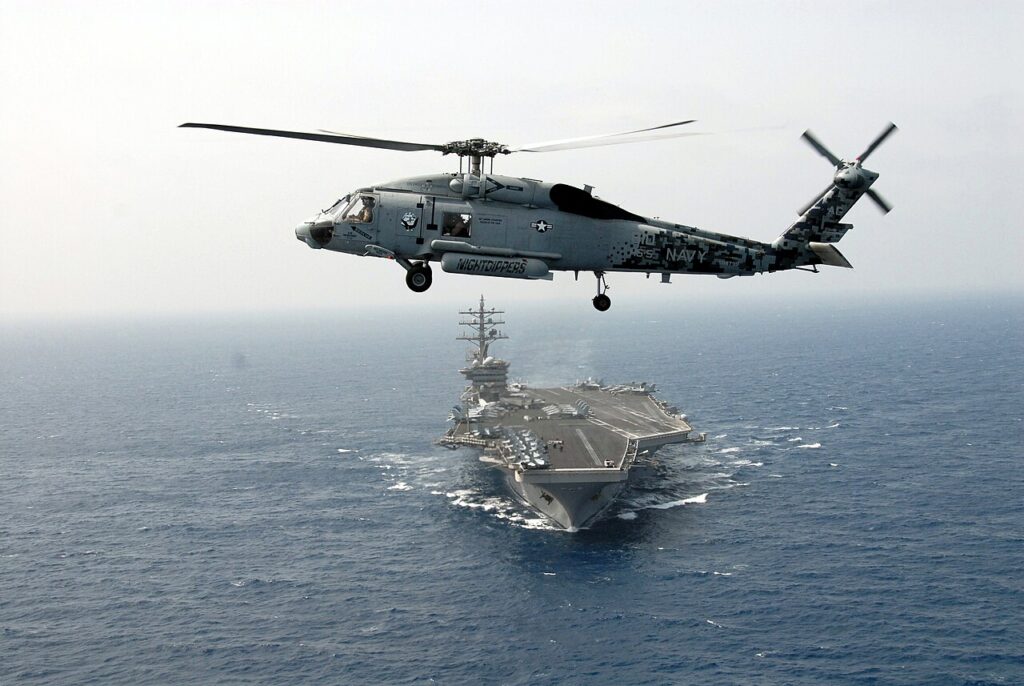
GULF OF OMAN (May 9, 2009) An SH-60F Sea Hawk helicopter assigned to Helicopter Antisubmarine Squadron (HS) 5 hovers over the bow of the aircraft carrier USS Dwight D. Eisenhower (CVN 69). The helicopter’s tail is painted with the Navy digital camouflage design. Eisenhower and Carrier Air Wing Seven are deployed to the U.S. Naval Forces Central Command area of responsibility, and are conducting operations in support of Operation Enduring Freedom. (U.S. Navy photo by Cmdr. Jane Campbell/Released)

Crew, Maintenance, and the Human Machine

When the ship’s company and air wing are combined, Eisenhower can carry around 5,000 to 6,000 personnel. That makes it closer to a floating military city than a traditional warship.

The crew includes engineers, aviation specialists, medical personnel, intelligence teams, cooks, weapons handlers, communications staff, security personnel, and flight deck crews. Every launch from the deck depends on a chain of work that starts long before the aircraft moves.

Flight operations are especially demanding. The deck is crowded, loud, dangerous, and highly choreographed. Aircraft are armed, fueled, launched, recovered, repaired, inspected, and repositioned in a limited space. A small mistake can create serious consequences.

This is why aircraft carriers should be understood as organizational achievements as much as technological ones. Steel, reactors, radar, and aircraft matter. Discipline matters just as much.
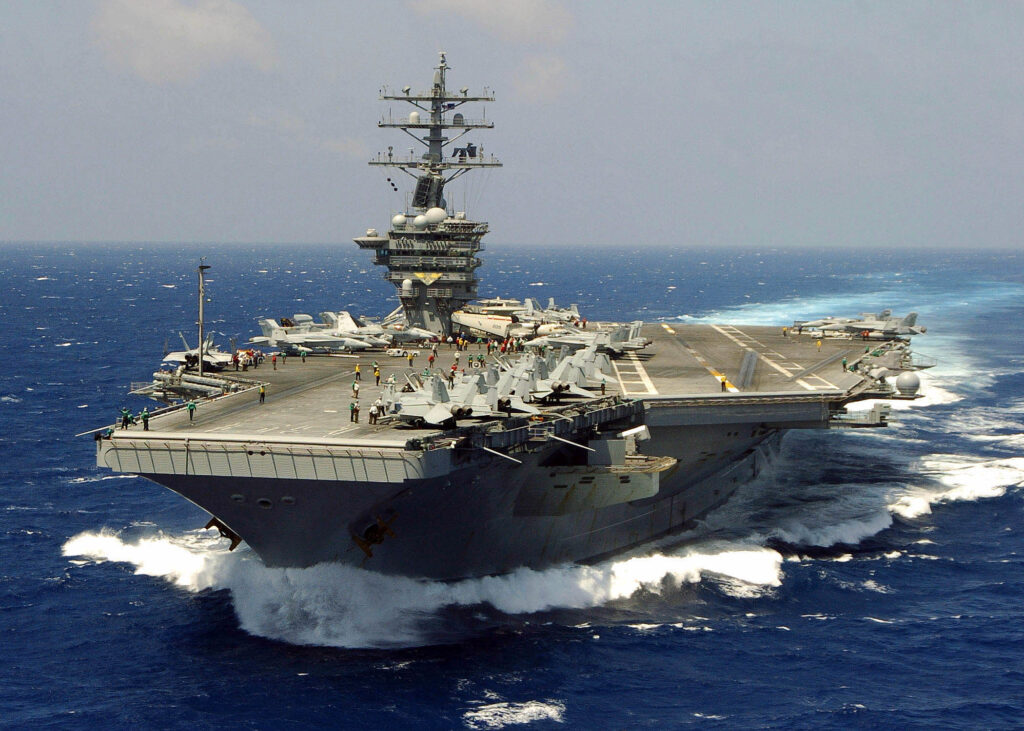
The Nimitz-class aircraft carrier w:USS Dwight D. Eisenhower (CVN-69) transits the Atlantic Ocean. Eisenhower and embarked Carrier Air Wing Seven (CVW-7) are participating in Composite Training Unit Exercise (COMPTUEX).

Defensive Systems and the Carrier Strike Group

Eisenhower has its own defensive weapons, including systems such as Rolling Airframe Missiles, Sea Sparrow missiles, and Phalanx close-in weapon systems. These are designed to protect the ship from aircraft, missiles, and close-range threats.

Still, a carrier is not meant to operate alone.

Its normal environment is a carrier strike group. Guided-missile destroyers, cruisers, submarines, logistics ships, aircraft, and command networks create layered protection around the carrier. The carrier sits at the center, but it is not the only asset doing the work.
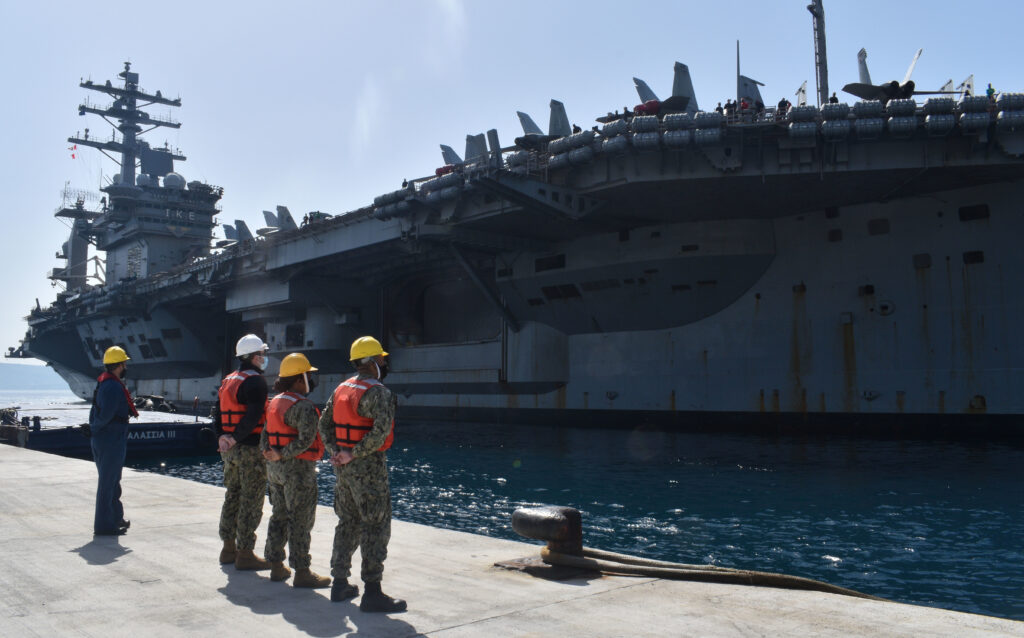
NAVAL SUPPORT ACTIVITY SOUDA BAY, Greece (March 20, 2021) Sailors look on as Nimitz-class aircraft carrier USS Dwight D. Eisenhower (CVN 69) moors pierside in Souda Bay, Greece, March 20, 2021. Dwight D. Eisenhower is on a routine deployment in the U.S. Sixth Fleet area of operations in support of U.S. national interests and security in Europe and Africa. NSA Souda Bay is an operational ashore base that enables U.S., allied, and partner nation forces to be where they are needed when they are needed to ensure security and stability in Europe, Africa, and Southwest Asia. (U.S. Navy photo by Mass Communication Specialist 2nd Class Kelly M. Agee/Released)

This is especially important today. Modern threats include anti-ship missiles, drones, submarines, mines, cyber pressure, and long-range surveillance. A carrier’s survival depends on detection, distance, escorts, electronic warfare, air defense, and operational discipline.

Recent Operations and the Red Sea Environment

Eisenhower’s 2023–2024 deployment showed how aircraft carriers are used in modern security crises. The carrier strike group operated in the Middle East and Red Sea region during a period of serious attacks against commercial shipping.

This was not a Cold War-style blue-water standoff. It was a complex operating environment involving drones, missiles, maritime disruption, regional escalation risks, and the protection of shipping routes.
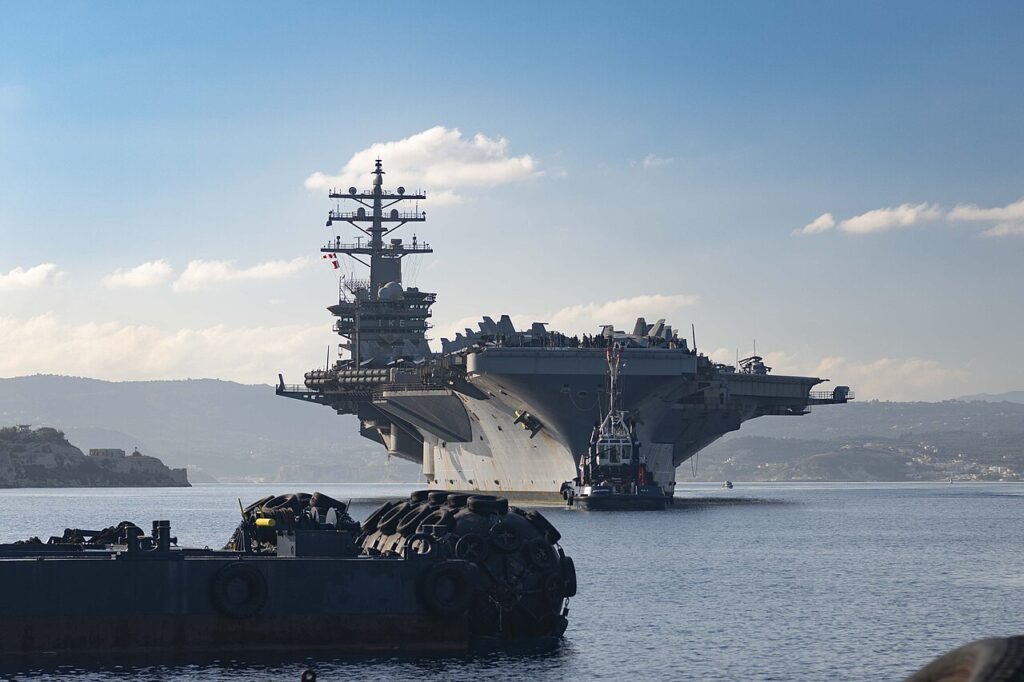
NAVAL SUPPORT ACTIVITY SOUDA BAY, Greece (April 28, 2024) ) The Nimitz-class aircraft carrier USS Dwight D. Eisenhower (CVN 69) arrives in Souda Bay, Crete, for a scheduled port visit on April 28, 2024. USS Dwight D.

The deployment lasted around nine months and became one of the most demanding recent carrier operations for the U.S. Navy. The strike group supported maritime security, deterrence, and combat operations connected to threats in the region.

For observers of naval power, this deployment is important because it shows that aircraft carriers are not only tools for major wars. They are also used in prolonged crisis management. They provide options when political leaders want presence, pressure, surveillance, and strike capability without immediately depending on local land infrastructure.

The Continuing Role of Eisenhower in Modern Naval Power

The aircraft carrier debate is not going away. Critics argue that large carriers are expensive, highly visible, and increasingly vulnerable to missiles and drones. Supporters argue that no other platform offers the same combination of mobility, airpower, endurance, and political signaling.

Both arguments deserve attention.

Eisenhower is powerful, but it is not invulnerable. Its value depends on how it is used, where it is deployed, what escorts it has, and what threats it faces. In a high-end conflict, the risks would be serious. In regional crises, maritime security operations, deterrence missions, and limited strike campaigns, the carrier remains highly useful.

The ship also has symbolic weight. When a U.S. carrier arrives in a region, it sends a message before any aircraft takes off. Allies read that message one way. Adversaries read it another way. Commercial actors, regional governments, and military planners all understand that a carrier strike group changes the operational atmosphere.

USS Dwight D. Eisenhower is therefore more than an aging Nimitz-class hull. It is a working example of how the United States uses naval aviation to project power, manage crises, and protect maritime interests. Its long service life also shows the durability of the Nimitz-class design. Built during the Cold War, it continues to operate in a security environment shaped by drones, missiles, electronic warfare, and contested sea lanes.

CVN-69 may not represent the future in the same way the newer Ford-class carriers do, but it still represents a major part of the present. Its relevance comes from adaptation, not novelty. As long as naval power requires mobile airpower, command capacity, and sustained presence at sea, ships like Eisenhower will remain central to the discussion.

Sources:

  • U.S. Navy, USS Dwight D. Eisenhower official page.
  • U.S. Navy, “Dwight D. Eisenhower Carrier Strike Group Returns from Combat Deployment,” July 2024.
  • U.S. Naval Institute, “Ike Carrier Strike Group and the Red Sea Crisis,” 2024.
  • Naval Technology, Nimitz-class aircraft carrier profile.
  • Reuters, reporting on Eisenhower and Red Sea operations, June 2024.

Previous Post

D-Day Beyond the Beaches: Logistics, Energy and Security Lessons

Related Posts

Demining_Vehicles_in_Ukraine
Military Systems

Demining Vehicles in Ukraine: Heavy Machines for a War That Stays Underground

June 1, 2026
Sikorsky CH-53E Super Stallion
Military Systems

CH-53E Super Stallion: The Heavy-Lift Aircraft That Keeps Marines Moving

May 30, 2026
Willys MB Jeep - from 1943
Military Systems

Jeep: The Small Vehicle That Changed Military Mobility

May 25, 2026
1280px-5-4_ADAR_Supports_Formidable_Shield_25_
Military Systems

SGT Stout: M-SHORAD and Mobile Air Defense

May 16, 2026
X-48B_aircraft
Military Systems

X-48B: The Small Experimental Aircraft Behind a Much Bigger Aviation Question

May 6, 2026
Bell Boeing V-22 Osprey
Military Systems

Bell Boeing V-22 Osprey: Between Innovation and Controversy

May 4, 2026
  • Trending
  • Latest
Operation Enduring Freedom

What Exactly Is a Private Military Company (PMC)?

September 6, 2025
MG42-1

MG42 Machine Gun: WWII History, Specifications and Battlefield Impact

April 21, 2026
Blackwater PMC

After Blackwater: How PMCs Evolved, Professionalized, and Fragmented

September 13, 2025
Beretta 92FS vs Beretta M9: Is There a Real Difference?

Beretta 92FS vs Beretta M9: Is There a Real Difference?

July 19, 2025
USS Dwight D. Eisenhower (CVN-69): The Enduring Weight of a Nuclear Aircraft Carrier

USS Dwight D. Eisenhower (CVN-69): The Enduring Weight of a Nuclear Aircraft Carrier

June 8, 2026
D-Day

D-Day Beyond the Beaches: Logistics, Energy and Security Lessons

June 6, 2026
Ukraine War

Ukraine’s Ground War: Rifles, Machine Guns, Trenches, and the Soldier Still Holding the Line

June 4, 2026
IWI Tavor X95

IWI Tavor X95: A Bullpup Rifle Shaped by Urban Combat Logic

June 2, 2026

Recent Articles

USS Dwight D. Eisenhower (CVN-69): The Enduring Weight of a Nuclear Aircraft Carrier

USS Dwight D. Eisenhower (CVN-69): The Enduring Weight of a Nuclear Aircraft Carrier

June 8, 2026
D-Day

D-Day Beyond the Beaches: Logistics, Energy and Security Lessons

June 6, 2026
Ukraine War

Ukraine’s Ground War: Rifles, Machine Guns, Trenches, and the Soldier Still Holding the Line

June 4, 2026
IWI Tavor X95

IWI Tavor X95: A Bullpup Rifle Shaped by Urban Combat Logic

June 2, 2026
Drill & Defense

Drill & Defense is an independent defense and security platform covering firearms, military technology, geopolitics, energy security, and industry developments. We provide clear, structured, and practical insight for professionals, companies, and readers following the evolving defense landscape worldwide.

Follow Us

Browse by Category

  • Air Systems
  • Defense & Energy Strategy
  • Defense Industry
  • Defense Know-How
  • Defense Technologies
  • Doctrines & Concepts
  • Energy & Security
  • Energy Fundamentals
  • Energy Technologies
  • Firearms
  • Geopolitics
  • Global Security
  • History
  • Industry News
  • Knowledge Base
  • Land Systems
  • Legacy Systems & Structures
  • Market Analysis
  • Market Trends & Analysis
  • Military History
  • Military Systems
  • Naval Systems
  • Oil & Gas News
  • Pistols
  • Regulations & Frameworks
  • Rifles
  • SMGs & Machine Guns
  • Strategic Turning Points
  • Tech & Innovation Crossover

Recent Articles

USS Dwight D. Eisenhower (CVN-69): The Enduring Weight of a Nuclear Aircraft Carrier

USS Dwight D. Eisenhower (CVN-69): The Enduring Weight of a Nuclear Aircraft Carrier

June 8, 2026
D-Day

D-Day Beyond the Beaches: Logistics, Energy and Security Lessons

June 6, 2026

© 2026 Drill & Defense. All rights reserved. Independent insights on firearms, defense, and energy. For business inquiries: info@drillanddefense.com | PRIVACY POLICY | COOKIE POLICY | TERMS AND CONDITIONS

Manage Consent

We use cookies to improve your experience. You can accept or refuse cookies; however, some features may not function properly without your consent.

Functional Always active
The technical storage or access is strictly necessary for the legitimate purpose of enabling the use of a specific service explicitly requested by the subscriber or user, or for the sole purpose of carrying out the transmission of a communication over an electronic communications network.
Preferences
The technical storage or access is necessary for the legitimate purpose of storing preferences that are not requested by the subscriber or user.
Statistics
The technical storage or access that is used exclusively for statistical purposes. The technical storage or access that is used exclusively for anonymous statistical purposes. Without a subpoena, voluntary compliance on the part of your Internet Service Provider, or additional records from a third party, information stored or retrieved for this purpose alone cannot usually be used to identify you.
Marketing
The technical storage or access is required to create user profiles to send advertising, or to track the user on a website or across several websites for similar marketing purposes.
  • Manage options
  • Manage services
  • Manage {vendor_count} vendors
  • Read more about these purposes
View preferences
  • {title}
  • {title}
  • {title}
No Result
View All Result
  • Defense Industry
    • Industry News
    • Defense Companies
    • Defense Technologies
    • Market Analysis
  • Military Systems
    • Land Systems
    • Air Systems
    • Naval Systems
    • Electronic & Cyber Systems
  • Firearms
    • Pistols
    • Rifles
    • SMGs & Machine Guns
    • Ammunition
    • Optics & Accessories
  • Geopolitics
    • Global Security
    • Defense & Energy Strategy
    • Tech & Innovation Crossover
    • Trade & Export Controls
  • Energy & Security
    • Oil & Gas News
    • Energy Technologies
    • Market Trends & Analysis
  • History
    • Military History
    • Doctrines & Concepts
    • Strategic Turning Points
    • Legacy Systems & Structures
  • Knowledge Base
    • Firearms Basics
    • Defense Know-How
    • Energy Fundamentals
    • Regulations & Frameworks
  • About
  • Contact
  • Login
  • Register

© 2026 Drill & Defense. All rights reserved. Independent insights on firearms, defense, and energy. For business inquiries: info@drillanddefense.com | PRIVACY POLICY | COOKIE POLICY | TERMS AND CONDITIONS