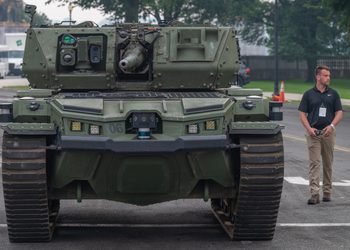

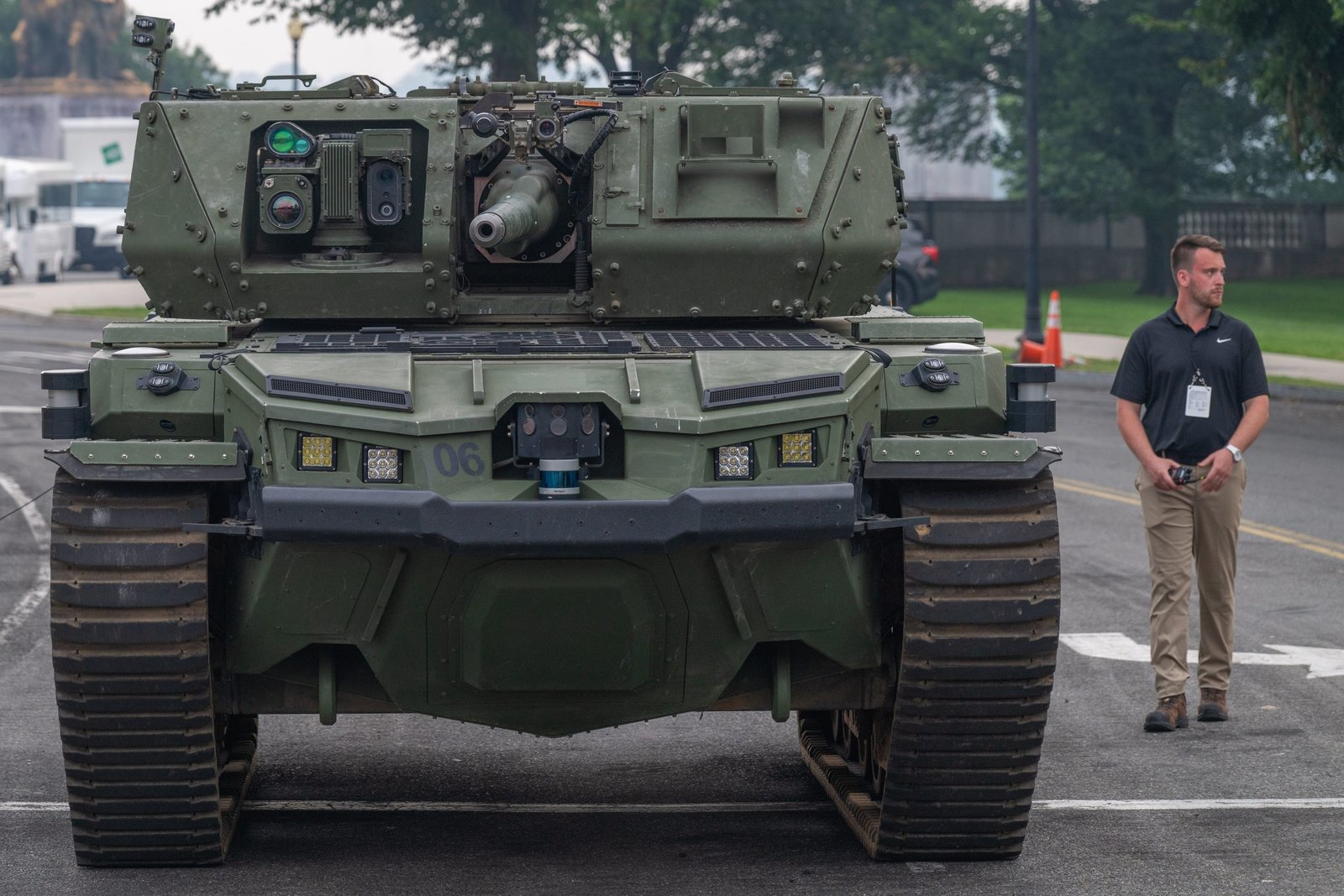
Imagine sending an armored vehicle into a dangerous area without placing a single soldier inside it. The vehicle could scout ahead, identify potential threats, carry weapons, or clear obstacles while its operators remain at a safer distance. This is the operational concept behind the RIPSAW M5, an American unmanned ground vehicle developed by Textron Systems and Howe & Howe.

Introduced in 2019, the RIPSAW M5 represents the fifth generation of a vehicle family originally developed around high-speed tracked mobility. Its appearance resembles a compact armored fighting vehicle, but its purpose extends beyond carrying weapons. The M5 was developed to explore how robotic platforms could operate alongside conventional military formations, particularly in situations where exposing human crews would be unnecessarily dangerous.
A Tracked Vehicle Built Around Flexibility
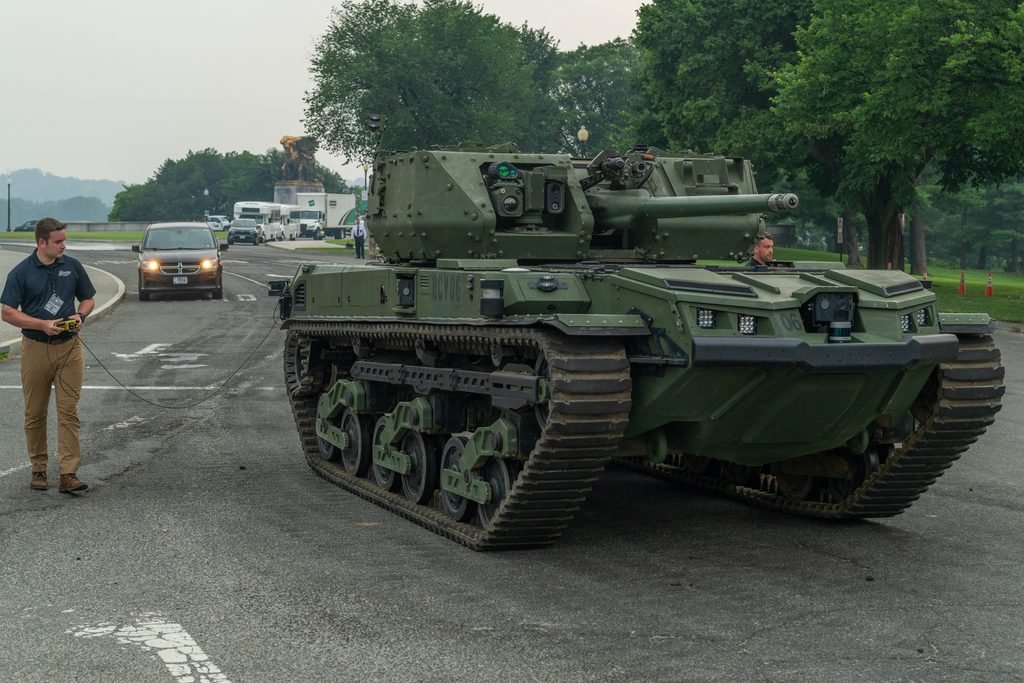
Measuring approximately 5.94 meters long and 2.67 meters wide, the RIPSAW M5 has a listed vehicle weight of 21,000 pounds (9.5 metric tons). Its maximum payload capacity reaches 8,000 pounds (3,629 kilograms), allowing considerable flexibility when integrating equipment.
A diesel-hybrid electric drivetrain provides propulsion, with the platform designed to exceed 25 mph (40 km/h). Its tracked configuration supports movement over difficult terrain, while electric propulsion capabilities offer opportunities for quieter maneuvering.
Speed alone, however, tells us little about battlefield effectiveness. Moving quickly across open ground is considerably different from navigating forests, damaged urban environments, or muddy terrain.
Perhaps more consequential than acceleration is the M5’s modular flat-deck architecture. Rather than committing to a fixed combat configuration, designers created a platform capable of accommodating different mission packages. A shared vehicle architecture could therefore support several operational requirements without demanding an entirely new chassis for each assignment.
Not Every Mission Requires a Gun
Weapons naturally attract attention when discussing robotic combat vehicles. The RIPSAW M5 has been demonstrated with a 30 mm cannon, and its architecture supports remotely operated weapon systems, including configurations involving anti-tank capabilities.
Armed reconnaissance, however, represents only part of its potential employment.
Depending on its configuration, the platform can accommodate surveillance equipment, electronic warfare systems, counter-drone technologies, and combat engineering attachments. Proposed configurations include mine plows, explosive hazard clearance equipment, and smaller robotic vehicles carried aboard the M5.
Consider a reconnaissance unit approaching a potentially mined route. Would sending an unmanned platform forward provide commanders with additional options before committing personnel?
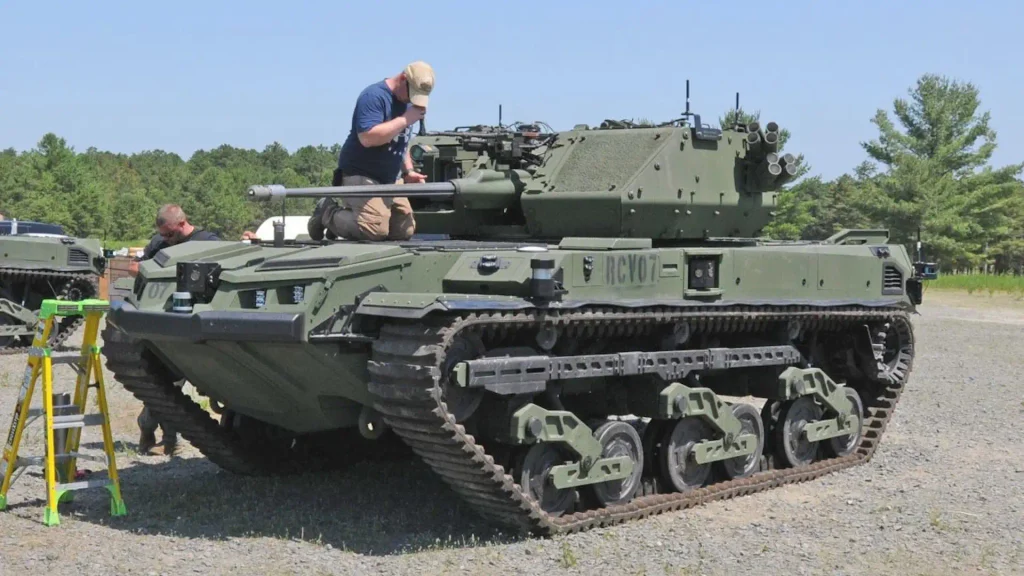
Potentially, yes. An M5 equipped for the task could investigate suspicious locations or support route-clearance operations while reducing immediate exposure for personnel. Actual effectiveness would still depend on installed equipment, communications reliability, terrain, and operational circumstances.
Integrating smaller unmanned aircraft would expand the concept further. A robotic ground vehicle carrying its own aerial reconnaissance capability could examine terrain beyond the immediate field of view of its onboard sensors.
The Problem of Controlling an Unmanned Vehicle
Removing the crew introduces challenges that conventional armored vehicles do not face in precisely the same way.
Communications, onboard computing, sensors, and control systems become essential to operating an unmanned vehicle effectively. Electronic warfare, signal interference, equipment failures, and obstructed communications can all compromise performance.
Autonomous navigation offers possible solutions, although autonomy should not be confused with independent combat decision-making. Navigating obstacles or following predefined routes does not necessarily mean a vehicle can identify and engage targets without human authorization.
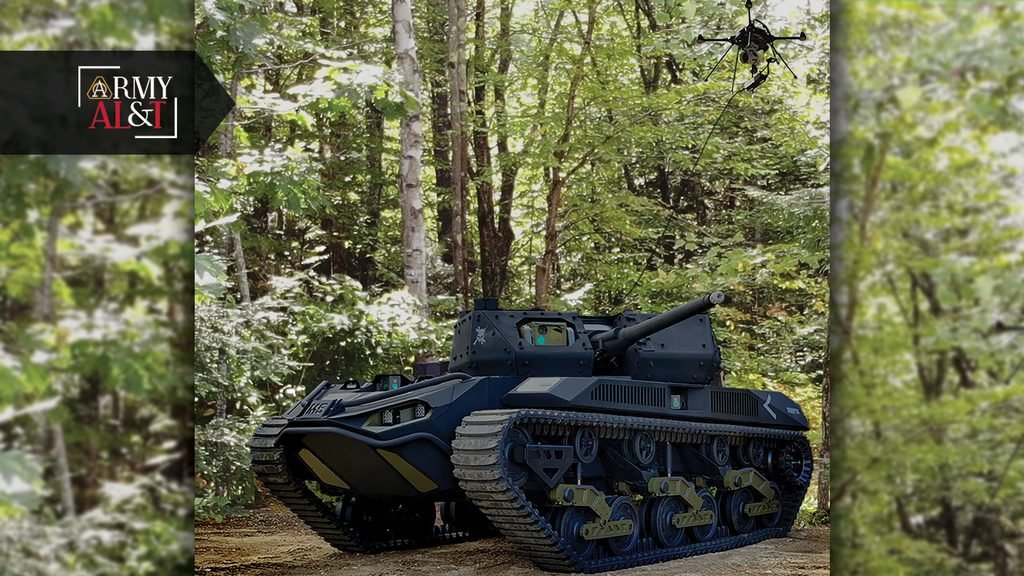
Reliable human supervision and operational safety remain central considerations.
Logistics presents another challenge. Robotic vehicles still require maintenance, fuel or electrical energy, spare parts, recovery equipment, and trained operators. Eliminating the onboard crew does not eliminate the supporting organization.
Consequently, an unmanned vehicle could reduce personnel exposure while introducing additional technical and logistical responsibilities.
From the M5 to an Expanding RIPSAW Family
Early development of the M5 contributed to the U.S. Army’s Robotic Combat Vehicle-Medium experimentation. Experience with the platform subsequently influenced other vehicles in the RIPSAW family.
In 2021, Textron Systems delivered the M5-E, an all-electric variant designed to support weapon integration testing. Its introduction demonstrated how the underlying architecture could accommodate different propulsion requirements.
Another development followed with the smaller RIPSAW M3, which became Textron’s offering for the Army’s robotic combat vehicle competition. Prototypes were delivered in October 2024.
Progress has extended beyond vehicle hardware. In October 2026, Textron introduced CoreMotion, a robotic control package intended to simplify integration between autonomy software and vehicle hardware. According to the company, more than 8,000 operational miles had been accumulated across the RIPSAW family using the technology.
Experimental use, prototype deliveries, and operational fielding are nevertheless distinct milestones. None of these announcements alone establishes that the M5 has entered widespread operational service.
Where Does the RIPSAW M5 Fit?
Perhaps the more useful question is not whether robotic vehicles will replace conventional armored vehicles, but which battlefield responsibilities can realistically be transferred to machines.
Reconnaissance, logistical resupply, hazardous route inspection, and selected weapons-support roles present plausible applications. Survivability, however, involves considerably more than removing soldiers from the vehicle.
Armor protection, electronic resilience, recovery procedures, procurement costs, and integration with existing formations will influence whether systems such as the M5 become practical military assets.
Over the years, the RIPSAW family has evolved from experimental high-speed tracked machines into increasingly configurable military platforms. The M5 illustrates this transition particularly well, combining substantial payload capacity with unmanned operation and a flexible architecture.
Whether such systems become a regular feature of military formations will depend on their ability to perform reliably outside controlled demonstrations. Carrying sophisticated weapons is one achievement; maintaining mobility, communications, and mission effectiveness under sustained battlefield pressure is another.
For military planners, that distinction may ultimately determine the RIPSAW M5’s place in future ground operations.
Sources:
- 1. Textron Systems. (2026). Ground Robotic Vehicles Family of Products.
- 2. Howe & Howe Technologies. (2019). Howe & Howe, Textron Systems and FLIR Systems Debut Multi-Mission RIPSAW M5 RCV.
- 3. U.S. Army. (2020). Rapid Robotic Requirement Relay.
- 4. Textron Systems. (2021). Textron Systems Delivers All-Electric RIPSAW M5, Known as M5-E.
- 5. Textron Inc. (2024). Textron Systems, Howe & Howe and Teledyne FLIR Defense Deliver RIPSAW M3 Prototypes for U.S. Army Robotic Combat Vehicle Program.
- 6. Textron Systems. (2026). Textron Systems Launches CoreMotion Robotic Control Package for Rapid Autonomy Deployment Across Ground Vehicle Platforms.