
Drill & Defense
Advertisement
  • Defense Industry
    • Industry News
    • Defense Companies
    • Defense Technologies
    • Market Analysis
  • Military Systems
    • Land Systems
    • Air Systems
    • Naval Systems
    • Electronic & Cyber Systems
  • Firearms
    • Pistols
    • Rifles
    • SMGs & Machine Guns
    • Ammunition
    • Optics & Accessories
  • Geopolitics
    • Global Security
    • Defense & Energy Strategy
    • Tech & Innovation Crossover
    • Trade & Export Controls
  • Energy & Security
    • Oil & Gas News
    • Energy Technologies
    • Market Trends & Analysis
  • History
    • Military History
    • Doctrines & Concepts
    • Strategic Turning Points
    • Legacy Systems & Structures
  • Knowledge Base
    • Firearms Basics
    • Defense Know-How
    • Energy Fundamentals
    • Regulations & Frameworks
  • About
  • Contact
  • Login
  • Register
No Result
View All Result
  • Defense Industry
    • Industry News
    • Defense Companies
    • Defense Technologies
    • Market Analysis
  • Military Systems
    • Land Systems
    • Air Systems
    • Naval Systems
    • Electronic & Cyber Systems
  • Firearms
    • Pistols
    • Rifles
    • SMGs & Machine Guns
    • Ammunition
    • Optics & Accessories
  • Geopolitics
    • Global Security
    • Defense & Energy Strategy
    • Tech & Innovation Crossover
    • Trade & Export Controls
  • Energy & Security
    • Oil & Gas News
    • Energy Technologies
    • Market Trends & Analysis
  • History
    • Military History
    • Doctrines & Concepts
    • Strategic Turning Points
    • Legacy Systems & Structures
  • Knowledge Base
    • Firearms Basics
    • Defense Know-How
    • Energy Fundamentals
    • Regulations & Frameworks
  • About
  • Contact
  • Login
  • Register
No Result
View All Result
Drill & Defense
No Result
View All Result
Home Geopolitics

Expeditionary Fuel Systems: Keeping Military Operations Moving Beyond Permanent Bases

September 25, 2026
in Geopolitics, Defense & Energy Strategy
233rd QM CO establish Fuel System Supply Point (FSSP) at QLLEX

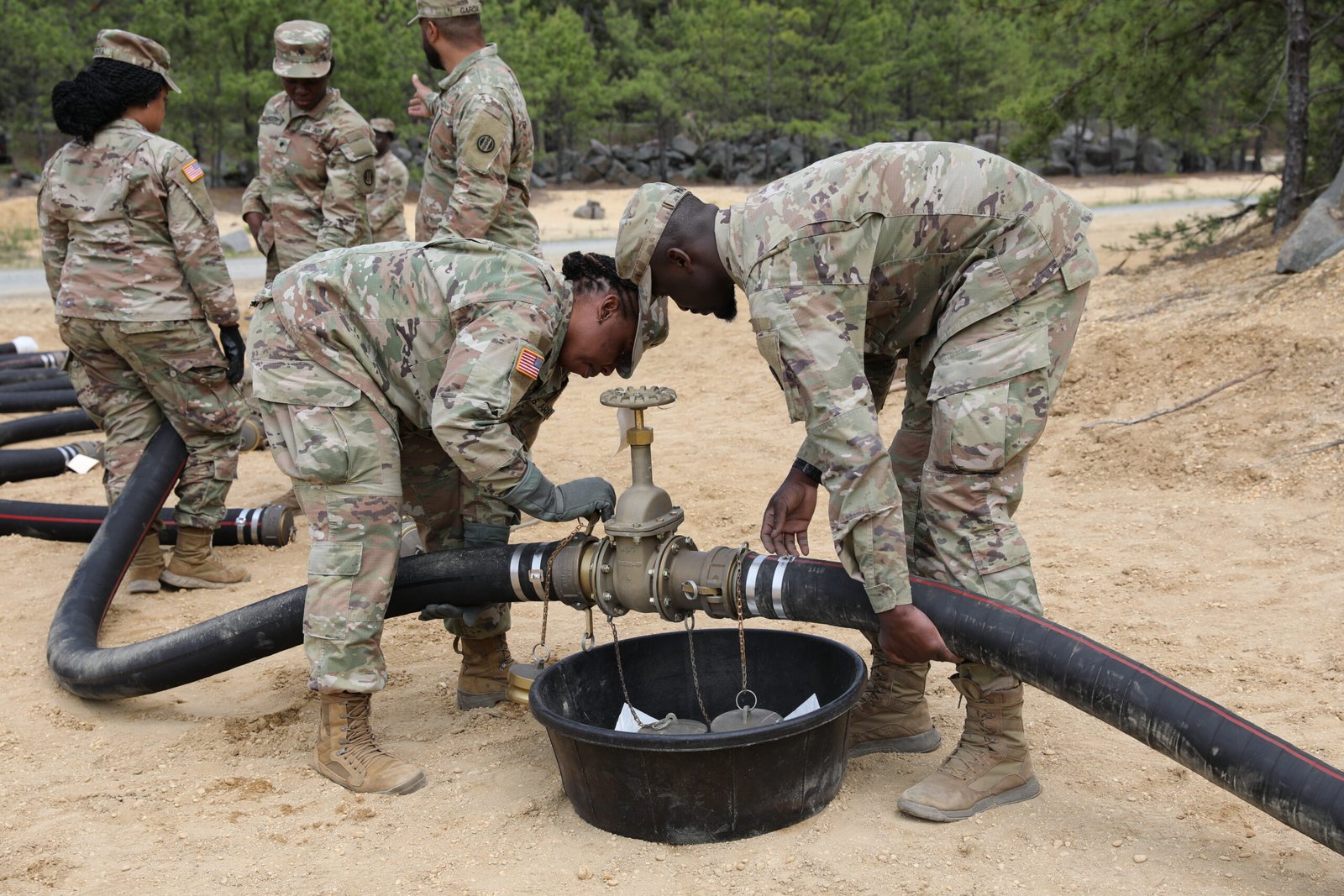
U.S. Army Reserve Soldiers from the 233rd Quartermaster Company assemble a Fuel System Supply Point (FSSP) during QLLEX at Fort Dix, N.J., June 1. Mojave Falcon 2025 is a multi-faceted first-of-its-kind Army Reserve training exercise that integrates Combat Support Training Exercise (CSTX), Global Medic, Quartermaster Liquid Logistics Exercise (QLLEX), Port Operations and Nationwide Move. (U.S. Army Reserve photo by Maj. Elizabeth Ohloff /649th Regional Support Group)

Share on LinkedInShare on Twitter

Fuel is one of the least visible limits on military mobility. An armored vehicle may have the range to cross hundreds of kilometers, a helicopter can relocate rapidly between operating areas, and aircraft can be dispersed across several airfields, but none of those capabilities removes the requirement for fuel. It simply moves the problem somewhere else in the logistics chain.

Expeditionary fuel systems are designed around that reality. Rather than treating petroleum infrastructure as something permanently attached to an established base, they allow storage, pumping, filtration and distribution capacity to move with the force. In practical terms, a military unit can create a substantial fuel installation without constructing conventional storage tanks or waiting for a permanent pipeline connection.

Calling these systems “fuel bladders” therefore misses most of what makes them important. The flexible tanks are certainly part of the architecture, but the real capability comes from connecting storage with pumps, filters, hoses, manifolds, tanker vehicles and personnel capable of keeping fuel moving through the network.

A Petroleum Terminal That Can Be Packed Up

The U.S. Army describes the Fuel System Supply Point, or FSSP, as its primary fuel storage and distribution system. Its purpose is straightforward: receive fuel, store it and issue it again for aviation or ground operations. How this is achieved is more interesting.

Different configurations can be selected according to demand. A 120,000-gallon FSSP uses six 20,000-gallon collapsible fabric tanks. A larger version provides 300,000 gallons through six 50,000-gallon tanks, while an Army Prepositioned Stock configuration reaches roughly 800,000 gallons using four much larger tanks.

Those numbers start to change the way we should think about expeditionary fuel equipment. A 120,000-gallon installation holds roughly 454,000 liters. At the upper end, an 800,000-gallon system approaches three million liters. We are no longer talking about a few tanks placed beside a maintenance area; this is deployable petroleum infrastructure.
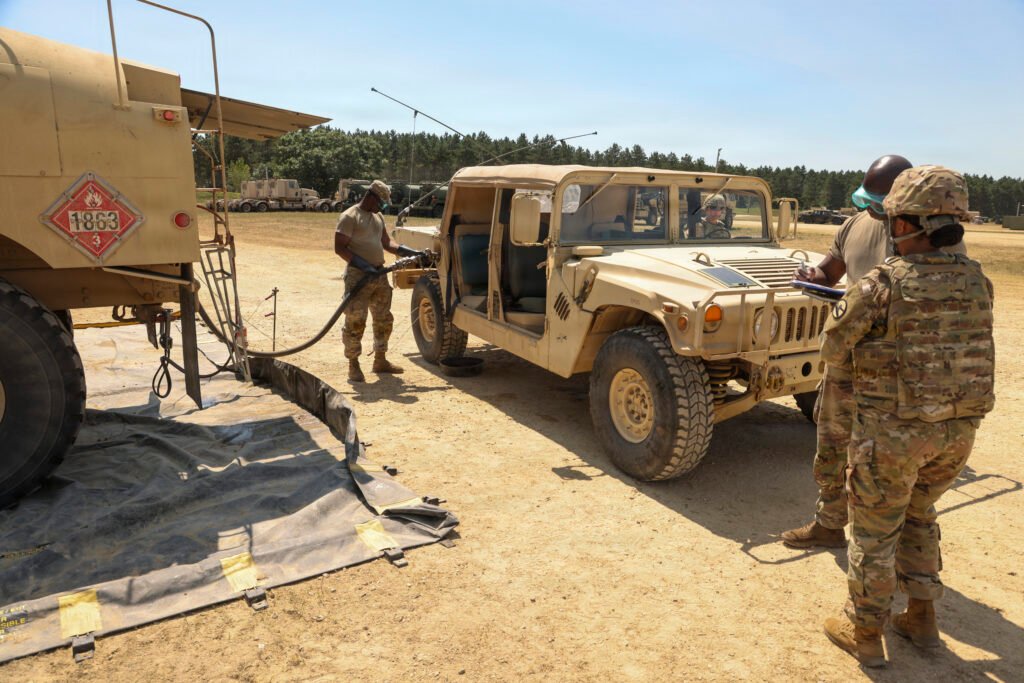
Army Reserve Spc. Segbegnon Dadakpete, a petroleum supply specialist with the 367th Engineer Battalion, refuels a High Mobility Multipurpose Wheeled Vehicle, August 6, 2026, at Fort McCoy, Wis. Units participating in Warrior Exercise/Regional Medic 2026 (WAREX/RM 26) simulate providing combat support, service support and medical support during a large scale combat operation.(U.S. Army Reserve photo by Sgt. 1st Class Justin Hardin)

Storage capacity, however, is only useful when fuel can move through it quickly enough. The Army’s 120,000- and 300,000-gallon configurations use pumps rated at 350 gallons per minute, together with filter-separators and multiple receipt and issue points. Larger systems can employ pumps rated at 600 gallons per minute.

Throughput matters as much as capacity. A depot containing an enormous quantity of fuel but unable to receive or issue it at the required rate can become a bottleneck instead of an asset.

Fuel Has to Travel Through a Chain

Military fuel rarely moves directly from a refinery to a tank, helicopter or fighter aircraft.

A much broader system exists behind the final refueling point. Organizations such as the Defense Logistics Agency manage strategic portions of petroleum procurement, storage, inventory, quality assurance and distribution. Fuel may arrive through commercial infrastructure, ports, pipelines or bulk storage terminals before military logistics formations take responsibility for moving it farther toward operational units.
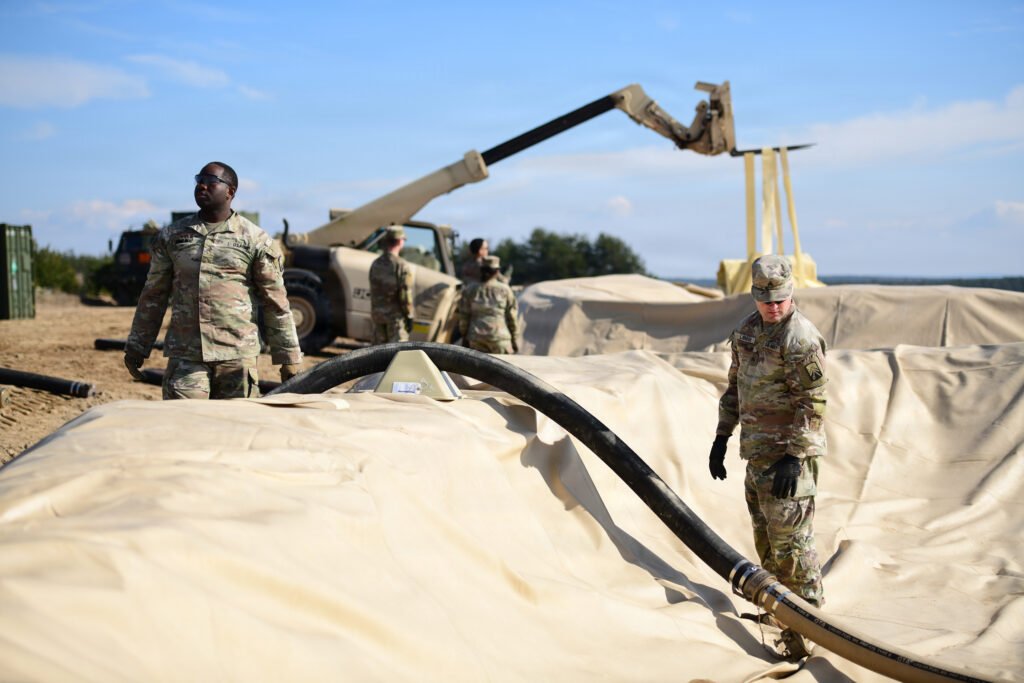
U.S. Soldiers assigned to the 493rd Petroleum Supply Company, 18th Combat Sustainment Support Battalion, execute fuel system supply point training during a Brigade evaluation at the 7th Army Training Command’s Grafenwoehr Training Area, March 5th, 2026. Within hours, 493rd PSC created an operational fueling point using collapsible fuel tanks from the FSSP , each capable of holding 20,000 gallons, with a combined holding capacity of 120,000 gallons of fuel. (U.S. Army photo by Kevin Sterling Payne)

Eventually the scale changes.

Strategic fuel movements involving ships, pipelines and major depots have to connect with tankers, temporary storage areas and tactical distribution systems. Expeditionary fuel equipment sits around this transition. It converts bulk supply into something that can follow forces operating beyond established infrastructure.

Exercises involving the U.S. military have demonstrated the same principle on a much larger geographical scale. Petroleum can be transferred from ships offshore, moved across a beach through expeditionary distribution systems and then sent inland toward operating bases. Other configurations may rely on tankers feeding temporary storage sites, which then supply smaller distribution vehicles or aircraft refueling points.
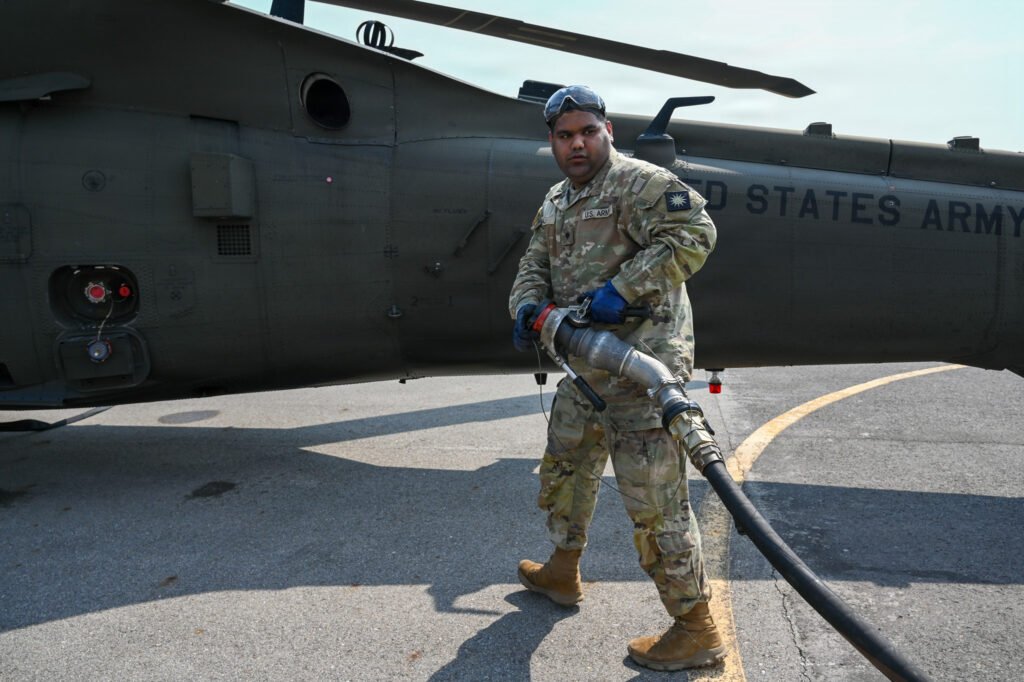
U.S. Army Specialist Prasheel Raj, a petroleum supply specialist with the 1st Battalion, 168th General Support Aviation Battalion, conducts refueling operations on a UH-60 Black Hawk helicopter supporting the Modrite Fire response. The Washington National Guard plays an active role in supporting the Washington State Department of Natural Resources with both aviation and ground firefighting support to safeguard lives and property in Washington state. (U.S. Air National Guard photo by Master Sgt. Brandy Burke)

There is no single fuel route. The network can be rearranged depending on geography and available infrastructure.

That flexibility is probably more important than the individual piece of equipment.

Why Not Just Use Fuel Trucks?

Tankers are indispensable, but relying entirely on vehicles creates limitations of its own.

A tanker combines transportation and storage in one asset. If a truck remains parked because its fuel is being used as local storage, it is no longer available to move another load. Temporary bulk storage separates those functions. Vehicles can deliver fuel, transfer it into the site and return to the supply chain while the product remains available locally.

The same principle appears in aviation support.

In December 2025, U.S. Air Force personnel in the CENTCOM area used an R-20 expeditionary refueling system to conduct hot-pit refueling of a U.S. Army UH-60 Black Hawk. Fuel was supplied directly from bulk storage instead of relying on a conventional R-11 refueling truck. With the helicopter remaining operational during refueling, the setup demonstrated how expeditionary equipment can reduce dependence on a limited fleet of dedicated refueling vehicles.

It would be wrong to interpret systems such as the R-20 or FSSP as replacements for tankers. They complement them. Trucks move petroleum between nodes; deployable systems allow those nodes to exist where permanent infrastructure does not.

The distinction becomes important when operations begin spreading across multiple locations.
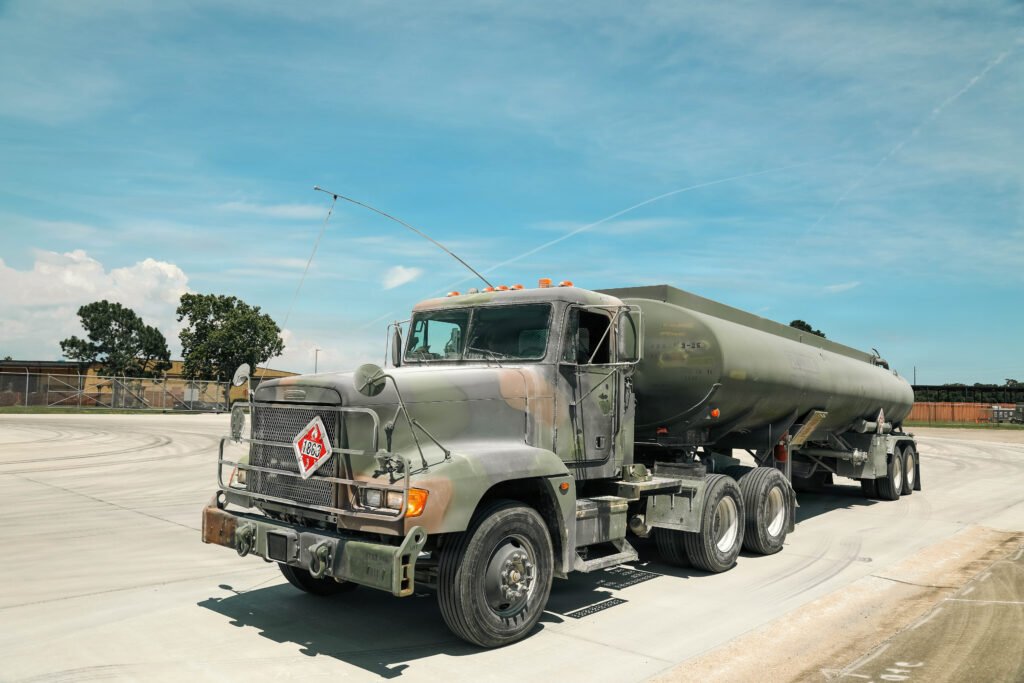
A M915 tractor truck, towing a M1062 bulk petroleum fuel tank, arrives at the bulk fuel point at Keesler Air Force Base in Biloxi, Mississippi as part of 737th Transportation Company’s fuel transfer mission during Operation Sentinel Justice at Camp Shelby, Mississippi, June 11, 2026. Operation Sentinel Justice is the crucible of the modern U.S. Army Reserve. OSJ is the largest training event in the history of the Army Reserve, with an estimated 12,000-15,000 Soldiers participating. The training event is comprised of Combat Support Training Exercise (CSTX) 26-01, Global Medic, and a Tech Evaluation (TECH EVAL) spread across Camp Shelby, MS, Camp Beauregard, LA, & Gulfport, MS. The CSTX is designed to assess and enhance the readiness and capabilities of Army Reserve Soldiers in a modern, dynamic, multi-echelon, and joint operational environment aimed at preparing the force for Large Scale Combat Operations. (U.S. Army photo by Maj. India Hunter)

Dispersed Operations Create a Fuel Problem

Military planners increasingly discuss dispersion as a way of reducing dependence on a small number of large installations. Aircraft may operate from several locations. Ground units can move between temporary bases. Logistics facilities themselves can be distributed rather than concentrated in one large hub.

Fuel has to become distributed as well.

A force cannot meaningfully disperse its combat platforms while keeping every critical support function centralized hundreds of kilometers away. Eventually aircraft have to land somewhere, vehicles need to refuel and generators require another delivery.

The Indo-Pacific makes the challenge particularly visible. Many islands have little or no indigenous petroleum production and depend heavily on imported energy. Distances are enormous, while the number of locations that might need support can be extensive. Moving fuel to the theater is therefore only the first part of the problem. It must then be stored and redistributed across the theater.

The Department of Defense has consequently placed considerable attention on contested logistics: maintaining supply when transportation routes, logistics nodes and infrastructure may themselves face disruption.

Petroleum sits directly inside that discussion because military forces consume it continuously. Ammunition expenditure changes according to the intensity of combat; fuel consumption continues simply because forces have to move, fly, generate electricity and transport supplies.
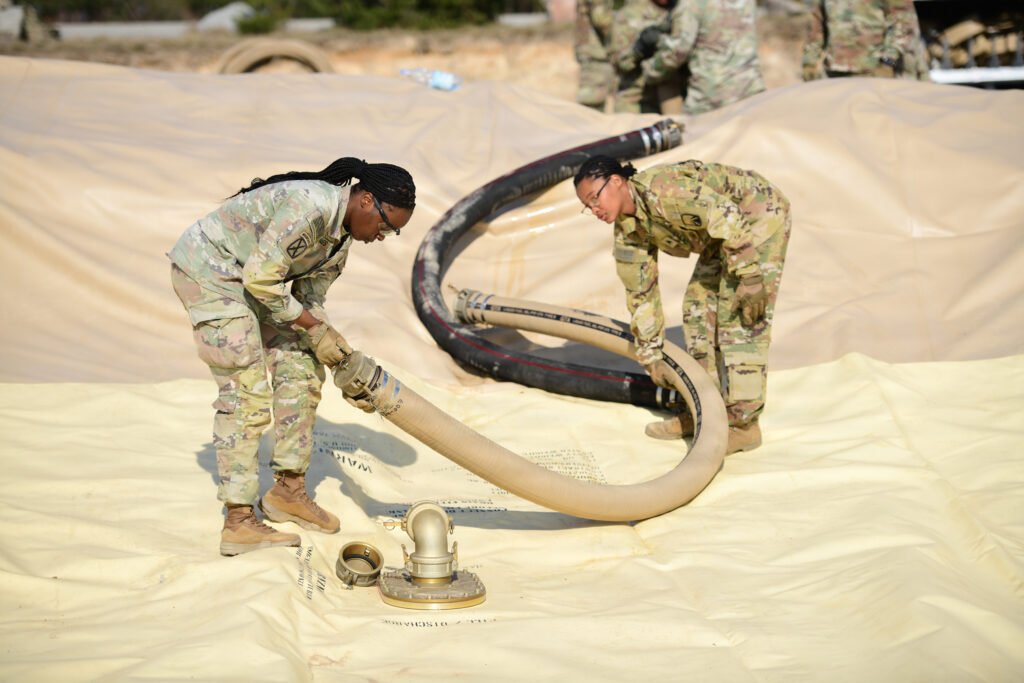
U.S. Soldiers assigned to the 493rd Petroleum Supply Company, 18th Combat Sustainment Support Battalion, execute fuel system supply point training during a Brigade evaluation at the 7th Army Training Command’s Grafenwoehr Training Area, March 5th, 2026. Within hours, 493rd PSC created an operational fueling point using collapsible fuel tanks from the FSSP , each capable of holding 20,000 gallons, with a combined holding capacity of 120,000 gallons of fuel. (U.S. Army photo by Kevin Sterling Payne)

Quality Matters as Much as Quantity

Petroleum logistics also has an unusual characteristic compared with many other supplies: the product can become unusable while it is being handled.

Water, particulate contamination or mixing incompatible products can create serious equipment problems. The longer the distribution chain becomes, the more opportunities exist for contamination during transfer, storage and transportation.

For this reason, military fuel infrastructure includes filter-separators and quality-surveillance procedures alongside pumps and tanks. The U.S. Army maintains dedicated petroleum laboratory capabilities because fuel quality management extends from production through storage and ultimately to the point where the product is issued.
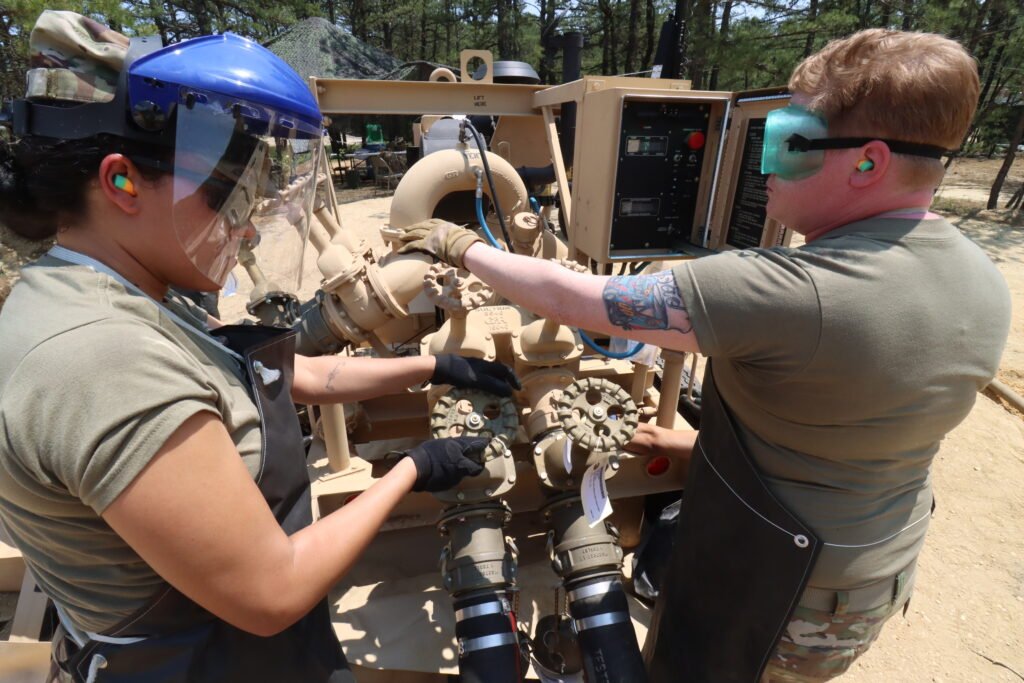
Running pumps and directing the flow of fuel into one of two storage bags, Soldiers from the 233 Quartermaster Company monitor and adjust the flow of fuel into the Fuel System Supply Point (FSSP) at ASA Fort Dix as part of QLLEX. Their tactical bulk fuel distribution site will house over 30,000 gallons of fuel for distribution during the exercise. US Army Reserve Command (USARC) Quartermaster Liquid Logistics Exercise (QLLEX) is the largest annual nation-wide logistics exercise conducted by the US Army. The Exercise Control Cell (EXCON) and the Northeast node of the exercise will be located on ASA Fort Dix and consist of 650 US Army Reserve Soldiers. (Images provided by the USASA Fort Dix Training Division / Steven Roussel)

This creates an interesting contradiction. Expeditionary logistics seeks greater flexibility, but petroleum demands procedural control. A fuel point may be rapidly deployable, yet it cannot simply be established anywhere and operated casually.

Thousands of gallons arriving at a forward location are of limited value if contamination makes the product unsuitable for the aircraft or vehicles waiting for it.

Deployable Does Not Mean Simple

Collapsible tanks create an impression of simplicity because the storage component itself appears uncomplicated. Supporting a serious expeditionary fuel operation is considerably more demanding.

Ground preparation and containment have to be considered. Pumps, filters and generators require maintenance. Hoses, valves and connections must tolerate repeated handling. Electrical grounding and fire protection are essential. Fuel inventories have to be tracked while product continuously arrives and leaves.

Damage presents another problem. Flexible storage allows considerable capacity to be deployed quickly, but a leaking tank may require fuel to be transferred elsewhere while repairs or replacement take place. Redundancy therefore has value beyond simply increasing total capacity.

Concentration is another trade-off. Putting large quantities of petroleum in a single location simplifies management and distribution, but it also creates dependence on one site. Splitting supplies between several smaller locations improves dispersion while increasing requirements for equipment, transportation and personnel.

Neither model is automatically better. The appropriate configuration depends on expected consumption, transportation capacity, geography, risk and how long the operation is expected to remain in place.

The Real Range of a Military Force

Platform specifications can give a misleading impression of military range. A vehicle might travel several hundred kilometers between refueling stops, but its operational range is ultimately connected to the distance over which its logistics network can reliably supply it.

Expeditionary fuel systems extend that network.

Their significance is not based on any revolutionary technology. Flexible tanks, pumps, filtration equipment and hoses are relatively conventional pieces of engineering. The value comes from combining them into a petroleum infrastructure that can be transported, assembled, expanded, reduced or relocated according to operational requirements.

There is something revealing about that simplicity. Some of the most advanced military platforms in service still depend on a logistics chain whose final stages may include fabric tanks, tanker trucks and long lengths of hose.

Technology can improve fuel efficiency, extend aircraft range and reduce consumption, but it cannot entirely remove the underlying logistics problem. As forces become more distributed and operations move farther from established bases, the question is no longer simply how much fuel is available.

The more useful question is whether that fuel can be placed in the right location, in usable condition, at the rate operations require.

For expeditionary forces, that may matter just as much as the range printed on the specification sheet.

Sources:

  • U.S. Army Combined Arms Support Command — U.S. Army Liquid Logistics How-To Handbook, Chapter 6: Fuel System Supply Point.
  • U.S. Army — TM 4-43.31, Petroleum Supply Operations, petroleum quality management and tactical field operations.
  • Defense Logistics Agency Energy — DLA Energy Americas, bulk petroleum receipt, storage, distribution, inventory accountability and quality assurance.
  • Defense Logistics Agency — “Forces Join Pipes for Fuel Distribution,” expeditionary offshore-to-inland petroleum distribution systems.
  • U.S. Department of Defense — Worldwide Logistics Symposium remarks on contested logistics, distributed operations and military energy requirements.
  • U.S. Air Forces Central — “332 ELRS Conducts First Hot-Pit Refuel with R-20 Expeditionary Refueling System,”.

Previous Post

What the Moscow Strike Reveals About Ukraine’s Expanding Long-Range Arsenal

Related Posts

Ukrainian_FP-5_Flamingo_long-range_cruise_missile_by_Fire_Point_at_MSPO_2026_in_Kielce
Geopolitics

What the Moscow Strike Reveals About Ukraine’s Expanding Long-Range Arsenal

September 21, 2026
Challenger_1MBT_Mk_3_(7527916878)
Geopolitics

Beyond Steel: Five Critical Minerals Behind Modern Armored Warfare

September 3, 2026
U.S. military NATO
Geopolitics

What Happens to European Security If America Steps Back?

August 28, 2026
Drone
Trade & Export Controls

The U.S. Drone Supply Chain Is Becoming a National Security Issue

August 14, 2026
REFORGER '91
Geopolitics

REFORGER and the Technical Problem Behind Military Mobility

June 24, 2026
U.S. Army Soldiers Conduct Operations in the Middle East - Patriot-Missile-Systems
Geopolitics

Patriot Systems: The Geopolitics of Air Defense in an Era of Missile Threats

June 19, 2026
  • Trending
  • Latest
Heckler_&_Koch_G3_Holzschaft_Display_noBG

HK G3: A Rifle That Stayed Longer Than Expected

April 29, 2026
FN FAL: The Right Arm of the Free World

FN FAL: The Right Arm of the Free World

March 31, 2026
MG42-1

MG42 Machine Gun: WWII History, Specifications and Battlefield Impact

April 21, 2026
Operation Enduring Freedom

What Exactly Is a Private Military Company (PMC)?

September 6, 2025
233rd QM CO establish Fuel System Supply Point (FSSP) at QLLEX

Expeditionary Fuel Systems: Keeping Military Operations Moving Beyond Permanent Bases

September 25, 2026
Ukrainian_FP-5_Flamingo_long-range_cruise_missile_by_Fire_Point_at_MSPO_2026_in_Kielce

What the Moscow Strike Reveals About Ukraine’s Expanding Long-Range Arsenal

September 21, 2026
Maritime Security: The Human Layer Behind Modern Naval Operations

Maritime Security: The Human Layer Behind Modern Naval Operations

September 16, 2026
General Atomics MQ-1 Predator

MQ-1 Predator: From ISR Platform to Armed UAV

September 8, 2026

Recent Articles

233rd QM CO establish Fuel System Supply Point (FSSP) at QLLEX

Expeditionary Fuel Systems: Keeping Military Operations Moving Beyond Permanent Bases

September 25, 2026
Ukrainian_FP-5_Flamingo_long-range_cruise_missile_by_Fire_Point_at_MSPO_2026_in_Kielce

What the Moscow Strike Reveals About Ukraine’s Expanding Long-Range Arsenal

September 21, 2026
Maritime Security: The Human Layer Behind Modern Naval Operations

Maritime Security: The Human Layer Behind Modern Naval Operations

September 16, 2026
General Atomics MQ-1 Predator

MQ-1 Predator: From ISR Platform to Armed UAV

September 8, 2026
Drill & Defense

Drill & Defense is an independent defense and security platform covering firearms, military technology, geopolitics, energy security, and industry developments. We provide clear, structured, and practical insight for professionals, companies, and readers following the evolving defense landscape worldwide.

Follow Us

Browse by Category

  • Air Systems
  • Defense & Energy Strategy
  • Defense Industry
  • Defense Know-How
  • Defense Technologies
  • Doctrines & Concepts
  • Energy & Security
  • Energy Fundamentals
  • Energy Technologies
  • Firearms
  • Geopolitics
  • Global Security
  • History
  • Industry News
  • Knowledge Base
  • Land Systems
  • Legacy Systems & Structures
  • Market Analysis
  • Market Trends & Analysis
  • Military History
  • Military Systems
  • Naval Systems
  • Oil & Gas News
  • Pistols
  • Regulations & Frameworks
  • Rifles
  • SMGs & Machine Guns
  • Strategic Turning Points
  • Tech & Innovation Crossover
  • Trade & Export Controls

Recent Articles

233rd QM CO establish Fuel System Supply Point (FSSP) at QLLEX

Expeditionary Fuel Systems: Keeping Military Operations Moving Beyond Permanent Bases

September 25, 2026
Ukrainian_FP-5_Flamingo_long-range_cruise_missile_by_Fire_Point_at_MSPO_2026_in_Kielce

What the Moscow Strike Reveals About Ukraine’s Expanding Long-Range Arsenal

September 21, 2026

© 2026 Drill & Defense. All rights reserved. Independent insights on firearms, defense, and energy. For business inquiries: info@drillanddefense.com | PRIVACY POLICY | COOKIE POLICY | TERMS AND CONDITIONS

Manage Consent

We use cookies to improve your experience. You can accept or refuse cookies; however, some features may not function properly without your consent.

Functional Always active
The technical storage or access is strictly necessary for the legitimate purpose of enabling the use of a specific service explicitly requested by the subscriber or user, or for the sole purpose of carrying out the transmission of a communication over an electronic communications network.
Preferences
The technical storage or access is necessary for the legitimate purpose of storing preferences that are not requested by the subscriber or user.
Statistics
The technical storage or access that is used exclusively for statistical purposes. The technical storage or access that is used exclusively for anonymous statistical purposes. Without a subpoena, voluntary compliance on the part of your Internet Service Provider, or additional records from a third party, information stored or retrieved for this purpose alone cannot usually be used to identify you.
Marketing
The technical storage or access is required to create user profiles to send advertising, or to track the user on a website or across several websites for similar marketing purposes.
  • Manage options
  • Manage services
  • Manage {vendor_count} vendors
  • Read more about these purposes
View preferences
  • {title}
  • {title}
  • {title}
No Result
View All Result
  • Defense Industry
    • Industry News
    • Defense Companies
    • Defense Technologies
    • Market Analysis
  • Military Systems
    • Land Systems
    • Air Systems
    • Naval Systems
    • Electronic & Cyber Systems
  • Firearms
    • Pistols
    • Rifles
    • SMGs & Machine Guns
    • Ammunition
    • Optics & Accessories
  • Geopolitics
    • Global Security
    • Defense & Energy Strategy
    • Tech & Innovation Crossover
    • Trade & Export Controls
  • Energy & Security
    • Oil & Gas News
    • Energy Technologies
    • Market Trends & Analysis
  • History
    • Military History
    • Doctrines & Concepts
    • Strategic Turning Points
    • Legacy Systems & Structures
  • Knowledge Base
    • Firearms Basics
    • Defense Know-How
    • Energy Fundamentals
    • Regulations & Frameworks
  • About
  • Contact
  • Login
  • Register

© 2026 Drill & Defense. All rights reserved. Independent insights on firearms, defense, and energy. For business inquiries: info@drillanddefense.com | PRIVACY POLICY | COOKIE POLICY | TERMS AND CONDITIONS