
Drill & Defense
Advertisement
  • Defense
    • Industry News
    • Weapon & Gear Reviews
    • Defense Technologies
    • Military Market Reports
  • Energy
    • Oil & Gas News
    • Energy Technologies
    • Market Trends & Analysis
  • Cross-Sector Insights
    • Defense & Energy Strategy
    • Global Security & Trade Analysis
    • Tech & Innovation Crossover
  • History & Legacy
    • Turning Points in Conflict
    • Legacy Systems & Structures
    • Resource Wars & Strategy
  • Knowledge Base
    • Defense Know-How
    • Energy Insight
  • About
  • Contact
  • Login
  • Register
No Result
View All Result
  • Defense
    • Industry News
    • Weapon & Gear Reviews
    • Defense Technologies
    • Military Market Reports
  • Energy
    • Oil & Gas News
    • Energy Technologies
    • Market Trends & Analysis
  • Cross-Sector Insights
    • Defense & Energy Strategy
    • Global Security & Trade Analysis
    • Tech & Innovation Crossover
  • History & Legacy
    • Turning Points in Conflict
    • Legacy Systems & Structures
    • Resource Wars & Strategy
  • Knowledge Base
    • Defense Know-How
    • Energy Insight
  • About
  • Contact
  • Login
  • Register
No Result
View All Result
Drill & Defense
No Result
View All Result
Home Defense

Russia’s Drone Campaign: Scale, Tactics, and Implications

July 22, 2025
in Defense, Industry News
FPV-drone_of_the_Southern_Group_of_Russian_troops_on_the_Donetsk_direction_(1)

Mil.ru, CC BY 4.0 , via Wikimedia Commons

Share on LinkedInShare on Twitter

In recent days, Russia has significantly intensified its use of unmanned aerial vehicles (UAVs) in the conflict with Ukraine. Over the course of a single night, 42 drones struck multiple regions including Kramatorsk, Sloviansk, Sumy, and Odesa. These attacks occurred mere hours before peace talks scheduled to begin in Istanbul. Ukrainian officials reported civilian casualties, including the death of a child and injuries to more than twenty others, highlighting the persistent threat to non-combatants.

This timing is not coincidental. Drone strikes immediately preceding peace negotiations signal a deliberate strategy—a show of force wrapped in diplomacy. The message is clear: Russia is reinforcing its position on the battlefield even as it engages in political dialogue. From a strategic standpoint, this approach mirrors a dual-track doctrine—advance militarily to gain leverage diplomatically.

Escalation Through Numbers: Russia’s Drone Surge

Recent assessments from military analysts suggest that Russia is now launching between 500 and 700 drones during its largest waves. The goal is not precision but volume—sheer saturation to overwhelm Ukrainian air defense systems. Since the beginning of the war, over 28,000 drones have been launched. According to intelligence officials, more than 10% of these were deployed in just the past month. This data paints a picture of a conflict rapidly shifting toward drone-centric warfare.

The implications are immense. Traditional air defense systems, designed for conventional threats such as missiles and aircraft, are ill-equipped to handle these massive UAV swarms. Instead of a few high-value targets, defenders must now confront dozens or hundreds of smaller, harder-to-detect threats that approach in unpredictable formations.
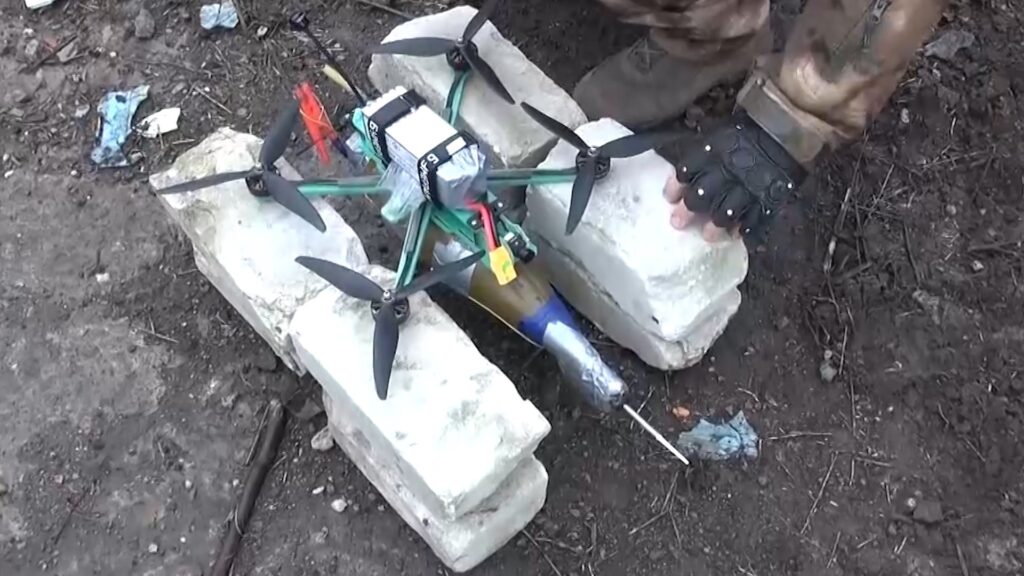
Mil.ru, CC BY 4.0 https://creativecommons.org/licenses/by/4.0, via Wikimedia Commons

Technological Advances: The Geran Model

A key player in this surge is the so-called “Geran” drone—a Russian-modified version of the Iranian Shahed-136. These drones are reportedly equipped with thermobaric warheads, capable of causing devastating overpressure damage in confined spaces. Some models now incorporate fiber-optic guidance systems, making them more resistant to electronic jamming. They are also launched from mobile platforms, including modified pickup trucks, allowing for flexible and concealed deployment even in contested territory.

Beyond their physical payloads, these drones represent an information warfare component as well. Their visible presence over civilian zones and frequent targeting of infrastructure serves to break morale, apply psychological pressure, and erode the daily routines of Ukrainian society.

Strategic Timing and Psychological Impact

The synchronization of drone attacks with peace efforts is not a new tactic, but its frequency and intensity are notable. These most recent strikes came directly before the third round of direct negotiations between Ukraine and Russia. Ukrainian President Volodymyr Zelensky has expressed willingness to hold leader-level talks, though skepticism remains high among the Ukrainian population due to the continuing attacks on civilian areas.

From the Russian perspective, the duality of diplomacy and destruction may serve multiple purposes. First, it sets the terms of negotiation under duress. Second, it aims to show internal audiences that military superiority is intact. And finally, it introduces an ambiguity that weakens Ukraine’s diplomatic standing by forcing them to negotiate under ongoing bombardment.

Ukraine’s Response and the Limits of Defense

Ukraine has been swift in adapting its defensive posture. Mobile teams using truck-mounted machine guns and MANPADS (man-portable air-defense systems) now patrol near expected drone routes. Additionally, new interceptor drones and jamming units have been deployed. Despite these efforts, the cost of defending against low-cost, mass-produced UAVs remains disproportionately high.

International support has been critical. Western countries have supplied radar systems, counter-drone software, and Patriot missile batteries. Yet these systems are expensive and often designed for larger threats. A drone that costs under $50,000 to produce may end up being shot down by a missile that costs $1 million, creating an unsustainable long-term imbalance.

The Istanbul Talks: A Hope Undermined?

The current round of Istanbul peace talks marks a crucial moment. After more than two years of war, both sides appear locked in a cycle of escalation. Ukraine, backed by Western partners, insists on sovereignty and the return of occupied territories. Russia, on the other hand, continues to present a maximalist stance while trying to secure what it already controls.

The latest attacks pose a significant threat to the success of these talks. Civilian casualties hours before negotiations erode goodwill and damage the political optics of diplomacy. Ukrainian representatives have called the timing a form of “terror diplomacy”—leveraging violence to shape the conversation around peace.

For outside observers, this development raises questions about the viability of current diplomatic channels. Can meaningful progress be achieved while one side escalates militarily? And how should the international community respond when peace talks are repeatedly overshadowed by fresh offensives?

Global Implications and Shifting Military Doctrine

The evolving role of drones in the Russia-Ukraine conflict may redefine future warfare. Russia’s high-volume, low-cost strategy contrasts with NATO’s focus on precision and deterrence. The success of this approach could encourage other actors—state and non-state alike—to pursue similar tactics.

There are also broader implications for global defense policy. As drone warfare becomes central to modern conflict, countries may be forced to reevaluate their procurement priorities. Counter-drone systems, artificial intelligence, mobile defenses, and low-cost interceptors could move to the top of defense budgets, replacing more traditional but less adaptable systems.

Moreover, the normalization of drone warfare raises ethical and legal challenges. Strikes on civilian infrastructure, ambiguity around drone origin, and the use of decoys and spoofing technologies complicate accountability in wartime. International law has yet to fully catch up with the implications of autonomous and semi-autonomous weapons systems.

Final Reflection

What we are witnessing is not merely an escalation—it is a redefinition. The Russia-Ukraine war is becoming a case study in next-generation warfare, where drones are not support tools but primary instruments of policy. The Istanbul peace talks, while symbolically significant, are taking place in the long shadow of a technological revolution unfolding above Ukraine’s cities.

For those of us watching from afar, the lesson is sobering: the age of drone diplomacy is here, and its consequences are still being written.


Sources:
AP News,

Reuters,

The Guardian,

Previous Post

Strengthening Türkiye’s Offshore Energy Fleet: A Strategic Leap Forward

Next Post

Securing the Future: Energy’s Pivotal Role in Modern Defense Strategy

Related Posts

USSPACECOM_Joint_Operations_Center_(7804714)
Defense

Deepfake Deception: The Phantom Siege Reshaping Espionage

December 3, 2025
ITAR Spotlight: Why USML Categories I, III and VIII Sit At The Heart Of Defense Export Controls
Military Market Reports

ITAR Spotlight: Why USML Categories I, III and VIII Sit At The Heart Of Defense Export Controls

November 26, 2025
Africa Partnership Station AK 47
Defense

The AK-47 Legacy in Africa

October 20, 2025
K2_(7445555272)_(cropped)
Defense

Hanwha Aerospace and South Korea’s Quiet Surge in Global Defense

October 8, 2025
F-35 Demo Team performs at the Defenders of Liberty Air & Space Show
Defense

Turkey and the F-35 Question: Is a Return to the Program Realistic?

October 1, 2025
DynCorp International: What It Does, Where It Operates, and Why It Matters
Defense

DynCorp International: What It Does, Where It Operates, and Why It Matters

September 29, 2025
Next Post
USS Dwight D. Eisenhower Deployment

Securing the Future: Energy’s Pivotal Role in Modern Defense Strategy

  • Trending
  • Comments
  • Latest
Blackwater PMC

After Blackwater: How PMCs Evolved, Professionalized, and Fragmented

September 13, 2025
Blackwater PMC

Inside Iraq’s Security Market: How Private Power Shapes a Fragile State

October 6, 2025
Operation Enduring Freedom

What Exactly Is a Private Military Company (PMC)?

September 6, 2025
Repkon Nammo in Denmark: What This Nordic Ammunition Play Really Signals

Repkon Nammo in Denmark: What This Nordic Ammunition Play Really Signals

August 21, 2025
A Historic $142 Billion Arms Deal: Unpacking the U.S.-Saudi Agreement

A Historic $142 Billion Arms Deal: Unpacking the U.S.-Saudi Agreement

A Silent Revolution on the Battlefield: AI-Enabled Tactical Communication Systems

A Silent Revolution on the Battlefield: AI-Enabled Tactical Communication Systems

Cominf.org, CC BY-SA 3.0 , via Wikimedia Commons

Is Europe Really Reducing Its Dependence on Russian Gas?

What is ITAR? The Invisible Line in Global Defense Trade

What is ITAR? The Invisible Line in Global Defense Trade

Israel’s F-15 News: What Actually Happened, and Why It Matters

Israel’s F-15 News: What Actually Happened, and Why It Matters

January 1, 2026
SDF and HTS: Managing Tension Without Open Conflict in Northern Syria

SDF and HTS: Managing Tension Without Open Conflict in Northern Syria

December 26, 2025
What 2025 Taught Us About Defense and Energy: Five Lessons for 2026

What 2025 Taught Us About Defense and Energy: Five Lessons for 2026

December 24, 2025
The New Taiwan Arms Package and China’s “Stop” Message: What Actually Changed

The New Taiwan Arms Package and China’s “Stop” Message: What Actually Changed

December 19, 2025

Recent News

Israel’s F-15 News: What Actually Happened, and Why It Matters

Israel’s F-15 News: What Actually Happened, and Why It Matters

January 1, 2026
SDF and HTS: Managing Tension Without Open Conflict in Northern Syria

SDF and HTS: Managing Tension Without Open Conflict in Northern Syria

December 26, 2025
What 2025 Taught Us About Defense and Energy: Five Lessons for 2026

What 2025 Taught Us About Defense and Energy: Five Lessons for 2026

December 24, 2025
The New Taiwan Arms Package and China’s “Stop” Message: What Actually Changed

The New Taiwan Arms Package and China’s “Stop” Message: What Actually Changed

December 19, 2025
Drill & Defense

Drill & Defense is an independent platform providing insights into firearms, defense technologies, and energy sectors. We deliver clear, practical content for professionals, enthusiasts, and industry followers worldwide.

Follow Us

Browse by Category

  • Cross-Sector Insights
  • Defense
  • Defense & Energy Strategy
  • Defense Know-How
  • Defense Technologies
  • Energy
  • Energy Insight
  • Energy Technologies
  • Global Security & Trade Analysis
  • History & Legacy
  • Industry News
  • Knowledge Base
  • Legacy Systems & Structures
  • Market Trends & Analysis
  • Military Market Reports
  • Oil & Gas News
  • Resource Wars & Strategy
  • Tech & Innovation Crossover
  • Turning Points in Conflict
  • Weapon & Gear Reviews

Recent News

Israel’s F-15 News: What Actually Happened, and Why It Matters

Israel’s F-15 News: What Actually Happened, and Why It Matters

January 1, 2026
SDF and HTS: Managing Tension Without Open Conflict in Northern Syria

SDF and HTS: Managing Tension Without Open Conflict in Northern Syria

December 26, 2025

© 2025 Drill & Defense. All rights reserved. Independent insights on firearms, defense, and energy. For business inquiries: info@drillanddefense.com | PRIVACY POLICY | COOKIE POLICY | TERMS AND CONDITIONS

Manage Consent

We use cookies to improve your experience. You can accept or refuse cookies; however, some features may not function properly without your consent.

Functional Always active
The technical storage or access is strictly necessary for the legitimate purpose of enabling the use of a specific service explicitly requested by the subscriber or user, or for the sole purpose of carrying out the transmission of a communication over an electronic communications network.
Preferences
The technical storage or access is necessary for the legitimate purpose of storing preferences that are not requested by the subscriber or user.
Statistics
The technical storage or access that is used exclusively for statistical purposes. The technical storage or access that is used exclusively for anonymous statistical purposes. Without a subpoena, voluntary compliance on the part of your Internet Service Provider, or additional records from a third party, information stored or retrieved for this purpose alone cannot usually be used to identify you.
Marketing
The technical storage or access is required to create user profiles to send advertising, or to track the user on a website or across several websites for similar marketing purposes.
  • Manage options
  • Manage services
  • Manage {vendor_count} vendors
  • Read more about these purposes
View preferences
  • {title}
  • {title}
  • {title}
No Result
View All Result
  • Defense
    • Industry News
    • Weapon & Gear Reviews
    • Defense Technologies
    • Military Market Reports
  • Energy
    • Oil & Gas News
    • Energy Technologies
    • Market Trends & Analysis
  • Cross-Sector Insights
    • Defense & Energy Strategy
    • Global Security & Trade Analysis
    • Tech & Innovation Crossover
  • History & Legacy
    • Turning Points in Conflict
    • Legacy Systems & Structures
    • Resource Wars & Strategy
  • Knowledge Base
    • Defense Know-How
    • Energy Insight
  • About
  • Contact
  • Login
  • Register

© 2025 Drill & Defense. All rights reserved. Independent insights on firearms, defense, and energy. For business inquiries: info@drillanddefense.com | PRIVACY POLICY | COOKIE POLICY | TERMS AND CONDITIONS