

The Oshkosh M1070 Heavy Equipment Transporter is one of those military vehicles that rarely receives the same attention as the combat platforms it carries. Yet in practical terms, it is directly connected to the movement, readiness, and sustainability of heavy armored forces.

A main battle tank may dominate the visual side of armored warfare, but moving that tank across long distances is a separate military problem. Tracked vehicles are not ideal for extended road marches. They consume large amounts of fuel, increase maintenance pressure, create road-wear issues, and can arrive at the operational area with unnecessary mechanical fatigue. Heavy Equipment Transporters are designed to reduce that burden.
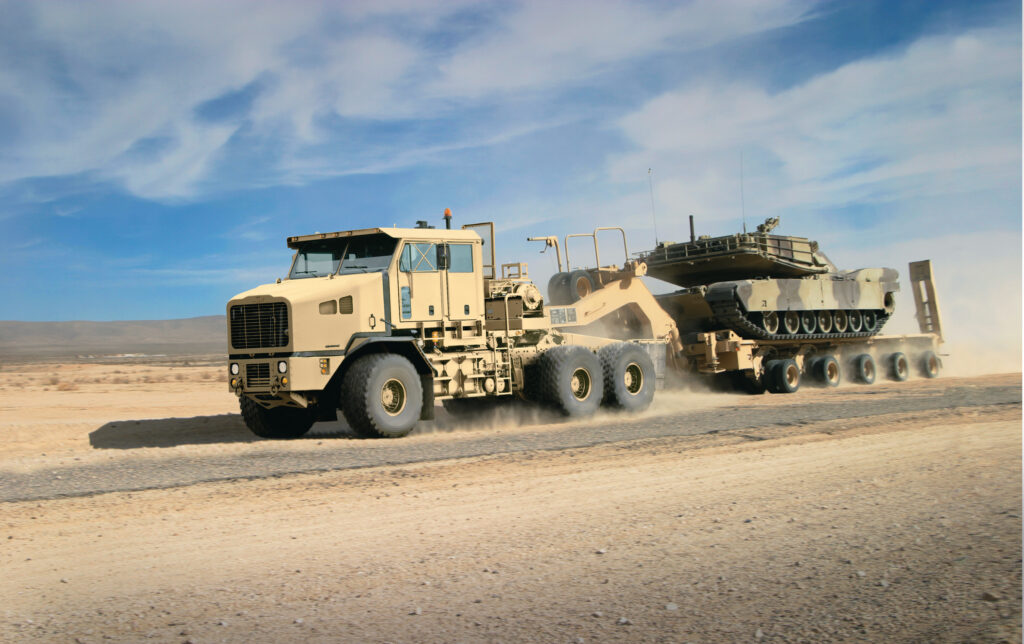
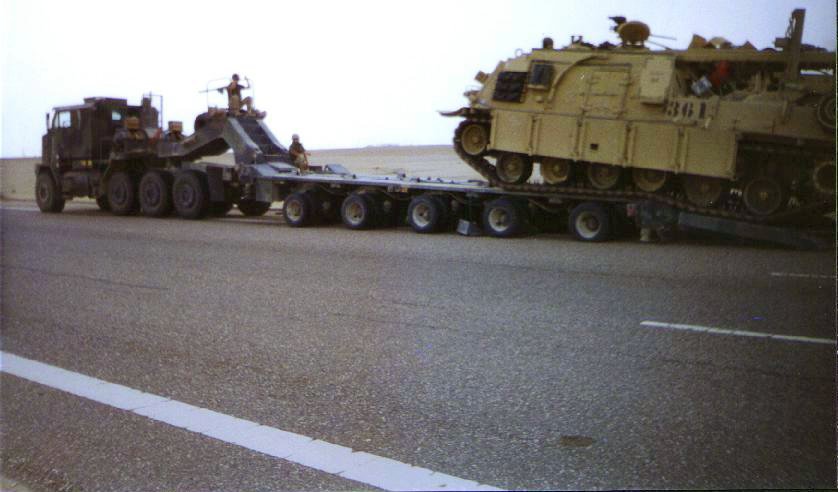
The Oshkosh M1070 HET, especially when paired with the M1000 semi-trailer, forms a transport system capable of moving extremely heavy military vehicles such as the M1 Abrams main battle tank, armored recovery vehicles, combat engineering platforms, and other oversized military equipment. It is not a combat vehicle in the traditional sense, but it directly supports the combat value of the vehicles it transports.
A Transporter Built Around Weight
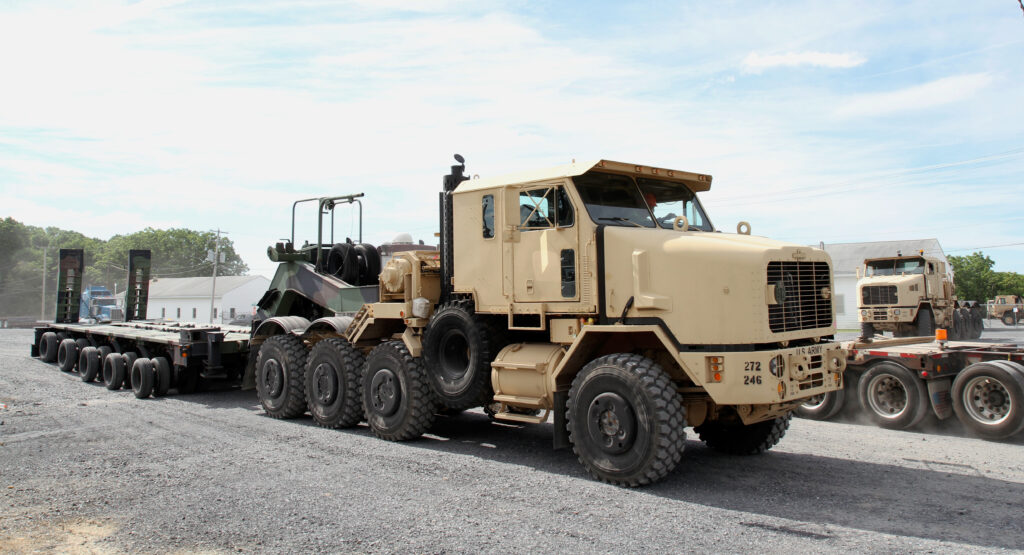
The M1070 is not simply a commercial heavy truck adapted for military use. It is an 8×8 heavy tractor unit designed for military transport missions involving exceptional weight, difficult loading requirements, and long-distance movement. Its layout reflects the demands of moving vehicles that may weigh more than many road bridges, civilian trailers, or commercial trucks are designed to handle.
The original M1070 was powered by a Detroit Diesel 8V92TA diesel engine, producing around 500 horsepower, and was paired with an automatic transmission suitable for heavy-haul work. Later development led to the M1070A1 HET A1, which introduced a more powerful Caterpillar C18 diesel engine rated at about 700 horsepower and an Allison 4800SP automatic transmission.
That power increase was not only about speed. A heavy transporter needs torque, controlled movement, reliability under load, and the ability to manage difficult terrain, gradients, and convoy conditions. With a payload such as an M1 Abrams on the trailer, the vehicle is not operating in a normal transport environment. It is moving a combat platform that can weigh around 60 to 70 tons depending on configuration.
The M1070A1 also includes features such as central tire inflation, all-wheel drive, anti-lock braking, and a six-person cab. The cab capacity is important because the vehicle can transport not only the driver and co-driver, but also crew members from the vehicle being carried.
The M1000 Trailer and the Full HET System
The M1070 is usually discussed together with the M1000 Heavy Equipment Transporter semi-trailer. This is important because the real capability comes from the tractor and trailer combination, not the tractor alone.
The M1000 trailer is a multi-axle, heavy-duty trailer designed to distribute extreme loads more effectively. It uses a large number of wheels and axles to reduce ground pressure and improve load distribution. This matters when transporting armored vehicles over road networks that may not always be designed for such concentrated weight.
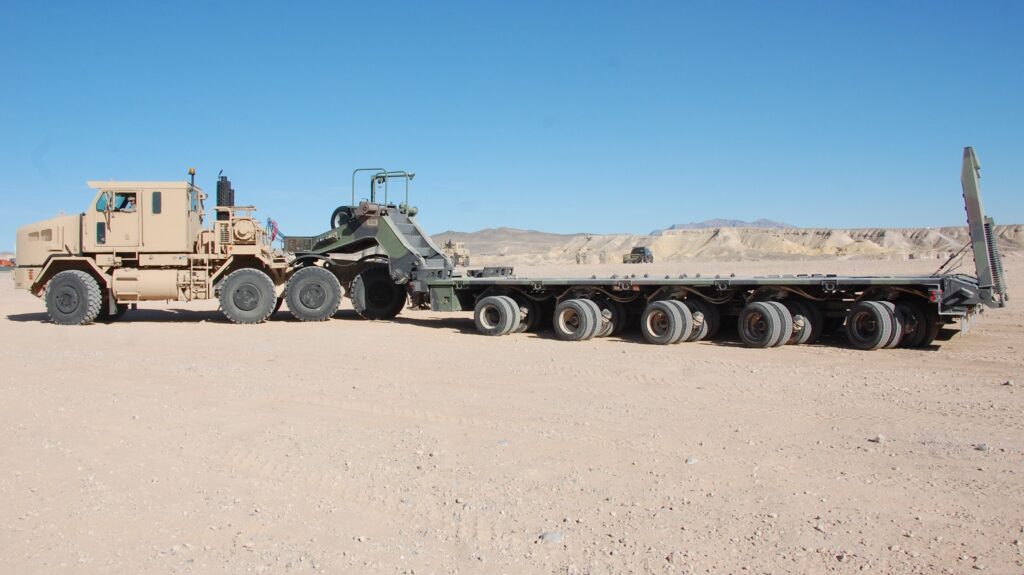
The HET system has commonly been associated with a payload capacity of around 70 tons, depending on source, configuration, and operational conditions. That capacity places it in the category needed for transporting heavy armored platforms such as the Abrams. The trailer also has loading ramps and a structure designed for tracked vehicles, not only wheeled machinery.
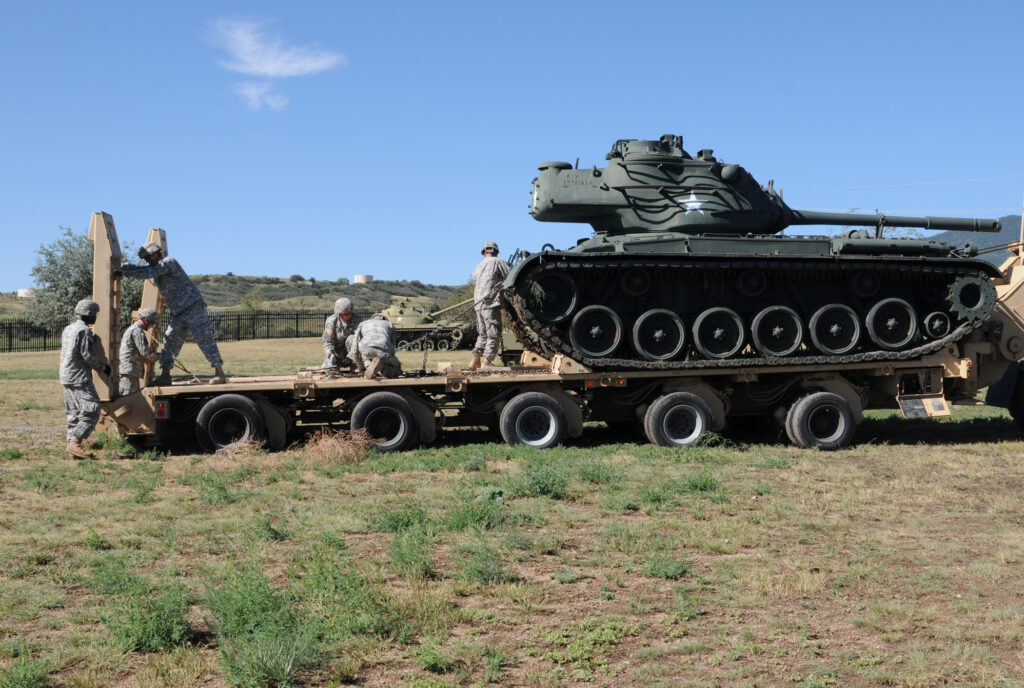
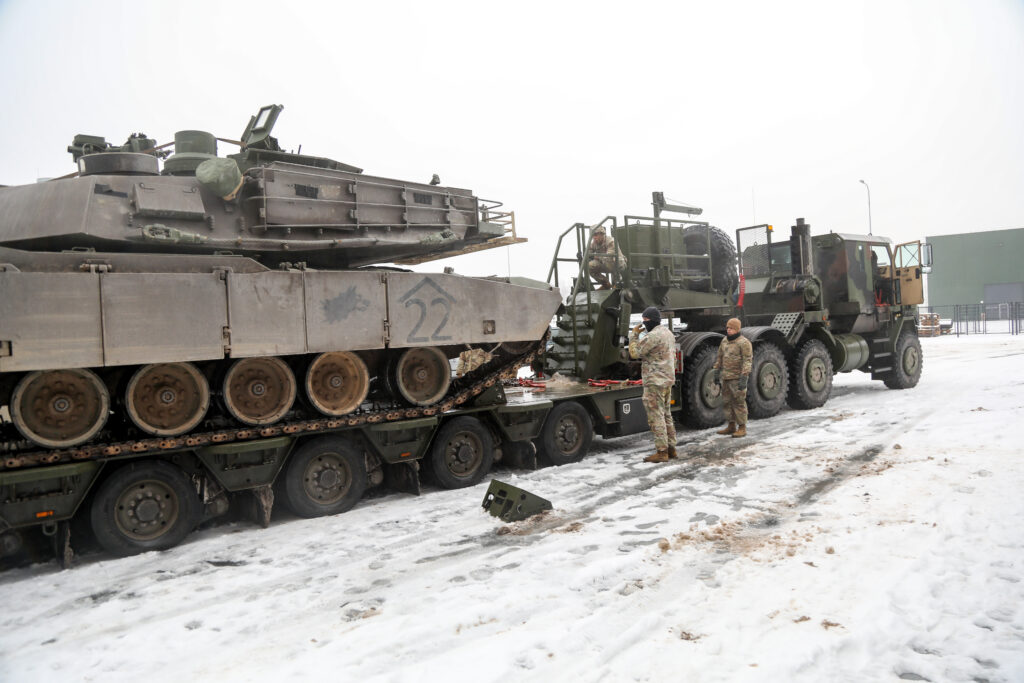
Loading a tank onto a transporter is not a simple driving task. Alignment, ramp angle, surface condition, center of gravity, braking, securing chains, and operator coordination all matter. A mistake can damage the transported vehicle, the trailer, or both. For that reason, HET crews need specific training rather than ordinary heavy truck experience alone.
Why Tanks Are Transported Instead of Driven
A main battle tank can move under its own power, but that does not mean it should be used for every long-distance movement.
Tracked vehicles are mechanically demanding. Long road movement wears tracks, road wheels, suspension components, engines, and transmissions. It also increases fuel consumption before the vehicle has reached the area where its combat capability is needed. In military logistics, preserving mechanical life is not a minor detail. It affects availability rates, maintenance planning, and operational tempo.
Using an M1070 HET allows a heavy force to move its tracked vehicles while reducing unnecessary wear. The tank arrives closer to the mission area with less mileage on its own systems. The crew also avoids part of the fatigue linked to long road movement inside a tracked armored vehicle.
This is especially relevant for forces that need to redeploy across large distances. Heavy transporters make it easier to move armored platforms between bases, ports, railheads, training areas, maintenance facilities, and operational zones.
Technical Profile of the M1070A1
The M1070A1 represents the modernized version of the HET concept. While details can vary according to configuration and user, the vehicle is generally associated with the following technical characteristics:
The vehicle uses an 8×8 drive configuration, giving it better traction than a conventional road tractor. This is valuable when operating on unimproved surfaces, military roads, training areas, or locations where road quality is limited.
Its Caterpillar C18 diesel engine provides around 700 horsepower, giving the system the power needed for heavy loads. The Allison 4800SP automatic transmission supports controlled heavy-haul operation and reduces the workload on the driver compared with manual systems in such demanding conditions.
The M1070A1 has a six-person cab, which supports movement of vehicle crews together with the transported platform. It also features two heavy winches, which can assist with loading disabled or non-running vehicles onto the trailer. This is especially important because not every vehicle requiring movement will be fully operational.
The vehicle’s central tire inflation system allows tire pressure adjustment for different terrain conditions. Lower pressures can improve traction on soft ground, while higher pressures are suitable for road movement. This gives the operator more flexibility across varied routes.
Braking and stability are also critical. A tractor and trailer combination carrying a main battle tank creates serious momentum. Safe downhill movement, convoy braking, and emergency stopping are not small concerns. The M1070A1 includes braking and control systems designed around the realities of moving extreme loads.
Recovery, Engineering, and Non-Tank Loads
The M1070 HET is most often associated with the Abrams, but its relevance is broader.
Armored forces rely on many heavy vehicles that are not tanks. Armored recovery vehicles, bridging systems, mine-clearing equipment, combat engineering vehicles, bulldozers, and heavy construction machinery may all require transport. Some of these platforms are essential for keeping routes open, recovering damaged vehicles, or preparing positions.
This gives the M1070 a wider role inside the mobility chain. It does not only move combat platforms. It can also move the support platforms that allow combat units to continue operating.
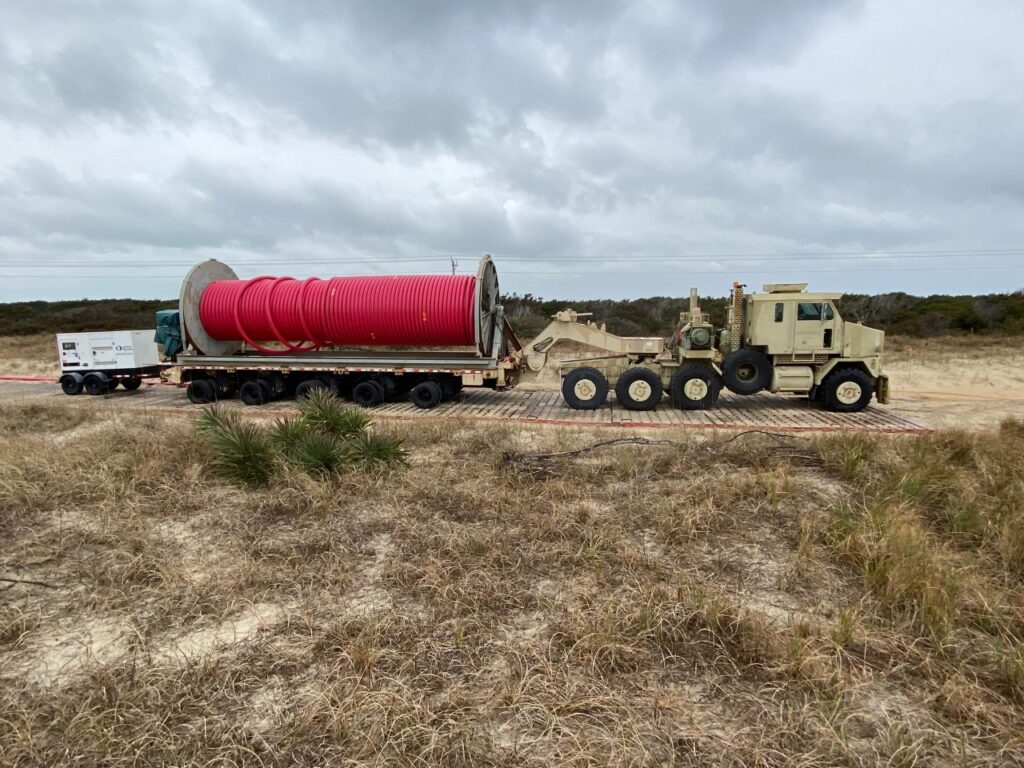
For example, a damaged armored vehicle may not be able to drive onto a trailer under its own power. In such cases, the transporter’s winches and crew training become important. The ability to move disabled equipment away from the operational area supports repair, recovery, and equipment preservation.
Route Planning and Infrastructure Limits
A vehicle like the M1070 HET cannot be used effectively without careful route planning.
The combined weight of the tractor, trailer, and cargo can create major restrictions. Bridges must be assessed. Road surfaces must be considered. Urban turns, tunnels, slopes, overhead clearance, and soft shoulders can all create problems. A transporter carrying a tank is not as flexible as a lighter tactical vehicle.
Military planners also need to consider convoy protection and movement timing. A heavy transporter is large, relatively slow compared with lighter vehicles, and difficult to conceal. In a contested environment, logistics routes can become targets. Transporters may require security, route clearance, electronic warfare support, air defense coverage, or movement under limited visibility conditions.
This is one reason heavy logistics is not only a rear-area subject. In modern warfare, the movement of heavy equipment can be exposed to drones, long-range fires, mines, sabotage, and surveillance. The M1070 gives mobility, but that mobility still has to be protected and planned.
The British 1070F Variant
The Oshkosh heavy transporter concept is also used outside the United States. The British Army operates the Oshkosh 1070F 8×8 tractor truck with the King Trailer GTS 100 seven-axle semi-trailer as part of its Heavy Equipment Transporter capability.
The British 1070F is also powered by a Caterpillar C18 engine, rated at around 700 bhp, and is used to transport heavy armored vehicles such as main battle tanks. The British system reflects the same basic requirement faced by any army operating heavy armor: tanks and other heavy platforms need reliable long-distance transport.
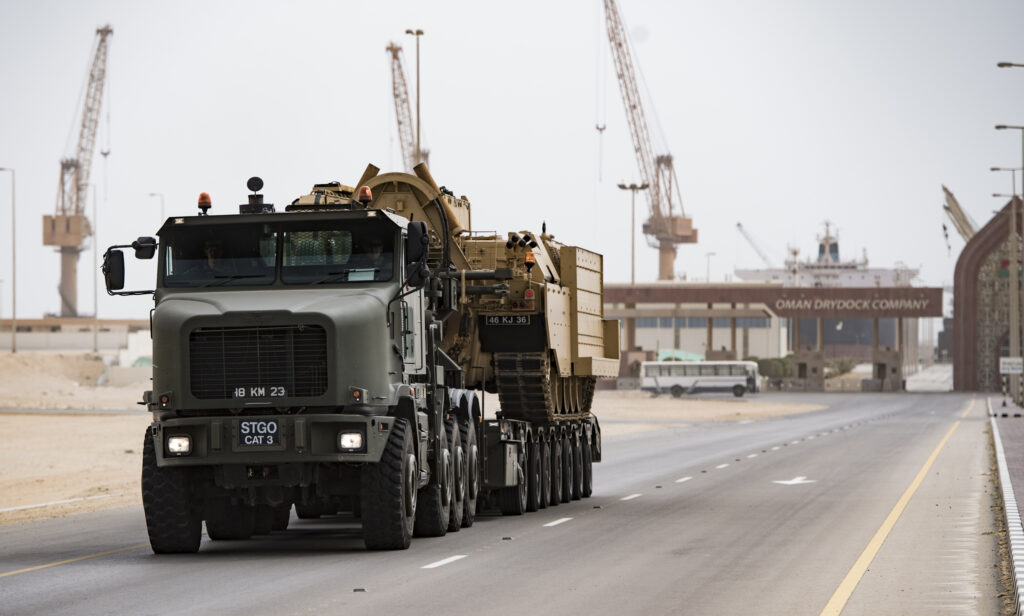
This allied use is worth noting because it shows the wider relevance of heavy equipment transporters. Armored mobility is not only about the vehicle’s own engine. It is also about the transport architecture around that vehicle.
Strengths and Limitations
The M1070 HET has several clear strengths. It can transport very heavy vehicles, reduce mechanical wear on tracked platforms, support long-distance redeployment, and assist in recovery-related movement. Its powertrain, 8×8 configuration, winches, and trailer pairing make it suitable for a specialized role that ordinary tactical trucks cannot perform.
Its limitations are also clear. It is large, expensive to operate, dependent on trained crews, and sensitive to route restrictions. It requires fuel, maintenance, spare parts, suitable roads, and movement planning. It can also become a high-value target because its loss can delay the movement of heavy equipment.
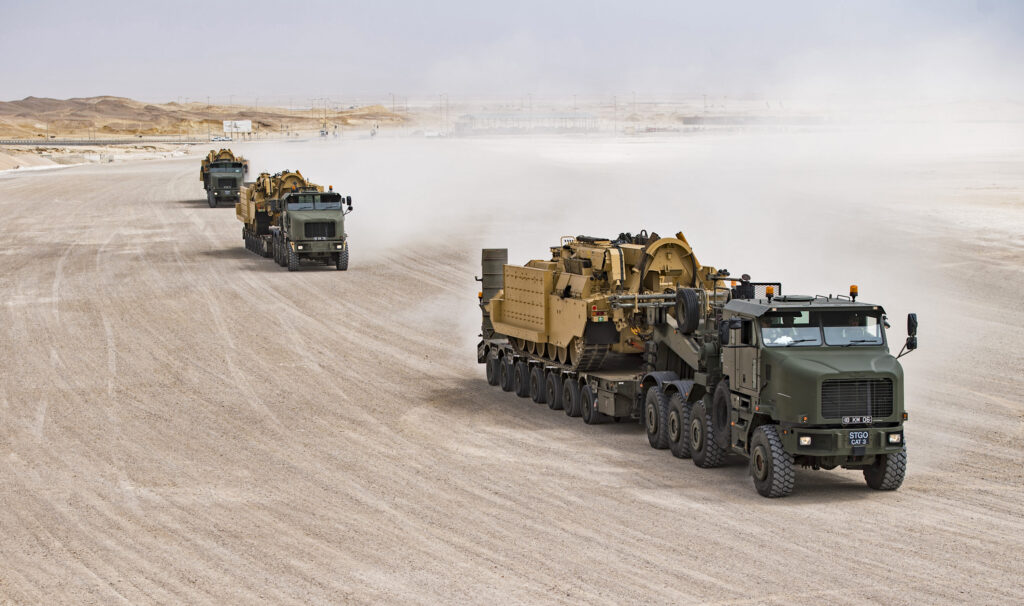
The transporter does not remove the difficulty of heavy armored warfare. It manages part of that difficulty. That distinction matters. The M1070 is a logistics enabler, but it still depends on the wider system around it.
Why the M1070 Still Matters
The increased visibility of drones, loitering munitions, and long-range precision fires has changed how armies think about movement. Large vehicles are easier to detect than before, and logistics convoys can no longer assume safety simply because they are behind the front line.
Even so, heavy equipment has not disappeared from modern warfare. Tanks, recovery vehicles, air defense systems, engineering vehicles, and heavy artillery support assets still need to move. The question is not whether heavy equipment transport remains necessary. The question is how it can be done with better protection, planning, dispersion, and timing.
The Oshkosh M1070 HET remains relevant because it solves a basic problem that modern armies still face: how to move extremely heavy military equipment without consuming the equipment’s own mechanical life before it is needed.
A tank’s combat value depends on more than armor and firepower. It also depends on whether it can be delivered, recovered, repaired, and redeployed. The M1070 HET supports that chain. It is not the most visible part of armored warfare, but it is one of the systems that makes heavy armored operations physically possible.
Sources:
- Oshkosh Defense, “HET A1 | Heavy Equipment Transporter.”
- Oshkosh Defense, “HET A1 | M1070A1 Heavy Equipment Transporter” specification sheet.
- The British Army, “Heavy Equipment Transporter (HETS).”
- U.S. Army Reserve, “443rd Transportation Company Heavy Equipment Transporter Training.”