
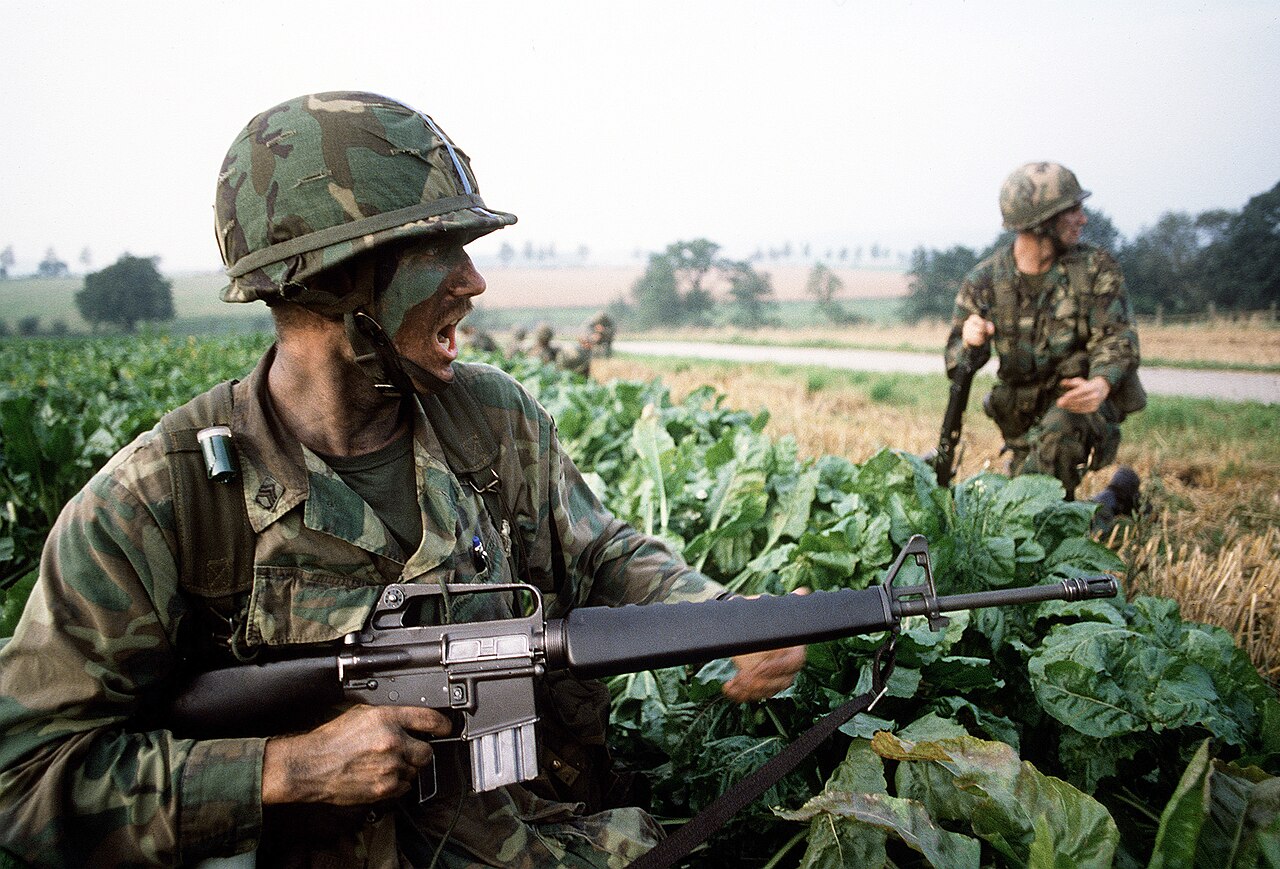
REFORGER, or Return of Forces to Germany, was not just a Cold War exercise series. It was a practical test of whether the United States could move combat forces from North America to Europe, link them with equipment already stored on the continent, and generate usable NATO combat power before a crisis on the Central Front moved beyond control. The first REFORGER exercise took place in 1969, and the series continued until 1993, with 1989 being the major exception.

The original logic came from a difficult NATO problem. The United States could not keep every required formation permanently stationed in Europe, but any reduction in forward presence had to be balanced by a credible reinforcement mechanism. REFORGER was the visible proof that U.S. units could return to Europe, draw equipment, move through host-nation infrastructure, and operate under NATO command arrangements.
That made the exercise more than a deployment drill. It was a test of time, tonnage and friction. Time meant how quickly troops could arrive. Tonnage meant how much heavy equipment, ammunition, fuel and support matériel had to be moved or drawn from storage. Friction meant everything that slows a force down: paperwork, rail availability, maintenance faults, bridge limits, route congestion, communications problems, weather, host-nation procedures and command coordination.
REFORGER 88 Shows the Scale
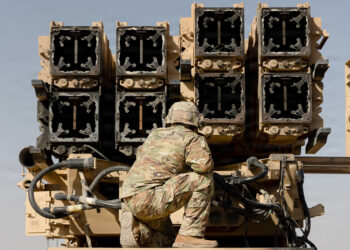
The best way to understand the technical weight of REFORGER is to look at REFORGER 88, Certain Challenge. It was one of the largest exercises in the series and involved approximately 125,000 soldiers from the United States and several NATO allies. The field exercise included about 15,000 wheeled vehicles, 7,000 tracked vehicles, roughly 1,095 main battle tanks, 795 anti-tank missile launchers, 400 artillery pieces, 92 M270 multiple-launch rocket systems, and 631 helicopters, including around 200 combat and anti-tank helicopters.
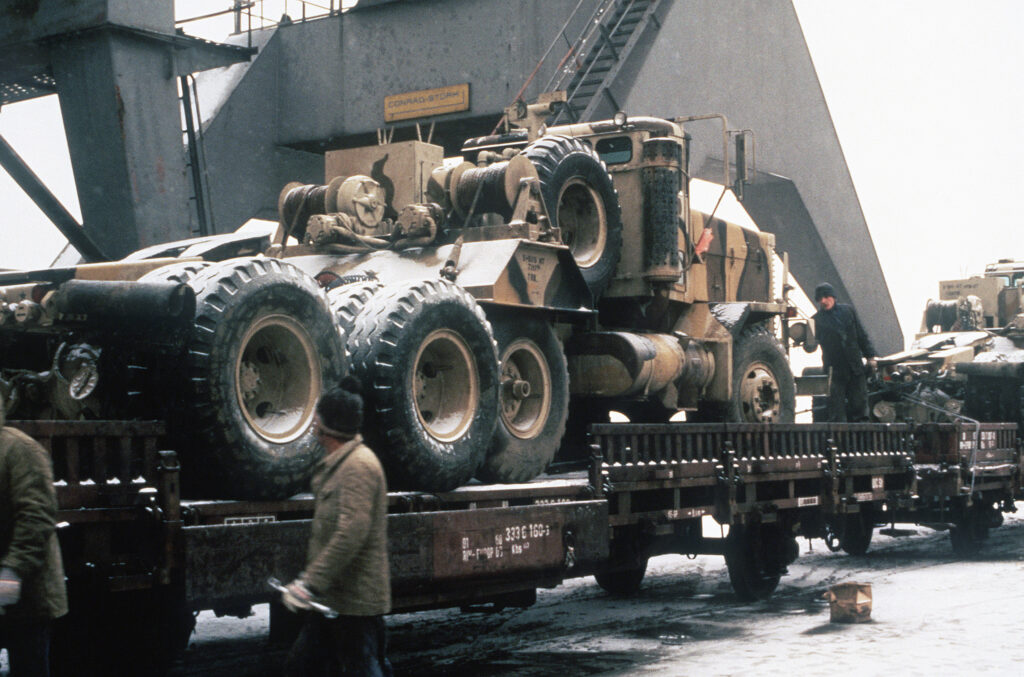
Those numbers matter because they show the exercise was not symbolic. Moving a few battalions is difficult enough. Moving corps-level formations with tanks, recovery vehicles, artillery, helicopters, fuel trucks, engineer equipment, communications vehicles and maintenance assets creates a different problem entirely. A single main battle tank may weigh more than 50 tons depending on model and configuration. A heavy armored formation requires not only tanks, but also bridging units, recovery vehicles, ammunition carriers, fuel distribution, repair parts, medical support and traffic control.
REFORGER 88 was conducted under the AirLand Battle context and involved major U.S. corps structures in Europe, including V Corps and VII Corps. Contemporary accounts note that V Corps alone fielded more than 50,000 troops in the field training exercise, with VII Corps providing a comparable opposing structure. This is important because the exercise was not only testing arrival in Europe. It was also testing whether large formations could maneuver once they had arrived.
POMCUS Was the Technical Center of the System
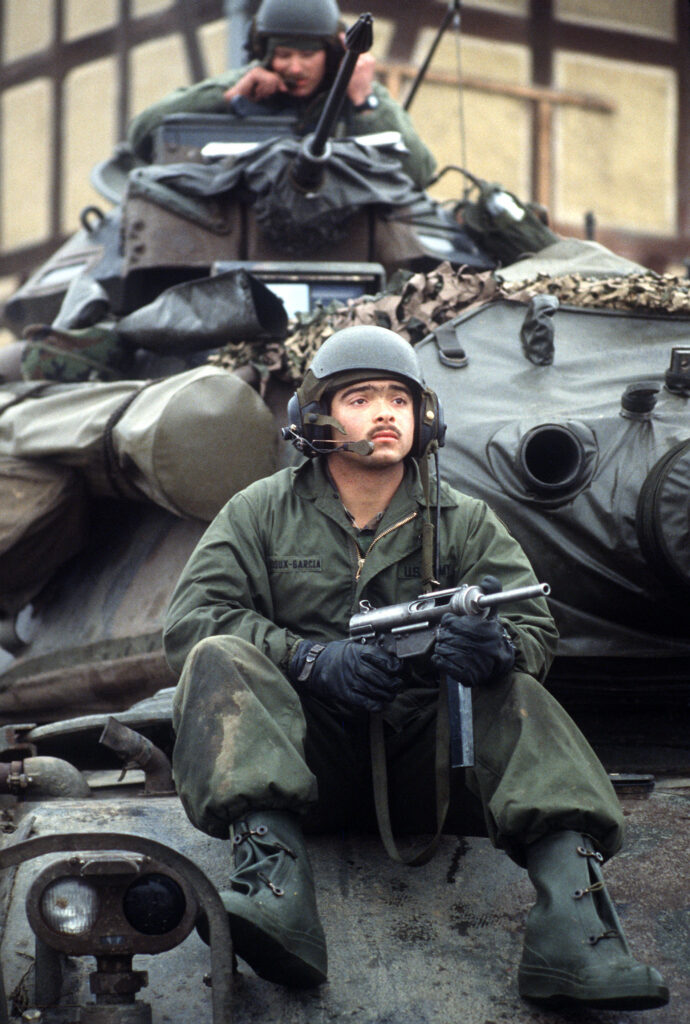
The key technical mechanism behind REFORGER was POMCUS, meaning Prepositioning of Materiel Configured in Unit Sets. The idea was to store heavy equipment in Europe in organized unit packages, so U.S.-based soldiers could fly in and draw the vehicles, weapons and support equipment they would need.
This solved one major problem: airlift can move personnel quickly, but it cannot move an entire heavy division’s equipment at speed. Tanks, armored personnel carriers, self-propelled artillery, engineer vehicles, tank transporters and large quantities of ammunition require sealift or pre-positioning. POMCUS reduced the need to ship everything across the Atlantic after a crisis had already started.
But POMCUS also created a readiness challenge. A vehicle stored in a depot is not automatically ready to fight. It requires battery maintenance, fluid checks, track inspection, optics, radios, weapons function checks, calibration, tire condition checks for wheeled vehicles, recovery equipment, tools and repair parts. REFORGER therefore tested a chain of events: arrival of personnel, equipment issue, maintenance recovery, loading of ammunition, communications setup, convoy formation and movement to assembly areas.
The U.S. Army’s own historical material describes REFORGER as a way to deploy, operate and exercise pre-positioned equipment, which also helped ensure that stored equipment was rotated and maintained. That point is important for today. Pre-positioned stocks are not only a storage concept. They are a maintenance, inventory and readiness system.
Rail, Roads and Bridges Were Not Background Details
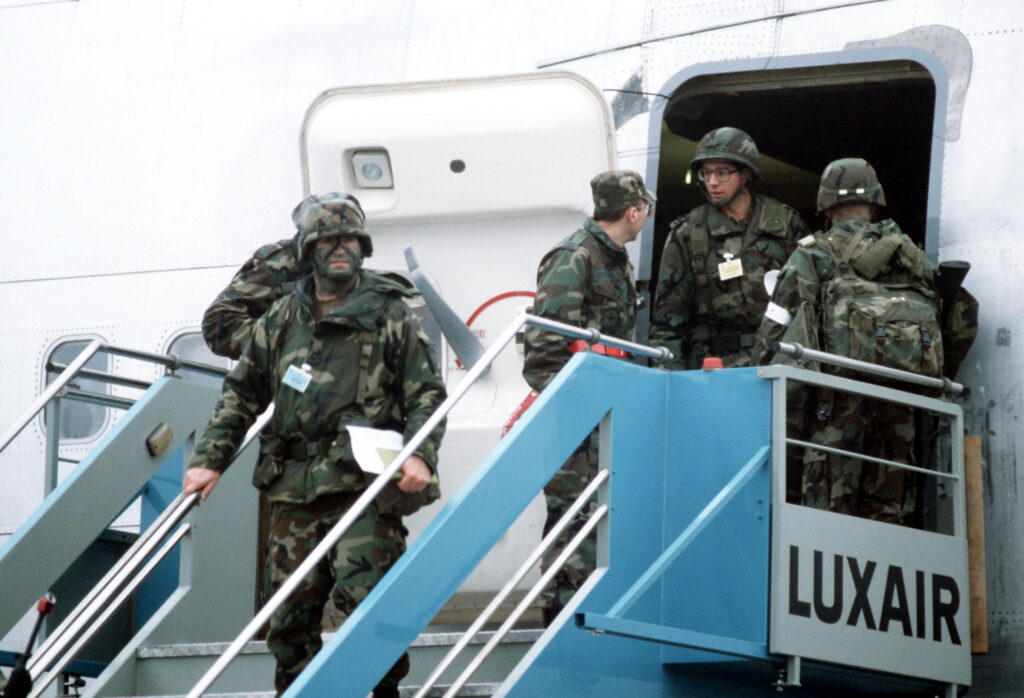
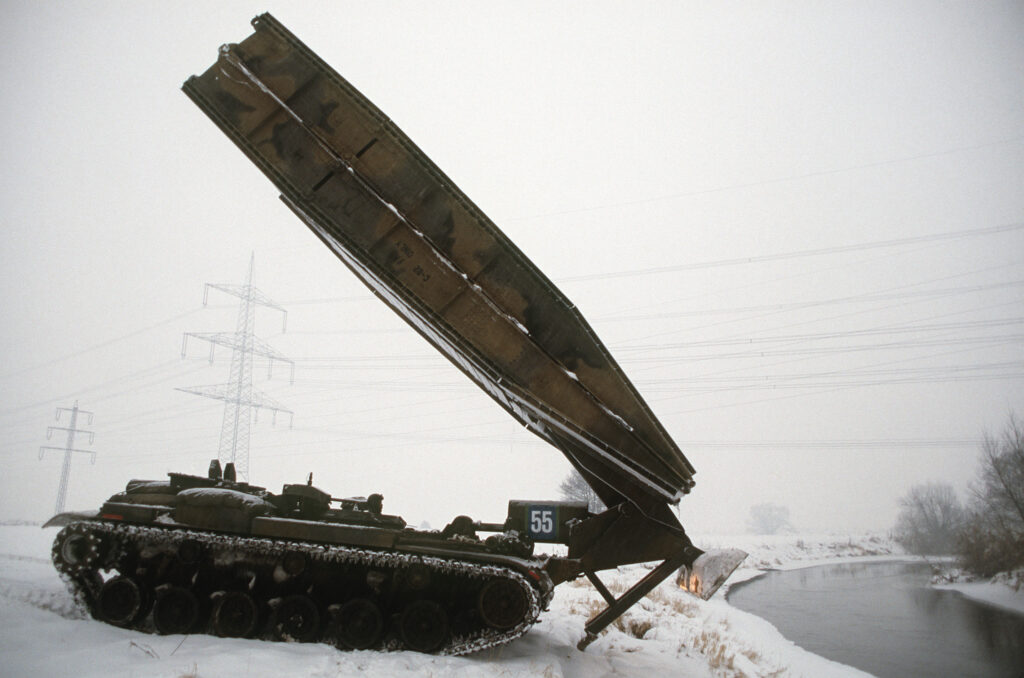
Heavy force movement in Europe depends on infrastructure. During REFORGER, railheads, autobahns, bridges, depots, ports and airfields were all part of the exercise architecture. A tank battalion cannot simply appear at the tactical line. It has to move through a sequence of reception, staging, onward movement and integration.
Rail was especially important because moving tracked vehicles long distances by road consumes track life, fuel and maintenance capacity. However, rail movement has its own restrictions. Railcars must be suitable for heavy armored vehicles. Loading ramps must be available. Tunnel clearances and bridge capacity matter. In modern European mobility debates, loading gauge, rail gauge and route classification remain serious issues, especially when moving heavy equipment across multiple national systems.
Road movement creates another set of problems. NATO uses the concept of Military Load Classification, or MLC, to classify whether roads, bridges and routes can support specific military loads. The lowest-rated bridge or route segment can become the limiting factor for the whole movement plan. For armored units, this is not theoretical. A bridge that cannot carry a tank, armored recovery vehicle or heavy equipment transporter forces rerouting, delays or engineering support.
That is why REFORGER remains useful as a case study. It treated mobility as an operational function, not an administrative detail.
Modern Europe Has a Similar Problem in a Different Form
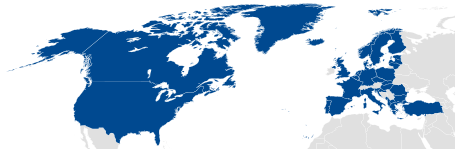
The current European military mobility problem is not identical to the Cold War version. During REFORGER, the main focus was reinforcement of West Germany and the Central Front. Today, the geography is wider. NATO’s eastern flank includes Poland, the Baltic states, Romania, the Black Sea region, Finland and northern reinforcement routes. The movement problem is therefore more dispersed.
Modern Europe also has a more complicated threat environment. Long-range precision fires, drones, cyber attacks, sabotage, electronic warfare and commercial satellite imagery can affect ports, rail nodes, fuel depots and staging areas. This means that reinforcement routes must be not only fast, but also resilient and protected.
The European Union has recognized this through its military mobility initiatives. Recent EU work has focused on dual-use transport infrastructure, cross-border procedures, rail and road upgrades, ports, inland waterways and the removal of administrative barriers. Public reporting has also highlighted the scale of the problem: outdated bridges, narrow tunnels, incompatible rail systems, limited heavy-load capacity and slow border procedures can all delay military movement.
One recent Financial Times report described a European ambition to reduce some troop and equipment movement timelines from around 45 days toward 3 to 5 days in certain scenarios. Another report cited EU plans involving €17 billion for hundreds of critical mobility projects. These figures should not be treated as a perfect operational measure for every scenario, but they show the same basic problem that REFORGER tested decades ago: moving forces across Europe is a technical, legal and infrastructural challenge.
The Real Technical Lesson
The technical lesson from REFORGER is not that NATO should recreate the same Cold War exercise exactly. The lesson is that reinforcement credibility depends on tested systems. Troops, vehicles and equipment are only part of the answer. The real system includes ports, railcars, bridge ratings, depots, fuel points, maintenance capacity, movement permissions, host-nation support, communications, air defense for logistics nodes and the ability to repair infrastructure under pressure.
This is why pre-positioned stocks alone are not enough. A warehouse full of vehicles does not equal a ready brigade. A ready brigade requires crews, maintainers, ammunition, fuel, spare parts, route clearance, recovery assets and command integration. It also requires realistic exercises that expose where the plan breaks.
REFORGER belongs to the Cold War, but its technical logic is highly relevant to today’s European defense debate. The central question is still practical: can NATO move heavy combat power across Europe fast enough, in enough volume, with enough sustainment, and through infrastructure that may itself be under pressure? For defense planning, that question is more important than the nostalgia around the exercise name.
Sources:
- U.S. Army University Press, Demonstrating Rapid Reinforcement of NATO: Return of Forces to Germany (REFORGER).
- Tankograd, REFORGER 88 Certain Challenge: The End of an Era.
- J. J. Raadschelders, Redeployment of Forces to Germany (REFORGER), Ohio State University Knowledge Bank.
- Douglas I. Bell, U.S. Army Heritage and Education Center, Just Add Soldiers: Army Prepositioned Stocks and Agile Force Projection.
- NATO, NATO’s Role in Logistics.
- European Commission, Military Mobility.
- Atlantic Council, Enhancing Land Military Mobility in Europe: Advocating a Pragmatic Approach