
Drill & Defense
Advertisement
  • Defense Industry
    • Industry News
    • Defense Companies
    • Defense Technologies
    • Market Analysis
  • Military Systems
    • Land Systems
    • Air Systems
    • Naval Systems
    • Electronic & Cyber Systems
  • Firearms
    • Pistols
    • Rifles
    • SMGs & Machine Guns
    • Ammunition
    • Optics & Accessories
  • Geopolitics
    • Global Security
    • Defense & Energy Strategy
    • Tech & Innovation Crossover
    • Trade & Export Controls
  • Energy & Security
    • Oil & Gas News
    • Energy Technologies
    • Market Trends & Analysis
  • History
    • Military History
    • Doctrines & Concepts
    • Strategic Turning Points
    • Legacy Systems & Structures
  • Knowledge Base
    • Firearms Basics
    • Defense Know-How
    • Energy Fundamentals
    • Regulations & Frameworks
  • About
  • Contact
  • Login
  • Register
No Result
View All Result
  • Defense Industry
    • Industry News
    • Defense Companies
    • Defense Technologies
    • Market Analysis
  • Military Systems
    • Land Systems
    • Air Systems
    • Naval Systems
    • Electronic & Cyber Systems
  • Firearms
    • Pistols
    • Rifles
    • SMGs & Machine Guns
    • Ammunition
    • Optics & Accessories
  • Geopolitics
    • Global Security
    • Defense & Energy Strategy
    • Tech & Innovation Crossover
    • Trade & Export Controls
  • Energy & Security
    • Oil & Gas News
    • Energy Technologies
    • Market Trends & Analysis
  • History
    • Military History
    • Doctrines & Concepts
    • Strategic Turning Points
    • Legacy Systems & Structures
  • Knowledge Base
    • Firearms Basics
    • Defense Know-How
    • Energy Fundamentals
    • Regulations & Frameworks
  • About
  • Contact
  • Login
  • Register
No Result
View All Result
Drill & Defense
No Result
View All Result
Home Geopolitics

VBSS: Visit, Board, Search and Seizure in Maritime Security

May 26, 2026
in Geopolitics, Defense & Energy Strategy
U.S. Navy SEALs, Chilean Navy SF, SOF Conduct VBSS Training

A Chilean Navy Special Forces operator climbs a ladder for visit, board, search and seizure (VBSS) training with U.S. East Coast-based Naval Special Warfare Operators (SEALs) aboard the Chilean Navy replenishment oiler CNS Almirante Montt (AO-52) during SOUTHERN STAR ‘25 in Valparaíso, Chile, May 28, 2025. SOUTHERN STAR ’25 is a multinational special operations exercise taking place across Chile from May 26 to June 8. The exercise brings together forces from six nations and 10 observer countries, totaling more than 2,700 participants, to enhance interoperability and strengthen global special operations partnerships through joint training from Antofagasta to Punta Arenas. (U.S. Navy photo by Mass Communication Specialist 1st Class Leon Wong)

Share on LinkedInShare on Twitter

Maritime security is usually discussed through patrols, ports, chokepoints, sanctions, piracy, and commercial shipping routes. Yet many of these issues eventually come down to a much more direct action: approaching a vessel, getting a team on board, checking who is operating it, inspecting what it carries, and deciding whether the ship is acting within the law.

This process is known as VBSS: Visit, Board, Search and Seizure. The name is technical, but the logic is straightforward. A vessel is visited, boarded, searched, and, when the legal basis exists, seized or detained.

The operation may be linked to piracy, narcotics trafficking, arms smuggling, illegal fishing, terrorism, sanctions enforcement, or suspicious behavior at sea. In some cases, the inspection may end quickly because the vessel’s documents and cargo are consistent. In other cases, small inconsistencies can lead to a much deeper investigation.

Calling VBSS “soldiers boarding ships” misses most of the work. A boarding team may spend more time checking paperwork, questioning the crew, confirming cargo details, preserving evidence, and reporting findings than using force. Weapons are present because the environment can change quickly, not because every boarding is expected to become a firefight.

Procedure matters as much as physical control. Legal authority, communication, discipline, evidence handling, and restraint all shape the outcome of a boarding operation. That is why VBSS belongs not only to naval operations, but also to law enforcement, border security, counter-smuggling work, and maritime governance.

The Practical Role of VBSS

Ships are difficult to understand from the outside. A vessel can change flags, switch ownership structures, alter its declared destination, manipulate or disable tracking systems, or carry cargo that does not match its documentation. Some of these things may have ordinary commercial explanations. Others may suggest an attempt to hide illegal activity.

Physical inspection still matters because remote monitoring has limits. A satellite image may show where a vessel is, but not always what is inside it. AIS data can show what a ship is claiming to be, but that claim may be incomplete, misleading, or deliberately false. Intelligence reports can raise suspicion, but suspicion alone is not the same as proof.
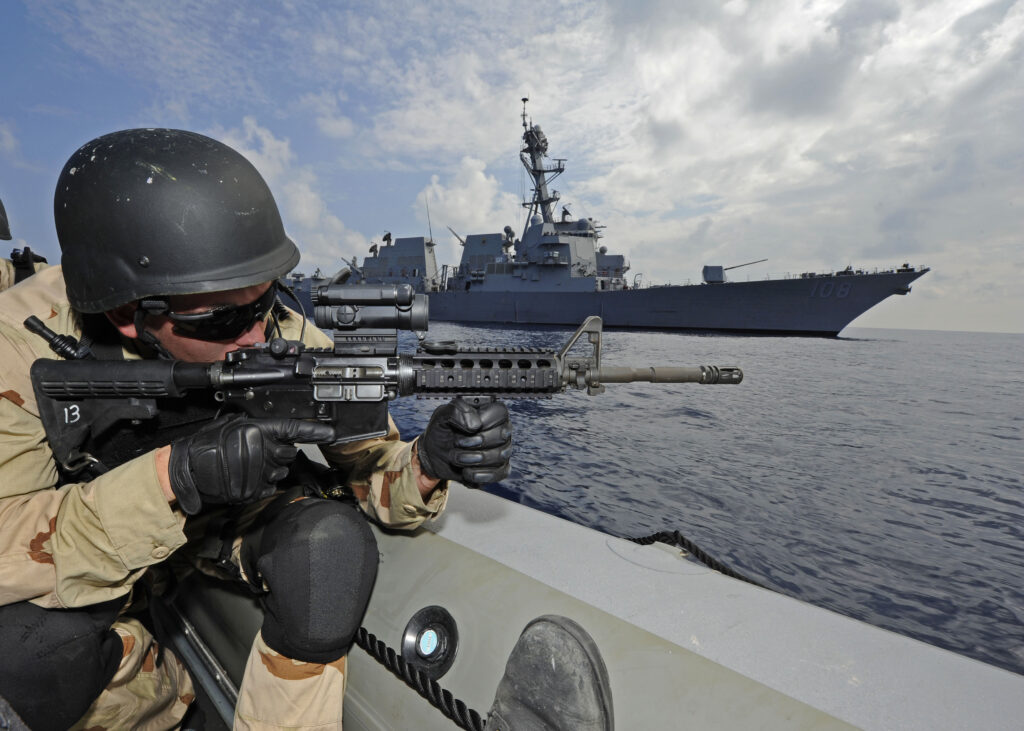
111116-N-VH839-045 PACIFIC OCEAN (Nov. 16, 2011) Machinery Repairman 3rd Class Tyler Long, a visit, board, search, and seizure team member aboard the Arleigh Burke-class guided-missile destroyer USS Wayne E. Meyer (DDG 108), sets a bubble perimeter in a rigid hull inflatable boat during a training exercise. Wayne E. Meyer is deployed to the 7th Fleet area of responsibility conducting maritime security operations. (U.S. Navy photo by Mass Communication Specialist 3rd Class Joshua Keim/Released)

A controlled boarding can connect those separate pieces. Documents, cargo, crew statements, route history, equipment, and observed behavior can be compared directly. That comparison is often where the real value of VBSS appears.

The aim is not always seizure. Verification is often enough. A vessel may be inspected and cleared, especially when the crew cooperates and the documents match the cargo and voyage. But when the details do not align, boarding teams may identify prohibited goods, weapons, narcotics, illegal fishing activity, piracy-related equipment, or violations of sanctions and embargoes.

Why Boarding Operations Are Difficult

Boarding a vessel at sea is not like entering a building on land. The target is moving, the weather may be poor, and the sea state can affect every step of the operation. A ship may be high-sided, poorly lit, crowded, unstable, or arranged in a way that slows inspection.

Crew behavior adds another layer of uncertainty. Some crews cooperate immediately. Others may be confused, frightened, evasive, or hostile. A boarding team has to manage that uncertainty while avoiding unnecessary escalation.
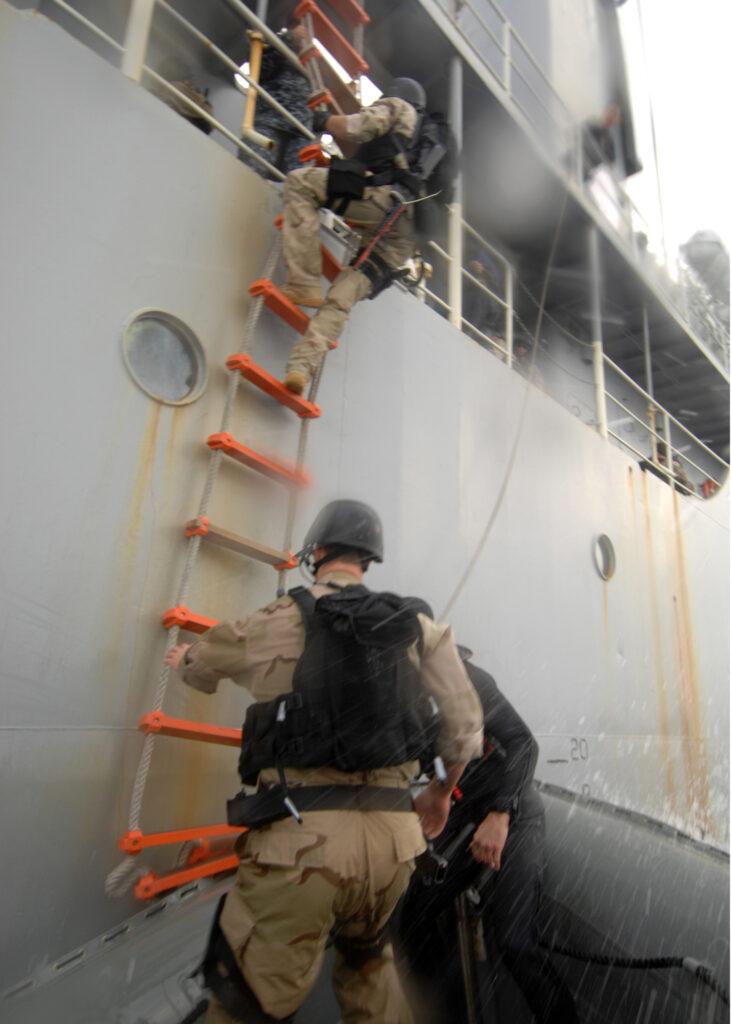
ATLANTIC OCEAN (Jan. 21, 2011) Members of the visit, board, search and seizure (VBSS) team assigned to the guided-missile destroyer USS Mitscher (DDG 57) board the training support vessel Prevail (TSV 1) during a VBSS exercise. Mitscher is conducting a composite training unit exercise as part of the George H.W. Bush Carrier Strike Group to prepare for an upcoming combat deployment. (U.S. Navy photo by Mass Communication Specialist Seaman Deven B. King/Released)

The team also has to understand that a commercial vessel is a working environment. There may be machinery spaces, cargo holds, narrow corridors, ladders, containers, chemicals, fuel, fishing gear, or confined compartments. None of this is designed for easy security work.

Searching the vessel is only one part of the mission. The team has to control movement, communicate clearly, protect evidence, read the vessel’s documents, compare them with what is found on board, and report the results accurately. Mistakes can create safety risks, legal problems, or diplomatic complications.

070209-N-8623S-013 Persian Gulf (Feb. 9, 2007) – Sailors stationed aboard guided missile destroyer USS Ramage (DDG 61) conduct a visit, board, search and seizure (VBSS) aboard a fishing dhow. Ramage is currently conducting Maritime Security Operations in the 5th Fleet area of responsibility as part of the USS Dwight D. Eisenhower Carrier Strike Group. U.S. Navy photo by Chief Mass Communication Specialist Daniel Sanford (RELEASED)

For that reason, VBSS requires training beyond basic combat skills. Maritime awareness, legal knowledge, evidence procedures, language awareness, and the ability to work in confined spaces are all part of the picture. The physical act of climbing onto the ship may be the most visible moment, but it is not always the hardest part.

VBSS and Maritime Law Enforcement

Naval forces, coast guards, and specialized law enforcement units can all be involved in VBSS, depending on the country, the location, the mission, and the legal authority behind the operation. This distinction is important because the same physical act of boarding may have different legal meanings in different contexts.

A navy may provide the ship, the presence, the command structure, and the operational capability. A coast guard or law enforcement detachment may provide specific authority for counter-narcotics, fisheries enforcement, customs violations, migration control, sanctions enforcement, or other law enforcement missions.
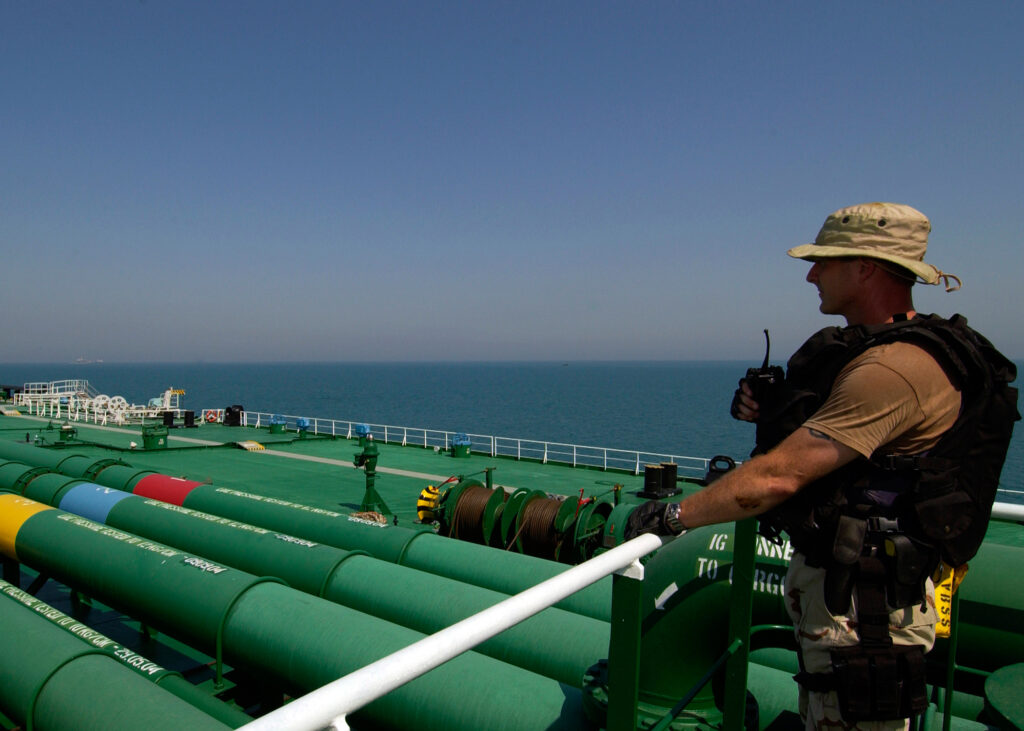
Arabian Gulf (Sept. 27, 2004) – A Sailor assigned to the Visit, Board, Search and Seizure (VBSS) team aboard the guided missile cruiser USS Mobile Bay (CG 53) stands watch aboard an oil tanker, as the rest of his team completes security checks in accordance with Maritime Interception Operating (MIO) procedures. Mobile Bay is a part of USS Essex (LHD 2) Expeditionary Strike Group Three (ESG-3) currently on deployment in the Northern Arabian Gulf in support of Operation Iraqi Freedom (OIF). U.S. Navy photo by Photographer’s Mate 2nd Class Samuel W. Shavers (RELEASED)

The United States Coast Guard’s Law Enforcement Detachments are a good example of this broader role. Their work shows that VBSS is not limited to wartime naval activity. It can also support counterdrug operations, maritime interdiction, counter-piracy, force protection, and international cooperation.

Training institutions also treat VBSS as a specialized skill rather than an improvised action. NATO’s Maritime Interdiction Operational Training Centre, for example, focuses on maritime interdiction and boarding-related training. That tells us something important: getting onto the vessel is only the beginning. The operation has to be controlled, lawful, documented, and defensible afterward.

A poorly handled boarding can cause more problems than it solves. It can endanger the team, harm civilians, damage evidence, disrupt lawful trade, or create diplomatic friction. Professional VBSS is therefore not about aggression for its own sake. It is about applying force, authority, and procedure in the right proportion.
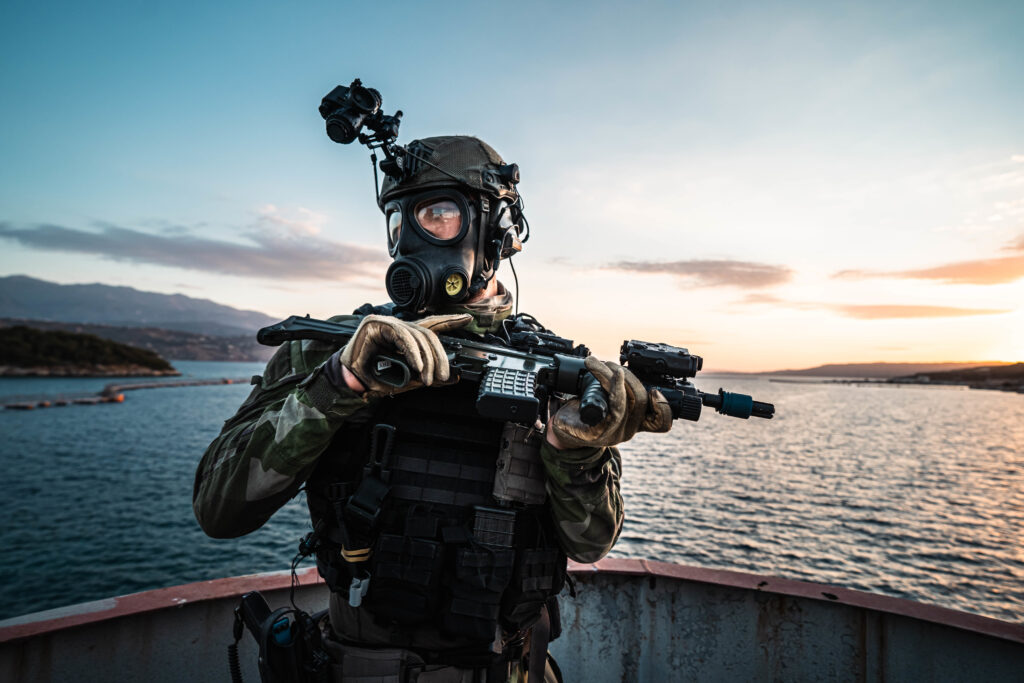
A Swedish Marine with 4th Marine Regiment, Swedish Amphibious Corps scans the area during a visit, board, search, and seizure for exercise TYR 22 at the NATO Maritime Interdiction Operational Training Centre (NMIOTC) in Souda bay, Greece, July 14, 2022. TYR 22 is a maritime interdiction operations exercise held at NMIOTC, bringing together Swedish Marines, U.S. Marines, U.S. Navy Special warfare combatant-craft crewmen to improve US and NATO Partner operational capacity, capability, and interoperability. (U.S. Marine Corps photo by Sgt. William Chockey)

Piracy and Armed Robbery at Sea

Piracy is one of the most familiar contexts for VBSS. Operations in the Gulf of Aden, waters off Somalia, parts of West Africa, and other high-risk areas have shown how quickly maritime crime can affect shipping routes, insurance costs, crew safety, and regional stability.

A boarding may happen after an attack, during the inspection of a suspicious vessel, or as part of a wider counter-piracy operation. Teams may look for weapons, ladders, fuel, communications equipment, captured crew members, or other signs that a vessel is being used to support piracy.
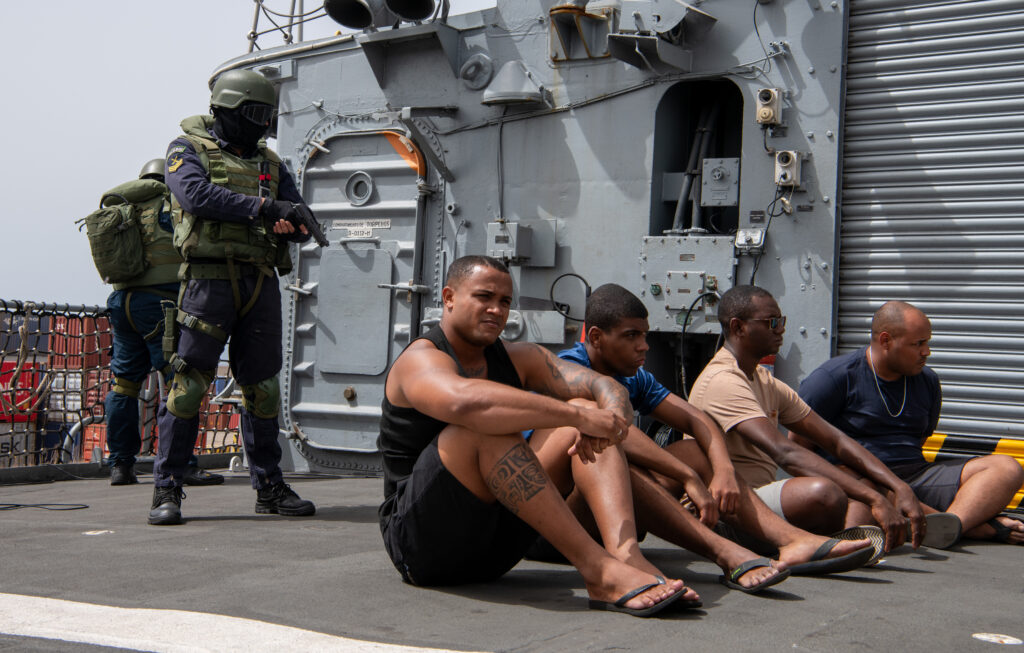
250508-N-RO855-1177 PRAIA, Cabo Verde (May 8, 2025) – Sailors attached to the Brazilian Navy Niterói-Class Frigate, BNS Defensora (F 41), simulate a visit, board, search, and seizure techniques during Obangame Express 2025. Obangame Express is one of three regional maritime exercises led by U.S. Sixth Fleet as part of a comprehensive strategy to provide collaborative opportunities to African forces and international partners to address maritime security concerns. (U.S. Navy photo by Mass Communication Specialist 2nd Class Caleb M. Foote)

Not every suspicious vessel is a pirate vessel. Fishing boats, dhows, small cargo craft, and local vessels may operate in the same waters for legitimate reasons. This is exactly why the inspection process matters. The goal is to separate normal maritime activity from criminal or hostile activity without treating every vessel as a threat by default.

Piracy also shows why VBSS has consequences beyond the ship being boarded. A small group operating from a relatively simple vessel can force commercial ships to change routes, increase security costs, raise insurance premiums, and trigger international naval responses. The tactical scale may be small, but the economic effect can be much larger.
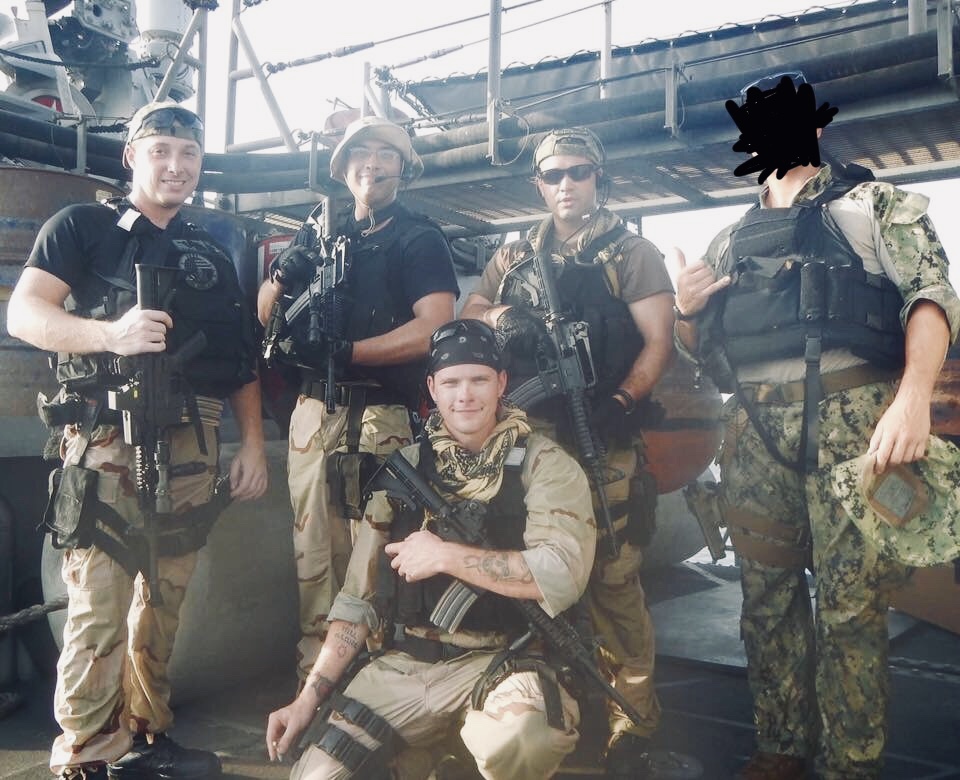
USS Whirlwind PC-11 VBSS team working in joint task force with US Navy SOF in Persian Gulf. ODE232323, CC BY-SA 4.0 https://creativecommons.org/licenses/by-sa/4.0.

Smuggling, Sanctions, and the Cargo Problem

Modern maritime security is heavily tied to cargo. Weapons, narcotics, sanctioned oil, dual-use goods, counterfeit products, and restricted components can all move through maritime channels. Commercial shipping is complex by design, and that complexity can be used both legally and illegally.

A ship may be owned in one country, flagged in another, operated by a third company, chartered by another party, insured elsewhere, and loaded with cargo belonging to multiple customers. This structure supports global trade, but it can also make responsibility harder to trace.
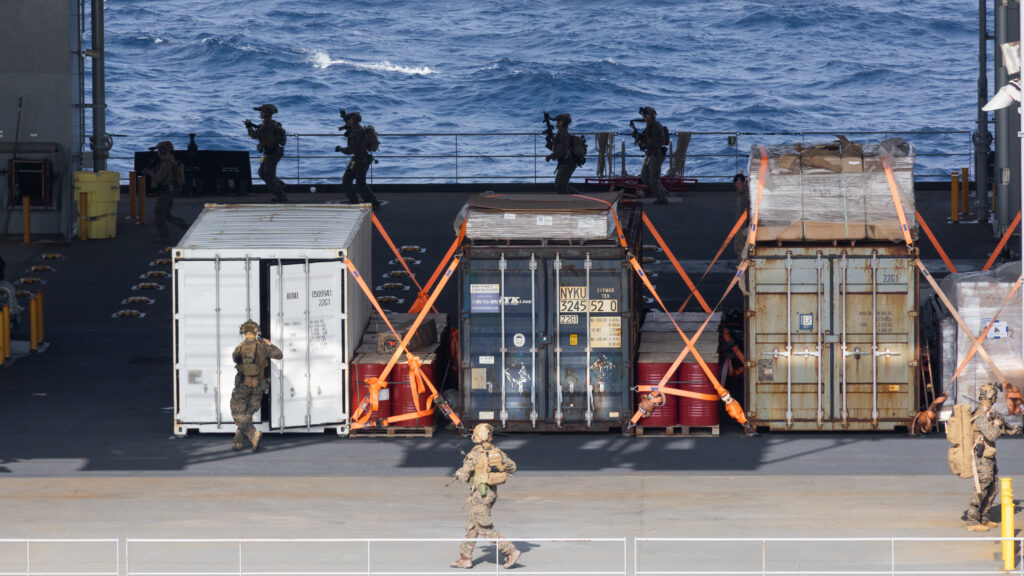
U.S. Marines with the maritime raid force, 31st Marine Expeditionary Unit, conduct a visit, board, search, and seizure exercise aboard the USS Miguel Keith (ESB 5), in the Philippine Sea, Feb. 11, 2024. VBSS is part of maritime interception operations that aim to delay, disrupt, or destroy enemy forces or supplies in the maritime domain. The 31st MEU is operating aboard ships of the America Amphibious Ready Group in the 7th Fleet area of operations to enhance interoperability with allies and partners and serve as a ready response force to defend peace and stability in the Indo-Pacific region. (U.S. Marine Corps photo by Cpl. Tyler Andrews)

During a boarding, documents may have to be compared with the ship’s route, cargo, crew statements, equipment, and observed behavior. If the declared cargo does not match what is found, or if the voyage history raises questions, the inspection becomes more serious.

Sanctions enforcement makes this issue even more complicated. A tanker suspected of carrying restricted oil, or a cargo vessel suspected of moving controlled goods, cannot always be judged only by paperwork or tracking data. Physical inspection may be necessary, especially when the vessel has changed names, used unusual routing, switched off AIS, or operated through opaque ownership structures.

VBSS therefore has a direct connection with economic security. It is not only about weapons, pirates, or naval patrols. It is also about whether the maritime system can identify when ordinary commercial movement is being used to hide restricted trade.

The Human Side of the Operation

Acronyms can make VBSS sound mechanical, but every boarding involves people under pressure. The team does not always know what kind of crew it is about to meet. The crew may not fully understand why the boarding is happening, what authority is being used, or what will happen if the inspection continues.

Clear communication matters from the first contact. So does body language, tone, timing, and the ability to control movement without turning confusion into confrontation.

A good boarding is not measured only by speed. It is also measured by whether the crew remains safe, whether the team avoids unnecessary escalation, whether evidence is preserved, and whether the final report can support whatever decision follows.

A Chilean Navy Special Forces operator climbs a ladder for visit, board, search and seizure (VBSS) training with U.S. East Coast-based Naval Special Warfare Operators (SEALs) aboard the Chilean Navy replenishment oiler CNS Almirante Montt (AO-52) during SOUTHERN STAR ‘25 in Valparaíso, Chile, May 28, 2025. SOUTHERN STAR ’25 is a multinational special operations exercise taking place across Chile from May 26 to June 8. The exercise brings together forces from six nations and 10 observer countries, totaling more than 2,700 participants, to enhance interoperability and strengthen global special operations partnerships through joint training from Antofagasta to Punta Arenas. (U.S. Navy photo by Mass Communication Specialist 1st Class Leon Wong)

Restraint is part of the capability. VBSS requires readiness for violence, but it cannot be built around violence as the default answer. In many cases, the best outcome is deliberately uneventful: the team boards, checks the vessel, clarifies the facts, and leaves without escalation.

That kind of result may not look dramatic, but it is often the sign of a well-managed operation.

Why VBSS Still Matters in a High-Tech Maritime Environment

Drones, satellites, sensors, artificial intelligence, and automated surveillance tools are becoming more important in maritime security. They help detect suspicious routes, identify unusual movement, monitor chokepoints, and support intelligence analysis.

None of that removes the need for boarding.

A Marine with the Maritime Raid Force, 24th Marine Expeditionary Unit, climbs a tactical ladder to board the amphibious transport dock ship USS New York (LPD 21) during a routine nighttime visit, board, search, and seizure training exercise, April 2, 2015. The 24th MEU is embarked on the ships of the Iwo Jima Amphibious Ready Group and deployed to maintain regional security in the U.S. 5th Fleet area of operations. (U.S. Marine Corps photo by Cpl. Todd F. Michalek/Released)

Technology can point toward a problem, but it does not always settle the question. A drone can observe a vessel. A satellite can show a pattern. AIS data can reveal gaps or manipulation. Intelligence can build a case for suspicion. At some point, however, someone may still need to inspect the compartments, speak to the crew, examine documents, and secure physical evidence.

This is why VBSS remains relevant. Maritime security is not only about detection. It is also about confirmation and enforcement. A system may identify a suspicious vessel, but a boarding operation can determine whether that suspicion is supported by cargo, documents, equipment, statements, and physical findings.

The more complex maritime trade becomes, the more important that final layer remains. Ships are not just dots on a screen. They are physical spaces carrying people, goods, documents, machinery, and sometimes hidden risks.
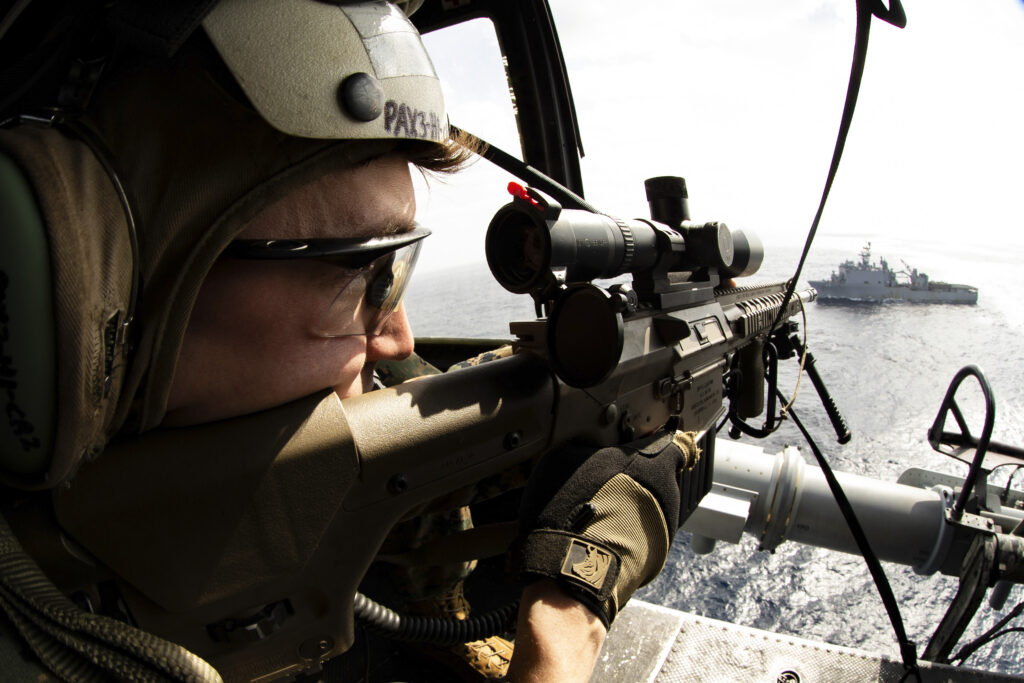
U.S. Marine Corps Sgt. Jason Florczyk, a scout sniper with Battalion Landing Team 3/4, 31st Marine Expeditionary Unit (MEU), provides aerial security using a M110 semi-automatic sniper system during a visit, board, search and seizure (VBSS) mission after taking off from amphibious assault ship USS America (LHA 6) in the Philippine Sea, Feb. 3, 2021. VBSS is part of Maritime Interception Operations that aim to delay, disrupt, or destroy enemy forces or supplies in the maritime domain. The 31st MEU is operating aboard ships of the America Expeditionary Strike Group in the 7th fleet area of operations to enhance interoperability with allies and partners and serve as a ready response force to defend peace and stability in the Indo-Pacific contingency. (U.S. Marine Corps photo by Cpl. Brandon Salas)

A Small Operation With Strategic Consequences

A single boarding may look minor compared to a naval deployment or a regional maritime crisis. Its consequences, however, can be significant. A seized cargo may expose a smuggling network. A detained vessel may reveal sanctions evasion. A piracy-related boarding may prevent further attacks. A routine inspection may clear an innocent vessel and prevent unnecessary disruption.

VBSS works as a practical link between surveillance, legal authority, and enforcement at sea. Without that link, maritime security risks becoming too dependent on observation without confirmation.

The sea is too large to control completely, and commercial shipping is too complex to understand through documents alone. Suspicious activity is often hidden inside normal movement. A ship may look ordinary from a distance and still require closer inspection.

For that reason, VBSS remains one of the most important but least understood parts of modern maritime security. It is not the largest capability, the most expensive platform, or the most visible part of naval power. But when maritime security has to move from monitoring a vessel to establishing the facts on board, VBSS becomes essential.

Sources:

  • International Maritime Organization, “SOLAS XI-2 and the ISPS Code”
  • International Maritime Organization, “Maritime Security”
  • NATO Maritime Interdiction Operational Training Centre, “Final Tactical Exercise (FTX)”
  • International Maritime Organization, “Guide to Maritime Security and the ISPS Code”
  • NATO Maritime Interdiction Operational Training Centre, “Course Catalogue”
  • NATO Maritime Interdiction Operational Training Centre, “Resident Courses”

Previous Post

Jeep: The Small Vehicle That Changed Military Mobility

Related Posts

Kosova War
Geopolitics

The Kosovo War: A Conflict That Never Fully Left Europe

May 23, 2026
T-80U_ROKA_제3기갑여단
Geopolitics

Brown Bear Project : How Republic of Korea added Russian weapons into its inventory?

April 14, 2026
DESERT STORM
Geopolitics

Iraq: A Preview of the Region’s Future

April 6, 2026
The Architecture of Global Power: Chokepoints, Energy Corridors, and Global Trade
Geopolitics

The Architecture of Global Power: Chokepoints, Energy Corridors, and Global Trade

March 12, 2026
Strategic Deception and Covert Warfare: The Logic Behind the Hezbollah Pager Operation
Geopolitics

Strategic Deception and Covert Warfare: The Logic Behind the Hezbollah Pager Operation

March 10, 2026
The Warfare Doctrine of Eliminations inthe Opening Strikes of Military Conflicts
Geopolitics

The Warfare Doctrine of Eliminations inthe Opening Strikes of Military Conflicts

March 3, 2026
  • Trending
  • Latest
Operation Enduring Freedom

What Exactly Is a Private Military Company (PMC)?

September 6, 2025
Blackwater PMC

After Blackwater: How PMCs Evolved, Professionalized, and Fragmented

September 13, 2025
MG42-1

MG42 Machine Gun: WWII History, Specifications and Battlefield Impact

April 21, 2026
Beretta 92FS vs Beretta M9: Is There a Real Difference?

Beretta 92FS vs Beretta M9: Is There a Real Difference?

July 19, 2025
U.S. Navy SEALs, Chilean Navy SF, SOF Conduct VBSS Training

VBSS: Visit, Board, Search and Seizure in Maritime Security

May 26, 2026
Willys MB Jeep - from 1943

Jeep: The Small Vehicle That Changed Military Mobility

May 25, 2026
Kosova War

The Kosovo War: A Conflict That Never Fully Left Europe

May 23, 2026
North_American_X-15A-2_with_external_fuel_tanks_(150806-F-IO108-005)

North American X-15: The Aircraft That Did Not Become a Fighter, But Changed High-Speed Flight

May 22, 2026

Recent Articles

U.S. Navy SEALs, Chilean Navy SF, SOF Conduct VBSS Training

VBSS: Visit, Board, Search and Seizure in Maritime Security

May 26, 2026
Willys MB Jeep - from 1943

Jeep: The Small Vehicle That Changed Military Mobility

May 25, 2026
Kosova War

The Kosovo War: A Conflict That Never Fully Left Europe

May 23, 2026
North_American_X-15A-2_with_external_fuel_tanks_(150806-F-IO108-005)

North American X-15: The Aircraft That Did Not Become a Fighter, But Changed High-Speed Flight

May 22, 2026
Drill & Defense

Drill & Defense is an independent defense and security platform covering firearms, military technology, geopolitics, energy security, and industry developments. We provide clear, structured, and practical insight for professionals, companies, and readers following the evolving defense landscape worldwide.

Follow Us

Browse by Category

  • Air Systems
  • Defense & Energy Strategy
  • Defense Industry
  • Defense Know-How
  • Defense Technologies
  • Doctrines & Concepts
  • Energy & Security
  • Energy Fundamentals
  • Energy Technologies
  • Firearms
  • Geopolitics
  • Global Security
  • History
  • Industry News
  • Knowledge Base
  • Land Systems
  • Legacy Systems & Structures
  • Market Analysis
  • Market Trends & Analysis
  • Military History
  • Military Systems
  • Naval Systems
  • Oil & Gas News
  • Pistols
  • Regulations & Frameworks
  • Rifles
  • SMGs & Machine Guns
  • Strategic Turning Points
  • Tech & Innovation Crossover

Recent Articles

U.S. Navy SEALs, Chilean Navy SF, SOF Conduct VBSS Training

VBSS: Visit, Board, Search and Seizure in Maritime Security

May 26, 2026
Willys MB Jeep - from 1943

Jeep: The Small Vehicle That Changed Military Mobility

May 25, 2026

© 2026 Drill & Defense. All rights reserved. Independent insights on firearms, defense, and energy. For business inquiries: info@drillanddefense.com | PRIVACY POLICY | COOKIE POLICY | TERMS AND CONDITIONS

Manage Consent

We use cookies to improve your experience. You can accept or refuse cookies; however, some features may not function properly without your consent.

Functional Always active
The technical storage or access is strictly necessary for the legitimate purpose of enabling the use of a specific service explicitly requested by the subscriber or user, or for the sole purpose of carrying out the transmission of a communication over an electronic communications network.
Preferences
The technical storage or access is necessary for the legitimate purpose of storing preferences that are not requested by the subscriber or user.
Statistics
The technical storage or access that is used exclusively for statistical purposes. The technical storage or access that is used exclusively for anonymous statistical purposes. Without a subpoena, voluntary compliance on the part of your Internet Service Provider, or additional records from a third party, information stored or retrieved for this purpose alone cannot usually be used to identify you.
Marketing
The technical storage or access is required to create user profiles to send advertising, or to track the user on a website or across several websites for similar marketing purposes.
  • Manage options
  • Manage services
  • Manage {vendor_count} vendors
  • Read more about these purposes
View preferences
  • {title}
  • {title}
  • {title}
No Result
View All Result
  • Defense Industry
    • Industry News
    • Defense Companies
    • Defense Technologies
    • Market Analysis
  • Military Systems
    • Land Systems
    • Air Systems
    • Naval Systems
    • Electronic & Cyber Systems
  • Firearms
    • Pistols
    • Rifles
    • SMGs & Machine Guns
    • Ammunition
    • Optics & Accessories
  • Geopolitics
    • Global Security
    • Defense & Energy Strategy
    • Tech & Innovation Crossover
    • Trade & Export Controls
  • Energy & Security
    • Oil & Gas News
    • Energy Technologies
    • Market Trends & Analysis
  • History
    • Military History
    • Doctrines & Concepts
    • Strategic Turning Points
    • Legacy Systems & Structures
  • Knowledge Base
    • Firearms Basics
    • Defense Know-How
    • Energy Fundamentals
    • Regulations & Frameworks
  • About
  • Contact
  • Login
  • Register

© 2026 Drill & Defense. All rights reserved. Independent insights on firearms, defense, and energy. For business inquiries: info@drillanddefense.com | PRIVACY POLICY | COOKIE POLICY | TERMS AND CONDITIONS