

Compact rifles are often discussed as if the only important question is size. That is too simple. A short weapon can be useful, but only if it keeps enough capability to remain serious in real use. The IWI Tavor X95 enters that debate from a different direction. It is not a conventional rifle shortened from the front. It is a bullpup built around the idea that the rifle can remain compact without giving away too much barrel length.

At first glance, the X95 may look unusual to anyone used to AR-pattern rifles. The magazine sits behind the trigger. The weight feels different. The body is short, dense, and visually compressed. Yet none of that is accidental. The rifle is shaped around movement in confined spaces, where vehicles, doorways, walls, checkpoints, and narrow streets can make a long weapon feel less practical.
Something else should be added before judging the platform too quickly: the X95 story does not end with the standard compact rifle. The X95L exists as a longer, marksman-oriented variant within the same family. That matters because it shows that the X95 design is not only about close-range compactness. It can also be adapted toward a more deliberate infantry role.
The X95 as a Compact Bullpup Service Rifle
Most discussions around the X95 begin with the bullpup layout, and rightly so. The action and magazine are placed behind the trigger, allowing the rifle to keep a shorter overall length while retaining a barrel length that would normally require a longer conventional design. This is the central logic of the weapon.
Inside a vehicle or building, that difference becomes easier to understand. A few centimeters can matter when a soldier is getting out of an armored vehicle, turning through a doorway, or moving through a narrow corridor. The question is not whether a conventional rifle can do the job. Of course it can. The sharper question is whether a more compact rifle can make the same movement easier without becoming too limited.

Developed by Israel Weapon Industries, the X95 is closely connected to the Micro TAVOR identity and the wider Tavor family. Its role has generally been linked to military, law enforcement, and security use, especially where mobility and compactness are valued. The rifle’s design language reflects that background. It is not elegant in a decorative sense. It is practical, dense, and mission-shaped.
Why the X95 Feels Different
A rifle’s appearance can mislead people. The X95 looks modern, but the more important issue is how it handles. Because the mass is concentrated toward the rear, the rifle does not balance like a conventional carbine. Some users may find that helpful in close movement. Others may need time to adapt.

That adaptation should not be dismissed. Training habits are powerful. A person who has spent years on AR-style controls may find the X95’s reloads and balance less natural at first. Under stress, familiarity matters. This is one reason bullpup rifles often divide opinion more sharply than conventional designs.
Still, the X95 offers something real in return. It gives the user a compact weapon without relying on the same barrel-shortening approach used by many conventional carbines. In urban operations, that can be valuable. But value depends on context. On an open range, the rifle may simply feel different. In a cramped operational setting, the same difference may become the reason the weapon makes sense.

Controls, Handling, and Bullpup Compromises
Older bullpup rifles have often faced criticism for awkward controls, heavy triggers, and slower reloads. The X95 appears to answer some of those criticisms directly. Compared with earlier Tavor models, it brought revised control placement, a relocated charging handle, an updated handguard, and a more practical handling layout.
Small design changes can have large consequences. A magazine release that is easier to reach, a charging handle placed more naturally, or a better trigger pack can affect how the rifle feels during repeated use. A service rifle is not judged only during firing. It is judged when it is carried, reloaded, cleared, stored, maintained, and used with optics or accessories.
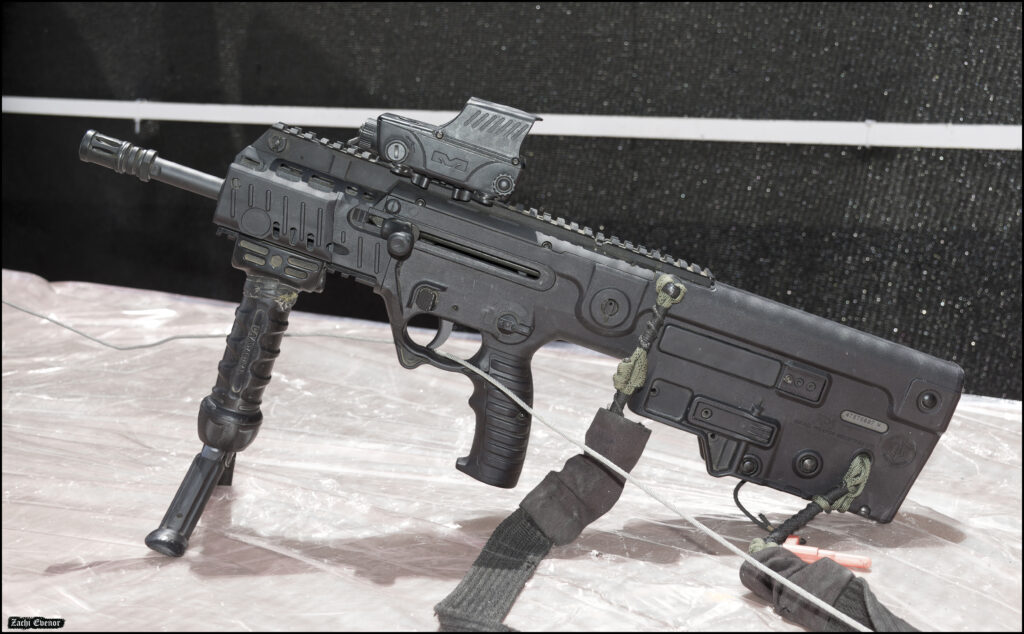
Yet the X95 does not become a conventional rifle just because it improves bullpup ergonomics. The magazine is still behind the firing hand. The balance is still rear-biased. The trigger system still belongs to the bullpup world. That is not automatically negative, but it should be understood honestly. The rifle improves the format rather than escaping it.
Caliber Options and Platform Flexibility
IWI has presented the X95 family across different caliber configurations, including 5.56×45mm NATO, .300 BLK, 5.45×39mm, and 9×19mm depending on market and variant. This gives the platform a broader identity than one fixed rifle.
Flexibility sounds attractive, but it should be treated carefully. A weapon family that supports different calibers still creates real logistical questions. Ammunition supply, spare parts, magazines, armorers, training material, and maintenance procedures all matter. If those systems are weak, modularity can become complexity.
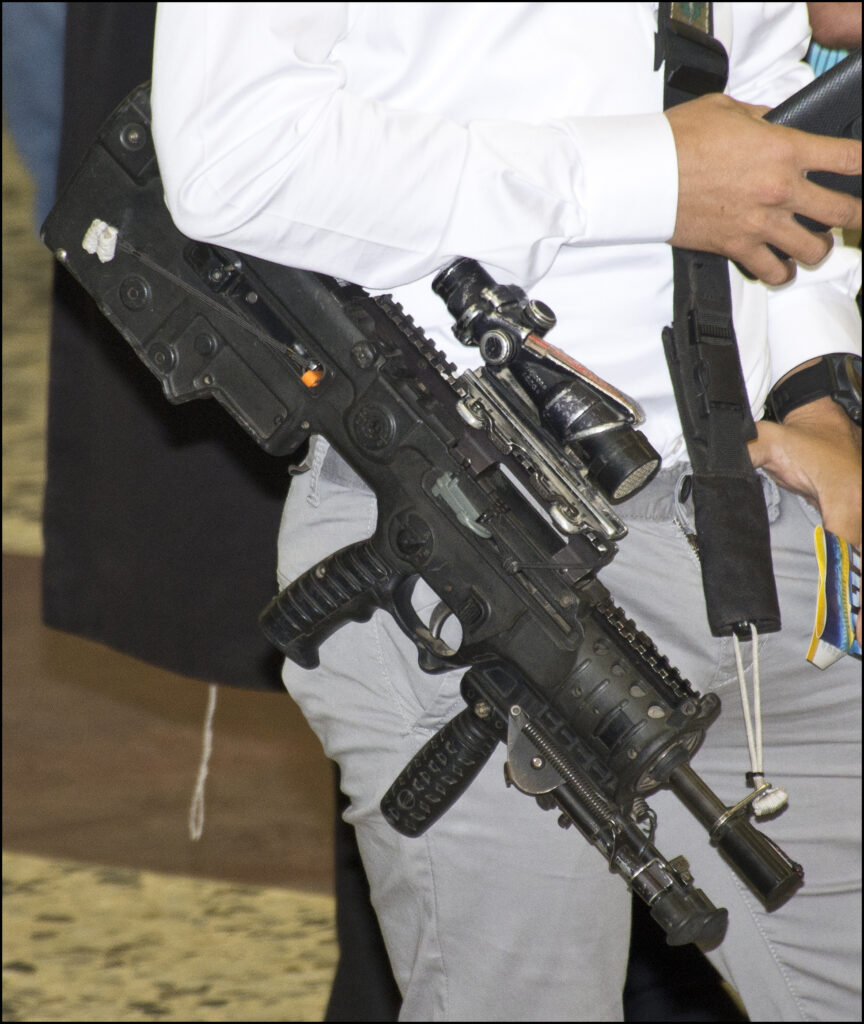
Even so, the X95’s wider platform logic is important. A 5.56 version fits the rifleman role. A 9mm version moves closer to a submachine-gun concept. A .300 BLK version suggests specialized use cases, especially where suppressed operation may be relevant. The X95 is therefore better understood as a family built around one design philosophy, not simply as one compact rifle.
The X95L and the Designated Marksman Role
Separate from the standard X95 discussion, the X95L deserves its own attention. It is commonly described as a longer-barreled, marksman-oriented version of the platform, associated with a 380 mm barrel.
A designated marksman works closer to the infantry unit. The role is not the same as a dedicated sniper mission. The marksman gives the unit a more precise option while still staying connected to ordinary infantry movement. In that sense, the X95L sits between the standard rifleman’s weapon and a specialized precision rifle.
Could a bullpup platform really serve that role effectively? The answer depends less on appearance and more on the total system around it. Barrel length helps. So do optics, ammunition quality, shooter training, and unit doctrine. The X95L only becomes meaningful when those elements support the weapon.

What the X95L Adds to the X95 Family
Beyond the technical detail of a longer barrel, the X95L changes the way the whole family can be interpreted. The standard X95 is easy to place inside an urban mobility discussion. The X95L pushes the same architecture into a more deliberate shooting role.
This is significant because bullpups are often reduced to close-quarters weapons in public discussion. The X95L complicates that picture. It suggests that the compact architecture can be adapted for more than rapid movement through tight spaces.

However, that does not mean the X95L should be praised without limits. Some marksmen may prefer conventional rifle layouts for prone shooting, trigger feel, accessory placement, or familiarity. Others may value the shorter overall length that a bullpup can provide even with a longer barrel. The important point is not that the X95L defeats every alternative. The point is that it expands the platform’s mission profile.
The Limits of the X95L
No rifle variant creates a role by itself. A longer barrel does not automatically produce a capable marksman. If the shooter lacks training, if the optic is unsuitable, or if the unit has no clear doctrine for using a designated marksman, the weapon’s advantage becomes much smaller.
Practical details matter here. A marksman-oriented rifle needs consistent ammunition, reliable optics, proper zeroing, good maintenance, and a user who understands distance, wind, target identification, and fire discipline. Without those pieces, the X95L is only a different configuration, not a complete capability.
There is also the matter of expectations. The X95L should not be treated as a replacement for dedicated sniper rifles or heavier precision systems. It belongs to a different category. Its value comes from giving the infantry unit a more precise option while staying within the same general bullpup family.
What the X95 and X95L Reveal About Modern Rifle Design
Viewed together, the X95 and X95L show how one platform can move in two directions. The standard X95 emphasizes compact handling, mobility, and close-to-mid-range rifle use. The X95L takes the same base idea and stretches it toward a marksman-oriented infantry role.
This makes the family more interesting than a simple “bullpup versus AR” comparison. The AR ecosystem is enormous, familiar, and logistically powerful. That is a serious advantage. Any rifle outside that world must offer a clear reason to exist. The X95’s reason is compact rifle capability. The X95L’s reason is role extension without abandoning the family’s core layout.
Perhaps the best way to judge the platform is not to ask whether it is universally better than conventional rifles. That question is too broad to be useful. A better question is this: in which environments does the X95 family’s compactness, balance, and role flexibility become worth the adaptation it demands?
Military rifles are rarely perfect objects. They are compromises shaped by doctrine, terrain, procurement habits, training culture, and expected threats. The X95 and X95L fit that reality well. They are not magic solutions, and they do not need to be. Their importance comes from offering a serious alternative design logic in a world where most rifles increasingly look and feel the same.
Sources:
- Israel Weapon Industries, “Micro TAVOR X95.”
- IWI US, “Tavor X95 Modern Bullpup 5.56, 300 BLK & 9mm Rifles.”
- IWI US, “5.56 NATO Tavor X95 With 16.5″ Barrel.”
- The Defense Post, “IDF Receives Thousands of X95 Micro-TAVOR Rifles From IWI.”