
Drill & Defense
Advertisement
  • Defense Industry
    • Industry News
    • Defense Companies
    • Defense Technologies
    • Market Analysis
  • Military Systems
    • Land Systems
    • Air Systems
    • Naval Systems
    • Electronic & Cyber Systems
  • Firearms
    • Pistols
    • Rifles
    • SMGs & Machine Guns
    • Ammunition
    • Optics & Accessories
  • Geopolitics
    • Global Security
    • Defense & Energy Strategy
    • Tech & Innovation Crossover
    • Trade & Export Controls
  • Energy & Security
    • Oil & Gas News
    • Energy Technologies
    • Market Trends & Analysis
  • History
    • Military History
    • Doctrines & Concepts
    • Strategic Turning Points
    • Legacy Systems & Structures
  • Knowledge Base
    • Firearms Basics
    • Defense Know-How
    • Energy Fundamentals
    • Regulations & Frameworks
  • About
  • Contact
  • Login
  • Register
No Result
View All Result
  • Defense Industry
    • Industry News
    • Defense Companies
    • Defense Technologies
    • Market Analysis
  • Military Systems
    • Land Systems
    • Air Systems
    • Naval Systems
    • Electronic & Cyber Systems
  • Firearms
    • Pistols
    • Rifles
    • SMGs & Machine Guns
    • Ammunition
    • Optics & Accessories
  • Geopolitics
    • Global Security
    • Defense & Energy Strategy
    • Tech & Innovation Crossover
    • Trade & Export Controls
  • Energy & Security
    • Oil & Gas News
    • Energy Technologies
    • Market Trends & Analysis
  • History
    • Military History
    • Doctrines & Concepts
    • Strategic Turning Points
    • Legacy Systems & Structures
  • Knowledge Base
    • Firearms Basics
    • Defense Know-How
    • Energy Fundamentals
    • Regulations & Frameworks
  • About
  • Contact
  • Login
  • Register
No Result
View All Result
Drill & Defense
No Result
View All Result
Home Geopolitics Defense & Energy Strategy

Saddam Hussein and the Petro-Military Complex: A Strategic Legacy

October 18, 2025
in Defense & Energy Strategy, Geopolitics
Saddam Hussein and the Petro-Military Complex: A Strategic Legacy

U.S. Navy photo by Photographer's Mate 1st Class Arlo K. Abrahamson., Public domain, via Wikimedia Commons

Share on LinkedInShare on Twitter

When one assesses Saddam Hussein’s nearly quarter-century in power (1979–2003), it becomes clear that his regime was shaped not simply by ideology or repression, but by a distinct petro-military complex: the use of oil revenue to build military capacity and project power, and the way strategic choices in arms and energy defined his rise and fall. For security and defense professionals, understanding this dynamic helps shed light on how resource-rich states can attempt to leverage energy wealth into military and geopolitical influence.

The Oil Foundation of Power

Iraq under Saddam was endowed with one of the world’s largest proven oil reserves. According to the Council on Foreign Relations, Iraq held roughly 110–115 billion barrels, though production and infrastructure were underdeveloped. Rather than focusing primarily on expanding production and modernizing the sector, and despite these reserves, the regime often channeled oil income into military and security apparatuses. In the late 1980s, the war economy had drained resources: “oil revenues continued to drop off … while military spending remained high.” For practitioners in defense analysis, this suggests a critical lesson: resource wealth is no guarantee of stability or strategic advantage unless the underlying economy and institutions can support it.
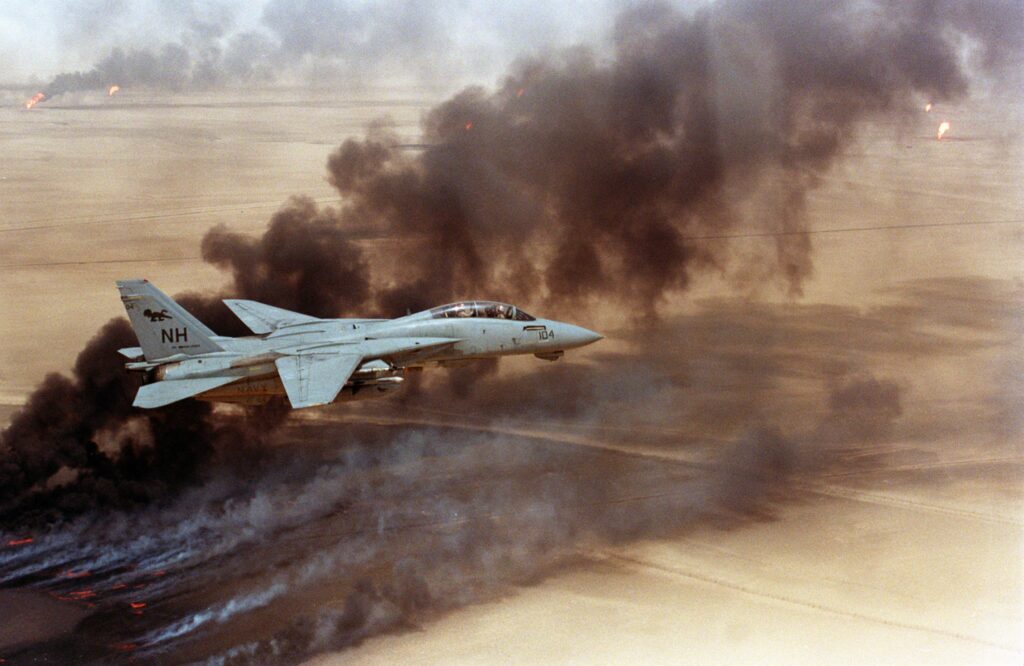
A U.S. Navy Grumman F-14A Tomcat from Fighter Squadron 114 (VF-114) “Aardvarks” flies past several still burning Kuwaiti oil wells, following the 1991 Gulf War. VF-114 was assigned to Carrier Air Wing 11 (CVW-11) aboard the aircraft carrier USS Abraham Lincoln (CVN-72) to the Western Pacific and the Indian Ocean from 28 May to 25 November 1991.

Arms, Ambition and the WMD Anchor

Saddam’s military ambitions were not limited to conventional forces. His regime placed considerable emphasis on weapons of mass destruction (WMD) programs, including chemical, biological, and potentially nuclear capabilities, as a tool of deterrence and regional coercion. A study of Iraqi WMD strategy emphasizes that Iraq viewed such programs “to re-shape the map of the Middle East” rather than merely defend against threats. For the security sector, this underscores how energy revenues, when combined with weak civilian oversight and ambitious military doctrine, can foster extreme strategic risk. In Saddam’s Iraq, oil financed paramilitary organizations, surveillance, and an internal security architecture which supplemented his formal military machine.

Iraqi propaganda poster from Iran-Iraq war, 1986

The Kuwait Move: Resource Competition Meets Geopolitics

A pivotal moment in Saddam’s strategic trajectory came with the invasion of Kuwait in August 1990. While the narrative often simplifies the motive as “grab the oil,” recent research urges a more nuanced view: Saddam’s decision-making was deeply intertwined with the end of the Cold War, perceptions of regional hegemony, and intra-Arab disputes over production and pricing. Iraq perceived Kuwait’s excess oil production as undercutting its own revenue and as economically offensive. The move into Kuwait was as much about restoring what Saddam saw as Iraq’s rightful role as a dominant oil-producer in the Gulf. This event highlights a broader point for defense analysts: competition over resource policy and energy markets can trigger military operations even when other motivations such as ideology or identity are present.
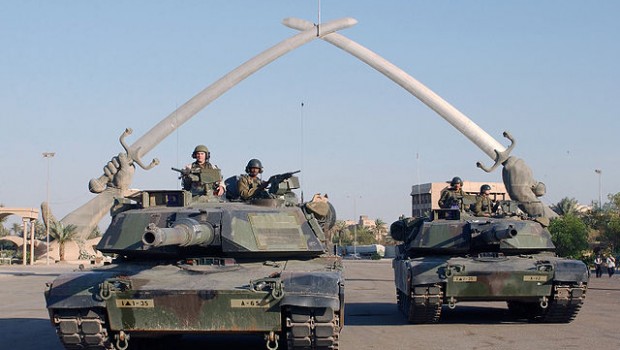
Shockabrah, CC BY-SA 4.0 https://creativecommons.org/licenses/by-sa/4.0, via Wikimedia Commons

Sanctions, Diversion, and the Limits of Coercion

Following the Kuwait invasion and the 1990–91 Gulf War, Iraq faced comprehensive UN sanctions. Scholars show that while sanctions significantly reduced trade and oil flows, they often failed to achieve their full political aims: Saddam remained in power until 2003. Meanwhile, the oil-for-food program was designed to allow limited oil sales for humanitarian goods but the regime diverted large amounts of revenue for military and elite use. The program allowed Saddam to maintain his internal security apparatus despite external pressure. For defense and energy professionals, the takeaway is that resource-based authoritarian regimes may be far more resilient than expected under economic pressure, particularly if they retain access to alternate revenue streams, smuggling routes, or internal networks.
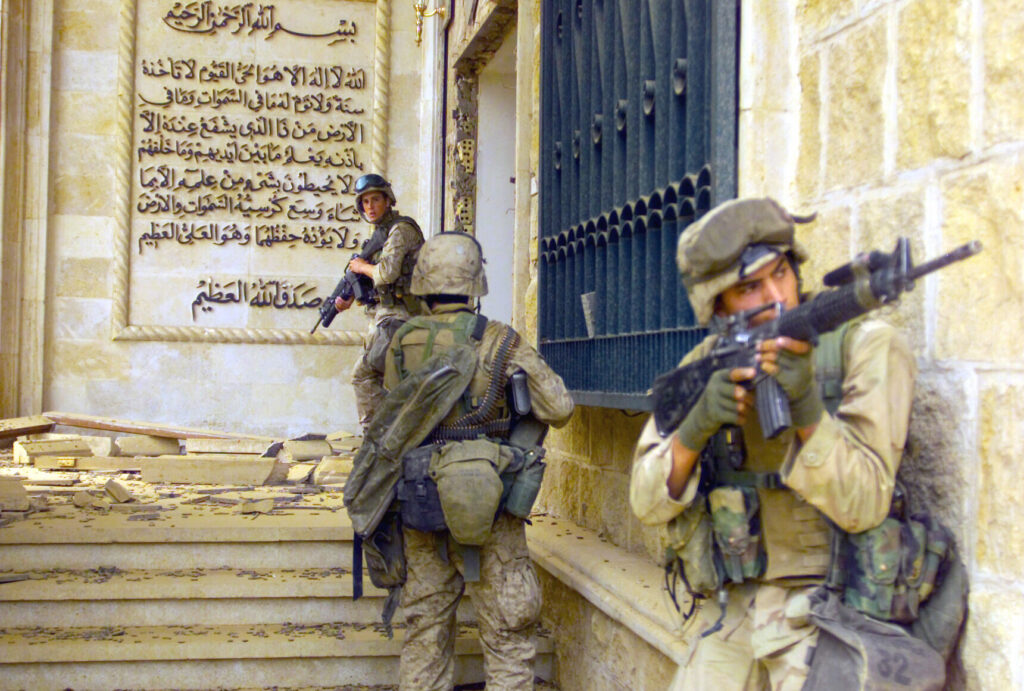
US Marines Corps (USMC) Marines from the 1st Battalion, 7th Marines (1/7), Charlie Company, Twentynine Palms, California (CA), cover each other with 5.56 mm M16A2 assault rifles as they prepare to enter one of Saddam Husseins palaces in Baghdad as they takeover the complex during Operation Iraqi Freedom.

Military Investment vs Sustainable Growth

Although oil finance supported a large army and security state, the long-term sustainability of this model was weak. Iraq’s economy-military imbalance persisted: industrial sectors declined, human capital drained, and investment into oil production and infrastructure lagged. The war economy diverted labor and resources into military uses; up to one million Iraqis were employed in the armed forces by the end of the Iran-Iraq war. Post-2003 studies showed that even with regime change, Iraq struggled to rebuild its oil infrastructure, signaling the structural weakness of Saddam’s model of militarized resource dependency. For analysts, that pattern signals a general rule: a strong military posture built on resource revenues can mask deeper structural weakness and may breed vulnerability if shocks such as war, sanctions, or mismanagement coincide.

Strategic Implications for Modern Security and Energy

What does Saddam’s case tell us about present-day defense, energy, and regional power dynamics?
Resource-rich regimes may pursue aggressive military postures if they believe energy revenue grants strategic freedom or leverage. Investment in arms and deterrents may reduce investment in broader economic development, thus increasing long-term strategic risk. External economic pressure may not suffice to overthrow entrenched regimes if alternative revenue or diversion mechanisms exist. Competition over energy production and export markets can become a catalyst for military conflict. Post-authoritarian reconstruction of the energy sector is often more difficult than expected, even when external support is available, due to a legacy of corruption, neglect, and war damage.

Looking Ahead: The Legacy in Context

The legacy of Saddam’s Iraq remains visible in many security discussions: how Gulf states view their militaries, how energy wealth can underwrite regional ambitions, and how sanctions regimes struggle when faced with resource-rich states. For the Drill & Defense reader, the message is clear: when you analyze a state’s defense posture, energy policy cannot be treated as a peripheral detail. It may be the very center of its strategic calculus. When future defense strategies or consultancy briefs evaluate states with similar resource-rich profiles, the Iraq case forces us to ask: are energy revenues being reinvested in sustainable development or diverted into force projection? Are there structural impediments to converting wealth into long-term stability? Understanding that dynamic is crucial for advising clients, mapping regional risk, or preparing defense-planning scenarios.


Further Reading

Baram, Amatzia. An Analysis of Iraqi WMD Strategy. Nonproliferation Review, Summer 2001.
Andrews, John S. Why Sanctions Fell Short of Their Objectives in the First Gulf War. Economic History Blog (LSE), 2023.
Duffield, John S. Oil and the Iraq War: How the United States Could Have Expected to Benefit. Middle East Review of International Affairs, Vol. 9 No. 2 (2005).
Otterman, Sharon. Iraq: Oil-for-Food Scandal. Council on Foreign Relations Backgrounder, 2005.
War Economy of Iraq. Middle East Research and Information Project (MERIP), 2007.
Hegemony and Oil: Factors That Caused Saddam Hussein to Be Removed from Power. University of Exeter, 2022.

Previous Post

MONUSCO in 2025: What a Managed Exit Means for Civilians, Security, and the Region

Next Post

The AK-47 Legacy in Africa

Related Posts

T-80U_ROKA_제3기갑여단
Geopolitics

Brown Bear Project : How Republic of Korea added Russian weapons into its inventory?

April 14, 2026
DESERT STORM
Geopolitics

Iraq: A Preview of the Region’s Future

April 6, 2026
The Architecture of Global Power: Chokepoints, Energy Corridors, and Global Trade
Geopolitics

The Architecture of Global Power: Chokepoints, Energy Corridors, and Global Trade

March 12, 2026
Strategic Deception and Covert Warfare: The Logic Behind the Hezbollah Pager Operation
Geopolitics

Strategic Deception and Covert Warfare: The Logic Behind the Hezbollah Pager Operation

March 10, 2026
The Warfare Doctrine of Eliminations inthe Opening Strikes of Military Conflicts
Geopolitics

The Warfare Doctrine of Eliminations inthe Opening Strikes of Military Conflicts

March 3, 2026
Mexican cartels and the shifting landscape of Mexico’s energy supply chain
Geopolitics

Mexican cartels and the shifting landscape of Mexico’s energy supply chain

February 24, 2026
Next Post
Africa Partnership Station AK 47

The AK-47 Legacy in Africa

  • Trending
  • Latest
Operation Enduring Freedom

What Exactly Is a Private Military Company (PMC)?

September 6, 2025
Blackwater PMC

After Blackwater: How PMCs Evolved, Professionalized, and Fragmented

September 13, 2025
MG42-1

MG42 Machine Gun: WWII History, Specifications and Battlefield Impact

April 21, 2026
Blackwater PMC

Inside Iraq’s Security Market: How Private Power Shapes a Fragile State

October 6, 2025
1280px-5-4_ADAR_Supports_Formidable_Shield_25_

SGT Stout: M-SHORAD and Mobile Air Defense

May 16, 2026
HEL_MD_Beam_Director

Laser Weapons: The New Layer in Modern Air Defense

May 14, 2026
EU Dual Use

EU Dual-Use Regulation: How Civilian Technology Becomes a Matter of Export Control

May 13, 2026
Barrett M82 DESERT SHIELD

Barrett M82A1: The Heavy Rifle That Redefined Anti-Materiel Firepower

May 12, 2026

Recent Articles

1280px-5-4_ADAR_Supports_Formidable_Shield_25_

SGT Stout: M-SHORAD and Mobile Air Defense

May 16, 2026
HEL_MD_Beam_Director

Laser Weapons: The New Layer in Modern Air Defense

May 14, 2026
EU Dual Use

EU Dual-Use Regulation: How Civilian Technology Becomes a Matter of Export Control

May 13, 2026
Barrett M82 DESERT SHIELD

Barrett M82A1: The Heavy Rifle That Redefined Anti-Materiel Firepower

May 12, 2026
Drill & Defense

Drill & Defense is an independent defense and security platform covering firearms, military technology, geopolitics, energy security, and industry developments. We provide clear, structured, and practical insight for professionals, companies, and readers following the evolving defense landscape worldwide.

Follow Us

Browse by Category

  • Air Systems
  • Defense & Energy Strategy
  • Defense Industry
  • Defense Know-How
  • Defense Technologies
  • Doctrines & Concepts
  • Energy & Security
  • Energy Fundamentals
  • Energy Technologies
  • Firearms
  • Geopolitics
  • Global Security
  • History
  • Industry News
  • Knowledge Base
  • Land Systems
  • Legacy Systems & Structures
  • Market Analysis
  • Market Trends & Analysis
  • Military History
  • Military Systems
  • Naval Systems
  • Oil & Gas News
  • Pistols
  • Regulations & Frameworks
  • Rifles
  • SMGs & Machine Guns
  • Strategic Turning Points
  • Tech & Innovation Crossover

Recent Articles

1280px-5-4_ADAR_Supports_Formidable_Shield_25_

SGT Stout: M-SHORAD and Mobile Air Defense

May 16, 2026
HEL_MD_Beam_Director

Laser Weapons: The New Layer in Modern Air Defense

May 14, 2026

© 2026 Drill & Defense. All rights reserved. Independent insights on firearms, defense, and energy. For business inquiries: info@drillanddefense.com | PRIVACY POLICY | COOKIE POLICY | TERMS AND CONDITIONS

Manage Consent

We use cookies to improve your experience. You can accept or refuse cookies; however, some features may not function properly without your consent.

Functional Always active
The technical storage or access is strictly necessary for the legitimate purpose of enabling the use of a specific service explicitly requested by the subscriber or user, or for the sole purpose of carrying out the transmission of a communication over an electronic communications network.
Preferences
The technical storage or access is necessary for the legitimate purpose of storing preferences that are not requested by the subscriber or user.
Statistics
The technical storage or access that is used exclusively for statistical purposes. The technical storage or access that is used exclusively for anonymous statistical purposes. Without a subpoena, voluntary compliance on the part of your Internet Service Provider, or additional records from a third party, information stored or retrieved for this purpose alone cannot usually be used to identify you.
Marketing
The technical storage or access is required to create user profiles to send advertising, or to track the user on a website or across several websites for similar marketing purposes.
  • Manage options
  • Manage services
  • Manage {vendor_count} vendors
  • Read more about these purposes
View preferences
  • {title}
  • {title}
  • {title}
No Result
View All Result
  • Defense Industry
    • Industry News
    • Defense Companies
    • Defense Technologies
    • Market Analysis
  • Military Systems
    • Land Systems
    • Air Systems
    • Naval Systems
    • Electronic & Cyber Systems
  • Firearms
    • Pistols
    • Rifles
    • SMGs & Machine Guns
    • Ammunition
    • Optics & Accessories
  • Geopolitics
    • Global Security
    • Defense & Energy Strategy
    • Tech & Innovation Crossover
    • Trade & Export Controls
  • Energy & Security
    • Oil & Gas News
    • Energy Technologies
    • Market Trends & Analysis
  • History
    • Military History
    • Doctrines & Concepts
    • Strategic Turning Points
    • Legacy Systems & Structures
  • Knowledge Base
    • Firearms Basics
    • Defense Know-How
    • Energy Fundamentals
    • Regulations & Frameworks
  • About
  • Contact
  • Login
  • Register

© 2026 Drill & Defense. All rights reserved. Independent insights on firearms, defense, and energy. For business inquiries: info@drillanddefense.com | PRIVACY POLICY | COOKIE POLICY | TERMS AND CONDITIONS