
Drill & Defense
Advertisement
  • Defense Industry
    • Industry News
    • Defense Companies
    • Defense Technologies
    • Market Analysis
  • Military Systems
    • Land Systems
    • Air Systems
    • Naval Systems
    • Electronic & Cyber Systems
  • Firearms
    • Pistols
    • Rifles
    • SMGs & Machine Guns
    • Ammunition
    • Optics & Accessories
  • Geopolitics
    • Global Security
    • Defense & Energy Strategy
    • Tech & Innovation Crossover
    • Trade & Export Controls
  • Energy & Security
    • Oil & Gas News
    • Energy Technologies
    • Market Trends & Analysis
  • History
    • Military History
    • Doctrines & Concepts
    • Strategic Turning Points
    • Legacy Systems & Structures
  • Knowledge Base
    • Firearms Basics
    • Defense Know-How
    • Energy Fundamentals
    • Regulations & Frameworks
  • About
  • Contact
  • Login
  • Register
No Result
View All Result
  • Defense Industry
    • Industry News
    • Defense Companies
    • Defense Technologies
    • Market Analysis
  • Military Systems
    • Land Systems
    • Air Systems
    • Naval Systems
    • Electronic & Cyber Systems
  • Firearms
    • Pistols
    • Rifles
    • SMGs & Machine Guns
    • Ammunition
    • Optics & Accessories
  • Geopolitics
    • Global Security
    • Defense & Energy Strategy
    • Tech & Innovation Crossover
    • Trade & Export Controls
  • Energy & Security
    • Oil & Gas News
    • Energy Technologies
    • Market Trends & Analysis
  • History
    • Military History
    • Doctrines & Concepts
    • Strategic Turning Points
    • Legacy Systems & Structures
  • Knowledge Base
    • Firearms Basics
    • Defense Know-How
    • Energy Fundamentals
    • Regulations & Frameworks
  • About
  • Contact
  • Login
  • Register
No Result
View All Result
Drill & Defense
No Result
View All Result
Home History

Messerschmitt Me 262: A Jet-Age Breakthrough That Arrived Too Late

August 25, 2025
in History, Legacy Systems & Structures
Messerschmitt_Me_262_replica_D-IMTT_ILA_2012_04

Julian Herzog, CC BY 4.0 , via Wikimedia Commons

Share on LinkedInShare on Twitter

Setting the Stage

If you follow aviation closely, you already know the Me 262’s reputation: sleek lines, twin turbojets, and speed that rewrote the rulebook. It was the world’s first operational jet fighter, fielded by the Luftwaffe in 1944, just as the Allies introduced the Gloster Meteor. The two types never actually met in combat, which already tells you something about how late in the war the jet age truly arrived.

What the Airframe Promised

On paper, the Me 262 looked like the answer to Allied air superiority. Its four 30 mm MK 108 cannons concentrated immense firepower, and in level flight the jet could push around 540 mph (≈ 870 km/h), well beyond the reach of most piston-engined escorts in a straight run. Those numbers mattered to bomber crews who suddenly had to deal with a threat they couldn’t simply out-climb or out-run.

Messerschmitt Me 262
Messerschmitt Me 262 Schwable, the world’s first jet fighter. (U.S. Air Force photo)

The Engine Learning Curve

The cutting edge cuts both ways. Junkers’ Jumo 004s were miracles of wartime improvisation and metallurgy under pressure. They also wore out with brutal speed. Contemporary restoration and flight-test accounts point to roughly 25 hours of engine life in 1945 conditions. A U.S. evaluation needed four engine changes in eight flights. Germany had pioneered the idea, but high-temperature alloys and manufacturing tolerances simply weren’t there yet for sustained operations. If you’re wondering why so many brand-new jets sat idle or cycled through maintenance, this is a big part of the answer.
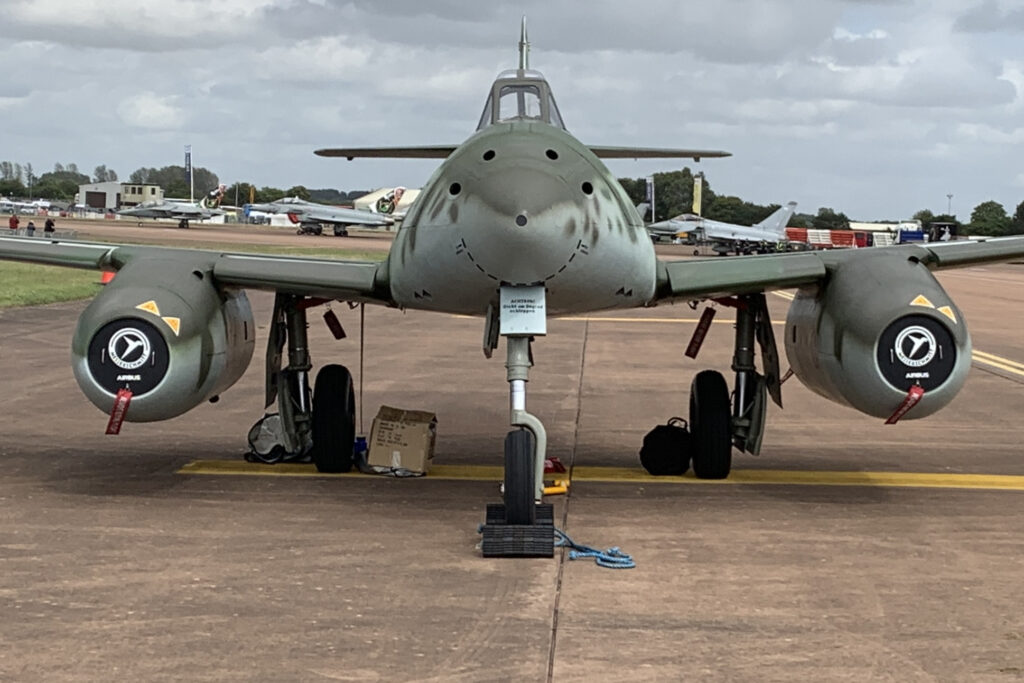
Ronnie Macdonald from Chelmsford, United Kingdom, CC BY 2.0 https://creativecommons.org/licenses/by/2.0, via Wikimedia Commons

Politics, Priorities, and a Lost Year

The Me 262’s story is not only about engineering, it’s also about decisions at the top. In 1944, Hitler pressed for a fighter-bomber emphasis, dragging the program away from its most effective role as a pure interceptor just when the Allies’ strategic bombing campaign demanded exactly that. The U.S. Strategic Bombing Survey later judged the conversion order ill-timed, a view echoed by senior German officers after the war. When you combine that with production dislocation and Allied attacks on transport, you see how a cutting-edge aircraft lost precious months it didn’t have.

What Actually Happened in Combat

When Me 262s did get airborne and formed up properly, they could shred bomber formations and disengage at will. But Allied pilots adapted quickly. They stalked jets near their bases, hitting them on takeoff or most often on landing, when the 004s’ slow spool-up left little margin to escape. Famous U.S. accounts from late 1944 describe exactly this pattern: Chuck Yeager’s unit encountering Me 262s, then catching one in the pattern as it returned to base. Tactics, not just technology, decided many of these engagements.

The Numbers Behind the Myth

Here’s the hardest truth. Germany built around 1,400 to 1,443 Me 262s, yet fewer than 300 ever saw combat. Why so few? Dispersed production, attacks on rail lines, shortages of trained pilots, and by early 1945 fuel scarcity that literally pinned jets to the ground. The jet’s promise collided with a collapsing wartime economy and a relentless air campaign aimed precisely at oil and transport.

Did It Change the War?

In the war’s final months, German jets reportedly downed dozens of Allied bombers, no small feat, but that tally came far too late to move the strategic needle. By spring 1945, Allied ground forces were at Germany’s doorstep and the Combined Bomber Offensive had crippled the Reich’s industrial base. A handful of high-performance squadrons could not reverse systemic collapse. The Me 262 earned its lethal aura tactically; strategically, it was a flashing warning light on a dashboard that was already failing.

Why It Still Matters

If you work in aerospace or simply enjoy the engineering story, the Me 262 offers a compact case study in how innovation, logistics, and doctrine must align. The jet itself was sound for its mission, the support system around it was not. Engines needed materials science Germany no longer controlled. Crews needed a training pipeline that no longer existed. Commanders needed to deploy the aircraft in mass as interceptors, not siphon them into ad-hoc bomber roles. And all of that needed fuel. The Me 262 is less a “what-if super-weapon” than a reminder that technology scales only when strategy, supply, and timing cooperate.

A Jet That Opened the Next Chapter

Even with those constraints, the Me 262 kicked open a door that could never be closed again. Allied and Soviet engineers studied captured airframes and, just as importantly, the ideas those airframes embodied: swept aerodynamics cues, weapons concentration for short firing windows, and operational concepts built around speed and energy. Within a few years, first-generation postwar jets eclipsed the 262 in reliability and range, but they were walking a path the Schwalbe had already traced. That’s the aircraft’s true legacy: not a miracle that never was, but a prototype of the jet age’s operating logic, fast, decisive, maintenance-hungry, and utterly dependent on the industrial ecosystem behind it.

Sources

  • Imperial War Museums – “What Did Fighter Command Do After the Battle of Britain?”
  • National Museum of the U.S. Air Force – “Messerschmitt Me 262A Schwalbe” fact sheet
  • Smithsonian National Air and Space Museum – “Junkers Jumo 004 B Turbojet Engine” and Me 262 collections note
  • Air & Space Forces Magazine – “Goering’s Big Bungle”
  • U.S. National Archives (Text Message blog) – “The German Jet Me-262 in 1944: A Failed Opportunity”
  • Encyclopaedia Britannica – “Strategic bombing during World War II”
  • The National WWII Museum – Articles referencing Me 262 combat outcomes and Allied tactics

 

Previous Post

Türkiye’s Defense-Export Boom: What’s Really Driving the Rise?

Next Post

Turkey’s “Steel Dome” Just Took a Big Step, Here’s What That Actually Means

Related Posts

General Orde Wingate_Chindit_leaders_Burma_1944_IWM_MH_7873
History

Orde Wingate: The Difficult Legacy of an Irregular Commander

May 18, 2026
Vietnam War
History

Vietnam War and the Limits of Conventional Power

May 11, 2026
Delta-Force
History

Delta Force: Beyond the Myth and Into Modern Special Operations

May 8, 2026
British, French and Italian wounded soldiers in a group
History

Britain’s Recruitment System in the First World War: Numbers, Pressure, and the Architecture of Persuasion

May 1, 2026
Tory-IIC_at_Jackass_flats
History

Project Pluto: Engineering Without Limits, Strategy Without Boundaries

April 27, 2026
Yalta_summit_1945_with_Churchill,_Roosevelt,_Stalin
History

Yalta: The Conference That Divided the Post-War World

March 25, 2026
Next Post
Fennek_reconnaissance_vehicle_of_340th_ASELSAN_MFR_C0415,_pic1

Turkey’s “Steel Dome” Just Took a Big Step, Here’s What That Actually Means

  • Trending
  • Latest
Operation Enduring Freedom

What Exactly Is a Private Military Company (PMC)?

September 6, 2025
Blackwater PMC

After Blackwater: How PMCs Evolved, Professionalized, and Fragmented

September 13, 2025
MG42-1

MG42 Machine Gun: WWII History, Specifications and Battlefield Impact

April 21, 2026
Blackwater PMC

Inside Iraq’s Security Market: How Private Power Shapes a Fragile State

October 6, 2025
General Orde Wingate_Chindit_leaders_Burma_1944_IWM_MH_7873

Orde Wingate: The Difficult Legacy of an Irregular Commander

May 18, 2026
1280px-5-4_ADAR_Supports_Formidable_Shield_25_

SGT Stout: M-SHORAD and Mobile Air Defense

May 16, 2026
HEL_MD_Beam_Director

Laser Weapons: The New Layer in Modern Air Defense

May 14, 2026
EU Dual Use

EU Dual-Use Regulation: How Civilian Technology Becomes a Matter of Export Control

May 13, 2026

Recent Articles

General Orde Wingate_Chindit_leaders_Burma_1944_IWM_MH_7873

Orde Wingate: The Difficult Legacy of an Irregular Commander

May 18, 2026
1280px-5-4_ADAR_Supports_Formidable_Shield_25_

SGT Stout: M-SHORAD and Mobile Air Defense

May 16, 2026
HEL_MD_Beam_Director

Laser Weapons: The New Layer in Modern Air Defense

May 14, 2026
EU Dual Use

EU Dual-Use Regulation: How Civilian Technology Becomes a Matter of Export Control

May 13, 2026
Drill & Defense

Drill & Defense is an independent defense and security platform covering firearms, military technology, geopolitics, energy security, and industry developments. We provide clear, structured, and practical insight for professionals, companies, and readers following the evolving defense landscape worldwide.

Follow Us

Browse by Category

  • Air Systems
  • Defense & Energy Strategy
  • Defense Industry
  • Defense Know-How
  • Defense Technologies
  • Doctrines & Concepts
  • Energy & Security
  • Energy Fundamentals
  • Energy Technologies
  • Firearms
  • Geopolitics
  • Global Security
  • History
  • Industry News
  • Knowledge Base
  • Land Systems
  • Legacy Systems & Structures
  • Market Analysis
  • Market Trends & Analysis
  • Military History
  • Military Systems
  • Naval Systems
  • Oil & Gas News
  • Pistols
  • Regulations & Frameworks
  • Rifles
  • SMGs & Machine Guns
  • Strategic Turning Points
  • Tech & Innovation Crossover

Recent Articles

General Orde Wingate_Chindit_leaders_Burma_1944_IWM_MH_7873

Orde Wingate: The Difficult Legacy of an Irregular Commander

May 18, 2026
1280px-5-4_ADAR_Supports_Formidable_Shield_25_

SGT Stout: M-SHORAD and Mobile Air Defense

May 16, 2026

© 2026 Drill & Defense. All rights reserved. Independent insights on firearms, defense, and energy. For business inquiries: info@drillanddefense.com | PRIVACY POLICY | COOKIE POLICY | TERMS AND CONDITIONS

Manage Consent

We use cookies to improve your experience. You can accept or refuse cookies; however, some features may not function properly without your consent.

Functional Always active
The technical storage or access is strictly necessary for the legitimate purpose of enabling the use of a specific service explicitly requested by the subscriber or user, or for the sole purpose of carrying out the transmission of a communication over an electronic communications network.
Preferences
The technical storage or access is necessary for the legitimate purpose of storing preferences that are not requested by the subscriber or user.
Statistics
The technical storage or access that is used exclusively for statistical purposes. The technical storage or access that is used exclusively for anonymous statistical purposes. Without a subpoena, voluntary compliance on the part of your Internet Service Provider, or additional records from a third party, information stored or retrieved for this purpose alone cannot usually be used to identify you.
Marketing
The technical storage or access is required to create user profiles to send advertising, or to track the user on a website or across several websites for similar marketing purposes.
  • Manage options
  • Manage services
  • Manage {vendor_count} vendors
  • Read more about these purposes
View preferences
  • {title}
  • {title}
  • {title}
No Result
View All Result
  • Defense Industry
    • Industry News
    • Defense Companies
    • Defense Technologies
    • Market Analysis
  • Military Systems
    • Land Systems
    • Air Systems
    • Naval Systems
    • Electronic & Cyber Systems
  • Firearms
    • Pistols
    • Rifles
    • SMGs & Machine Guns
    • Ammunition
    • Optics & Accessories
  • Geopolitics
    • Global Security
    • Defense & Energy Strategy
    • Tech & Innovation Crossover
    • Trade & Export Controls
  • Energy & Security
    • Oil & Gas News
    • Energy Technologies
    • Market Trends & Analysis
  • History
    • Military History
    • Doctrines & Concepts
    • Strategic Turning Points
    • Legacy Systems & Structures
  • Knowledge Base
    • Firearms Basics
    • Defense Know-How
    • Energy Fundamentals
    • Regulations & Frameworks
  • About
  • Contact
  • Login
  • Register

© 2026 Drill & Defense. All rights reserved. Independent insights on firearms, defense, and energy. For business inquiries: info@drillanddefense.com | PRIVACY POLICY | COOKIE POLICY | TERMS AND CONDITIONS