
The Boeing X-48B was never meant to be seen as a conventional aircraft program. It was a research platform built to explore whether a radically different airframe shape could offer practical advantages for future aviation, especially in long-range transport and high-capacity aircraft design.

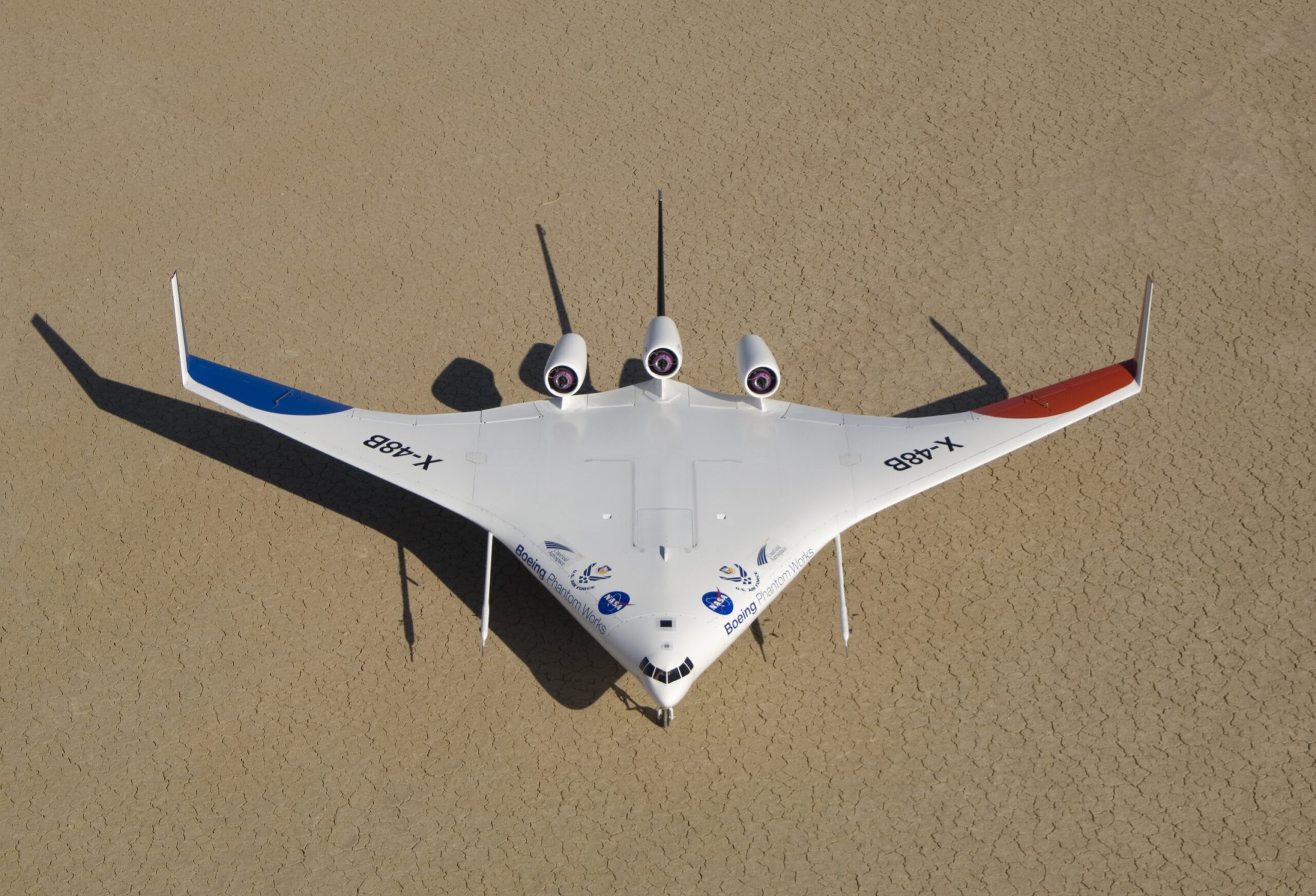
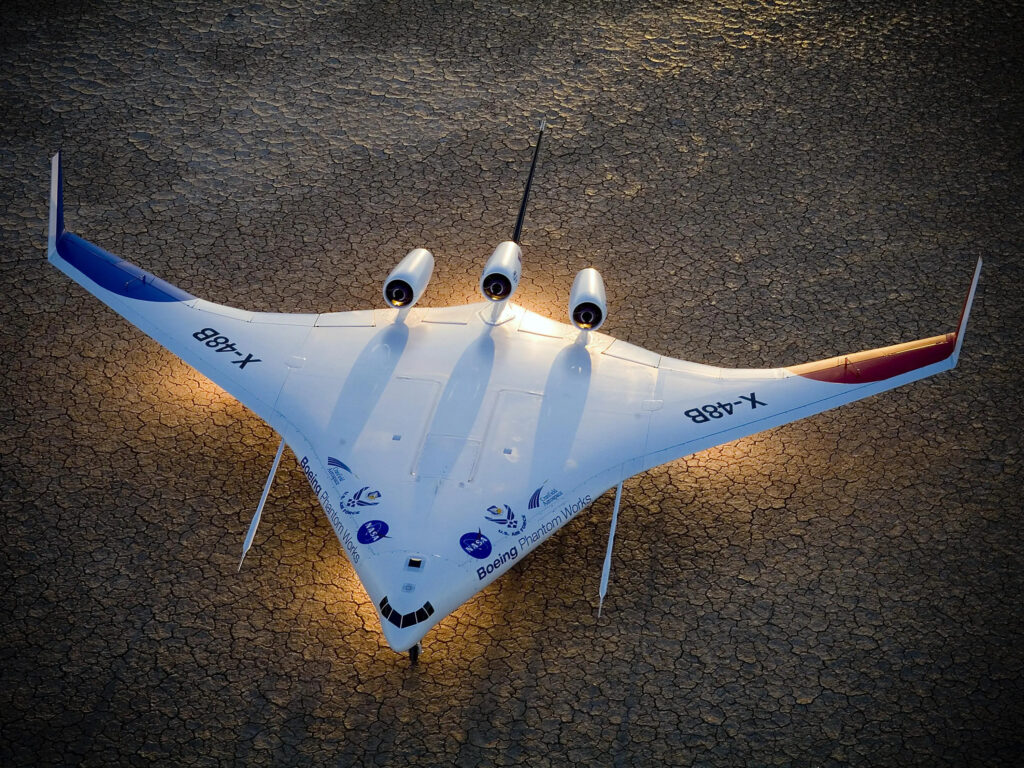
At first glance, it does not look like a conventional military aircraft, a commercial airliner, or even a normal unmanned aircraft. Its shape is wide, flat, almost manta-like. There is no clear separation between fuselage and wing in the traditional sense. The body itself becomes part of the lifting surface. That is the core idea behind the blended wing body concept, and the X-48B was one of the most important flying demonstrators built to test whether that idea could move from theory into practical aviation.
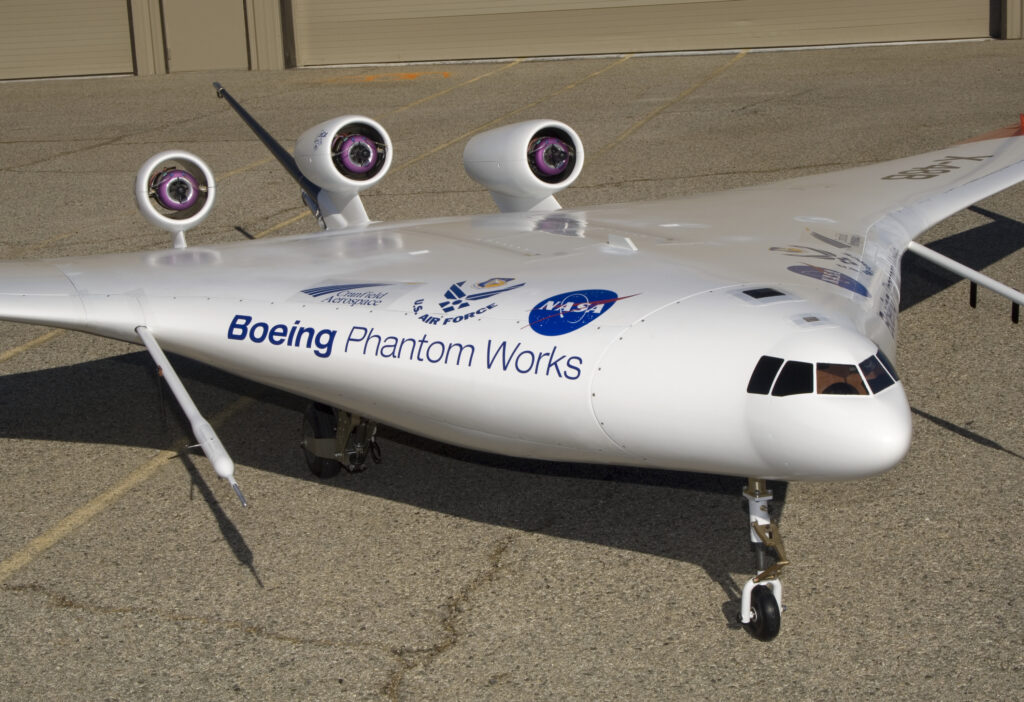
For defense readers, the most important point is this: the X-48B was not an operational military aircraft. It was not a bomber, not a transport aircraft in service, and not a combat UAV. But its research was closely connected to future military transport possibilities. NASA, Boeing Phantom Works, and the U.S. Air Force Research Laboratory worked together on the program, and the Air Force interest was tied to the potential of a long-range, high-capacity, multi-role military transport design.
That makes the X-48B more interesting, not less. It sits in the space between civil aviation research, military logistics thinking, and the long-term search for more efficient aircraft architecture.
Why the Shape Matters
Most large aircraft still follow the familiar tube-and-wing formula. A long cylindrical fuselage carries passengers or cargo, while separate wings generate most of the lift. It works. It is reliable, familiar, and deeply understood by manufacturers, regulators, crews, and operators.
The blended wing body challenges that logic.
Instead of attaching wings to a tube, the aircraft blends the lifting surfaces and central body into a single aerodynamic form. In simple terms, more of the aircraft contributes to lift. This can reduce drag, improve fuel efficiency, create more internal volume, and potentially reduce noise depending on engine placement and airframe design.
That sounds attractive, but aviation is never just about attractive ideas. The difficult question is whether such a design can be controlled safely, especially at low speed, during takeoff, landing, stall conditions, and engine-out scenarios. These are not minor details. A future transport aircraft cannot simply be efficient at cruise altitude. It must also behave predictably when close to the ground, heavy, slow, and exposed to changing winds.
This is where the X-48B becomes important.
A Scale Model with Full-Size Implications
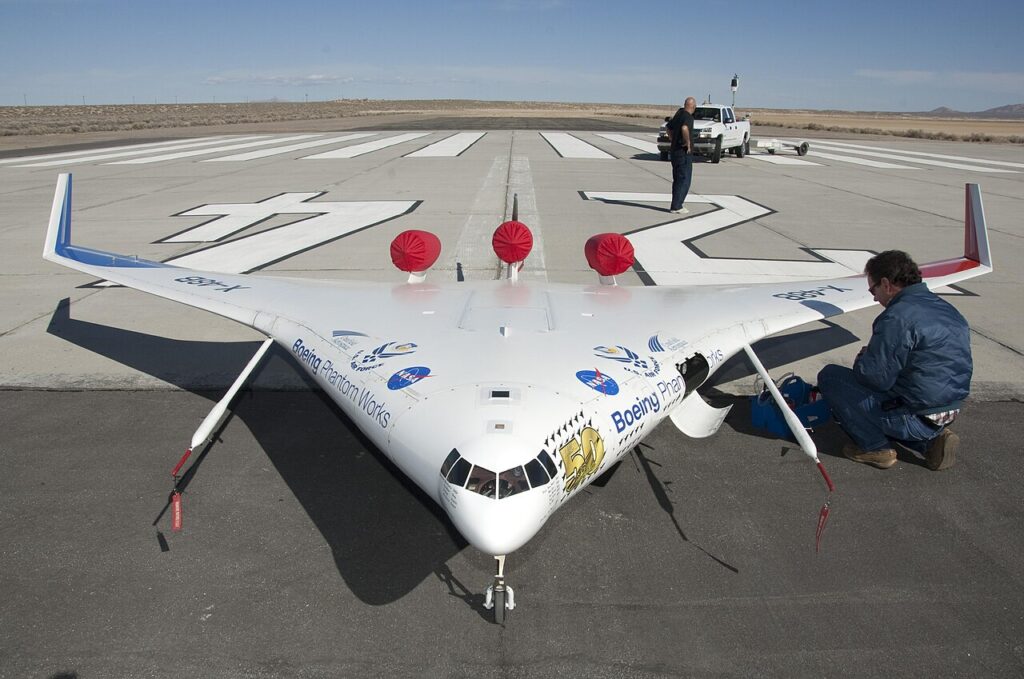
The X-48B was a subscale demonstrator. It had a wingspan of just over 20 feet and weighed roughly 523 pounds. It was remotely piloted rather than crewed. Its estimated top speed was around 118 knots, with a maximum altitude near 10,000 feet and a flight duration of about 40 minutes.
Those numbers might sound modest. But the aircraft was not built to impress anyone with speed or payload. It was built to collect data. In particular, it was dynamically scaled to represent the behavior of a much larger blended wing body aircraft, with NASA documentation connecting the test work to the handling qualities of a conceptual 240-foot wingspan aircraft.
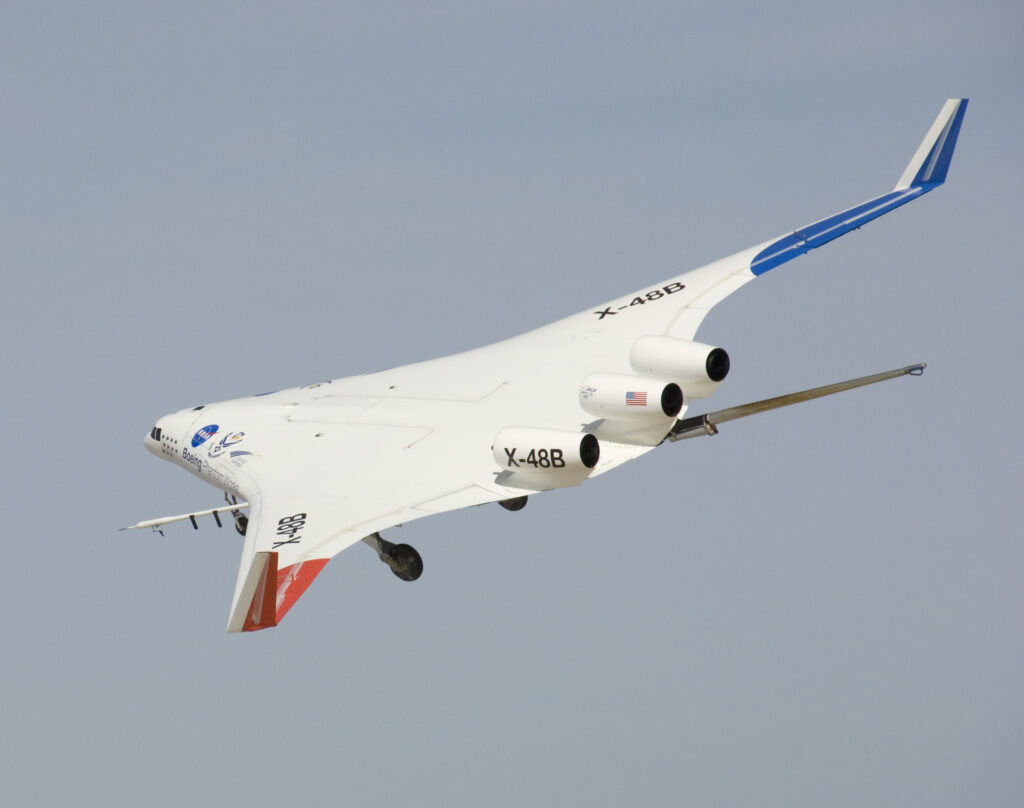
That is the key. The X-48B was small, but its purpose was not small. It was a bridge between wind tunnel models, computer simulations, and the possibility of future large aircraft that do not look like today’s transports.
Its flight tests focused on low-speed, low-altitude characteristics, including stall behavior, engine-out control, and general handling qualities. In other words, researchers were not merely asking whether a blended wing body could fly. They were asking whether it could be handled safely in the parts of flight where safety margins matter most.
The Military Transport Angle
The X-48B is often discussed in relation to future commercial aviation, especially fuel efficiency and reduced noise. That is valid. NASA’s broader interest included cleaner, quieter future aircraft.
But from a defense perspective, the U.S. Air Force Research Laboratory’s role matters. Military logistics places enormous pressure on range, payload, fuel consumption, airfield access, and operating cost. A future blended wing body transport could theoretically carry large volumes over long distances more efficiently than a traditional design.
This does not mean that the X-48B was a prototype for a specific military aircraft. That would be overstating it. It means the concept had military relevance. Large transport aircraft are not glamorous in the same way as fighters, but they are strategic assets. They move troops, equipment, vehicles, supplies, and sometimes entire operational possibilities. If a future airframe can carry more, fly farther, burn less fuel, and generate less noise, defense planners will naturally pay attention.
There is also an industrial lesson here. Some military technologies do not begin as weapons. They begin as efficiency studies, flight-control experiments, materials research, or configuration testing. The X-48B belongs to that category. Its value was not in firepower. Its value was in shaping the future design space.
Control Was the Real Test
The most important achievement of the X-48B program was not that it looked futuristic. Futuristic shapes are easy to sketch. Stable, controllable, test-validated aircraft are much harder.
NASA’s reporting emphasized that the flight campaign helped demonstrate that a blended wing body could be controlled effectively during takeoff, landing, and other low-speed segments. That is a major point because tailless or semi-tailless aircraft forms can raise serious control questions. Without the conventional tail arrangement, flight-control software, elevons, rudders, and aerodynamic surfaces must do more of the work.
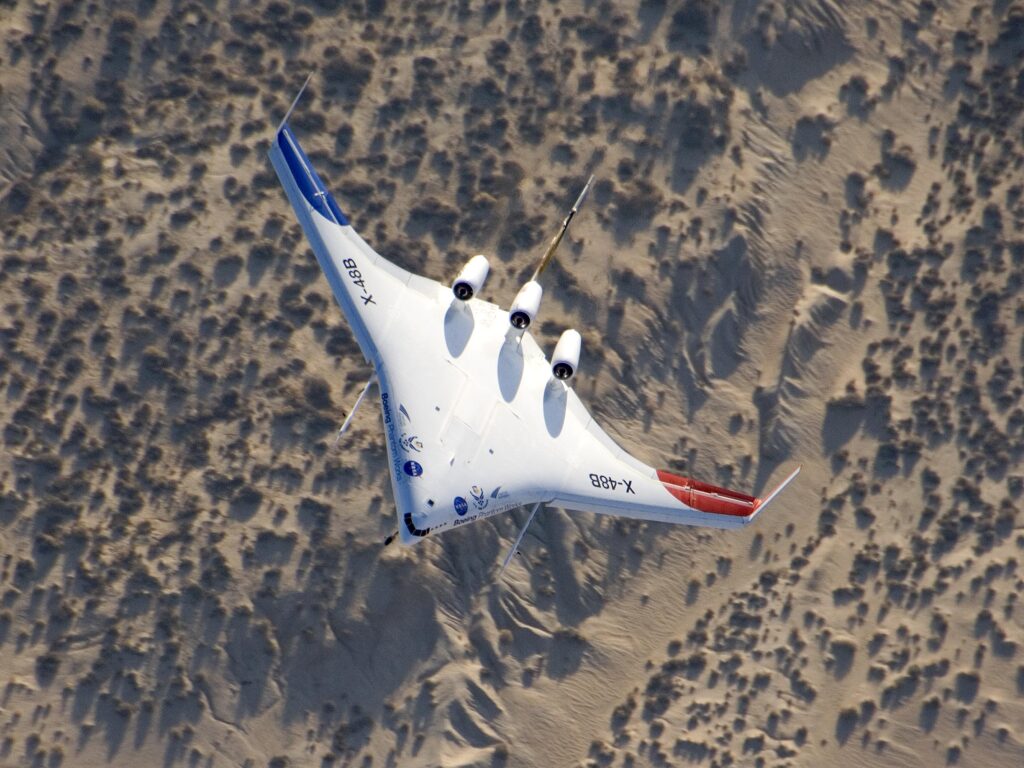
The X-48B carried prominent vertical fins and rudders at the wingtips, with elevons along the trailing edges. It was powered by three small turbojet engines. The test program compared flight data with wind tunnel results, allowing engineers to see whether predictions matched real behavior.
For any future large aircraft, this validation process is essential. Computer models are powerful, but aviation history repeatedly shows that real flight testing remains irreplaceable. Airflow separates, aircraft flex, control surfaces interact, engines influence the surrounding flow, and pilots or remote operators discover behaviors that spreadsheets alone cannot fully reveal.
The X-48B helped close that gap.
From X-48B to X-48C
The program did not stop with the B model. The X-48C was a modified version designed to evaluate a lower-noise hybrid or blended wing body configuration. The C model retained much of the same general size but included important changes: the wingtip winglets were moved inboard near the engines, the rear deck was extended, and the three-engine setup was replaced with two higher-thrust engines.
This shift tells us something important about the maturity of the research. Once the basic low-speed controllability of the configuration had been explored, the next question became refinement. How could the design reduce noise? How would modifications affect stability and handling? What kind of flight-control software would be needed for safer future prototypes?
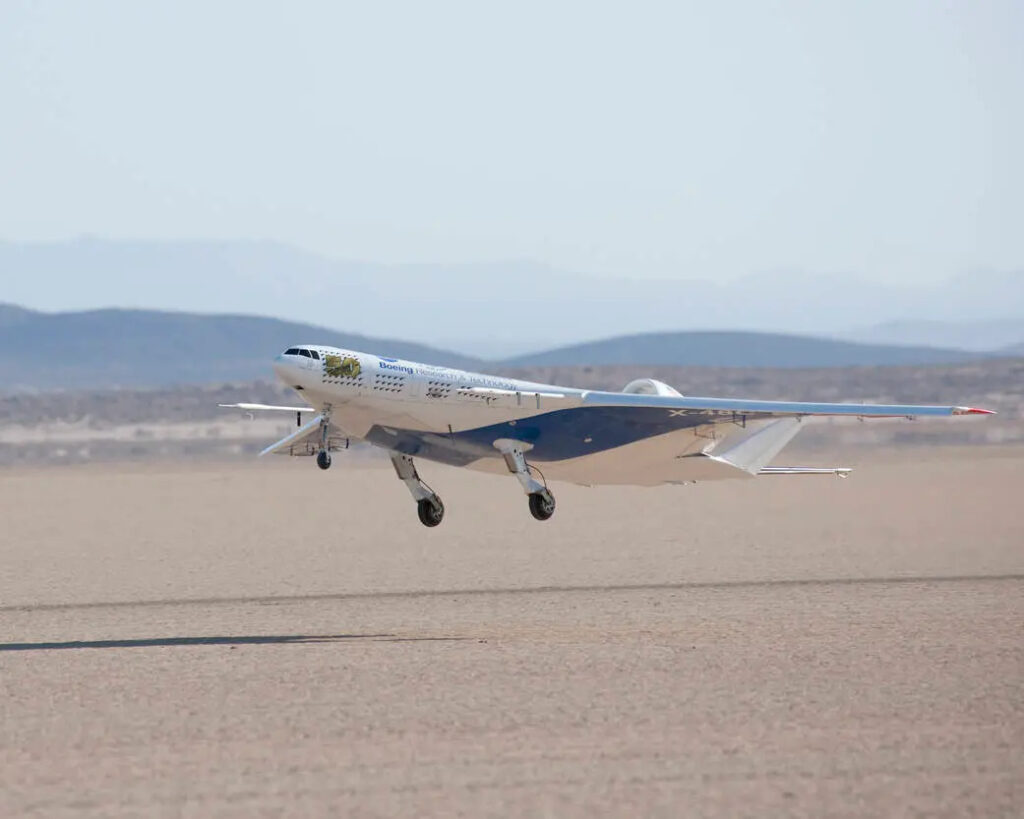
NASA reported that the X-48C completed a 30-flight campaign, bringing the broader project to a close in 2013. Across the X-48B and X-48C work, the research helped establish a ground-to-flight database for future blended wing body studies.
That phrase may sound technical, but it is important. A database like that becomes part of the foundation for future design work. Even if no direct production aircraft appears immediately, the knowledge remains useful.
Why It Still Matters
The X-48B is a good reminder that aircraft development is rarely linear. Not every X-plane becomes an operational platform. Many never do. But they can still change the way engineers, defense planners, and manufacturers think.
For Drill & Defense readers, the X-48B matters because it shows how future air mobility may be shaped by logistics and efficiency as much as speed or stealth. A future battlefield or crisis zone will not only require advanced fighters and drones. It will require the ability to move mass across distance. Fuel efficiency, payload volume, lower acoustic signature, and range are not secondary issues. They directly affect operational reach.
The blended wing body concept also forces a broader question: how long will the traditional tube-and-wing layout remain dominant for large aircraft? It may remain dominant for decades because infrastructure, certification, manufacturing, and passenger expectations all favor familiar designs. But military transport has sometimes accepted unconventional solutions when the operational benefit was strong enough.
That is where the X-48B’s legacy sits. It did not produce a new aircraft overnight. It did something more subtle. It reduced uncertainty around a radical configuration. It showed that a blended wing body aircraft could be flown, tested, refined, and understood in real airspace.
In defense technology, that kind of progress matters. Before a system becomes visible, deployable, and politically important, it usually spends years as a strange-looking test article on a dry lakebed, proving one narrow point at a time.
The X-48B was exactly that kind of aircraft.
Sources
- NASA, “X-48B Blended Wing Body.”
- NASA Dryden / Armstrong Fact Sheet, “X-48 Hybrid/Blended Wing Body
- NASA, Beyond Tube-and-Wing: The X-48 Blended Wing-Body and NASA’s Quest to Reshape Future Transport Aircraft.