
Drill & Defense
Advertisement
  • Defense
    • Industry News
    • Weapon & Gear Reviews
    • Defense Technologies
    • Military Market Reports
  • Energy
    • Oil & Gas News
    • Energy Technologies
    • Market Trends & Analysis
  • Cross-Sector Insights
    • Defense & Energy Strategy
    • Global Security & Trade Analysis
    • Tech & Innovation Crossover
  • History & Legacy
    • Turning Points in Conflict
    • Legacy Systems & Structures
    • Resource Wars & Strategy
  • Knowledge Base
    • Defense Know-How
    • Energy Insight
  • About
  • Contact
  • Login
  • Register
No Result
View All Result
  • Defense
    • Industry News
    • Weapon & Gear Reviews
    • Defense Technologies
    • Military Market Reports
  • Energy
    • Oil & Gas News
    • Energy Technologies
    • Market Trends & Analysis
  • Cross-Sector Insights
    • Defense & Energy Strategy
    • Global Security & Trade Analysis
    • Tech & Innovation Crossover
  • History & Legacy
    • Turning Points in Conflict
    • Legacy Systems & Structures
    • Resource Wars & Strategy
  • Knowledge Base
    • Defense Know-How
    • Energy Insight
  • About
  • Contact
  • Login
  • Register
No Result
View All Result
Drill & Defense
No Result
View All Result
Home Defense

A-10 Thunderbolt II: A Platform Built Around Purpose

March 24, 2026
in Defense, Defense Technologies
A-10 Thunderbolt II: A Platform Built Around Purpose

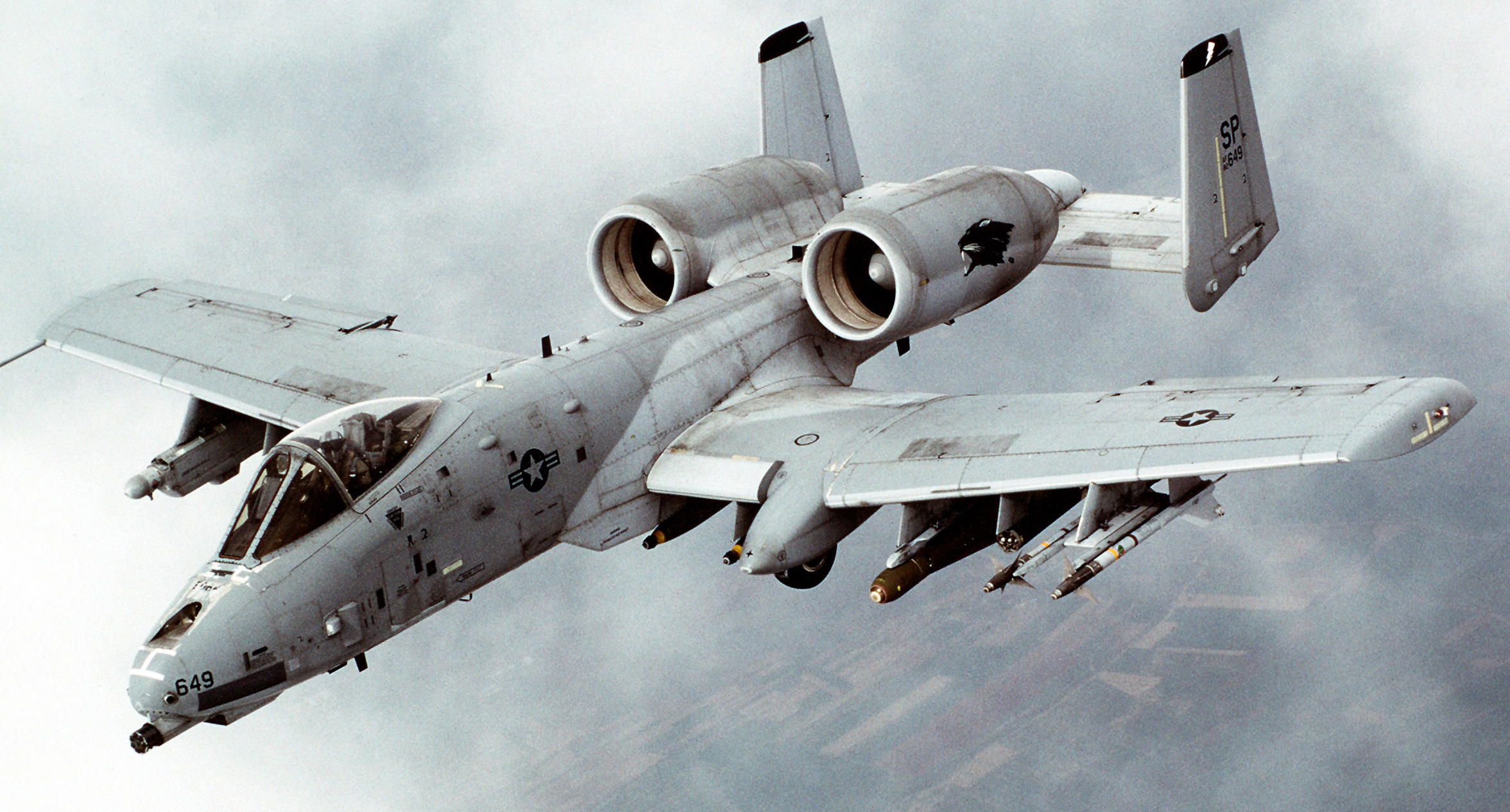
An A-10 Thunderbolt II from the 81st Fighter Squadron, Spangdahlem Air Base, Germany, pulls away from a tanker (not shown) after refueling on the way to Serbian targets during Operation ALLIED FORCE. This photograph was used in the September 1999 issue of Airman Magazine.

Share on LinkedInShare on Twitter

There are aircraft that represent speed. Others represent stealth. A smaller group represents technological ambition. And then there is the A-10 Thunderbolt II, a platform that was never designed to impress in any of those categories. It was designed to solve a very specific problem, and it has continued to do so with a level of consistency that few systems in modern warfare can match.

If viewed without the cultural narrative surrounding it, the A-10 does not stand out for elegance, speed, or subtlety. Those characteristics were never part of its intended role.

A System Defined by Close Air Support

The A-10 emerged from a very clear strategic requirement during the Cold War. The United States needed an aircraft capable of countering large formations of armored forces, particularly Soviet tanks advancing across Europe. The result was not a multirole compromise, but a dedicated close air support platform designed specifically to operate in direct coordination with ground forces.

This distinction matters more than it first appears. Most modern combat aircraft are built to perform multiple roles, balancing air superiority, strike capability, and survivability within a single platform. The A-10 does not attempt to balance. It commits fully to one role and accepts the trade-offs that come with that decision.
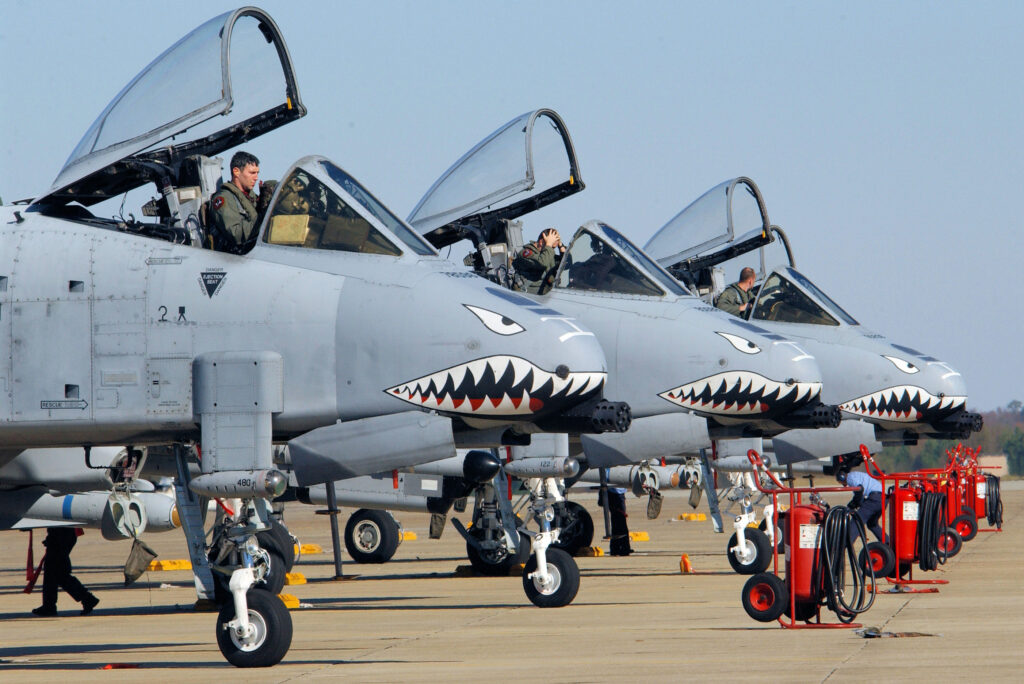
A-10s of the 23d Fighter Group shut their engines off after a mission in support of Operation Dynamic Weasel. Pope AFB, North Carolina.

That is why it remains relevant. Close air support is not simply about delivering firepower. It is about timing, precision, communication, and persistence over the battlefield. The A-10 was built to stay in the fight longer than other aircraft, to operate at lower altitudes, and to maintain visual awareness of the ground situation. In practical terms, that means it does not just strike targets. It supports decision-making on the ground.

Built Around a Weapon, Not the Other Way Around

One of the most defining aspects of the A-10 is that it was designed around its primary weapon, the GAU-8/A Avenger cannon. This is not a typical design approach. In most aircraft, the weapon is integrated into the platform. In the A-10, the platform was built around the weapon itself.

The GAU-8 is a 30 mm, seven-barrel rotary cannon capable of firing approximately 3,900 rounds per minute. It was specifically developed to defeat armored targets, including tanks, which shaped the entire architecture of the aircraft.
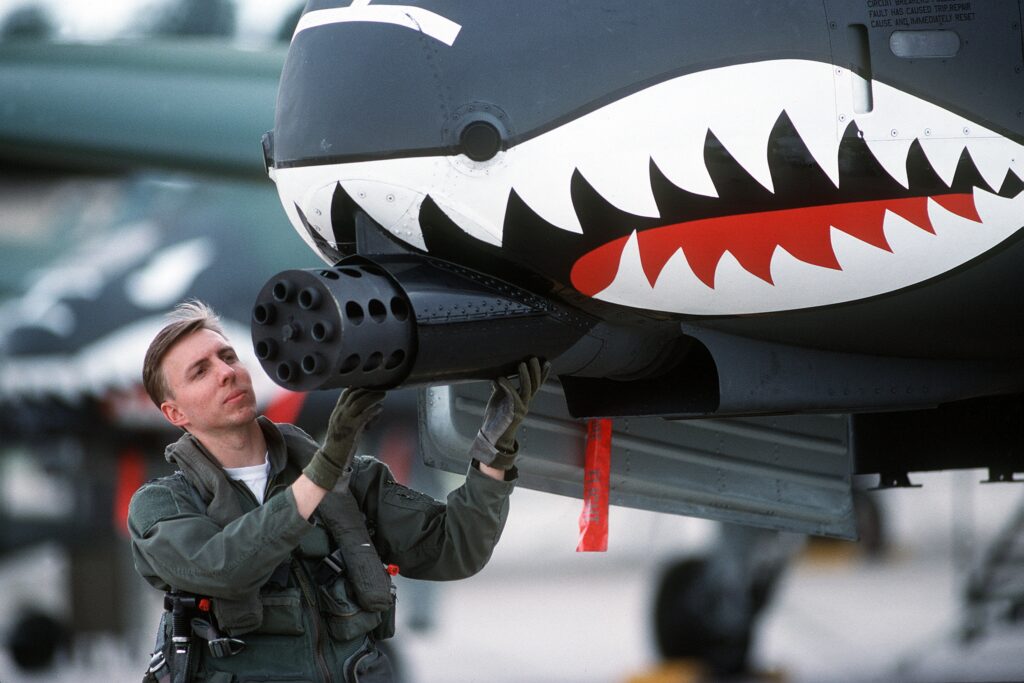
Capt. Todd Sheehy, 75th Fighter Squadron, inspects the GAU-8A 30mm gun on an A-10A Thunderbolt II aircraft. The squadron was recently activated under the 23rd Wing to support Army operations at Fort Bragg.

This decision has consequences. The weight of the gun system alone represents a significant portion of the aircraft’s structure. The cannon is aligned with the centerline to maintain accuracy, and even the landing gear is positioned in a way that accommodates the weapon’s placement.

From a design perspective, this is a level of specialization that modern programs often avoid. But it is also the reason why the A-10 delivers a type of firepower that cannot be easily replicated by external pods or modular systems.

Survivability Over Sophistication

Modern airpower discussions tend to focus heavily on stealth, electronic warfare, and networked capabilities. The A-10 approaches survivability differently. Instead of avoiding damage, it is built to absorb it.

The aircraft includes a titanium armored cockpit, often referred to as a “bathtub,” designed to protect the pilot from ground fire. It also features redundant flight control systems, allowing it to continue flying even after significant structural damage.

This philosophy reflects a different understanding of risk. The A-10 is expected to operate in environments where threats are not theoretical. It flies low, remains visible, and enters engagement zones where anti-aircraft fire is likely. Its survivability is not based on avoiding detection, but on enduring exposure.

That distinction separates it from most contemporary platforms.
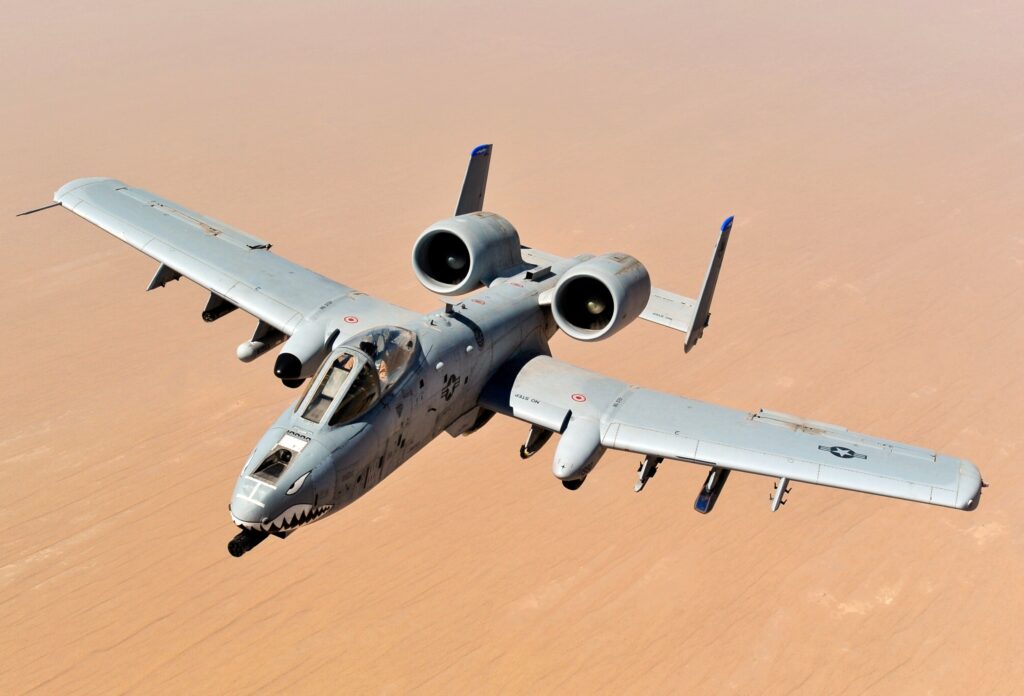
An A-10 Thunderbolt II, assigned to the 74th Fighter Squadron, Moody Air Force Base, GA, returns to mission after receiving fuel from a KC-135 Stratotanker, 340th Expeditionary Air Refueling Squadron, over the skies of Afghanistan in support of Operation Enduring Freedom, May 8, 2011. (U.S. Air Force photo/Master Sgt. William Greer)

Operational Reality: Persistence and Pressure

One of the less discussed advantages of the A-10 is not its firepower, but its presence. The aircraft is capable of loitering over a battlefield for extended periods, maintaining continuous support for ground units.

This creates a form of operational pressure that is difficult to quantify. Ground forces do not just receive occasional support. They operate under a constant umbrella of potential intervention, and the psychological effect of that presence, both for friendly forces and opposing units, is significant.

This is where the A-10’s slower speed becomes an advantage rather than a limitation. It allows the aircraft to stay engaged, observe, and respond with precision rather than simply delivering high-speed strike missions and departing the area.
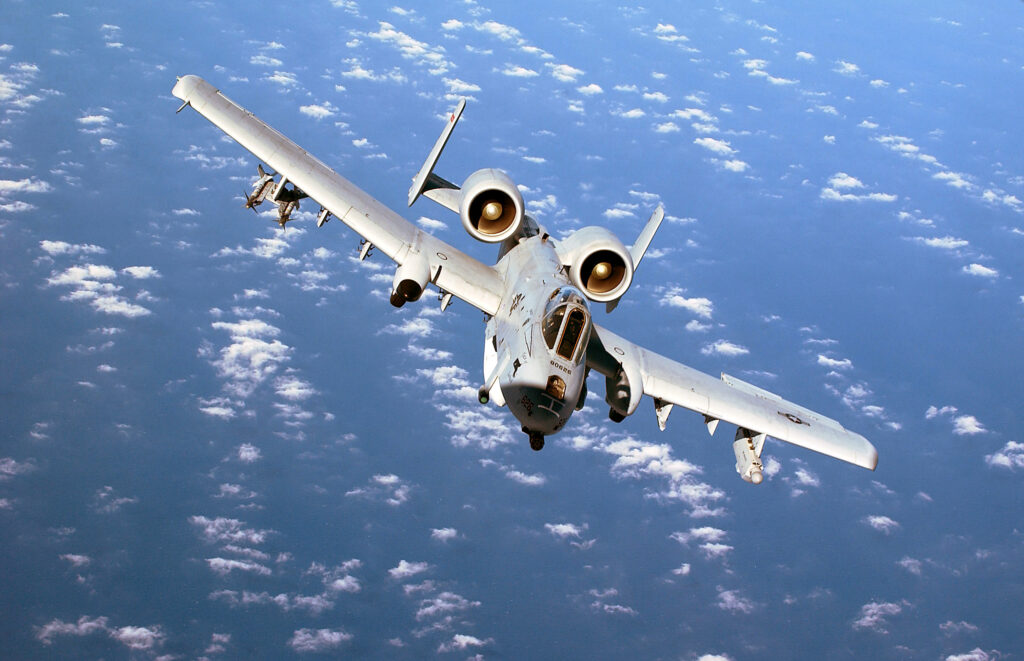
OVER THE MEDITERRANEAN SEA — An A-10 Thunderbolt II from the 104th Fighter Wing, Barnes Municipal Airport, Westfield Mass., Massachusetts Air National Guard, banks while flying accross the Mediterranean Sea enroute to a forward operating base.

Combat Record and Strategic Value

The A-10’s performance in operations such as the Gulf War demonstrated its effectiveness in large-scale conventional conflict. It achieved high mission readiness rates and was heavily used in anti-armor roles, including the destruction of tanks and artillery systems.

In later conflicts, including Afghanistan and Iraq, its role evolved. Instead of engaging massed armored formations, it was used in more complex environments involving dispersed targets, urban settings, and irregular warfare. The aircraft adapted, not through fundamental redesign, but through upgrades in targeting systems and munitions.

This adaptability is often overlooked. The A-10 is frequently described as a legacy platform, but its continued use across different types of conflicts suggests a level of operational flexibility that goes beyond its original design.

The Debate Around Replacement

There has been an ongoing discussion about whether the A-10 should be replaced by more modern multirole aircraft, particularly platforms that emphasize stealth and advanced sensors. From a purely technological perspective, newer systems offer clear advantages.

But the question is not whether other aircraft are more advanced. The question is whether they can replicate the specific role that the A-10 performs. Close air support at low altitude, with sustained presence, high survivability, and direct coordination with ground forces, is not easily transferable to platforms optimized for different mission profiles.
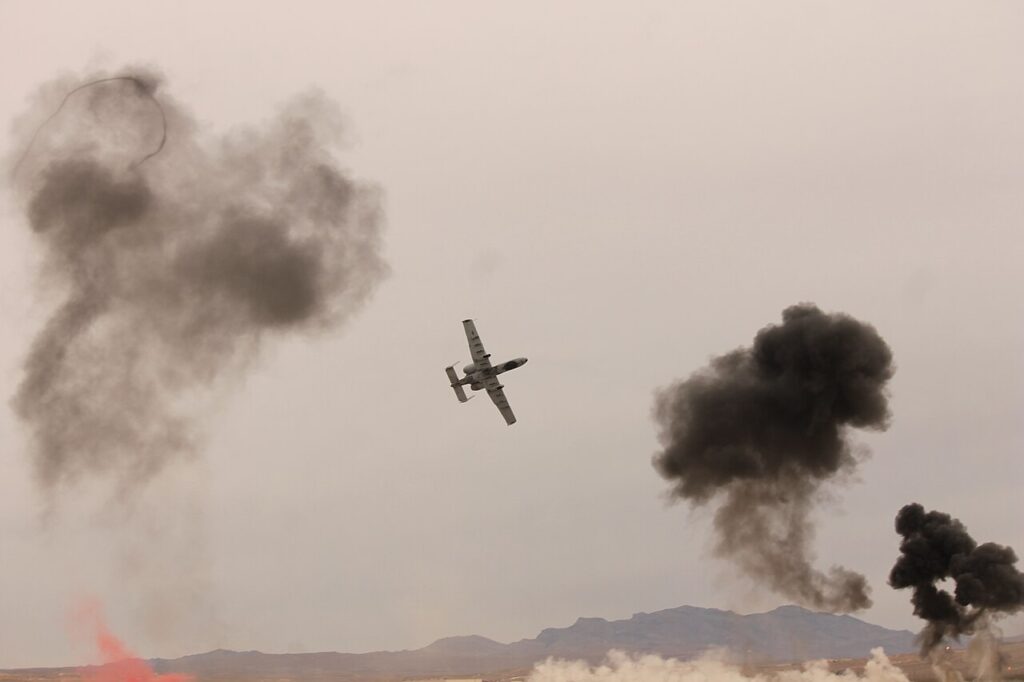
An A-10 Thunderbolt II banks to the left after performing a mock gun run during the Combined Arms Demo at Aviation Nation 2017. Aviation Nation is an airshow at Nellis Air Force Base, Nevada. The smoke is caused by pyrotechnics. Noah Wulf, CC BY-SA 4.0 https://creativecommons.org/licenses/by-sa/4.0.

This is where the debate becomes less about technology and more about doctrine. If the nature of warfare shifts away from environments where close air support is critical, the A-10 becomes less relevant. If those environments persist, its value remains.

A Platform That Reflects a Different Design Philosophy

What makes the A-10 worth analyzing is not just its performance, but what it represents. It reflects a design philosophy that prioritizes clarity of purpose over versatility.

It accepts limitations in speed and technological sophistication in exchange for reliability, survivability, and mission effectiveness. It is not optimized for every scenario. It is optimized for one scenario, and it performs that role with consistency.

In a defense environment increasingly focused on multi-domain integration and high-end conflict, that level of specialization stands out. Not because it is outdated, but because it is deliberate. And that is why the A-10 continues to generate discussion, not just as an aircraft, but as a concept.

Sources

  • U.S. Air Force
    A-10C Thunderbolt II Fact Sheet
  • Whiteman Air Force Base
    A-10 Thunderbolt II Overview
  • Airforce-Technology
    A-10 Thunderbolt (Warthog) Project Overview

Previous Post

Desert Storm and the War Within the War

Related Posts

Merkava Barak: The Evolution of Armored Warfare
Defense

Merkava Barak: The Evolution of Armored Warfare

March 17, 2026
2048px-U_S_Forces_Launch_Operation_Epic_Fury_(9542616)
Defense

Carrier Strike Power: Super Hornet, Hawkeye, JDAM and the Mechanics of Modern Air Operations

March 4, 2026
“Iron Swords” – The Continuing War Born from the Tunnels
Defense

“Iron Swords” – The Continuing War Born from the Tunnels

February 18, 2026
Stealth Technology’s Mathematics: How Low Observability Is Actually Engineered
Defense

Stealth Technology’s Mathematics: How Low Observability Is Actually Engineered

February 11, 2026
ITAR Spotlight: Why USML Categories I, III and VIII Sit At The Heart Of Defense Export Controls
Military Market Reports

ITAR Spotlight: Why USML Categories I, III and VIII Sit At The Heart Of Defense Export Controls

November 26, 2025
Africa Partnership Station AK 47
Defense

The AK-47 Legacy in Africa

October 20, 2025
  • Trending
  • Comments
  • Latest
Blackwater PMC

After Blackwater: How PMCs Evolved, Professionalized, and Fragmented

September 13, 2025
Blackwater PMC

Inside Iraq’s Security Market: How Private Power Shapes a Fragile State

October 6, 2025
Operation Enduring Freedom

What Exactly Is a Private Military Company (PMC)?

September 6, 2025
FeisalPartyAtVersaillesCopy

T. E. Lawrence: Strategic Influence, Cultural Depth, and the Enduring Architecture of a Legacy

January 26, 2026
A Historic $142 Billion Arms Deal: Unpacking the U.S.-Saudi Agreement

A Historic $142 Billion Arms Deal: Unpacking the U.S.-Saudi Agreement

A Silent Revolution on the Battlefield: AI-Enabled Tactical Communication Systems

A Silent Revolution on the Battlefield: AI-Enabled Tactical Communication Systems

Cominf.org, CC BY-SA 3.0 , via Wikimedia Commons

Is Europe Really Reducing Its Dependence on Russian Gas?

What is ITAR? The Invisible Line in Global Defense Trade

What is ITAR? The Invisible Line in Global Defense Trade

A-10 Thunderbolt II: A Platform Built Around Purpose

A-10 Thunderbolt II: A Platform Built Around Purpose

March 24, 2026
Desert Storm and the War Within the War

Desert Storm and the War Within the War

March 23, 2026
WAR & CONFLICT BOOKERA: KOREAN WAR/PERSONALITIES & POLITICS

Douglas MacArthur: Power, Command, and the Boundaries of Strategy

March 19, 2026
Türkei, Dardanellen, MG-Stellung

Gallipoli Campaign: When Strategy Met Reality

March 18, 2026

Recent News

A-10 Thunderbolt II: A Platform Built Around Purpose

A-10 Thunderbolt II: A Platform Built Around Purpose

March 24, 2026
Desert Storm and the War Within the War

Desert Storm and the War Within the War

March 23, 2026
WAR & CONFLICT BOOKERA: KOREAN WAR/PERSONALITIES & POLITICS

Douglas MacArthur: Power, Command, and the Boundaries of Strategy

March 19, 2026
Türkei, Dardanellen, MG-Stellung

Gallipoli Campaign: When Strategy Met Reality

March 18, 2026
Drill & Defense

Drill & Defense is an independent platform providing insights into firearms, defense technologies, and energy sectors. We deliver clear, practical content for professionals, enthusiasts, and industry followers worldwide.

Follow Us

Browse by Category

  • Cross-Sector Insights
  • Defense
  • Defense & Energy Strategy
  • Defense Know-How
  • Defense Technologies
  • Energy
  • Energy Insight
  • Energy Technologies
  • Global Security & Trade Analysis
  • History & Legacy
  • Industry News
  • Knowledge Base
  • Legacy Systems & Structures
  • Market Trends & Analysis
  • Military Market Reports
  • Oil & Gas News
  • Resource Wars & Strategy
  • Tech & Innovation Crossover
  • Turning Points in Conflict
  • Weapon & Gear Reviews

Recent News

A-10 Thunderbolt II: A Platform Built Around Purpose

A-10 Thunderbolt II: A Platform Built Around Purpose

March 24, 2026
Desert Storm and the War Within the War

Desert Storm and the War Within the War

March 23, 2026

© 2026 Drill & Defense. All rights reserved. Independent insights on firearms, defense, and energy. For business inquiries: info@drillanddefense.com | PRIVACY POLICY | COOKIE POLICY | TERMS AND CONDITIONS

Manage Consent

We use cookies to improve your experience. You can accept or refuse cookies; however, some features may not function properly without your consent.

Functional Always active
The technical storage or access is strictly necessary for the legitimate purpose of enabling the use of a specific service explicitly requested by the subscriber or user, or for the sole purpose of carrying out the transmission of a communication over an electronic communications network.
Preferences
The technical storage or access is necessary for the legitimate purpose of storing preferences that are not requested by the subscriber or user.
Statistics
The technical storage or access that is used exclusively for statistical purposes. The technical storage or access that is used exclusively for anonymous statistical purposes. Without a subpoena, voluntary compliance on the part of your Internet Service Provider, or additional records from a third party, information stored or retrieved for this purpose alone cannot usually be used to identify you.
Marketing
The technical storage or access is required to create user profiles to send advertising, or to track the user on a website or across several websites for similar marketing purposes.
  • Manage options
  • Manage services
  • Manage {vendor_count} vendors
  • Read more about these purposes
View preferences
  • {title}
  • {title}
  • {title}
No Result
View All Result
  • Defense
    • Industry News
    • Weapon & Gear Reviews
    • Defense Technologies
    • Military Market Reports
  • Energy
    • Oil & Gas News
    • Energy Technologies
    • Market Trends & Analysis
  • Cross-Sector Insights
    • Defense & Energy Strategy
    • Global Security & Trade Analysis
    • Tech & Innovation Crossover
  • History & Legacy
    • Turning Points in Conflict
    • Legacy Systems & Structures
    • Resource Wars & Strategy
  • Knowledge Base
    • Defense Know-How
    • Energy Insight
  • About
  • Contact
  • Login
  • Register

© 2026 Drill & Defense. All rights reserved. Independent insights on firearms, defense, and energy. For business inquiries: info@drillanddefense.com | PRIVACY POLICY | COOKIE POLICY | TERMS AND CONDITIONS