
Drill & Defense
Advertisement
  • Defense
    • Industry News
    • Weapon & Gear Reviews
    • Defense Technologies
    • Military Market Reports
  • Energy
    • Oil & Gas News
    • Energy Technologies
    • Market Trends & Analysis
  • Cross-Sector Insights
    • Defense & Energy Strategy
    • Global Security & Trade Analysis
    • Tech & Innovation Crossover
  • History & Legacy
    • Turning Points in Conflict
    • Legacy Systems & Structures
    • Resource Wars & Strategy
  • Knowledge Base
    • Defense Know-How
    • Energy Insight
  • About
  • Contact
  • Login
  • Register
No Result
View All Result
  • Defense
    • Industry News
    • Weapon & Gear Reviews
    • Defense Technologies
    • Military Market Reports
  • Energy
    • Oil & Gas News
    • Energy Technologies
    • Market Trends & Analysis
  • Cross-Sector Insights
    • Defense & Energy Strategy
    • Global Security & Trade Analysis
    • Tech & Innovation Crossover
  • History & Legacy
    • Turning Points in Conflict
    • Legacy Systems & Structures
    • Resource Wars & Strategy
  • Knowledge Base
    • Defense Know-How
    • Energy Insight
  • About
  • Contact
  • Login
  • Register
No Result
View All Result
Drill & Defense
No Result
View All Result
Home Knowledge Base

The Sykes-Picot Agreement: A Century of Consequences in the Middle East

June 3, 2025
in Knowledge Base, Energy Insight
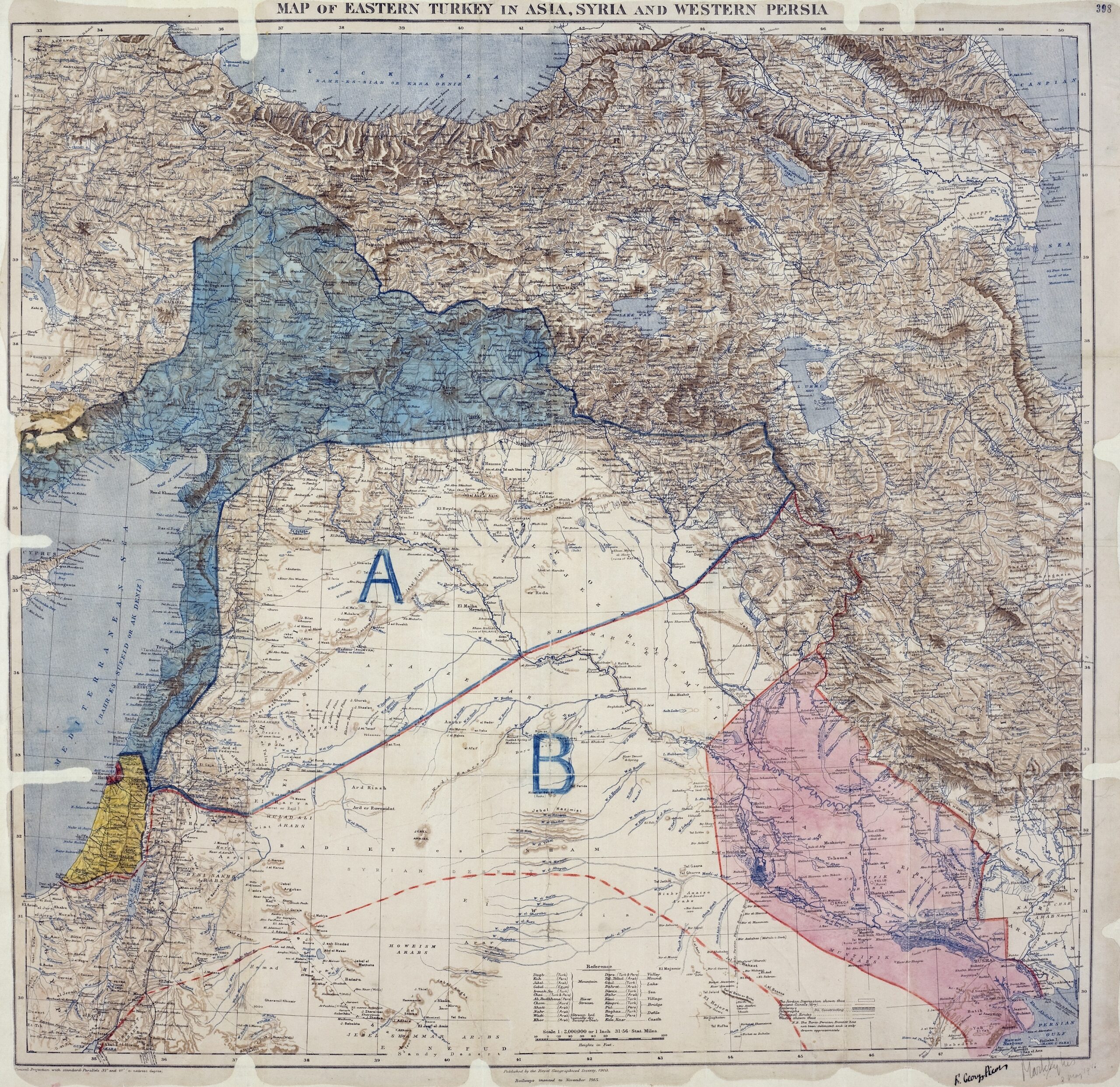
The Sykes-Picot Agreement: A Century of Consequences in the Middle East

Royal Geographical Society (Map), Mark Sykes & François Georges-Picot (Annotations), Public domain, via Wikimedia Commons

Share on LinkedInShare on Twitter

In the annals of Middle Eastern history, few agreements have had as profound and lasting an impact as the Sykes-Picot Agreement. Signed in secrecy during World War I, this accord between Britain and France laid the groundwork for the modern geopolitical landscape of the Middle East. Its legacy continues to influence the region’s politics, borders, and conflicts to this day.
Understanding the Sykes-Picot Agreement

The Sykes-Picot Agreement, officially known as the Asia Minor Agreement, was concluded in May 1916 between Britain and France, with the assent of Russia. The agreement aimed to divide the Ottoman Empire’s Arab provinces into spheres of influence and control after the anticipated Allied victory in World War I. Under its terms, France would control southeastern Turkey, northern Iraq, Syria, and Lebanon, while Britain would control southern Iraq and the area around the Persian Gulf. Palestine was to be placed under international administration due to its religious significance.

The Context of the Agreement

During World War I, the Ottoman Empire aligned with the Central Powers, opposing the Allied forces. As the war progressed, the Allies began to consider the post-war division of Ottoman territories. Britain and France, seeking to protect and expand their colonial interests, entered into secret negotiations to delineate their respective spheres of influence in the Middle East. The resulting Sykes-Picot Agreement was a manifestation of these imperial ambitions.

Mark Sykes

Contradictory Promises and Arab Disillusionment

The Sykes-Picot Agreement directly contradicted promises made by the British to Arab leaders during the Hussein-McMahon Correspondence (1915–1916), in which Britain pledged support for an independent Arab state in exchange for Arab assistance against the Ottomans. The revelation of the Sykes-Picot Agreement in 1917, following its publication by the Bolsheviks after the Russian Revolution, led to widespread Arab disillusionment and a sense of betrayal.

Impact on Modern Middle Eastern Borders

Although the exact borders outlined in the Sykes-Picot Agreement were not implemented, the agreement set a precedent for the arbitrary division of the Middle East by external powers. The subsequent establishment of the British and French mandates in the region, sanctioned by the League of Nations, largely followed the spheres of influence proposed in the agreement. These mandates laid the foundation for the modern states of Iraq, Syria, Lebanon, and Jordan, often disregarding ethnic, tribal, and religious considerations.

François Georges-Picot

Long-Term Consequences

Artificial Borders and Sectarian Conflict

The borders drawn during the mandate period, influenced by the Sykes-Picot Agreement, often grouped disparate communities together or divided cohesive groups across national boundaries. This has contributed to ongoing sectarian tensions and conflicts in countries like Iraq and Syria. For example, the Sunni-Shia divide in Iraq and the complex ethnic composition of Syria have been sources of persistent instability.

Rise of Nationalism and Extremism

The perceived betrayal by Western powers fueled Arab nationalism and later Islamist movements. Leaders and groups have cited the Sykes-Picot Agreement as a symbol of Western duplicity and imperialism. In recent years, extremist groups like ISIS have invoked the agreement to justify their actions and to promote the idea of dismantling the current state system in the Middle East.

Ongoing Geopolitical Struggles

The legacy of the Sykes-Picot Agreement continues to influence geopolitical dynamics in the Middle East. The arbitrary borders have led to disputes over territory and resources, as well as challenges in nation-building efforts. External powers have often intervened in the region, citing historical agreements and strategic interests, further complicating the pursuit of stability and self-determination for the peoples of the Middle East.

Conclusion

The Sykes-Picot Agreement stands as a testament to the far-reaching consequences of colonial-era decisions. Its legacy is evident in the ongoing conflicts, political struggles, and calls for reform that characterize the modern Middle East. Understanding this agreement is crucial for comprehending the historical roots of current issues in the region and for informing future policy decisions aimed at promoting peace and stability.

References:

  • The Sykes-Picot Agreement’s Regional Moment – NYU Law (PDF)
  • Is There a Sykes-Picot Syndrome in the Middle East? – Middle East Journal, JSTOR
  • Learning from Sykes-Picot – Wilson Center
  • Persistence of the Sykes–Picot Frontiers – Leiden Journal of International Law
  • Is the Sykes–Picot Agreement the Basis for the Middle East’s Political Division? – Journal of Geography, Politics and Society
  • Sykes-Picot and ‘Artificial’ States – American Journal of International Law, Cambridge University Press


Previous Post

A New Energy Equation: Turkey, BP, and SOCAR’s Strategic Alliance in the Caspian Sea

Next Post

The Strategic Role of Private Military Companies in Oil Tanker Transportation

Related Posts

Live firing of the Light Forces Anti-Tank Guided Weapon (LFATGW) Javelin.
Knowledge Base

Common Misconceptions About ITAR: What Organizations Should Actually Know

December 9, 2025
The Invisible Arsenal: How OSINT Is Re-engineering the Global Arms Trade
Knowledge Base

The Invisible Arsenal: How OSINT Is Re-engineering the Global Arms Trade

November 19, 2025
Iraqi Freedom
Knowledge Base

The Iraq War’s Hidden Battle: How Logistics Shaped the Conflict’s Reality

November 17, 2025
Why Blackwater existed: The logic behind outsourcing war and security
Knowledge Base

Why Blackwater existed: The logic behind outsourcing war and security

November 6, 2025
TE_2REI_Afghanistan French Foregin Legion
Knowledge Base

The French Foreign Legion After the Sahel: Where It Fits Now

October 29, 2025
The Montreux Document: Why It Still Matters for Security Work
Knowledge Base

The Montreux Document: Why It Still Matters for Security Work

September 26, 2025
Next Post
The Strategic Role of Private Military Companies in Oil Tanker Transportation

The Strategic Role of Private Military Companies in Oil Tanker Transportation

  • Trending
  • Comments
  • Latest
Blackwater PMC

After Blackwater: How PMCs Evolved, Professionalized, and Fragmented

September 13, 2025
Blackwater PMC

Inside Iraq’s Security Market: How Private Power Shapes a Fragile State

October 6, 2025
Operation Enduring Freedom

What Exactly Is a Private Military Company (PMC)?

September 6, 2025
Repkon Nammo in Denmark: What This Nordic Ammunition Play Really Signals

Repkon Nammo in Denmark: What This Nordic Ammunition Play Really Signals

August 21, 2025
A Historic $142 Billion Arms Deal: Unpacking the U.S.-Saudi Agreement

A Historic $142 Billion Arms Deal: Unpacking the U.S.-Saudi Agreement

A Silent Revolution on the Battlefield: AI-Enabled Tactical Communication Systems

A Silent Revolution on the Battlefield: AI-Enabled Tactical Communication Systems

Cominf.org, CC BY-SA 3.0 , via Wikimedia Commons

Is Europe Really Reducing Its Dependence on Russian Gas?

What is ITAR? The Invisible Line in Global Defense Trade

What is ITAR? The Invisible Line in Global Defense Trade

Israel’s F-15 News: What Actually Happened, and Why It Matters

Israel’s F-15 News: What Actually Happened, and Why It Matters

January 1, 2026
SDF and HTS: Managing Tension Without Open Conflict in Northern Syria

SDF and HTS: Managing Tension Without Open Conflict in Northern Syria

December 26, 2025
What 2025 Taught Us About Defense and Energy: Five Lessons for 2026

What 2025 Taught Us About Defense and Energy: Five Lessons for 2026

December 24, 2025
The New Taiwan Arms Package and China’s “Stop” Message: What Actually Changed

The New Taiwan Arms Package and China’s “Stop” Message: What Actually Changed

December 19, 2025

Recent News

Israel’s F-15 News: What Actually Happened, and Why It Matters

Israel’s F-15 News: What Actually Happened, and Why It Matters

January 1, 2026
SDF and HTS: Managing Tension Without Open Conflict in Northern Syria

SDF and HTS: Managing Tension Without Open Conflict in Northern Syria

December 26, 2025
What 2025 Taught Us About Defense and Energy: Five Lessons for 2026

What 2025 Taught Us About Defense and Energy: Five Lessons for 2026

December 24, 2025
The New Taiwan Arms Package and China’s “Stop” Message: What Actually Changed

The New Taiwan Arms Package and China’s “Stop” Message: What Actually Changed

December 19, 2025
Drill & Defense

Drill & Defense is an independent platform providing insights into firearms, defense technologies, and energy sectors. We deliver clear, practical content for professionals, enthusiasts, and industry followers worldwide.

Follow Us

Browse by Category

  • Cross-Sector Insights
  • Defense
  • Defense & Energy Strategy
  • Defense Know-How
  • Defense Technologies
  • Energy
  • Energy Insight
  • Energy Technologies
  • Global Security & Trade Analysis
  • History & Legacy
  • Industry News
  • Knowledge Base
  • Legacy Systems & Structures
  • Market Trends & Analysis
  • Military Market Reports
  • Oil & Gas News
  • Resource Wars & Strategy
  • Tech & Innovation Crossover
  • Turning Points in Conflict
  • Weapon & Gear Reviews

Recent News

Israel’s F-15 News: What Actually Happened, and Why It Matters

Israel’s F-15 News: What Actually Happened, and Why It Matters

January 1, 2026
SDF and HTS: Managing Tension Without Open Conflict in Northern Syria

SDF and HTS: Managing Tension Without Open Conflict in Northern Syria

December 26, 2025

© 2025 Drill & Defense. All rights reserved. Independent insights on firearms, defense, and energy. For business inquiries: info@drillanddefense.com | PRIVACY POLICY | COOKIE POLICY | TERMS AND CONDITIONS

Manage Consent

We use cookies to improve your experience. You can accept or refuse cookies; however, some features may not function properly without your consent.

Functional Always active
The technical storage or access is strictly necessary for the legitimate purpose of enabling the use of a specific service explicitly requested by the subscriber or user, or for the sole purpose of carrying out the transmission of a communication over an electronic communications network.
Preferences
The technical storage or access is necessary for the legitimate purpose of storing preferences that are not requested by the subscriber or user.
Statistics
The technical storage or access that is used exclusively for statistical purposes. The technical storage or access that is used exclusively for anonymous statistical purposes. Without a subpoena, voluntary compliance on the part of your Internet Service Provider, or additional records from a third party, information stored or retrieved for this purpose alone cannot usually be used to identify you.
Marketing
The technical storage or access is required to create user profiles to send advertising, or to track the user on a website or across several websites for similar marketing purposes.
  • Manage options
  • Manage services
  • Manage {vendor_count} vendors
  • Read more about these purposes
View preferences
  • {title}
  • {title}
  • {title}
No Result
View All Result
  • Defense
    • Industry News
    • Weapon & Gear Reviews
    • Defense Technologies
    • Military Market Reports
  • Energy
    • Oil & Gas News
    • Energy Technologies
    • Market Trends & Analysis
  • Cross-Sector Insights
    • Defense & Energy Strategy
    • Global Security & Trade Analysis
    • Tech & Innovation Crossover
  • History & Legacy
    • Turning Points in Conflict
    • Legacy Systems & Structures
    • Resource Wars & Strategy
  • Knowledge Base
    • Defense Know-How
    • Energy Insight
  • About
  • Contact
  • Login
  • Register

© 2025 Drill & Defense. All rights reserved. Independent insights on firearms, defense, and energy. For business inquiries: info@drillanddefense.com | PRIVACY POLICY | COOKIE POLICY | TERMS AND CONDITIONS