
Written by Ido Kalev

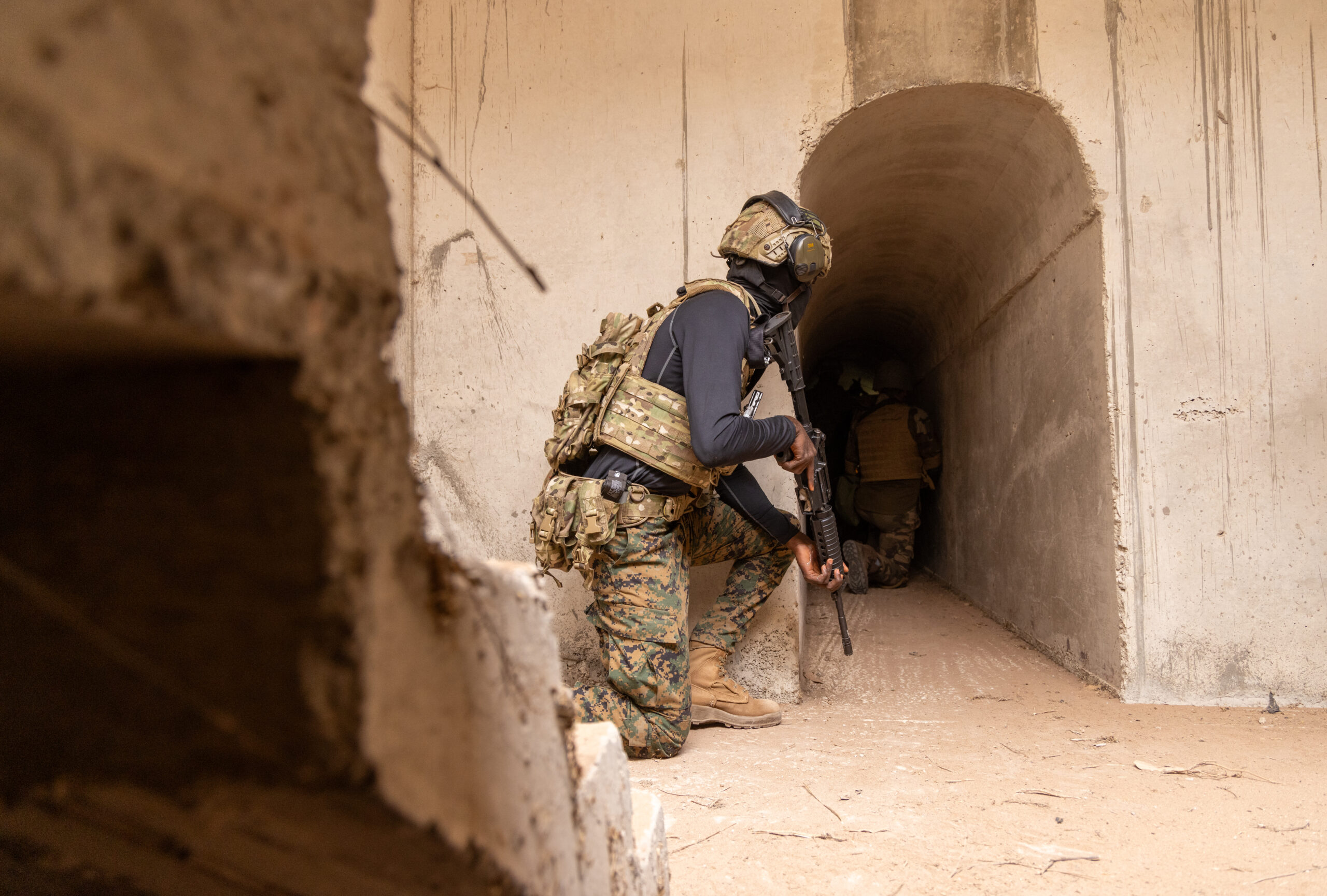
I imagine myself standing in front of the mouth of a dark shaft.
Above me is the blazing Gazan sun, but below me lies another world, cold and still, where time freezes and the air is thick with the smell of dust and concrete. This is not just another “tactical obstacle.” The latest evidence from Gaza suggests that underground warfare is a disruptive innovation that has fundamentally altered the rules of the game. In the technological world, disruptive innovation is not simply an improvement of an existing product, but the entry of a simpler or cheaper technology that creates an entirely new market and collapses the old and powerful players.
In this article, I explore the “Subterranean Disruption,” where high-tech satellites and AI meet their match in the silent, concrete labyrinths of Gaza and Lebanon. It is no longer a “War of Eyes”; it is a “War of the Gut.” From the “Gaza Metro” to Iran’s regional doctrine, the world’s most advanced militaries are being forced back to a primal form of combat. We spent billions mastering the sky, only to find the next war is being fought beneath our boots. The chessboard is gone and the labyrinth has arrived.
The Labyrinth Below – Why the High-Tech Revolution Ends Underground
For decades, modern military strategy has been played on a global chessboard, a flat, visible surface where every move is monitored by satellites, analyzed by AI, and executed with precision from the air. We became masters of the “War of the Eyes,” operating under the doctrine that if you can see it, you can hit it.
Today, the board has been flipped. In the subterranean depths of Gaza and Lebanon, the enemy has replaced the chessboard with a blind labyrinth. This is not merely a tactical shift; it is a strategic disruption that challenges core assumptions of modern warfare.
Creating Depth Where None Exists
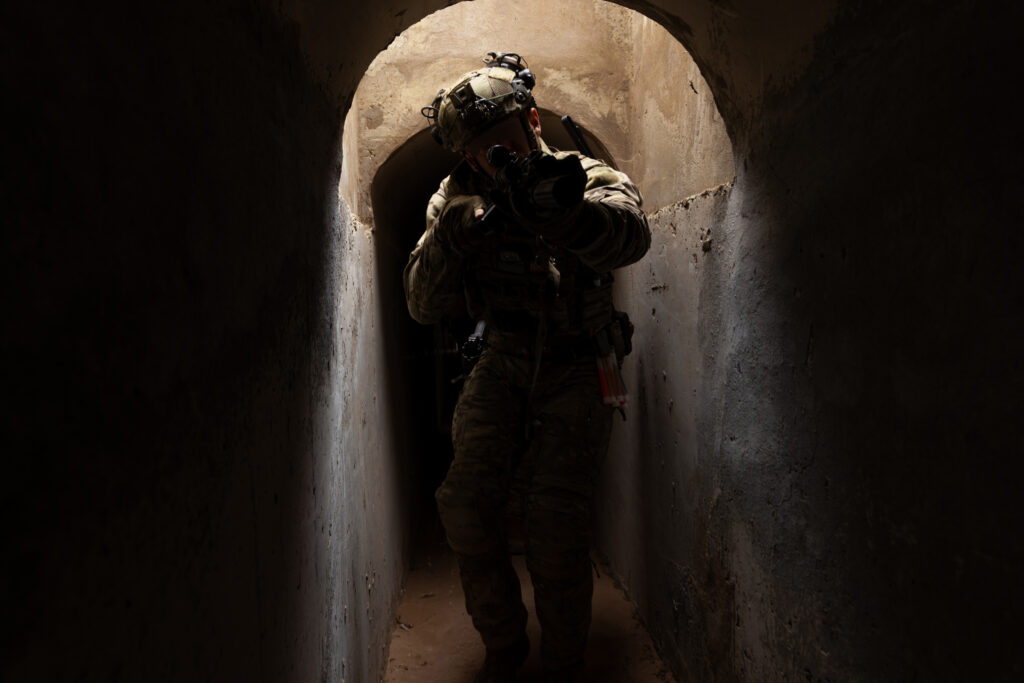
By moving the battlefield underground, adversaries like Hamas and Hezbollah have achieved what was once thought impossible: strategic depth in a tiny, crowded territory.
In a strip of land only 10 kilometers wide, hundreds of kilometers of tunnels have created a multi-layered fortress. Vast borders are no longer necessary. The battlefield goes vertical. The earth itself becomes armor against the world’s most advanced air forces.
The Ultimate A2/AD Strategy
This is the evolution of A2/AD (Anti-Access/Area Denial). Traditionally, this meant using missiles to keep an army away. Today, it means turning the subsurface into a lethal, invisible maze.
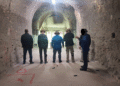
What is referred to as the “Gaza Metro” is not merely a collection of shafts. It is a subterranean infrastructure of command centers, oxygen systems, and logistical hubs. It renders satellites blind and reduces high-tech drones to limited tools against low-tech traps.
The “War of the Gut”
We are witnessing a transition from the “War of Data” to the “War of the Gut,” a claustrophobic reality where the digital revolution fades and raw human instinct returns to the forefront. In the tunnels, there is no GPS, no cloud, and no clearly defined front line.
Pop-up tactics dominate. Fighters emerge from hidden shafts, strike, and vanish back into concrete veins before sensors can respond. A modern army’s visibility and speed can become liabilities in such terrain.
The Human Element – Grit over Gadgets
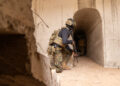
This war, as engineering officers testify from the heart of the underground network, is still in full swing. It has no clear front and rear, no fixed boundary.
Territory above ground may be secured in days. True clearance below the surface takes months. The engineering effort becomes the beating heart of the campaign, with all other units operating in support of subterranean control.
The threat has not disappeared. It may intensify if adversaries adapt, refine excavation methods, and improve shaft concealment. The operational reality deep underground suggests that the conflict beneath the surface has only begun.
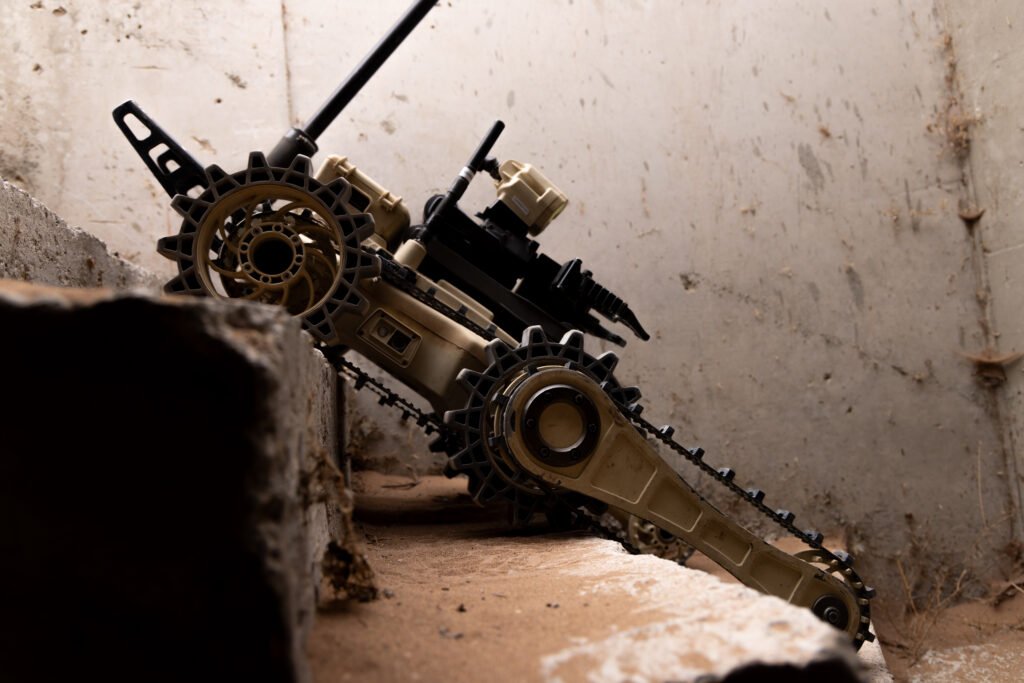
Technology alone is not a silver bullet. Throwbots, K9 units, seismic sensors, and combat innovation help. But the final decider remains the human element.
It requires a unique breed of warrior, such as the engineers of Israel’s SF “Yahalom” unit, capable of navigating and neutralizing these fortresses face-to-face.
Looking Forward – A Regional Doctrine
The subterranean challenge is no longer local. It reflects a broader regional doctrine influenced by Iran. From underground missile complexes to hardened rock formations in southern Lebanon, future conflicts are increasingly shifting below the surface. To maintain a qualitative edge, adaptation is required. Victory will not come from mastering the sky alone, but from understanding the silence beneath.
Lessons are not confined to the Middle East. In Mariupol, the Azovstal complex demonstrated how fortified infrastructure can immobilize powerful forces for extended periods. In an era where drones turn surface movement into a risk, fighters are pushed underground. Global militaries are watching closely. Control of depth is becoming inseparable from control of cities and battlefields.
Engineering the Next Leap
Breaking the stalemate demands a technological leap. The integration of tunnel boring machines and micro-tunneling technologies into combat engineering is increasingly discussed as a strategic necessity. While civilian infrastructure industries invest heavily in precision drilling, militaries risk lagging behind in a domain that may define future battlefields. Advanced tunneling could enable protected logistics routes, secure maneuver corridors, and resilient communication networks. The adaptation of knowledge from oil and gas drilling, horizontal and multilateral technologies, and geological mapping could reshape operational thinking.
The message is clear. The war below the surface is not a temporary anomaly. It represents an enduring dimension of 21st-century conflict. In an era where the digital sky has been mastered, the ancient earth remains a decisive arena. To protect the future above, we must understand the darkness below. Because in the end, control of depth may determine control of land in the century ahead.