
Drill & Defense
Advertisement
  • Defense
    • Industry News
    • Weapon & Gear Reviews
    • Defense Technologies
    • Military Market Reports
  • Energy
    • Oil & Gas News
    • Energy Technologies
    • Market Trends & Analysis
  • Cross-Sector Insights
    • Defense & Energy Strategy
    • Global Security & Trade Analysis
    • Tech & Innovation Crossover
  • History & Legacy
    • Turning Points in Conflict
    • Legacy Systems & Structures
    • Resource Wars & Strategy
  • Knowledge Base
    • Defense Know-How
    • Energy Insight
  • About
  • Contact
  • Login
  • Register
No Result
View All Result
  • Defense
    • Industry News
    • Weapon & Gear Reviews
    • Defense Technologies
    • Military Market Reports
  • Energy
    • Oil & Gas News
    • Energy Technologies
    • Market Trends & Analysis
  • Cross-Sector Insights
    • Defense & Energy Strategy
    • Global Security & Trade Analysis
    • Tech & Innovation Crossover
  • History & Legacy
    • Turning Points in Conflict
    • Legacy Systems & Structures
    • Resource Wars & Strategy
  • Knowledge Base
    • Defense Know-How
    • Energy Insight
  • About
  • Contact
  • Login
  • Register
No Result
View All Result
Drill & Defense
No Result
View All Result
Home Cross-Sector Insights

Maduro Detained: The Energy and Defense Angles Most Coverage Skims Past

January 4, 2026
in Cross-Sector Insights, Defense & Energy Strategy
Maduro Detained: The Energy and Defense Angles Most Coverage Skims Past

President Donald Trump monitors U.S. military operations in Venezuela, from Mar-a-Lago Club in Palm Beach, Florida, on Saturday, January 3, 2026.

Share on LinkedInShare on Twitter

The last 48 hours produced one of those moments that instantly reshapes risk models faster than it reshapes headlines: Venezuelan President Nicolás Maduro has been detained and moved into U.S. custody following a U.S. operation in Venezuela, while Caracas institutions are scrambling to project continuity.

Most reporting is understandably dominated by legality, sovereignty, and the spectacle of a head of state in detention. But for anyone tracking energy security and defense dynamics, the more important question is simpler and colder: what systems move next. Because the event is not only political. It is operational, logistical, and market-sensitive.

If you are reading this, keep one thing in mind: the first narrative is rarely the final one. The first narrative is for public consumption. The second is for institutions, investors, and security planners.

What We Know So Far (and What We Don’t)

Reporting from multiple international outlets indicates that Maduro was captured during a U.S. operation and transported to the United States, where he faces U.S. criminal charges. A separate reporting line shows Venezuelan state institutions attempting to frame the detention as an external coercive act rather than an internal rupture, with the Supreme Court ordering Vice President Delcy Rodríguez to assume an interim role to maintain administrative continuity.

At the same time, international reaction is splitting along familiar lines, with Latin American governments divided between condemnation and approval, and a UN Security Council meeting reportedly requested.

Nicolas Maduro on board the USS Iwo Jima.

What remains unclear is the practical chain of command inside Venezuela’s security architecture, and whether the state’s coercive institutions are unified, fragmented, or quietly negotiating. That uncertainty matters more than any televised speech, because it determines whether the next phase looks like orderly consolidation, factional competition, or sustained instability.

The Energy Layer: Oil Flows, Sanctions Logic, and Authority

Venezuela’s oil sector is not just an economic asset. It is an instrument of political survival and, in crisis conditions, an instrument of bargaining. When the head of state is removed from the immediate domestic equation, the first energy question becomes authority: who can legally sign, direct, or guarantee contracts, cargoes, and payments.

Even before this event, Venezuela’s energy system operated under heavy constraint: underinvestment, degraded infrastructure, and the long shadow of sanctions and compliance risk. A sudden leadership discontinuity compresses timelines for every actor involved, including intermediaries and refiners who may be asking whether counterparty risk has improved or worsened.
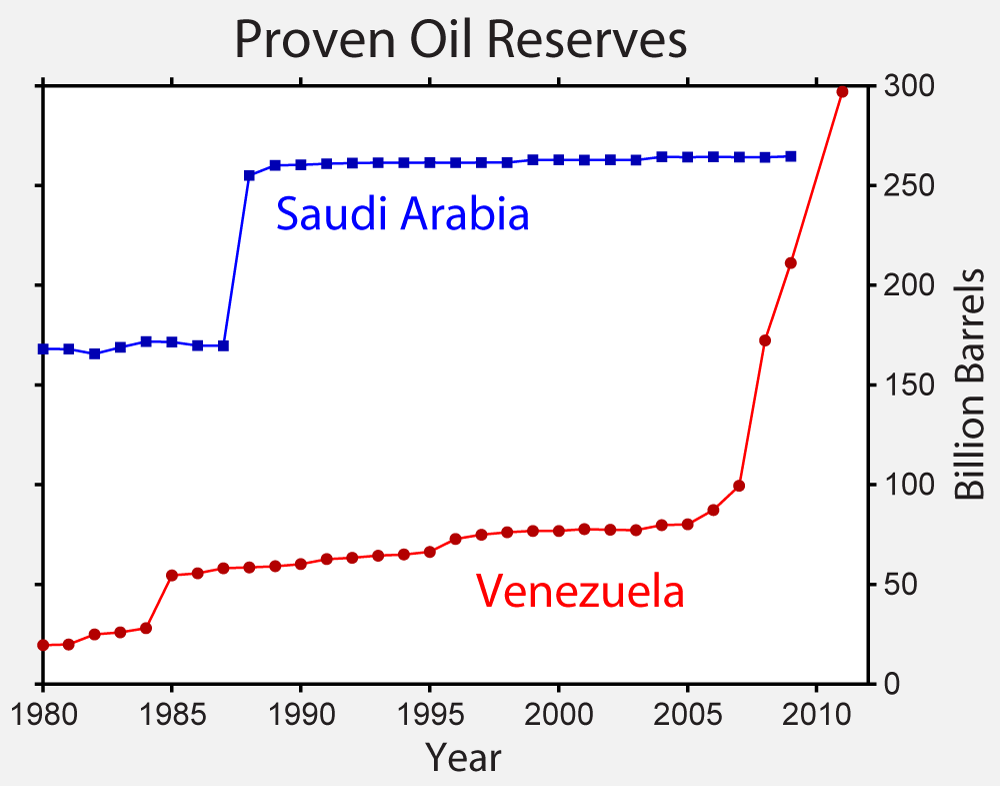
Dragons flight, CC BY-SA 3.0 https://creativecommons.org/licenses/by-sa/3.0, via Wikimedia Commons

Two dynamics follow.

First, short-term operational friction. If internal institutions compete for legitimacy, delays may appear in export logistics, insurance, shipping confidence, and payment routing. Oil does not stop because of politics, but it does slow because of paperwork, fear, and unclear enforcement.

Second, sanctions policy becomes leverage. If Washington frames the detention as law enforcement rather than war or regime change, it may seek to present a pathway for conditional relief tied to transition steps. Regardless of one’s view of legitimacy, this is how statecraft often functions in energy environments: sanctions are not simply punishment, they are bargaining chips. Markets will watch for even small signals such as licensing changes, statements about U.S. oil companies, or enforcement posture.

If you care about energy security, watch the routine indicators: maritime tracking patterns, cargo destinations, insurer behavior, and whether PDVSA-linked channels keep moving without interruption. Political drama moves fast. Energy systems reveal truth slowly.

The Defense Layer: Control of the Coercive Apparatus

Venezuela’s stability has long depended on the loyalty and structure of its security organs, including military leadership and intelligence services. In previous reporting, allegations of repression and internal enforcement practices were frequently linked to regime durability.

In a leadership disruption, three defense questions dominate.

Does the chain of command hold. If orders continue to flow with discipline under an interim authority, the state can project continuity quickly. If orders splinter, localized power centers may emerge around units, regions, or individual commanders.
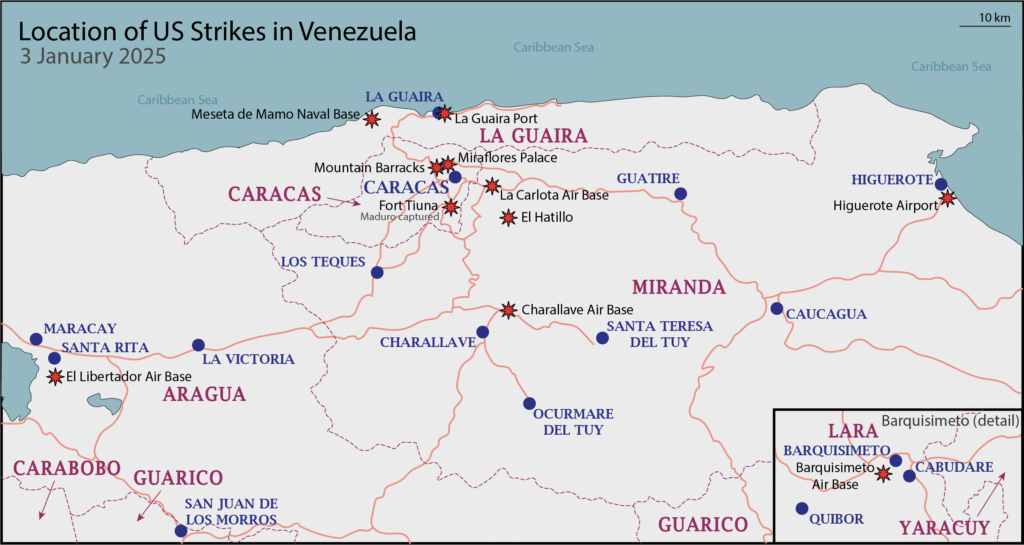
Chorchapu, CC BY 4.0 https://creativecommons.org/licenses/by/4.0, via Wikimedia Commons

Who controls internal security in the capital. Caracas is not a symbolic prize; it is the administrative switchboard. If the capital remains stable, the country can appear stable even when underlying tensions persist. If the capital fractures, perception and reality converge rapidly.

What happens to armed non-state actors and cross-border networks. Any state shock creates opportunity space for criminal networks, militias, or opportunistic actors. If enforcement weakens, trafficking routes and smuggling economics adjust quickly. If enforcement hardens, violence can spike as networks test new limits.

For defense observers, the key is not formal titles but force posture, deployments, and whether any actors attempt to secure infrastructure under the justification of national protection.

Regional and Strategic Spillover

The divided reaction across Latin America is not purely ideological. It is also shaped by historical memory. The region has experienced decades of interventions and externally driven transitions, which influences how governments interpret the same event: as accountability, violation, or dangerous precedent.

Calls for multilateral discussion are not only moral positioning. They are attempts to place the event inside an international framework that reduces the likelihood of replication elsewhere.

Extra-regional actors view Venezuela through two lenses: energy positioning and precedent. Access, leverage, and future contracts on one side; normalization of head-of-state detention on the other. This duality explains why narratives harden quickly. Narratives are not simply stories. They are defensive instruments.
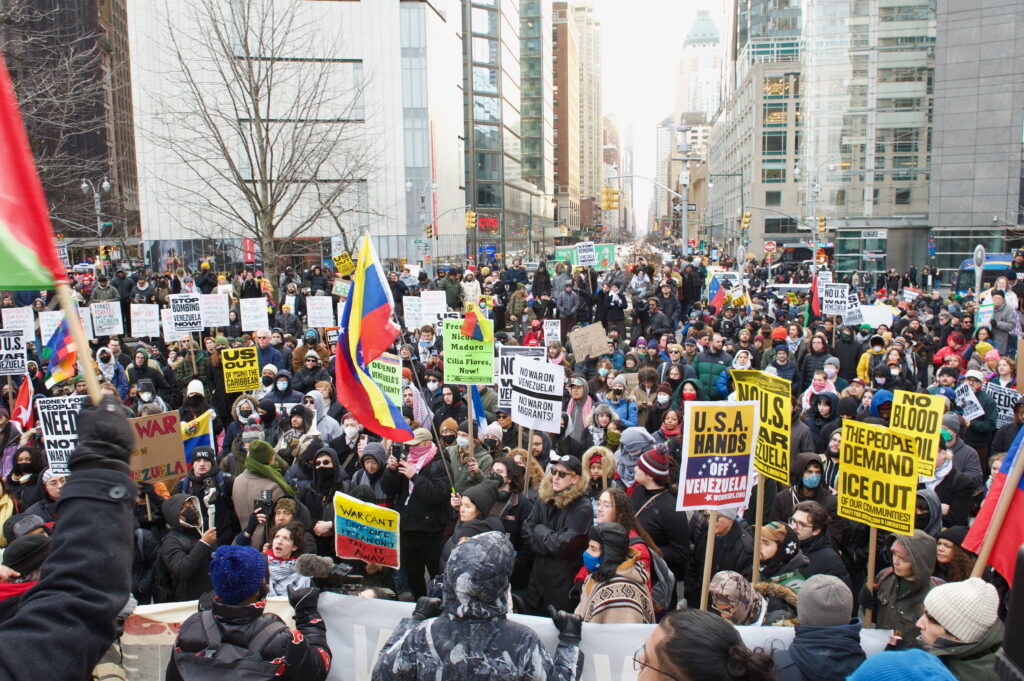
Protestors gather in Times Square against the invasion of Venezuela and kidnapping of Nicolás Maduro by the U.S. SWinxy, CC BY 4.0 https://creativecommons.org/licenses/by/4.0, via Wikimedia Commons

Legal Framing as an Operational Tool

Debate over legality under international and domestic law has become central to coverage. In practice, legal framing often determines coalition behavior. It shapes intelligence sharing, financial clearance, port cooperation, and diplomatic alignment.

If the action is broadly accepted as legitimate law enforcement, space opens for coordinated transition management. If it is viewed as unlawful coercion, resistance and constraint mechanisms follow. For energy and defense observers, the issue is not legal theory but operational consequence.

What to Watch Next

Over the coming days, attention should focus on institutional behavior rather than rhetoric.

Interim governance actions that demonstrate administrative control.
Military cohesion and visibility of unified command.
Energy export continuity and compliance signaling.
Multilateral response trajectories.
Domestic public order, especially the functioning of logistics and essential services.

This is an event where rapid commentary will dominate public discourse. The real outcomes will be shaped quietly by institutions, markets, and enforcement structures.

References

Reuters (Jan 3, 2026). Trump says U.S. has captured Venezuela President Maduro.
Reuters (Jan 4, 2026). Venezuela’s Supreme Court orders Delcy Rodríguez become interim president.
Associated Press (Jan 4, 2026). How cocaine and corruption led to the indictment of Maduro.
Reuters (Jan 4, 2026). Maduro is out but his top allies still hold power in Venezuela.

Previous Post

Israel’s F-15 News: What Actually Happened, and Why It Matters

Next Post

Digital Soldiers of Fortune: How PMCs Are Hacking for Governments

Related Posts

Digital Soldiers of Fortune: How PMCs Are Hacking for Governments
Cross-Sector Insights

Digital Soldiers of Fortune: How PMCs Are Hacking for Governments

January 6, 2026
Israel’s F-15 News: What Actually Happened, and Why It Matters
Cross-Sector Insights

Israel’s F-15 News: What Actually Happened, and Why It Matters

January 1, 2026
SDF and HTS: Managing Tension Without Open Conflict in Northern Syria
Cross-Sector Insights

SDF and HTS: Managing Tension Without Open Conflict in Northern Syria

December 26, 2025
What 2025 Taught Us About Defense and Energy: Five Lessons for 2026
Cross-Sector Insights

What 2025 Taught Us About Defense and Energy: Five Lessons for 2026

December 24, 2025
The New Taiwan Arms Package and China’s “Stop” Message: What Actually Changed
Cross-Sector Insights

The New Taiwan Arms Package and China’s “Stop” Message: What Actually Changed

December 19, 2025
The Black Sea’s Evolving Battlespace: Ukraine’s Maritime Operations and Shifting Security Dynamics
Cross-Sector Insights

The Black Sea’s Evolving Battlespace: Ukraine’s Maritime Operations and Shifting Security Dynamics

December 12, 2025
Next Post
Digital Soldiers of Fortune: How PMCs Are Hacking for Governments

Digital Soldiers of Fortune: How PMCs Are Hacking for Governments

  • Trending
  • Comments
  • Latest
Blackwater PMC

After Blackwater: How PMCs Evolved, Professionalized, and Fragmented

September 13, 2025
Blackwater PMC

Inside Iraq’s Security Market: How Private Power Shapes a Fragile State

October 6, 2025
Operation Enduring Freedom

What Exactly Is a Private Military Company (PMC)?

September 6, 2025
Repkon Nammo in Denmark: What This Nordic Ammunition Play Really Signals

Repkon Nammo in Denmark: What This Nordic Ammunition Play Really Signals

August 21, 2025
A Historic $142 Billion Arms Deal: Unpacking the U.S.-Saudi Agreement

A Historic $142 Billion Arms Deal: Unpacking the U.S.-Saudi Agreement

A Silent Revolution on the Battlefield: AI-Enabled Tactical Communication Systems

A Silent Revolution on the Battlefield: AI-Enabled Tactical Communication Systems

Cominf.org, CC BY-SA 3.0 , via Wikimedia Commons

Is Europe Really Reducing Its Dependence on Russian Gas?

What is ITAR? The Invisible Line in Global Defense Trade

What is ITAR? The Invisible Line in Global Defense Trade

Galil vs AK: When Reliability Meets Standardization

Galil vs AK: When Reliability Meets Standardization

January 14, 2026
When Do PMCs Enter a War, and Why It Rarely Looks Like “Joining the Fight”

When Do PMCs Enter a War, and Why It Rarely Looks Like “Joining the Fight”

January 9, 2026
Digital Soldiers of Fortune: How PMCs Are Hacking for Governments

Digital Soldiers of Fortune: How PMCs Are Hacking for Governments

January 6, 2026
Maduro Detained: The Energy and Defense Angles Most Coverage Skims Past

Maduro Detained: The Energy and Defense Angles Most Coverage Skims Past

January 4, 2026

Recent News

Galil vs AK: When Reliability Meets Standardization

Galil vs AK: When Reliability Meets Standardization

January 14, 2026
When Do PMCs Enter a War, and Why It Rarely Looks Like “Joining the Fight”

When Do PMCs Enter a War, and Why It Rarely Looks Like “Joining the Fight”

January 9, 2026
Digital Soldiers of Fortune: How PMCs Are Hacking for Governments

Digital Soldiers of Fortune: How PMCs Are Hacking for Governments

January 6, 2026
Maduro Detained: The Energy and Defense Angles Most Coverage Skims Past

Maduro Detained: The Energy and Defense Angles Most Coverage Skims Past

January 4, 2026
Drill & Defense

Drill & Defense is an independent platform providing insights into firearms, defense technologies, and energy sectors. We deliver clear, practical content for professionals, enthusiasts, and industry followers worldwide.

Follow Us

Browse by Category

  • Cross-Sector Insights
  • Defense
  • Defense & Energy Strategy
  • Defense Know-How
  • Defense Technologies
  • Energy
  • Energy Insight
  • Energy Technologies
  • Global Security & Trade Analysis
  • History & Legacy
  • Industry News
  • Knowledge Base
  • Legacy Systems & Structures
  • Market Trends & Analysis
  • Military Market Reports
  • Oil & Gas News
  • Resource Wars & Strategy
  • Tech & Innovation Crossover
  • Turning Points in Conflict
  • Weapon & Gear Reviews

Recent News

Galil vs AK: When Reliability Meets Standardization

Galil vs AK: When Reliability Meets Standardization

January 14, 2026
When Do PMCs Enter a War, and Why It Rarely Looks Like “Joining the Fight”

When Do PMCs Enter a War, and Why It Rarely Looks Like “Joining the Fight”

January 9, 2026

© 2026 Drill & Defense. All rights reserved. Independent insights on firearms, defense, and energy. For business inquiries: info@drillanddefense.com | PRIVACY POLICY | COOKIE POLICY | TERMS AND CONDITIONS

Manage Consent

We use cookies to improve your experience. You can accept or refuse cookies; however, some features may not function properly without your consent.

Functional Always active
The technical storage or access is strictly necessary for the legitimate purpose of enabling the use of a specific service explicitly requested by the subscriber or user, or for the sole purpose of carrying out the transmission of a communication over an electronic communications network.
Preferences
The technical storage or access is necessary for the legitimate purpose of storing preferences that are not requested by the subscriber or user.
Statistics
The technical storage or access that is used exclusively for statistical purposes. The technical storage or access that is used exclusively for anonymous statistical purposes. Without a subpoena, voluntary compliance on the part of your Internet Service Provider, or additional records from a third party, information stored or retrieved for this purpose alone cannot usually be used to identify you.
Marketing
The technical storage or access is required to create user profiles to send advertising, or to track the user on a website or across several websites for similar marketing purposes.
  • Manage options
  • Manage services
  • Manage {vendor_count} vendors
  • Read more about these purposes
View preferences
  • {title}
  • {title}
  • {title}
No Result
View All Result
  • Defense
    • Industry News
    • Weapon & Gear Reviews
    • Defense Technologies
    • Military Market Reports
  • Energy
    • Oil & Gas News
    • Energy Technologies
    • Market Trends & Analysis
  • Cross-Sector Insights
    • Defense & Energy Strategy
    • Global Security & Trade Analysis
    • Tech & Innovation Crossover
  • History & Legacy
    • Turning Points in Conflict
    • Legacy Systems & Structures
    • Resource Wars & Strategy
  • Knowledge Base
    • Defense Know-How
    • Energy Insight
  • About
  • Contact
  • Login
  • Register

© 2026 Drill & Defense. All rights reserved. Independent insights on firearms, defense, and energy. For business inquiries: info@drillanddefense.com | PRIVACY POLICY | COOKIE POLICY | TERMS AND CONDITIONS