
Drill & Defense
Advertisement
  • Defense
    • Industry News
    • Weapon & Gear Reviews
    • Defense Technologies
    • Military Market Reports
  • Energy
    • Oil & Gas News
    • Energy Technologies
    • Market Trends & Analysis
  • Cross-Sector Insights
    • Defense & Energy Strategy
    • Global Security & Trade Analysis
    • Tech & Innovation Crossover
  • History & Legacy
    • Turning Points in Conflict
    • Legacy Systems & Structures
    • Resource Wars & Strategy
  • Knowledge Base
    • Defense Know-How
    • Energy Insight
  • About
  • Contact
  • Login
  • Register
No Result
View All Result
  • Defense
    • Industry News
    • Weapon & Gear Reviews
    • Defense Technologies
    • Military Market Reports
  • Energy
    • Oil & Gas News
    • Energy Technologies
    • Market Trends & Analysis
  • Cross-Sector Insights
    • Defense & Energy Strategy
    • Global Security & Trade Analysis
    • Tech & Innovation Crossover
  • History & Legacy
    • Turning Points in Conflict
    • Legacy Systems & Structures
    • Resource Wars & Strategy
  • Knowledge Base
    • Defense Know-How
    • Energy Insight
  • About
  • Contact
  • Login
  • Register
No Result
View All Result
Drill & Defense
No Result
View All Result
Home Knowledge Base

The Iraq War’s Hidden Battle: How Logistics Shaped the Conflict’s Reality

November 17, 2025
in Knowledge Base, Defense Know-How
Iraqi Freedom

U.S. Army and Iraqi soldiers cross an intersection during a routine security patrol in downtown Tal Afar, Iraq, on Sept. 11, 2005. Iraqi army security forces, with assistance from the 3rd Armored Cavalry Regiment, are providing security for the region of Tal Afar in order to disrupt insurgent safe havens and to clear weapons cache sights in the area of operation. English: Petty Officer 1st Class Alan D. Monyelle, U.S. Navy, Public domain

Share on LinkedInShare on Twitter

From the moment the invasion of Iraq began in early 2003, the operational focus was on speed: armored columns moving toward Baghdad, air strikes, regime collapse. What is less discussed, yet equally decisive, is the vast logistical apparatus that made this possible. Reports from the Government Accountability Office indicate that of the 28.1 billion dollars obligated by the Department of Defense toward the campaign, more than half went to operating support and transportation costs. This underscores a reality for industry players and security professionals: success in conflict depends on the strength of supply chains as much as the strength of firepower. The significance of Iraq War logistics cannot be overstated in this context.

The Opportunity and the Strain of Rapid Advance

Understanding Iraq War logistics is essential for evaluating the overall effectiveness of military campaigns. The campaign’s speed created both an opportunity and a strain. On one hand, the rapid advance through Iraq validated the concept of swift, decisive maneuver. On the other, the logistics system behind it showed its limits. Analysis from RAND Corporation described major combat operations as successful but noted friction in distribution, asset visibility, and sustainment. Supplies travelled long distances through harsh terrain, and although prepositioned stocks and transport assets were prepared, they struggled at times to keep up with real consumption patterns and the pace of movement.

The faster the advance became, the more pressure was placed on sustainment. Delays in parts or maintenance had the potential to slow entire formations. Units consuming more fuel, water and spares than expected created additional strain on a system originally designed for a more predictable operational tempo.

U.S. Army Staff Sgt. Jesus Guzman of 2nd platoon, 293rd Military Police Company, 385th Military Police Battalion, 3rd Infantry Division, discusses movement techniques with an Iraqi Soldier during a visit to an Iraqi compound in the village of Sherween on January 24, 2007.
(U.S. Army Photo by: Spc. LaRayne Hurd)(Released) https://www.dvidshub.net/image/76231, Public domain

Fuel, Water and the Hidden Weight of Supply

Fuel distribution was one of the most critical planning elements. RAND’s assessments show that fuel requirements shaped preparation well before ground operations. Water proved equally demanding. At one point in the conflict, daily bottled water convoys reached about 144 trucks, reflecting how even the simplest requirements become major logistical burdens in hostile environments.

Every truck on the road represented risk, manpower, maintenance, and exposure. For modern supply chain professionals, the lesson is straightforward: reducing demand or producing essential resources closer to the point of use is not merely an efficiency exercise but a risk reduction strategy.
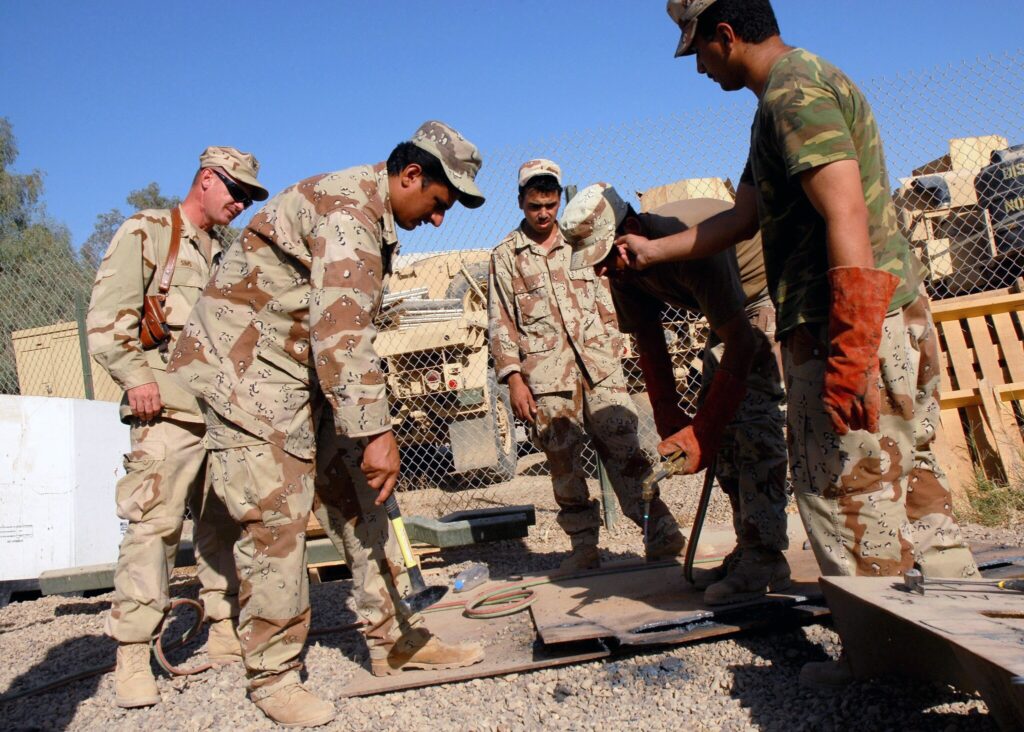
AR RAMADI, Iraq (Nov. 6, 2007) Iraqi enlisted soldiers, or Jundee, practice techniques during a prefabrication training evolution taught by Steelworker 2nd Class Timothy Sims, left, assigned to Naval Mobile Construction Battalion (NMCB) 1. NMCB-1 augmented six Seabees to the 7th Iraqi Division Military Transition Team to provide expert training to members of the Iraqi Army. U.S. Navy photo by Mass Communication Specialist 2nd Class Ja’lon A. Rhinehart (Released) U.S. Navy photo by Mass Communication Specialist 2nd Class Ja’lon A. Rhinehart, Public domain

Outsourced Support and the Blurring of Frontlines

Another defining feature of the Iraq campaign was the increased reliance on contractors for logistics and base support. Civilian drivers, maintenance teams and supply personnel operated in areas that were not always secure, creating a complex mix of roles and responsibilities. Audit summaries years later indicated that accountability for large amounts of equipment and supplies was incomplete or inconsistent, partly due to the blend of military and contractor operations.

A U.S. Soldier from the Nemesis troop, 3rd Squadron, 2nd Stryker Cavalry Regiment clears a house after one of the regiment’s Stryker vehicles gets hit by an improvised explosive device, October 18, 2007, Baghdad, Iraq.(Photo by Luke Thornberry) Lukethornberry, Public domain

For defense and energy companies, this offers an important reminder. Supply chains in unstable regions rely not only on military protection but on coordination between actors with different mandates, standards and levels of exposure to risk.

Real Time Visibility and Adaptive Distribution

Modern logistics emphasizes real time visibility, adaptive networks and flexible distribution models. The Iraq conflict highlighted the limits of static, push based systems. RAND’s findings describe issues such as bottlenecks at distribution nodes, delays, unbalanced inventories and difficulty tracking assets in transit. When units moved faster than planned or when demand fluctuated unexpectedly, the system struggled to adjust.

For organizations working in high risk areas today, the implication is clear. Without accurate visibility of assets and consumption, decisions rely on outdated assumptions rather than current realities, increasing both cost and vulnerability.

U.S. Army Spc. Joshua Rachal, from 2nd Platoon, Alpha Company, 1st Battalion, 502nd Infantry Regiment, 2nd Brigade Combat Team, 101st Airborne Division provides security, armed with an M249 squad automatic weapon during a patrol of the Hariyah district of Baghdad, Iraq, Aug. 30, 2008. (U.S. Army photo by Spc. Charles W. Gill/Released) Spc. Charles W. Gill, Public domain

Infrastructure, Hubs and the Hidden Nodes

Behind every forward unit exists a chain of infrastructure including ports, depots, airbases and inland transport routes. In Iraq, these nodes became decisive elements. Shortages in transport trucks, congestion at distribution hubs and limited capacity at key staging areas created disruptions that rippled through the supply system. Oversight reviews also found that accountability for billions in deployed equipment was incomplete, reflecting the complexity of managing assets across a fluid operational landscape.

For businesses in defense or energy, this demonstrates that risk analysis must consider not only the movement of supplies but the stability and capacity of the nodes that support them. A failure at any single node can compromise an entire chain.

Why This Still Matters

Although the Iraq War peaked two decades ago, its logistical lessons remain central to modern planning. The conflict is regularly cited in professional literature as an example of the challenges of expeditionary sustainment. The themes that emerged remain relevant today: the integration of strategic and tactical logistics, the vulnerability of essential commodities, the limits of static planning, and the importance of visibility across every segment of the network.

For organizations operating in defense, firearms, security or energy, these lessons provide a reminder that logistics is not a background process but a core determinant of resilience and operational success. The Iraq experience demonstrates how rapidly changing conditions, shifting demand and contested environments can transform logistics into a strategic factor in its own right.


References
Peltz, Eric, et al. Sustainment of Army Forces in Operation Iraqi Freedom. RAND Corporation, 2005.
United States Government Accountability Office. Defense Logistics: Preliminary Observations on the Effectiveness of Logistics Activities During Operation Iraqi Freedom. GAO 04 305R, 2003.
United States Government Accountability Office. Summary of Challenges Impacting Operations Iraqi Freedom and Enduring Freedom. June 2008.


Previous Post

Why Toyota Became The Unofficial Vehicle Of Modern Warzones

Next Post

The Invisible Arsenal: How OSINT Is Re-engineering the Global Arms Trade

Related Posts

Live firing of the Light Forces Anti-Tank Guided Weapon (LFATGW) Javelin.
Knowledge Base

Common Misconceptions About ITAR: What Organizations Should Actually Know

December 9, 2025
The Invisible Arsenal: How OSINT Is Re-engineering the Global Arms Trade
Knowledge Base

The Invisible Arsenal: How OSINT Is Re-engineering the Global Arms Trade

November 19, 2025
Why Blackwater existed: The logic behind outsourcing war and security
Knowledge Base

Why Blackwater existed: The logic behind outsourcing war and security

November 6, 2025
TE_2REI_Afghanistan French Foregin Legion
Knowledge Base

The French Foreign Legion After the Sahel: Where It Fits Now

October 29, 2025
The Montreux Document: Why It Still Matters for Security Work
Knowledge Base

The Montreux Document: Why It Still Matters for Security Work

September 26, 2025
Operation Enduring Freedom
Knowledge Base

What Exactly Is a Private Military Company (PMC)?

September 6, 2025
Next Post
The Invisible Arsenal: How OSINT Is Re-engineering the Global Arms Trade

The Invisible Arsenal: How OSINT Is Re-engineering the Global Arms Trade

  • Trending
  • Comments
  • Latest
Blackwater PMC

After Blackwater: How PMCs Evolved, Professionalized, and Fragmented

September 13, 2025
Blackwater PMC

Inside Iraq’s Security Market: How Private Power Shapes a Fragile State

October 6, 2025
Operation Enduring Freedom

What Exactly Is a Private Military Company (PMC)?

September 6, 2025
Repkon Nammo in Denmark: What This Nordic Ammunition Play Really Signals

Repkon Nammo in Denmark: What This Nordic Ammunition Play Really Signals

August 21, 2025
A Historic $142 Billion Arms Deal: Unpacking the U.S.-Saudi Agreement

A Historic $142 Billion Arms Deal: Unpacking the U.S.-Saudi Agreement

A Silent Revolution on the Battlefield: AI-Enabled Tactical Communication Systems

A Silent Revolution on the Battlefield: AI-Enabled Tactical Communication Systems

Cominf.org, CC BY-SA 3.0 , via Wikimedia Commons

Is Europe Really Reducing Its Dependence on Russian Gas?

What is ITAR? The Invisible Line in Global Defense Trade

What is ITAR? The Invisible Line in Global Defense Trade

Israel’s F-15 News: What Actually Happened, and Why It Matters

Israel’s F-15 News: What Actually Happened, and Why It Matters

January 1, 2026
SDF and HTS: Managing Tension Without Open Conflict in Northern Syria

SDF and HTS: Managing Tension Without Open Conflict in Northern Syria

December 26, 2025
What 2025 Taught Us About Defense and Energy: Five Lessons for 2026

What 2025 Taught Us About Defense and Energy: Five Lessons for 2026

December 24, 2025
The New Taiwan Arms Package and China’s “Stop” Message: What Actually Changed

The New Taiwan Arms Package and China’s “Stop” Message: What Actually Changed

December 19, 2025

Recent News

Israel’s F-15 News: What Actually Happened, and Why It Matters

Israel’s F-15 News: What Actually Happened, and Why It Matters

January 1, 2026
SDF and HTS: Managing Tension Without Open Conflict in Northern Syria

SDF and HTS: Managing Tension Without Open Conflict in Northern Syria

December 26, 2025
What 2025 Taught Us About Defense and Energy: Five Lessons for 2026

What 2025 Taught Us About Defense and Energy: Five Lessons for 2026

December 24, 2025
The New Taiwan Arms Package and China’s “Stop” Message: What Actually Changed

The New Taiwan Arms Package and China’s “Stop” Message: What Actually Changed

December 19, 2025
Drill & Defense

Drill & Defense is an independent platform providing insights into firearms, defense technologies, and energy sectors. We deliver clear, practical content for professionals, enthusiasts, and industry followers worldwide.

Follow Us

Browse by Category

  • Cross-Sector Insights
  • Defense
  • Defense & Energy Strategy
  • Defense Know-How
  • Defense Technologies
  • Energy
  • Energy Insight
  • Energy Technologies
  • Global Security & Trade Analysis
  • History & Legacy
  • Industry News
  • Knowledge Base
  • Legacy Systems & Structures
  • Market Trends & Analysis
  • Military Market Reports
  • Oil & Gas News
  • Resource Wars & Strategy
  • Tech & Innovation Crossover
  • Turning Points in Conflict
  • Weapon & Gear Reviews

Recent News

Israel’s F-15 News: What Actually Happened, and Why It Matters

Israel’s F-15 News: What Actually Happened, and Why It Matters

January 1, 2026
SDF and HTS: Managing Tension Without Open Conflict in Northern Syria

SDF and HTS: Managing Tension Without Open Conflict in Northern Syria

December 26, 2025

© 2025 Drill & Defense. All rights reserved. Independent insights on firearms, defense, and energy. For business inquiries: info@drillanddefense.com | PRIVACY POLICY | COOKIE POLICY | TERMS AND CONDITIONS

Manage Consent

We use cookies to improve your experience. You can accept or refuse cookies; however, some features may not function properly without your consent.

Functional Always active
The technical storage or access is strictly necessary for the legitimate purpose of enabling the use of a specific service explicitly requested by the subscriber or user, or for the sole purpose of carrying out the transmission of a communication over an electronic communications network.
Preferences
The technical storage or access is necessary for the legitimate purpose of storing preferences that are not requested by the subscriber or user.
Statistics
The technical storage or access that is used exclusively for statistical purposes. The technical storage or access that is used exclusively for anonymous statistical purposes. Without a subpoena, voluntary compliance on the part of your Internet Service Provider, or additional records from a third party, information stored or retrieved for this purpose alone cannot usually be used to identify you.
Marketing
The technical storage or access is required to create user profiles to send advertising, or to track the user on a website or across several websites for similar marketing purposes.
  • Manage options
  • Manage services
  • Manage {vendor_count} vendors
  • Read more about these purposes
View preferences
  • {title}
  • {title}
  • {title}
No Result
View All Result
  • Defense
    • Industry News
    • Weapon & Gear Reviews
    • Defense Technologies
    • Military Market Reports
  • Energy
    • Oil & Gas News
    • Energy Technologies
    • Market Trends & Analysis
  • Cross-Sector Insights
    • Defense & Energy Strategy
    • Global Security & Trade Analysis
    • Tech & Innovation Crossover
  • History & Legacy
    • Turning Points in Conflict
    • Legacy Systems & Structures
    • Resource Wars & Strategy
  • Knowledge Base
    • Defense Know-How
    • Energy Insight
  • About
  • Contact
  • Login
  • Register

© 2025 Drill & Defense. All rights reserved. Independent insights on firearms, defense, and energy. For business inquiries: info@drillanddefense.com | PRIVACY POLICY | COOKIE POLICY | TERMS AND CONDITIONS