

South Korea’s defense industry didn’t appear overnight. It was built under pressure, iterated in the open, and stress-tested by an unforgiving neighborhood. Today, that ecosystem spanning land systems, shipbuilding, avionics, and guided weapons has become one of the most responsive supply bases in the world. Hanwha Aerospace sits at the center of this momentum. In this post, I’ll synthesize open-source reporting with an informed insider perspective to map what is actually changing: product mix, industrial footprint, capital strategy, and export positioning without the noise or hype. I should mention that, this post was prepared with the kind assistance and valuable insights of Junghoon Kim. His perspective helped shape a clearer understanding of Hanwha’s strategic direction within the global defense landscape. Collaborative efforts like this remind us that meaningful analysis often begins with open dialogue and shared expertise.

From Regional Supplier to Multi-Theater Prime
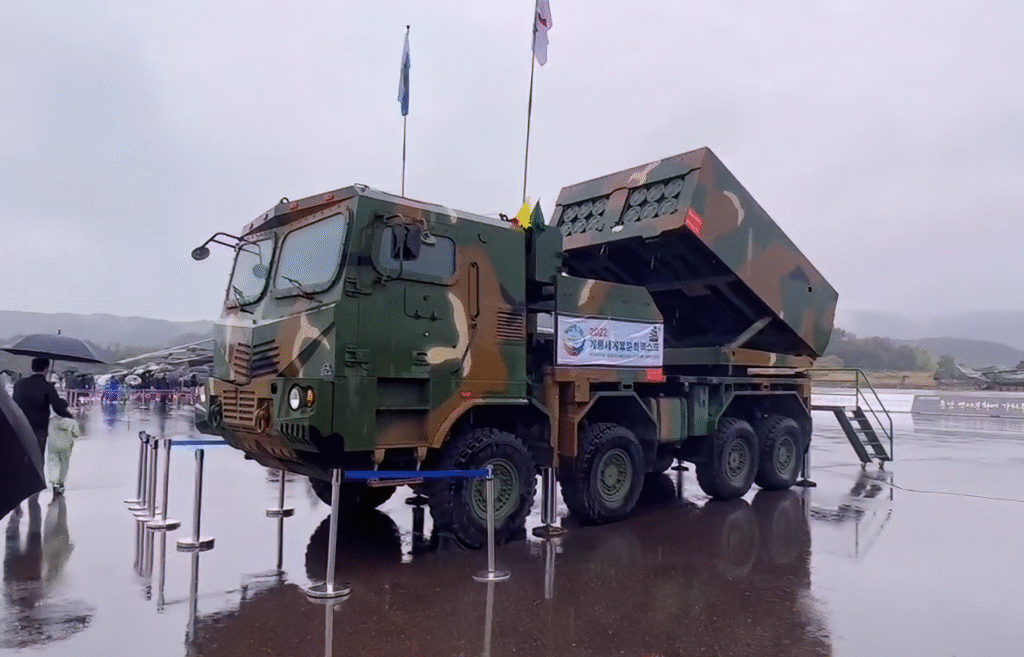
Hanwha’s recent trajectory is best understood as a shift from platform-by-platform sales to portfolio-level positioning. The K9 Thunder self-propelled howitzer remains the visible tip of the spear, but the underlying story is the firm’s capacity to deliver, localize, and iterate. European orders, especially Poland’s combined package for K2 tanks, K9 howitzers, and Homar-K (K239 Chunmoo) rocket launchers, show how speed of delivery, scalable production, and transfer-of-technology options can outcompete slower procurement cycles. Norway’s follow-on K9 VIDAR buys reinforce a pattern: once fielded, the ecosystem (spares, training, K10 resupply vehicles) tends to expand rather than stall.

This is not solely a European story. In India, the K9 Vajra-T program, produced domestically with Larsen & Toubro, has moved beyond a one-off to a structured second batch, an indicator that Hanwha’s co-production model can survive political cycles and budget resets. The program’s indigenous content has increased, and vendor integration has deepened. That combination, assured timelines plus rising local workshare, is what regional armies now expect by default.
Australia as a Systems and Industrial Node
Australia has become Hanwha’s second growth engine. After winning LAND 400 Phase 3 with the AS21 Redback IFV, Hanwha Defence Australia is building out a production and sustainment hub near Geelong, scheduled to support 129 vehicles from 2027. The ecosystem forming around Redback is telling: complementary sub-system awards like remote weapon stations are flowing to Australian suppliers, anchoring local capability rather than simply assembling imported kits. This is industrial policy by design, not accident, and it positions Australia as a long-term node for upgrades, exports, and fleet sustainment across the region.
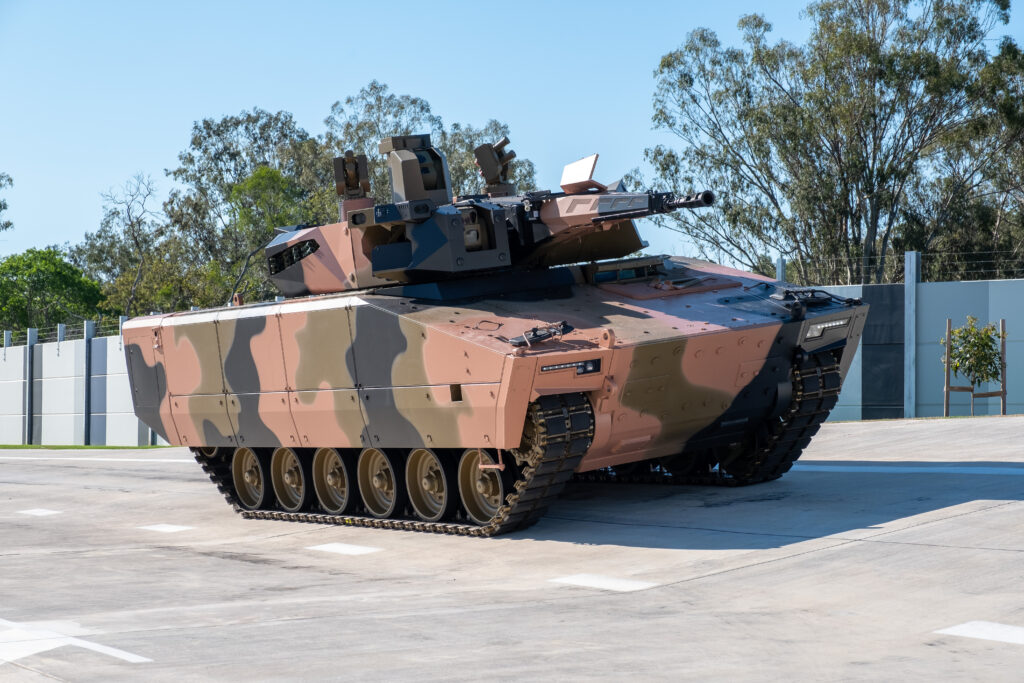
The lesson is broader than one win. When Hanwha brings artillery (AS9/AS10 Huntsman) and IFV lines under one national roof, the company reduces logistics friction, stabilizes supplier calendars, and earns political resilience. It’s also building credibility for future bids in C-UAS sensors, loitering munitions integration, and protected mobility, areas where Australia’s doctrine and geography demand continuous adaptation.
Capital, R&D, and the Anti-Drone Imperative
Production speed was yesterday’s differentiator; survivability against cheap, abundant drones is today’s. Hanwha’s capital strategy reflects that pivot. In 2025 the company outlined a multi-tranche raise to accelerate work in unmanned systems and engines. That is not a press-release flourish, it’s recognition that counter-UAS is no longer a “nice-to-have” bolt-on but a design driver shaping turrets, fire-control software, EW suites, and even power management. In parallel, allied markets such as Australia are expanding their own C-UAS industrial base, exactly the kind of adjacent ecosystem Hanwha will need for rapid integration paths and export variants.

Hanwha Aerospace, Public domain, via Wikimedia Commons
Readers often ask whether Hanwha has a distinctive anti-drone product already “on the shelf.” That’s the wrong question. The competitive edge here is integration velocity: how quickly a prime can absorb third-party RF detection, hard-kill or soft-kill options, and AI-assisted target classification into vehicles already in production. Hanwha’s pattern of standing up local hubs, partnering for subsystems, and funding core R&D suggests an answer rooted in process, not a single SKU.
Engines, Avionics, and the Path to Self-Reliance
In aero-propulsion, South Korea is still in transition from assembler-integrator to partial originator. Hanwha’s current engine work includes licensed assembly and component supply for Western primes, while indigenous gas-turbine development advances step by step. Recent corporate materials and government contracts point to a steady, pragmatic build-up rather than a leap. For customers, this matters less as a binary “domestic vs imported” question and more as a signal about lifecycle control: spares, upgrades, and export clearances. The nearer Hanwha moves to design authority, piece by piece, the more predictable those downstream variables become.
Europe: Opportunity, but on Europe’s Terms
Europe’s rearmament is real, and so are its incentives to buy European. EU-level instruments over the last two years have explicitly aimed to expand domestic production of munitions and platforms, from ammunition support schemes to collaborative procurement. That does not lock out non-EU primes, but it raises the threshold: tie-ups, licensed production, and local content become prerequisites, not options. Hanwha’s playbook in Poland, deep industrial linkage with groups like WB, shows how a non-EU supplier can meet Europe where it is, especially in missiles and C4ISR. Follow-on contracts in Norway further demonstrate that performance and delivery credibility can still move the needle inside NATO.
The Poland Effect: Speed, Scale, and Certainty
Poland’s multi-year packages are more than headlines; they’re a test of whether a non-European prime can sustain tempo through surges, election cycles, and infrastructure constraints. As deliveries accumulate across K2, K9, and Homar-K, the reinforcing effects are visible: training cadres grow, depot-level maintenance matures, and planners can model genuine multi-domain fires with interoperable logistics. For neighbors in Central and Northern Europe, the signal is hard to ignore: if supply assurance is the priority, Korea’s model is no longer a contingency plan but a front-row option.
What This Means for Buyers (and for Hanwha)
For defense ministries and acquisition agencies, Hanwha’s proposition has three pillars.
Assured capacity. Lines are running, not aspirational. Customers can phase deliveries without breaking production rhythm. The Norway and India cases illustrate how initial buys convert to credible follow-ons when training, MRO, and resupply vehicles are part of the package from day one.
Industrial anchoring. Australia’s Redback and Huntsman programs show that Hanwha is willing to go beyond final assembly to meaningful local industry participation, tooling, fabrication, and sub-systems. That aligns with sovereign sustainment policies across the Indo-Pacific and Europe.
Integration velocity. Counter-UAS, active protection, and next-gen networked fires are not static requirements. The firms that win this decade will be those that integrate faster than adversaries iterate. Hanwha’s capital allocation toward unmanned systems and engines, paired with regional sub-system partners, suggests it understands that race.
A Note on Insider Perspective
The practitioner view we reviewed emphasizes two points often missed in outside commentary. First, South Korea’s production advantage was not an accident of 2022; it was the product of continuous domestic procurement since the 1990s, keeping lines hot while others idled. Second, diversification beyond artillery, most notably into IFVs and counter-UAS, has become a strategic necessity as European primes scale back up. That read matches the observable market: follow-on Redback ecosystem awards in Australia, additional K9 tranches in Europe and India, and deepening JV structures in Poland centered on missiles and guidance.
References:
Interview with Junghoon Kim
Reuters, “Hanwha Aerospace to issue new shares worth 1.3 trillion won,” 18 April 2025.
Army Technology, “EOS wins A$108m RWS contract from Hanwha Defence Australia,” 7 October 2025.
Hanwha Aerospace (corporate), “Ships more K9 howitzers and K10 resupply vehicles to Norway,” 17 December 2024.
Army Recognition, “Poland confirms delivery of K2, K9, and Homar-K from South Korea,” 19 September 2025.