
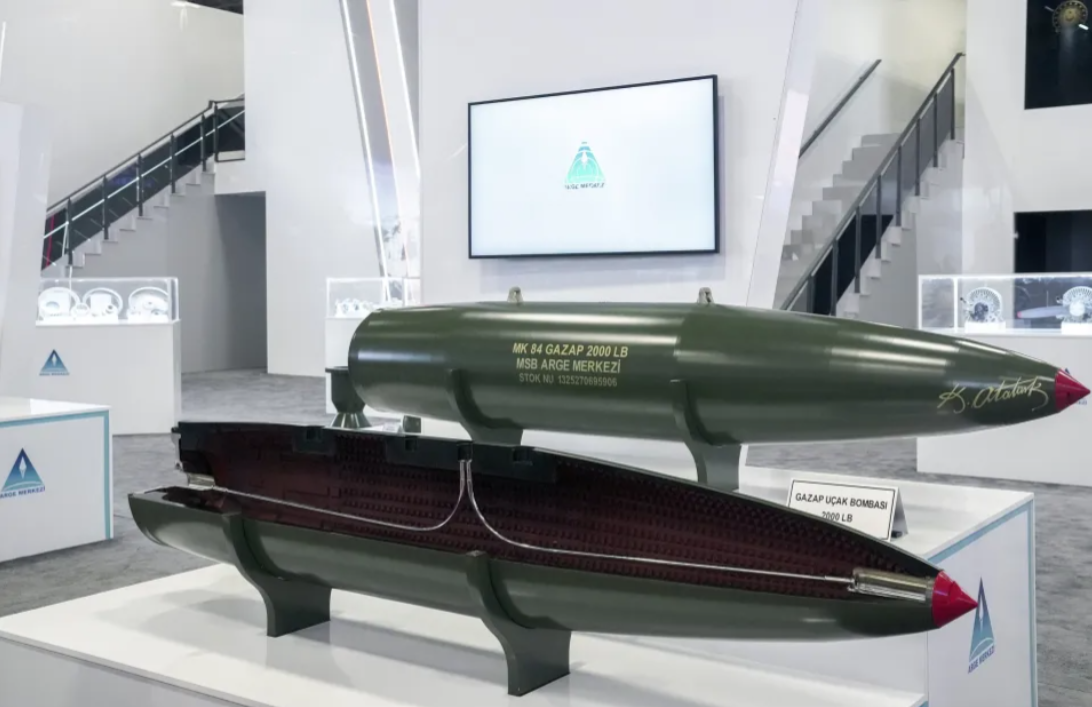
At this year’s IDEF 2025 in Istanbul, Turkey made headlines not just with its expanding product showcase but with the magnitude of what it unveiled. For seasoned observers of global defense trends, the most talked-about reveal was the Gazap bomb—a thermobaric, 1-ton payload that, according to multiple international sources, might now be the most destructive conventional weapon on Earth.

As Drill & Defense, we closely follow Turkey’s growing role in the international arms industry. But what makes Gazap, and other Turkish technologies such as the Tayfun Block 4 hypersonic missile and NEB‑2 bunker buster, so significant is not just their destructive potential—but their strategic implications. They’re not just weapons; they are statements.
Gazap: The Vacuum Bomb of Global Concern
Imagine a weapon that weighs nearly a metric ton, generates over 3,000°C upon detonation, and vacuums oxygen out of a radius before flooding the zone with explosive pressure. That’s what the Gazap bomb is—an air-dropped thermobaric warhead based on the Mk‑84 chassis, engineered to inflict devastating pressure damage in enclosed spaces like bunkers or cave networks.
International media quickly labeled it a “nuclear bomb without the radiation.” While such headlines are sensational, they aren’t entirely off-base. The Gazap is not a new concept in warfare—Russia’s FOAB and the U.S.’s MOAB follow a similar logic—but Turkey’s indigenous development of such a weapon represents a strategic leap in self-reliant firepower.
Its very public reveal was also a calculated move. By displaying it at IDEF, Turkey wasn’t just marketing a weapon—it was asserting a new level of sovereign deterrence.
The Rise of Tayfun Block 4: Speed, Stealth, and Symbolism
Following the Gazap bomb was the upgraded Tayfun Block 4 hypersonic missile system. Although Turkey had previously tested early Tayfun models, this variant is reportedly capable of traveling at Mach 5+, with maneuverability that makes it a challenge for most air defense systems to intercept.
In the hypersonic arms race—currently dominated by the U.S., Russia, and China—Turkey’s inclusion signals an ambition to sit at that table. Whether Tayfun Block 4 will match the technological maturity of its competitors is still under observation, but its range, targeting agility, and dual-use (surface-to-surface and potentially anti-ship) architecture are notable.
As foreign analysts have noted, the Tayfun’s development is occurring amid heightened Eastern Mediterranean tensions, and Turkey’s ability to field hypersonic systems could shift regional balance calculations.
NEB‑2 and Aselsan’s Expanding Ecosystem
Then there’s the NEB‑2 bunker buster, a new-generation penetrator bomb designed to destroy hardened underground structures. It combines blast pressure with reinforced tip guidance to break through meters of reinforced concrete.
What ties Gazap, Tayfun, and NEB‑2 together is the broader infrastructure supporting them—namely, Turkey’s national defense firms such as Aselsan, TAI, Roketsan, and STM. These entities are not simply weapons producers—they form a vertically integrated ecosystem that spans radar, missile guidance, drone systems, submarine platforms, and electronic warfare suites.
Aselsan, for instance, showcased its “Steel Dome” integrated air defense system at IDEF 2025, with modular upgrades including the KORAL-200 EW platform and GÜRZ counter-drone defense. The firm is signaling not only battlefield utility but export-readiness.
STM, on the other hand, unveiled designs for a new generation of fast-attack naval craft, while TAI continues its TF-Kaan fighter jet rollout. These programs are no longer just national assets; they are internationally positioned, with deals already inked in Indonesia and Central Asia.
What It Means for the Region
One may argue: is this simply Turkey following global defense trends? After all, every power invests in new bombs and jets. The distinction lies in how Turkey is doing it.
Firstly, the weapons being unveiled are increasingly indigenous. Secondly, the pace of integration—from idea to battlefield testing—is accelerating. Lastly, Turkey is now an exporter, not just an importer, of these systems. Countries like Somalia, Qatar, and Indonesia are receiving Turkish weapons or negotiating joint-production agreements.
There’s also a shift in geopolitical posture. With Gazap and Tayfun, Turkey is no longer just a regional actor; it is sending signals to NATO, Russia, and Middle Eastern powers alike.
Yet this isn’t purely an aggressive projection. Much of what’s being showcased—such as the modular VTOL drones, naval EW systems, and radar command centers—is defensive in nature. The narrative isn’t just power—it’s resilience and autonomy.
Risks and International Perception
Of course, such rapid developments are not without global scrutiny. Human rights groups have raised concerns about thermobaric weapons being used in dense civilian environments. Export destinations like Sudan have already sparked debate around compliance with international arms transfer norms.
Moreover, countries watching these advancements—particularly Greece, Israel, and Egypt—are likely revisiting their own defense postures. As a result, Turkish defense innovation is both an enabler of hard power and a stimulant for regional arms competition.
Looking Ahead
Turkey’s unveiling of Gazap and Tayfun isn’t just a one-off marketing move—it’s a marker of strategic evolution. The defense industry here is no longer focused solely on meeting domestic military needs. It’s building for export, for influence, and for deterrence.
As a platform that tracks defense, energy, and geopolitics, Drill & Defense will continue monitoring these developments not just as news—but as signals of long-term positioning.
Will Turkey’s rising defense industry catalyze regional stability through deterrence, or spark new rounds of militarization? That remains an open question—but one we intend to keep asking.