
Drill & Defense
Advertisement
  • Defense
    • Industry News
    • Weapon & Gear Reviews
    • Defense Technologies
    • Military Market Reports
  • Energy
    • Oil & Gas News
    • Energy Technologies
    • Market Trends & Analysis
  • Cross-Sector Insights
    • Defense & Energy Strategy
    • Global Security & Trade Analysis
    • Tech & Innovation Crossover
  • History & Legacy
    • Turning Points in Conflict
    • Legacy Systems & Structures
    • Resource Wars & Strategy
  • Knowledge Base
    • Defense Know-How
    • Energy Insight
  • About
  • Contact
  • Login
  • Register
No Result
View All Result
  • Defense
    • Industry News
    • Weapon & Gear Reviews
    • Defense Technologies
    • Military Market Reports
  • Energy
    • Oil & Gas News
    • Energy Technologies
    • Market Trends & Analysis
  • Cross-Sector Insights
    • Defense & Energy Strategy
    • Global Security & Trade Analysis
    • Tech & Innovation Crossover
  • History & Legacy
    • Turning Points in Conflict
    • Legacy Systems & Structures
    • Resource Wars & Strategy
  • Knowledge Base
    • Defense Know-How
    • Energy Insight
  • About
  • Contact
  • Login
  • Register
No Result
View All Result
Drill & Defense
No Result
View All Result
Home Cross-Sector Insights

The Black Sea’s Evolving Battlespace: Ukraine’s Maritime Operations and Shifting Security Dynamics

December 12, 2025
in Cross-Sector Insights, Defense & Energy Strategy
The Black Sea’s Evolving Battlespace: Ukraine’s Maritime Operations and Shifting Security Dynamics

Denizcilik Genel Müdürlüğü

Share on LinkedInShare on Twitter

The Black Sea, once a relatively stable maritime corridor defined by predictable state interests, has become one of the most complex strategic theaters of the post Cold War era. This section includes analysis contributed by Rustam Taghizade, whose insight is gratefully acknowledged. Ukraine’s recent operations involving Russia linked commercial tankers, many operating under opaque ownership and inconsistently using maritime identification systems, mark a new phase in this evolving environment. These incidents do not only affect individual vessels; they challenge long standing assumptions about maritime order, elevate the risk of regional spillover, and may influence how global energy flows are safeguarded in contested waters.

This atmosphere reflects a broader trend in modern geopolitics: regional conflicts can rapidly become global flashpoints when they intersect with transportation chokepoints, shifting power balances, and emerging security vacuums. The Black Sea exemplifies this dynamic with growing clarity.

Recent reporting indicates that Ukraine’s tactical approach has expanded beyond traditional military infrastructure toward the maritime logistics networks supporting Russian activities. Kyiv has increasingly employed drones and long range strike capabilities in ways that signal an intent to impose additional operational risks on these logistics corridors. This development underscores a wider pattern in contemporary conflict: critical supply networks are no longer peripheral but integral to the battlespace, reshaping risk assessments for militaries and commercial actors alike.

A New Target Set: From Naval Bases to Logistics Assets at Sea

Ukraine’s strategy has shifted from focusing primarily on Russian naval bases in Crimea to engaging maritime logistics assets, particularly those that facilitate Russia’s energy export capacity. The network of loosely regulated tankers involved in these flows, numbering over 600 worldwide by some estimates, plays a significant role in enabling Russia’s oil exports outside conventional monitoring frameworks. Many vessels operate with irregular AIS activity, uncertain registries, and limited insurance coverage.

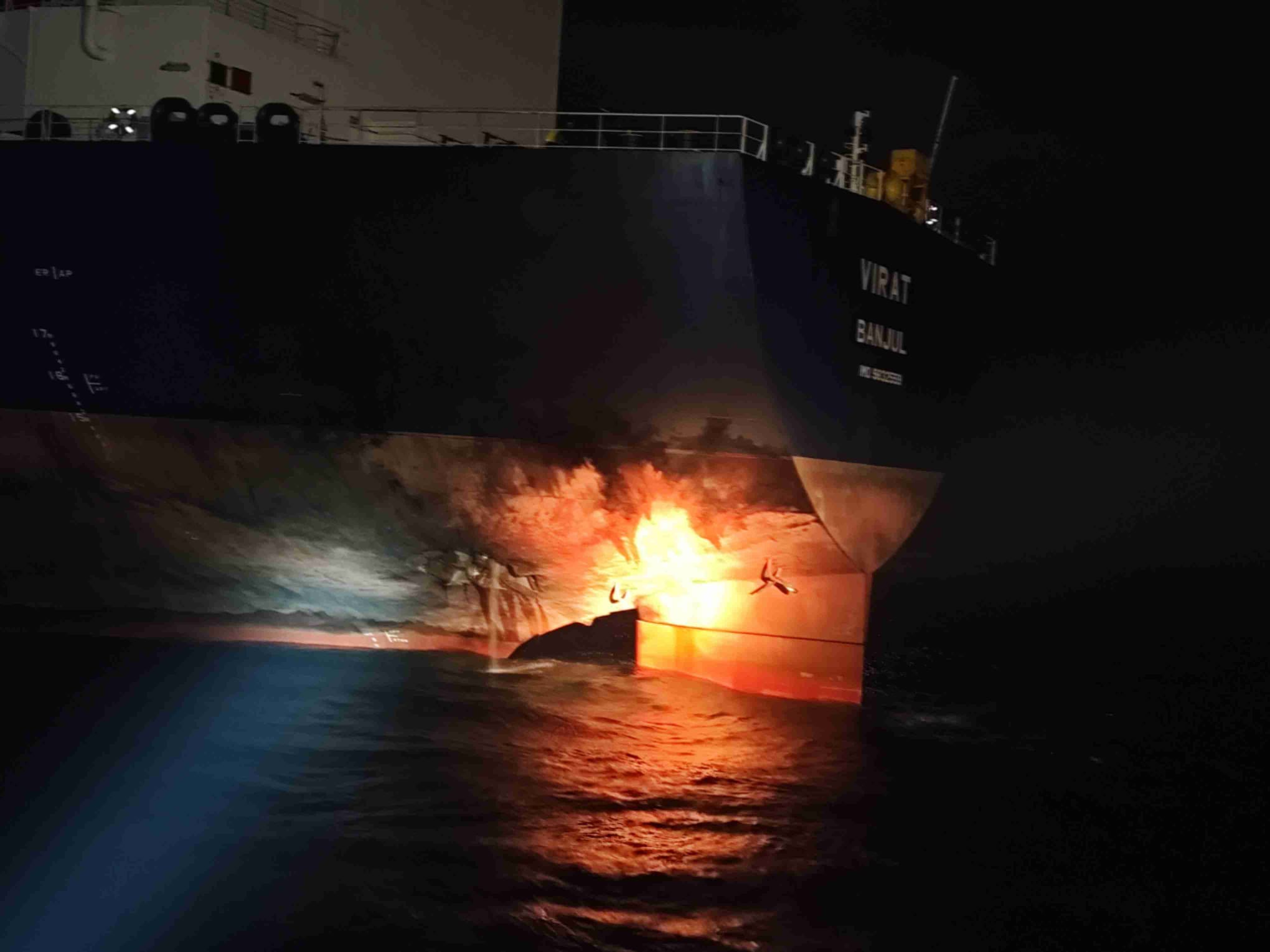
Incidents involving tankers such as Kairos and Virat broaden the operational geography well beyond traditional military targets. Ukraine appears to frame these logistics assets as part of Russia’s broader military support system, especially when they are perceived to contribute to wartime resilience. The underlying message is that distance from Russian territorial waters no longer ensures immunity from conflict related risk.

Yet the broader implications extend far beyond any single vessel.

A Maritime Security Grey Zone

The Black Sea has been edging toward a security grey zone for years, highly militarized, contested, and marked by asymmetric activity short of direct interstate confrontation. Ukraine’s evolving maritime campaign accelerates this trajectory.

First, these incidents expose regional vulnerabilities to miscalculation. Vessels operating within loosely regulated logistics networks often sail under third country flags, complicating legal responsibilities and diplomatic responses. Any incident involving a nominally neutral flag state could generate political tension or reciprocal actions by Russia, potentially affecting coastal NATO members.

Second, the maritime industry’s risk calculus is being reshaped. War risk insurance premiums have risen, some shipowners are reassessing voyages to Russian ports, and others attempt to minimize detection. The result is a more fragmented maritime environment driven increasingly by intelligence assessments rather than purely commercial considerations.

Third, regional states are being drawn further into the evolving security picture. Turkey has expressed concern about navigation risks near the Bosporus, highlighting the stakes for a region where any major incident, whether due to strike activity, mechanical failure, or crew abandonment, could produce immediate political and economic consequences.
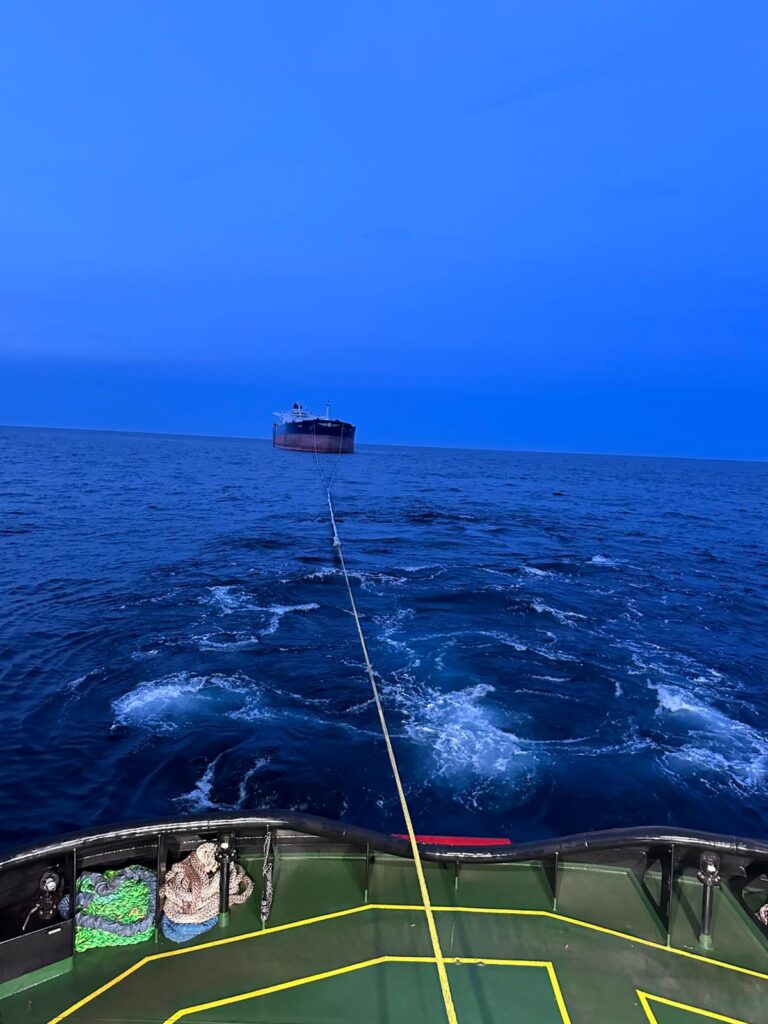
Denizcilik Genel Müdürlüğü

Diplomatic Friction in a Region Without a Comprehensive Framework

The Black Sea lacks a unified maritime security architecture. The Montreux Convention governs naval access but does not address drones, long range strikes involving commercial vessels, or the legal status of irregularly monitored tankers. NATO has expanded surveillance and coordination efforts, yet direct involvement remains constrained by alliance caution and Turkey’s pivotal role as gatekeeper.

This creates an environment shaped less by formal structures and more by adaptive, opportunistic, and asymmetric behavior.

Russia seeks to retain influence through its naval posture and strategic signaling. Ukraine aims to widen the operational geography facing Russian defenses. NATO members emphasize deterrence and containment. At the same time, external powers such as China observe developments closely as they expand their global maritime presence.

No major actor currently possesses a comprehensive strategy for addressing the uncertainty generated by repeated incidents involving logistics linked commercial vessels. The absence of such a framework increases the potential for friction.

Energy Geopolitics: A Local Risk with Global Reach

Despite sanctions pressure, Russia remains among the world’s leading oil exporters. A significant share of its crude exports passes through the Black Sea before onward shipment to global markets. Any disruption to this corridor, whether due to attacks, drifting tankers, tightened insurance conditions, or heightened inspections, carries consequences beyond the region.

This intersection between regional conflict and global economic vulnerability underscores the Black Sea’s strategic significance. While Ukraine’s actions may not halt Russian exports outright, they add logistical complexity, elevate operating costs, and introduce uncertainty into global markets. Even marginal interruptions can shape price expectations and risk models across Europe, Asia, and beyond.

Over the longer term, persistent insecurity could accelerate Russia’s diversification toward alternative export routes, including overland pipelines and Arctic shipping lanes. If the Black Sea becomes structurally higher risk, its role in Russian energy strategy could diminish, with implications for global trade patterns.

Forecast: Three Strategic Trajectories

Over the next year, several trends are likely to shape the Black Sea’s maritime landscape:

  1. Intensified competition in the maritime domain.
    Ukraine is expected to continue targeting logistics linked vessels it perceives as supporting Russian wartime activities. Russia may seek additional naval escorts or new defensive systems, raising escalation risks.
  2. Increasing expectations on coastal states.
    Turkey, Romania, and Bulgaria may face growing pressure from NATO, the EU, and the shipping industry to strengthen monitoring, risk mitigation practices, and maritime deconfliction mechanisms.
  3. A widening international debate on regulating opaque shipping practices.
    These incidents spotlight vulnerabilities in global maritime governance, including ownership opacity and variable flag state oversight. The IMO and major insurers may pursue tighter compliance rules that extend far beyond the Black Sea.

The Black Sea as a Preview of Future Maritime Conflict

The ongoing confrontation in the Black Sea is more than a regional episode; it illustrates the emerging characteristics of future maritime conflict, contested commercial shipping, drone enabled operations, and strategic pressure on logistics networks. Ukraine’s actions demonstrate how commercial vessels can become entangled in broader geopolitical dynamics. Russia’s responses may deepen the region’s militarization.

The Black Sea is evolving into a strategic hinge where regional conflict intersects with global economic systems and great power competition. Its future will depend not only on battlefield developments but also on whether maritime governance adapts to the changing nature of conflict at sea.

References

https://www.dailysabah.com/opinion/op-ed/black-sea-strikes-risk-regional-spillover

https://windward.ai/blog/ukraines-drone-war-on-dark-fleet-triggers-diplomatic-tensions-heightens-black-sea-risk

Previous Post

Common Misconceptions About ITAR: What Organizations Should Actually Know

Next Post

Libya After Gaddafi: Security Fragmentation, Weapons Proliferation, and Energy Challenges

Related Posts

Israel’s F-15 News: What Actually Happened, and Why It Matters
Cross-Sector Insights

Israel’s F-15 News: What Actually Happened, and Why It Matters

January 1, 2026
SDF and HTS: Managing Tension Without Open Conflict in Northern Syria
Cross-Sector Insights

SDF and HTS: Managing Tension Without Open Conflict in Northern Syria

December 26, 2025
What 2025 Taught Us About Defense and Energy: Five Lessons for 2026
Cross-Sector Insights

What 2025 Taught Us About Defense and Energy: Five Lessons for 2026

December 24, 2025
The New Taiwan Arms Package and China’s “Stop” Message: What Actually Changed
Cross-Sector Insights

The New Taiwan Arms Package and China’s “Stop” Message: What Actually Changed

December 19, 2025
The Rise of Commercial Drones in Conflict Zones: A New Layer in Modern Warfare
Cross-Sector Insights

The Rise of Commercial Drones in Conflict Zones: A New Layer in Modern Warfare

December 6, 2025
Black Sea Tanker Explosion: New Details on the Twin Incidents
Cross-Sector Insights

Black Sea Tanker Explosion: New Details on the Twin Incidents

November 29, 2025
Next Post
Libya After Gaddafi: Security Fragmentation, Weapons Proliferation, and Energy Challenges

Libya After Gaddafi: Security Fragmentation, Weapons Proliferation, and Energy Challenges

  • Trending
  • Comments
  • Latest
Blackwater PMC

After Blackwater: How PMCs Evolved, Professionalized, and Fragmented

September 13, 2025
Blackwater PMC

Inside Iraq’s Security Market: How Private Power Shapes a Fragile State

October 6, 2025
Operation Enduring Freedom

What Exactly Is a Private Military Company (PMC)?

September 6, 2025
Repkon Nammo in Denmark: What This Nordic Ammunition Play Really Signals

Repkon Nammo in Denmark: What This Nordic Ammunition Play Really Signals

August 21, 2025
A Historic $142 Billion Arms Deal: Unpacking the U.S.-Saudi Agreement

A Historic $142 Billion Arms Deal: Unpacking the U.S.-Saudi Agreement

A Silent Revolution on the Battlefield: AI-Enabled Tactical Communication Systems

A Silent Revolution on the Battlefield: AI-Enabled Tactical Communication Systems

Cominf.org, CC BY-SA 3.0 , via Wikimedia Commons

Is Europe Really Reducing Its Dependence on Russian Gas?

What is ITAR? The Invisible Line in Global Defense Trade

What is ITAR? The Invisible Line in Global Defense Trade

Israel’s F-15 News: What Actually Happened, and Why It Matters

Israel’s F-15 News: What Actually Happened, and Why It Matters

January 1, 2026
SDF and HTS: Managing Tension Without Open Conflict in Northern Syria

SDF and HTS: Managing Tension Without Open Conflict in Northern Syria

December 26, 2025
What 2025 Taught Us About Defense and Energy: Five Lessons for 2026

What 2025 Taught Us About Defense and Energy: Five Lessons for 2026

December 24, 2025
The New Taiwan Arms Package and China’s “Stop” Message: What Actually Changed

The New Taiwan Arms Package and China’s “Stop” Message: What Actually Changed

December 19, 2025

Recent News

Israel’s F-15 News: What Actually Happened, and Why It Matters

Israel’s F-15 News: What Actually Happened, and Why It Matters

January 1, 2026
SDF and HTS: Managing Tension Without Open Conflict in Northern Syria

SDF and HTS: Managing Tension Without Open Conflict in Northern Syria

December 26, 2025
What 2025 Taught Us About Defense and Energy: Five Lessons for 2026

What 2025 Taught Us About Defense and Energy: Five Lessons for 2026

December 24, 2025
The New Taiwan Arms Package and China’s “Stop” Message: What Actually Changed

The New Taiwan Arms Package and China’s “Stop” Message: What Actually Changed

December 19, 2025
Drill & Defense

Drill & Defense is an independent platform providing insights into firearms, defense technologies, and energy sectors. We deliver clear, practical content for professionals, enthusiasts, and industry followers worldwide.

Follow Us

Browse by Category

  • Cross-Sector Insights
  • Defense
  • Defense & Energy Strategy
  • Defense Know-How
  • Defense Technologies
  • Energy
  • Energy Insight
  • Energy Technologies
  • Global Security & Trade Analysis
  • History & Legacy
  • Industry News
  • Knowledge Base
  • Legacy Systems & Structures
  • Market Trends & Analysis
  • Military Market Reports
  • Oil & Gas News
  • Resource Wars & Strategy
  • Tech & Innovation Crossover
  • Turning Points in Conflict
  • Weapon & Gear Reviews

Recent News

Israel’s F-15 News: What Actually Happened, and Why It Matters

Israel’s F-15 News: What Actually Happened, and Why It Matters

January 1, 2026
SDF and HTS: Managing Tension Without Open Conflict in Northern Syria

SDF and HTS: Managing Tension Without Open Conflict in Northern Syria

December 26, 2025

© 2025 Drill & Defense. All rights reserved. Independent insights on firearms, defense, and energy. For business inquiries: info@drillanddefense.com | PRIVACY POLICY | COOKIE POLICY | TERMS AND CONDITIONS

Manage Consent

We use cookies to improve your experience. You can accept or refuse cookies; however, some features may not function properly without your consent.

Functional Always active
The technical storage or access is strictly necessary for the legitimate purpose of enabling the use of a specific service explicitly requested by the subscriber or user, or for the sole purpose of carrying out the transmission of a communication over an electronic communications network.
Preferences
The technical storage or access is necessary for the legitimate purpose of storing preferences that are not requested by the subscriber or user.
Statistics
The technical storage or access that is used exclusively for statistical purposes. The technical storage or access that is used exclusively for anonymous statistical purposes. Without a subpoena, voluntary compliance on the part of your Internet Service Provider, or additional records from a third party, information stored or retrieved for this purpose alone cannot usually be used to identify you.
Marketing
The technical storage or access is required to create user profiles to send advertising, or to track the user on a website or across several websites for similar marketing purposes.
  • Manage options
  • Manage services
  • Manage {vendor_count} vendors
  • Read more about these purposes
View preferences
  • {title}
  • {title}
  • {title}
No Result
View All Result
  • Defense
    • Industry News
    • Weapon & Gear Reviews
    • Defense Technologies
    • Military Market Reports
  • Energy
    • Oil & Gas News
    • Energy Technologies
    • Market Trends & Analysis
  • Cross-Sector Insights
    • Defense & Energy Strategy
    • Global Security & Trade Analysis
    • Tech & Innovation Crossover
  • History & Legacy
    • Turning Points in Conflict
    • Legacy Systems & Structures
    • Resource Wars & Strategy
  • Knowledge Base
    • Defense Know-How
    • Energy Insight
  • About
  • Contact
  • Login
  • Register

© 2025 Drill & Defense. All rights reserved. Independent insights on firearms, defense, and energy. For business inquiries: info@drillanddefense.com | PRIVACY POLICY | COOKIE POLICY | TERMS AND CONDITIONS