
Small drones have changed the way security forces think about low-altitude airspace. A small quadcopter no longer represents only a hobby device or a camera platform. In the wrong context, it can become a surveillance tool, a delivery method, a distraction, or a cheap way to force an expensive security response.

This is why one of the strangest-looking tools in the counter-drone field has gained attention: the so-called drone gun.
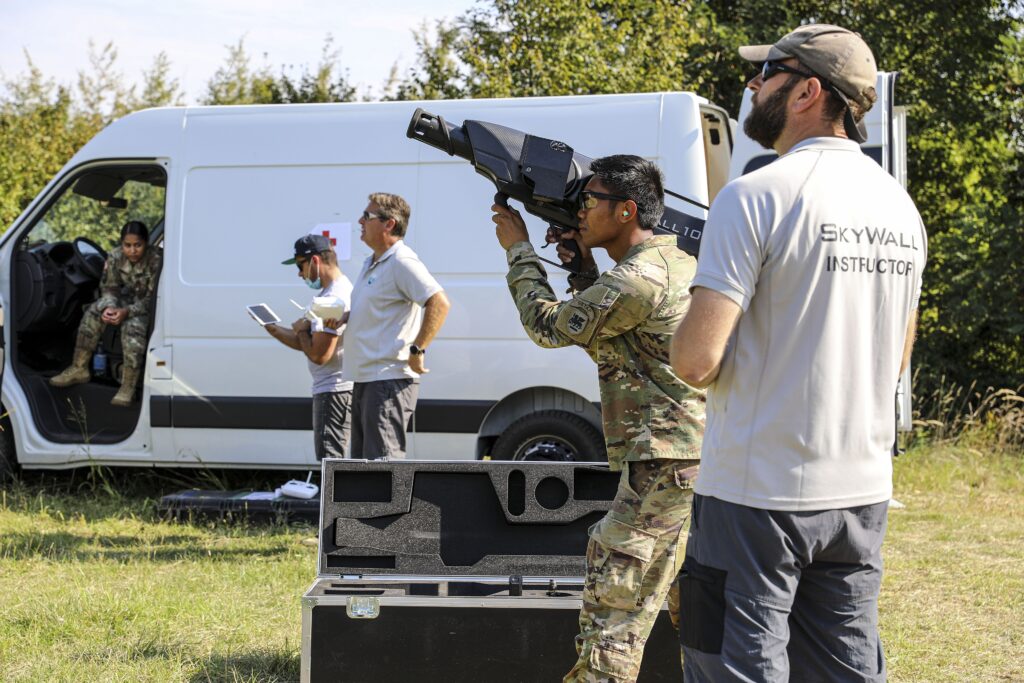
The name is slightly misleading. Most drone guns are not firearms in the traditional sense. They do not fire bullets, pellets or shells. They do not usually destroy the drone by physical impact. Instead, they are handheld or shoulder-fired electronic countermeasure systems designed to interfere with the signals that allow a drone to communicate, navigate and remain under operator control.
That difference matters. A drone gun is not really aimed at the body of the drone. It is aimed at the invisible system around it.
Not a Rifle, but an Electronic Warfare Tool
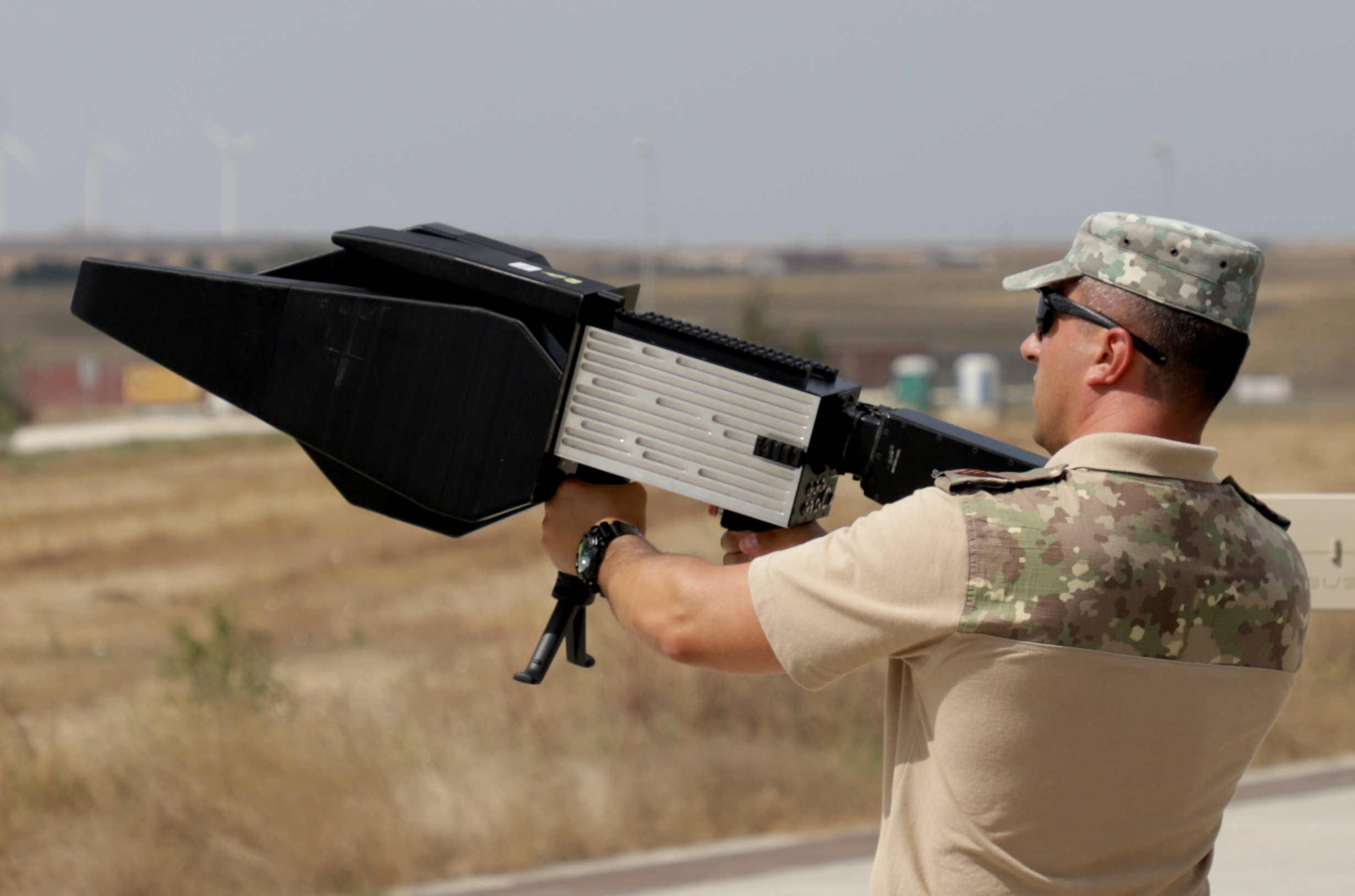
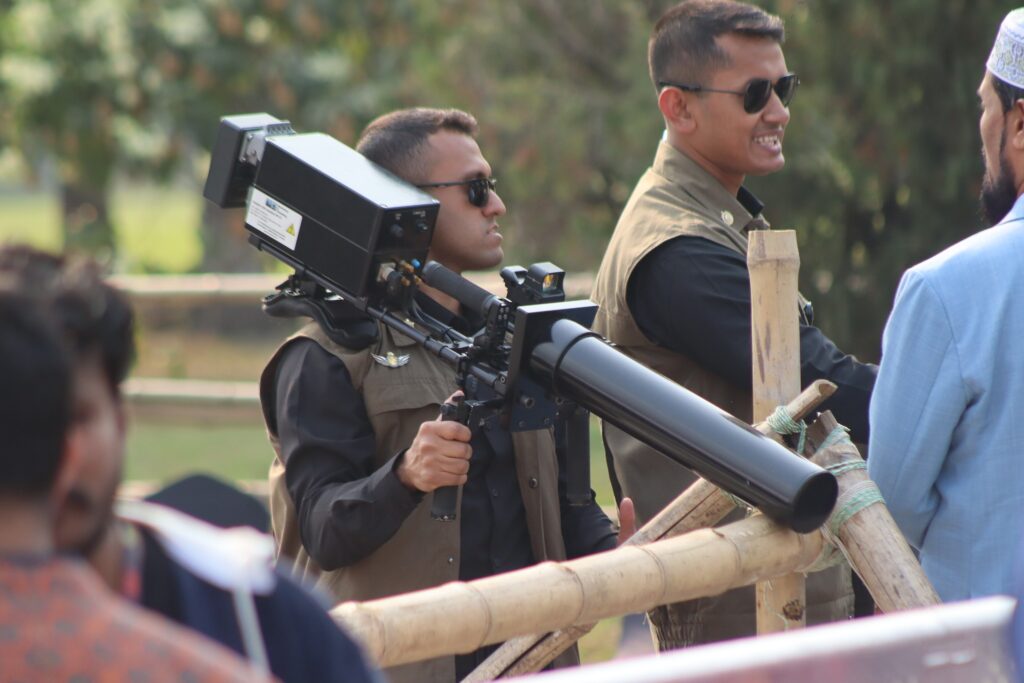
At first glance, many drone guns look like oversized rifles with strange antenna structures attached to the front. The shape is practical. A rifle-style form allows the operator to aim the device toward a specific airborne target, keep it aligned, and use a familiar shoulder-fired posture. It also helps concentrate the system’s effect in a particular direction rather than spreading interference everywhere.
Technically, most of these systems work by transmitting radio frequency interference toward the drone. Depending on the design, they may target common control and video transmission bands such as 2.4 GHz and 5.8 GHz. Some systems may also affect satellite navigation signals used by drones, including GPS, GLONASS, Galileo or BeiDou bands. The exact frequency coverage depends on the system, the legal framework, and the intended user.
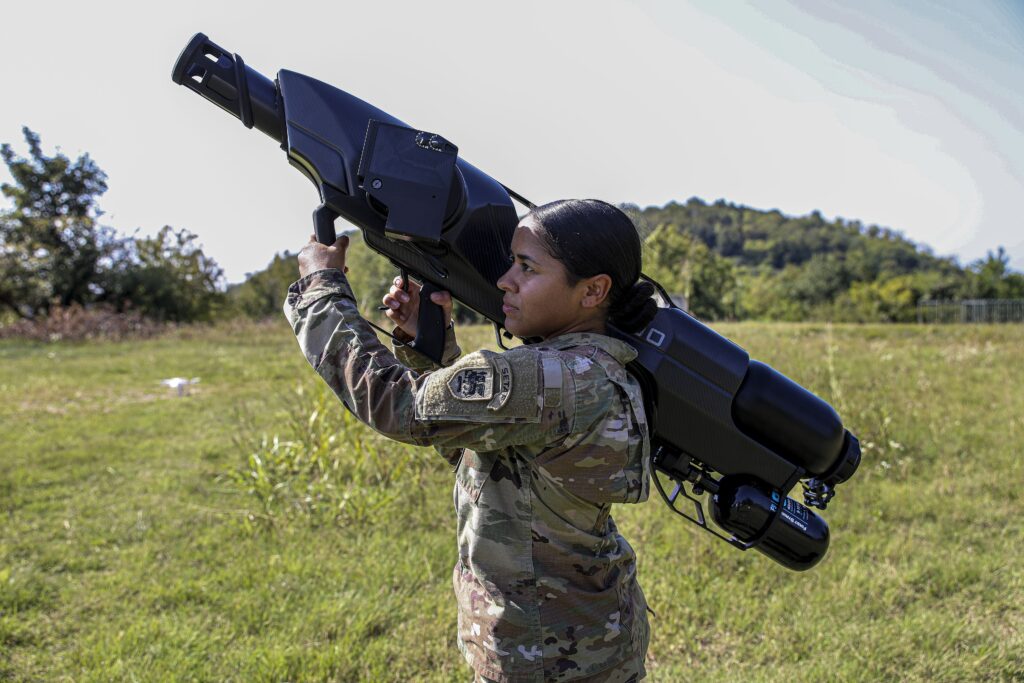
The goal is usually not to make the drone explode or fall instantly. In many cases, the objective is to interrupt the drone’s command link, video link or navigation confidence. What happens next depends on the drone’s internal programming. It may hover, descend, return to its launch point, lose video feed, or enter a failsafe mode.
This is one of the reasons drone guns are both useful and limited. They exploit the dependency of many small drones on radio control and satellite navigation, but they are not a universal answer to every unmanned aircraft.
What Happens When the Signal Is Disrupted?
A small drone is not just a flying object. It is a combination of airframe, motors, battery, flight controller, sensors, radio link, software and navigation input. The operator sees the drone through a video feed and controls it through a command link. The drone may also use satellite navigation for positioning, route planning or return-to-home functions.
A drone gun tries to disturb that relationship.
If the command link is affected, the drone may no longer receive instructions from its operator. If the video link is affected, the operator may lose situational awareness. If satellite navigation is disrupted, the drone may struggle to maintain position or execute pre-set navigation functions accurately. In some cases, the drone may initiate an automatic landing or return-to-home procedure.
This sounds clean on paper, but real conditions are rarely clean. Different drones respond differently. Some have stronger links. Some use frequency hopping. Some can continue parts of their mission autonomously. Some may be modified specifically to resist jamming. A basic commercial drone and a hardened military drone are not the same target.
That is why the phrase “anti-drone gun” can create a false impression. It suggests a simple weapon with a simple effect. In reality, the result depends on the target, the environment, the operator, the distance, the antenna direction, the power output and the drone’s own failsafe logic.
Why These Systems Became Attractive
The appeal is obvious. A drone gun gives a trained security team a portable response tool. It can be carried by one person, deployed quickly, and used without launching a missile or firing conventional ammunition into the air.
That matters in places where falling debris is a serious concern. Airports, stadiums, prisons, energy facilities, government buildings and public events are not good environments for uncontrolled kinetic engagement. Shooting at a small drone with conventional weapons can be dangerous, ineffective or legally unacceptable. A directional electronic response offers another option. It does not remove all risk, but it may reduce some of the dangers associated with bullets, fragmentation or explosive interceptors. It also allows the drone to be handled as potential evidence if it lands or is recovered intact.
There is another reason these systems attract attention: cost logic. Using a very expensive missile against a cheap drone can be strategically uncomfortable, especially if drone incidents become frequent. A handheld jammer does not solve the full cost problem, but it belongs to a wider search for lower-cost, scalable counter-UAS responses.
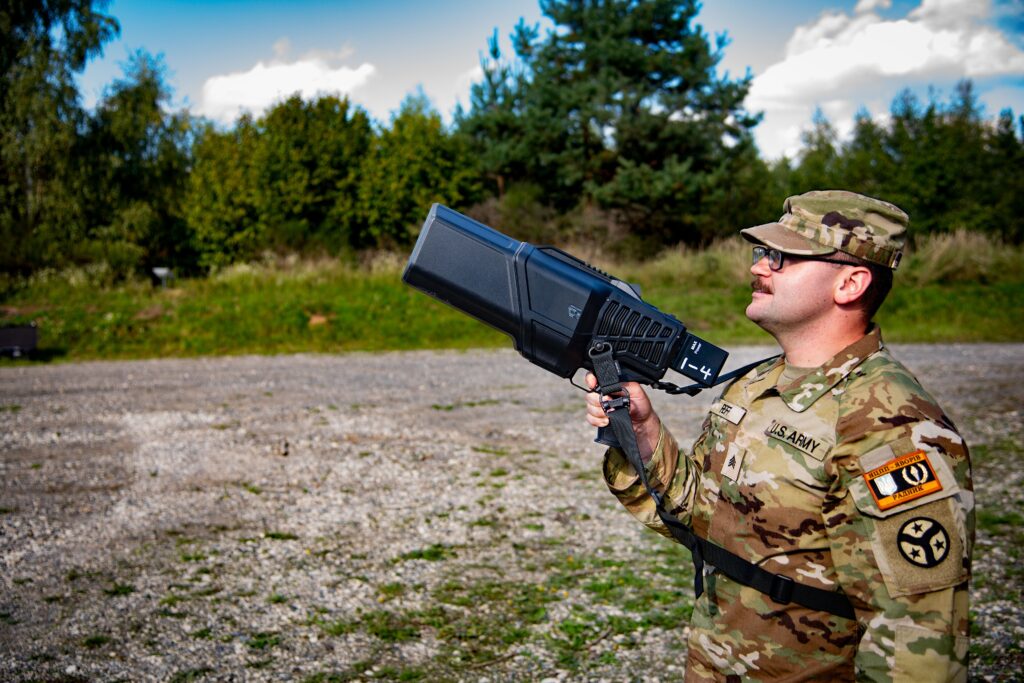
Still, the word “scalable” should be used carefully. A person with a drone gun cannot defend an entire city. A handheld system covers a limited angle, a limited range and a limited tactical situation. It is useful only when placed inside a broader system.
Detection Comes Before Mitigation
This is the part that often gets skipped. A drone gun is useless if the security team does not know where the drone is, what it is, and whether it should be engaged.
Small drones are difficult targets. They can fly low, move slowly, stop in the air, blend into urban backgrounds and produce a radar signature much smaller than traditional aircraft. At night, in bad weather or in cluttered environments, visual identification becomes even harder. Noise can help, but cities and industrial areas are already noisy.
A serious counter-UAS setup usually starts with detection and classification. This can include radio frequency sensors, compact radars, electro-optical cameras, thermal cameras, acoustic sensors and command-and-control software that brings these feeds together. Only after detection and classification does mitigation make sense.
This is why drone guns should not be treated as standalone solutions. They are better understood as one possible effector within a layered counter-drone system. The system detects, tracks, identifies, decides and then responds. The handheld jammer is only one of the possible response tools. A facility that buys a drone gun but has no detection architecture is still reacting late. By the time a guard sees the drone with the naked eye, the drone may already have completed its mission.
Technical Limits in Real Environments
The technical limitations are important because they prevent unrealistic expectations. Range is one of them. A manufacturer may state a maximum effective distance, but real-world performance depends on line of sight, antenna alignment, interference, weather, terrain, urban clutter and the drone’s link strength. A drone behind structures, near reflective surfaces, or operating in a noisy electromagnetic environment may not behave the same way as a drone in a controlled test field.
Power is another issue. A handheld system must balance output, battery life, weight and heat. More power may improve effect, but it also creates design challenges. The unit must remain portable, usable and safe for the operator. Battery endurance matters because drone incidents may not happen at convenient moments.
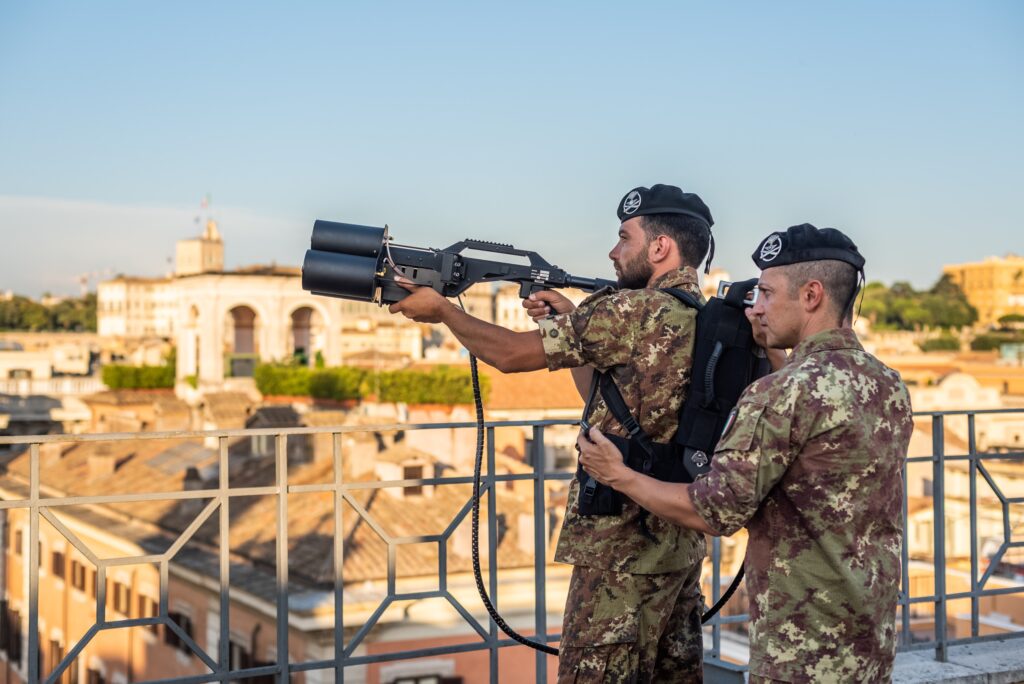
There is also the question of directionality. Many drone guns use directional antennas to focus energy toward the target, but aiming an electronic effect is not the same as aiming a bullet. The operator is trying to affect a radio link, not place a projectile on a visible point. Training matters. So does understanding what the device can and cannot do.
Autonomy is another major limitation. If a drone is flying a pre-programmed route and does not need live operator input, disrupting the control link may not stop it immediately. If the drone has inertial navigation support or alternative guidance methods, the effect of GNSS disruption may also be reduced. This is why electronic countermeasures are most effective when matched to the actual threat profile.
The Legal and Safety Problem
Drone guns sit in a difficult legal area because they involve radio frequency interference. In many countries, jamming devices are heavily restricted or prohibited for private use. The reason is simple: radio spectrum is shared by many legitimate users. Interfering with it can affect communications, navigation, emergency services or other systems that have nothing to do with the drone.
This is especially sensitive near airports. A drone near an airport is already a safety issue, but an uncoordinated jamming response could create additional risks. Aviation environments depend on reliable communications and navigation. Any counter-drone action in that space must be handled under strict authority and procedures.
For private companies, the realistic path is usually not “buy a drone gun and solve the problem.” It is risk assessment, legal compliance, detection, reporting procedures, coordination with authorities and, where allowed, authorized mitigation. In many cases, private users may be able to detect and document drone activity but not legally jam or disable it themselves.
That point should not be treated as a minor footnote. It is central to the subject. Drone guns are security tools, but they are not consumer gadgets.
Where Drone Guns Fit in the Bigger Counter-UAS Picture
The counter-drone field is becoming more diverse. Drone guns are only one part of it. Other options include net capture systems, interceptor drones, high-energy lasers, high-power microwave systems, kinetic ammunition, electronic take-over methods and integrated base-defense systems.
Each option has trade-offs. Lasers need line of sight and sufficient dwell time on target. Microwave systems may offer broader electronic effects but raise other operational questions. Kinetic systems can destroy the drone but create debris. Net systems may preserve evidence but have range and accuracy limits. Cyber or protocol-based methods may work only against certain drone types.
Drone guns sit somewhere in the middle. They are portable, visible and relatively quick to deploy, but they are not the deepest or most comprehensive layer. Their value is strongest when the threat is a small drone using vulnerable links, when the operator has line of sight, and when the legal authority to use jamming exists.
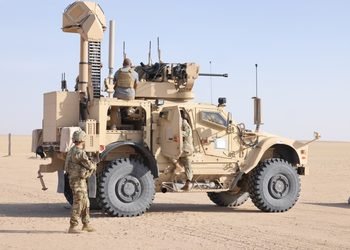
In military settings, they can support patrols, checkpoints, convoys, bases and forward positions. In domestic security settings, they are more complicated because public safety, spectrum regulation and aviation law become much more prominent.
What They Reveal About Modern Defense
Drone guns are interesting because they look familiar but function differently. They borrow the shape of a rifle, yet they belong more to the world of electronic warfare than small arms. That contrast says something about modern defense technology.
The battlefield is no longer shaped only by platforms that can be seen and destroyed physically. It is also shaped by signals, software, navigation systems, data links and automation. A cheap flying device can create pressure because it connects several technologies into one small package. The response has to target that package intelligently. Drone guns are not the final answer to the drone problem. They are not even the most advanced answer in many cases. But they are a visible example of how defense is adapting to smaller, cheaper and more distributed threats.
The important lesson is not that every drone can be stopped by a rifle-shaped jammer. The lesson is that low-altitude security now requires tools that can act against both physical objects and the electronic systems that make those objects useful.
In that sense, drone guns are strange only at first glance. Once we understand the environment they are built for, their design starts to make sense. They are not traditional weapons trying to imitate science fiction. They are practical responses to a security problem that has moved faster than many institutions expected.
Sources:
- DroneShield, “Dismounted Counter-UAS System Products.”
- IXI EW, “DRONEKILLER.”
- Federal Communications Commission, “Jammer Enforcement.”
- Federal Aviation Administration, “UAS Detection, Mitigation, and Response on Airports.”