
Drill & Defense
Advertisement
  • Defense
    • Industry News
    • Weapon & Gear Reviews
    • Defense Technologies
    • Military Market Reports
  • Energy
    • Oil & Gas News
    • Energy Technologies
    • Market Trends & Analysis
  • Cross-Sector Insights
    • Defense & Energy Strategy
    • Global Security & Trade Analysis
    • Tech & Innovation Crossover
  • History & Legacy
    • Turning Points in Conflict
    • Legacy Systems & Structures
    • Resource Wars & Strategy
  • Knowledge Base
    • Defense Know-How
    • Energy Insight
  • About
  • Contact
  • Login
  • Register
No Result
View All Result
  • Defense
    • Industry News
    • Weapon & Gear Reviews
    • Defense Technologies
    • Military Market Reports
  • Energy
    • Oil & Gas News
    • Energy Technologies
    • Market Trends & Analysis
  • Cross-Sector Insights
    • Defense & Energy Strategy
    • Global Security & Trade Analysis
    • Tech & Innovation Crossover
  • History & Legacy
    • Turning Points in Conflict
    • Legacy Systems & Structures
    • Resource Wars & Strategy
  • Knowledge Base
    • Defense Know-How
    • Energy Insight
  • About
  • Contact
  • Login
  • Register
No Result
View All Result
Drill & Defense
No Result
View All Result
Home Cross-Sector Insights

The New Taiwan Arms Package and China’s “Stop” Message: What Actually Changed

December 19, 2025
in Cross-Sector Insights, Global Security & Trade Analysis
The New Taiwan Arms Package and China’s “Stop” Message: What Actually Changed

An ATACMS missile being launched from an M270 MLRS

Share on LinkedInShare on Twitter

US arms sales Taiwan have once again moved to the center of regional security debates, following a new package and a sharp response from Beijing. This week’s round is bigger than usual, so it is worth slowing down and separating signal from noise.

The United States has initiated procedures for an arms package publicly framed at roughly 11.1 billion dollars, with multiple items intended to strengthen Taiwan’s defensive capabilities. Taiwan’s defense authorities welcomed the move, while China’s official messaging called on Washington to stop. The exchange itself is not new. What makes this moment worth closer attention is the scale, the composition, and the strategic messaging embedded in the package.

What matters for a serious read is not the headline number alone. It is what this package communicates about strategy, risk, and the future shape of deterrence across the Taiwan Strait.

What Systems Are Included in the Current Package

Publicly reported details indicate that the package is not symbolic but operationally specific. The systems involved include the M142 High Mobility Artillery Rocket System (HIMARS), supported by guided rocket and missile munitions designed for rapid and mobile fires. Ground forces are further reinforced through self propelled artillery platforms and associated ammunition stocks. Anti armor capabilities feature prominently, with systems such as the FGM 148 Javelin and TOW variants intended to counter mechanized and amphibious landings. The package also includes loitering munitions and unmanned aerial systems for reconnaissance and precision strike roles, alongside command, control, communications, sustainment, and training components. Taken together, these systems emphasize mobility, dispersion, and survivability rather than air or naval power projection, reinforcing a defensive posture built around delaying, disrupting, and increasing the cost of any large scale military operation against the island.
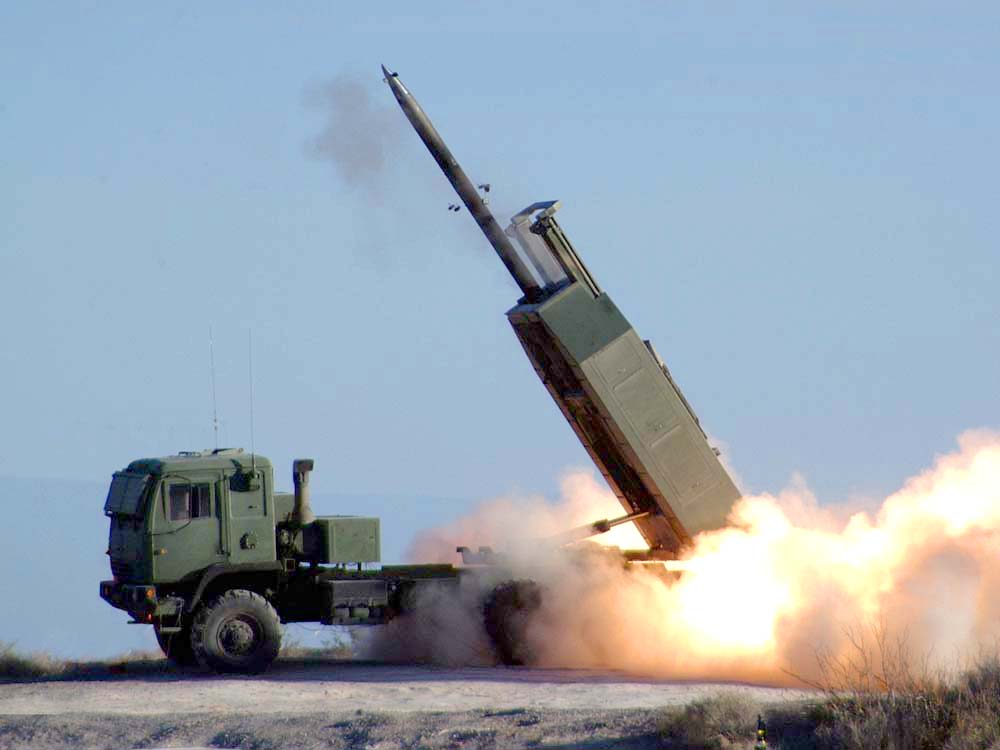
The High Mobility Artillery Rocket System fires the U.S. Army’s new guided Multiple Launch Rocket System during testing at White Sands Missile Range.

Why Beijing Says “Stop” Even When It Cannot Literally Stop It

China’s reaction is not improvised. It follows a consistent political and legal position. Taiwan is framed as an internal sovereignty issue, and foreign arms transfers are portrayed as external interference. This language appears repeatedly in official Chinese statements whenever U.S. Taiwan defense ties become visible.

In the current cycle, Beijing again argues that arms sales violate the One China principle and undermine regional stability. This framing sets the boundaries of China’s diplomatic posture. From Beijing’s perspective, arms sales are not a negotiable detail but a challenge to legitimacy itself.

At the same time, there is no direct mechanism through which China can veto U.S. arms transfers. Pressure is applied instead through diplomatic escalation, military signaling, economic warnings directed at defense firms, and strategic messaging aimed at Taiwan, the United States, and regional partners.

Marines with 3rd Battalion, 12th Marine Regiment, a part of Marine Rotational Force-Darwin (MRF-D), fire Guided Multiple Launch Rocket System (GMLRS) munitions during Southern Reach, at Bradshaw Field Training Area, Northern Territory, Australia on August 15, 2019. GMLRS provide pinpoint accuracy and deliver 200 pounds of high explosives directly on a target. (U.S. Marine Corps photo by Lance Cpl. Brandon Salas)

The U.S. Rationale: Deterrence, Not Recognition

From Washington’s standpoint, arms sales to Taiwan are justified as a means of supporting self defense rather than formal recognition. U.S. policy has long been built around managing this contradiction. Taiwan is not diplomatically recognized as a sovereign state, yet its security is supported through legislation and long standing policy commitments.

This is why U.S. officials consistently emphasize the defensive nature of the systems involved. The stated goal is to raise the cost of coercion or invasion, not to enable Taiwan to project power outward. That distinction is central to how Washington argues it can support stability without altering its formal diplomatic position.

What the Package Suggests About the Preferred Shape of Deterrence

The composition of the package offers insight into strategic priorities.

Systems such as mobile rocket artillery, drones, loitering munitions, and anti armor weapons align with the idea that Taiwan must complicate any assault through dispersion, survivability, and rapid response. This logic is frequently described as asymmetric defense. Rather than matching China platform for platform, the aim is to make any military operation against Taiwan costly, uncertain, and prolonged.

This does not imply that conventional platforms are irrelevant. It suggests that immediate emphasis is placed on systems that can survive initial strikes, operate in degraded conditions, and be replenished quickly. The long term objective is a defensive network that remains functional under sustained pressure.

The Pressure Cycle: Arms Sales, Protests, Drills, and Messaging

The Taiwan Strait is best understood not as a simple peace or war divide, but as a continuously contested environment. Each actor uses recurring actions to influence the calculations of the others.

The current sequence follows a familiar pattern. U.S. announcements are followed by Taiwanese political and defense planning responses. China issues diplomatic protests and warnings, often accompanied by heightened military activity or exercises. These moves are designed less to trigger immediate conflict than to reinforce red lines and signal resolve.

This cycle does not automatically point toward war. The greater risk lies in miscalculation, domestic political pressure, or unintended incidents that force decision makers into harder positions than originally intended.

The more relevant analytical question is not whether China objects to arms sales. That objection is constant. The real issue is how each side seeks to extract leverage from these moments without losing control of escalation.

What This Means for Industry and Procurement Observers

For defense industry and procurement analysts, Taiwan arms packages are also roadmaps. Announcements signal future demand, training requirements, sustainment challenges, and integration timelines.

One persistent gap between perception and reality lies in timing. Approval does not equal capability. Deterrence is built through delivery, training, integration, logistics, and survivability planning. Systems must be absorbed into doctrine and exercised realistically before they meaningfully affect the strategic balance.

Continuity also matters. Repeated, structured support sends signals to regional partners about commitment and reliability. Uncertainty, by contrast, encourages hedging behavior and independent capability development across the region.

Reading the Moment Without Overreading It

Large arms packages invite dramatic interpretation. Some do mark inflection points. Many do not.

A disciplined reading suggests continuity rather than rupture. The United States continues to strengthen Taiwan’s defensive posture. China continues to challenge the legitimacy of that support through political pressure and signaling. Both sides communicate simultaneously to domestic audiences, international partners, and each other.

For observers, the most useful indicators remain practical rather than rhetorical. Follow how quickly announced systems move toward operational status. Watch how Taiwan adapts its force structure and budget priorities. Track whether Chinese responses remain within established patterns or begin to alter them.

Managed tension can persist for years. The analytical task is not to predict imminent conflict, but to understand which actions reinforce the existing balance and which quietly attempt to reshape it.

Sources

  1. Reuters
    Coverage on U.S. arms sales procedures to Taiwan, Chinese diplomatic reactions, and regional security implications.
  2. The Guardian
    Reporting on recent U.S. defense packages for Taiwan and Beijing’s official responses.
  3. Wall Street Journal
    Analysis of U.S. Taiwan defense cooperation, arms sales composition, and strategic signaling in the Indo Pacific.

Previous Post

Libya After Gaddafi: Security Fragmentation, Weapons Proliferation, and Energy Challenges

Next Post

What 2025 Taught Us About Defense and Energy: Five Lessons for 2026

Related Posts

Israel’s F-15 News: What Actually Happened, and Why It Matters
Cross-Sector Insights

Israel’s F-15 News: What Actually Happened, and Why It Matters

January 1, 2026
SDF and HTS: Managing Tension Without Open Conflict in Northern Syria
Cross-Sector Insights

SDF and HTS: Managing Tension Without Open Conflict in Northern Syria

December 26, 2025
What 2025 Taught Us About Defense and Energy: Five Lessons for 2026
Cross-Sector Insights

What 2025 Taught Us About Defense and Energy: Five Lessons for 2026

December 24, 2025
The Black Sea’s Evolving Battlespace: Ukraine’s Maritime Operations and Shifting Security Dynamics
Cross-Sector Insights

The Black Sea’s Evolving Battlespace: Ukraine’s Maritime Operations and Shifting Security Dynamics

December 12, 2025
The Rise of Commercial Drones in Conflict Zones: A New Layer in Modern Warfare
Cross-Sector Insights

The Rise of Commercial Drones in Conflict Zones: A New Layer in Modern Warfare

December 6, 2025
Black Sea Tanker Explosion: New Details on the Twin Incidents
Cross-Sector Insights

Black Sea Tanker Explosion: New Details on the Twin Incidents

November 29, 2025
Next Post
What 2025 Taught Us About Defense and Energy: Five Lessons for 2026

What 2025 Taught Us About Defense and Energy: Five Lessons for 2026

  • Trending
  • Comments
  • Latest
Blackwater PMC

After Blackwater: How PMCs Evolved, Professionalized, and Fragmented

September 13, 2025
Blackwater PMC

Inside Iraq’s Security Market: How Private Power Shapes a Fragile State

October 6, 2025
Operation Enduring Freedom

What Exactly Is a Private Military Company (PMC)?

September 6, 2025
Repkon Nammo in Denmark: What This Nordic Ammunition Play Really Signals

Repkon Nammo in Denmark: What This Nordic Ammunition Play Really Signals

August 21, 2025
A Historic $142 Billion Arms Deal: Unpacking the U.S.-Saudi Agreement

A Historic $142 Billion Arms Deal: Unpacking the U.S.-Saudi Agreement

A Silent Revolution on the Battlefield: AI-Enabled Tactical Communication Systems

A Silent Revolution on the Battlefield: AI-Enabled Tactical Communication Systems

Cominf.org, CC BY-SA 3.0 , via Wikimedia Commons

Is Europe Really Reducing Its Dependence on Russian Gas?

What is ITAR? The Invisible Line in Global Defense Trade

What is ITAR? The Invisible Line in Global Defense Trade

Israel’s F-15 News: What Actually Happened, and Why It Matters

Israel’s F-15 News: What Actually Happened, and Why It Matters

January 1, 2026
SDF and HTS: Managing Tension Without Open Conflict in Northern Syria

SDF and HTS: Managing Tension Without Open Conflict in Northern Syria

December 26, 2025
What 2025 Taught Us About Defense and Energy: Five Lessons for 2026

What 2025 Taught Us About Defense and Energy: Five Lessons for 2026

December 24, 2025
The New Taiwan Arms Package and China’s “Stop” Message: What Actually Changed

The New Taiwan Arms Package and China’s “Stop” Message: What Actually Changed

December 19, 2025

Recent News

Israel’s F-15 News: What Actually Happened, and Why It Matters

Israel’s F-15 News: What Actually Happened, and Why It Matters

January 1, 2026
SDF and HTS: Managing Tension Without Open Conflict in Northern Syria

SDF and HTS: Managing Tension Without Open Conflict in Northern Syria

December 26, 2025
What 2025 Taught Us About Defense and Energy: Five Lessons for 2026

What 2025 Taught Us About Defense and Energy: Five Lessons for 2026

December 24, 2025
The New Taiwan Arms Package and China’s “Stop” Message: What Actually Changed

The New Taiwan Arms Package and China’s “Stop” Message: What Actually Changed

December 19, 2025
Drill & Defense

Drill & Defense is an independent platform providing insights into firearms, defense technologies, and energy sectors. We deliver clear, practical content for professionals, enthusiasts, and industry followers worldwide.

Follow Us

Browse by Category

  • Cross-Sector Insights
  • Defense
  • Defense & Energy Strategy
  • Defense Know-How
  • Defense Technologies
  • Energy
  • Energy Insight
  • Energy Technologies
  • Global Security & Trade Analysis
  • History & Legacy
  • Industry News
  • Knowledge Base
  • Legacy Systems & Structures
  • Market Trends & Analysis
  • Military Market Reports
  • Oil & Gas News
  • Resource Wars & Strategy
  • Tech & Innovation Crossover
  • Turning Points in Conflict
  • Weapon & Gear Reviews

Recent News

Israel’s F-15 News: What Actually Happened, and Why It Matters

Israel’s F-15 News: What Actually Happened, and Why It Matters

January 1, 2026
SDF and HTS: Managing Tension Without Open Conflict in Northern Syria

SDF and HTS: Managing Tension Without Open Conflict in Northern Syria

December 26, 2025

© 2025 Drill & Defense. All rights reserved. Independent insights on firearms, defense, and energy. For business inquiries: info@drillanddefense.com | PRIVACY POLICY | COOKIE POLICY | TERMS AND CONDITIONS

Manage Consent

We use cookies to improve your experience. You can accept or refuse cookies; however, some features may not function properly without your consent.

Functional Always active
The technical storage or access is strictly necessary for the legitimate purpose of enabling the use of a specific service explicitly requested by the subscriber or user, or for the sole purpose of carrying out the transmission of a communication over an electronic communications network.
Preferences
The technical storage or access is necessary for the legitimate purpose of storing preferences that are not requested by the subscriber or user.
Statistics
The technical storage or access that is used exclusively for statistical purposes. The technical storage or access that is used exclusively for anonymous statistical purposes. Without a subpoena, voluntary compliance on the part of your Internet Service Provider, or additional records from a third party, information stored or retrieved for this purpose alone cannot usually be used to identify you.
Marketing
The technical storage or access is required to create user profiles to send advertising, or to track the user on a website or across several websites for similar marketing purposes.
  • Manage options
  • Manage services
  • Manage {vendor_count} vendors
  • Read more about these purposes
View preferences
  • {title}
  • {title}
  • {title}
No Result
View All Result
  • Defense
    • Industry News
    • Weapon & Gear Reviews
    • Defense Technologies
    • Military Market Reports
  • Energy
    • Oil & Gas News
    • Energy Technologies
    • Market Trends & Analysis
  • Cross-Sector Insights
    • Defense & Energy Strategy
    • Global Security & Trade Analysis
    • Tech & Innovation Crossover
  • History & Legacy
    • Turning Points in Conflict
    • Legacy Systems & Structures
    • Resource Wars & Strategy
  • Knowledge Base
    • Defense Know-How
    • Energy Insight
  • About
  • Contact
  • Login
  • Register

© 2025 Drill & Defense. All rights reserved. Independent insights on firearms, defense, and energy. For business inquiries: info@drillanddefense.com | PRIVACY POLICY | COOKIE POLICY | TERMS AND CONDITIONS