
Drill & Defense
Advertisement
  • Defense
    • Industry News
    • Weapon & Gear Reviews
    • Defense Technologies
    • Military Market Reports
  • Energy
    • Oil & Gas News
    • Energy Technologies
    • Market Trends & Analysis
  • Cross-Sector Insights
    • Defense & Energy Strategy
    • Global Security & Trade Analysis
    • Tech & Innovation Crossover
  • History & Legacy
    • Turning Points in Conflict
    • Legacy Systems & Structures
    • Resource Wars & Strategy
  • Knowledge Base
    • Defense Know-How
    • Energy Insight
  • About
  • Contact
  • Login
  • Register
No Result
View All Result
  • Defense
    • Industry News
    • Weapon & Gear Reviews
    • Defense Technologies
    • Military Market Reports
  • Energy
    • Oil & Gas News
    • Energy Technologies
    • Market Trends & Analysis
  • Cross-Sector Insights
    • Defense & Energy Strategy
    • Global Security & Trade Analysis
    • Tech & Innovation Crossover
  • History & Legacy
    • Turning Points in Conflict
    • Legacy Systems & Structures
    • Resource Wars & Strategy
  • Knowledge Base
    • Defense Know-How
    • Energy Insight
  • About
  • Contact
  • Login
  • Register
No Result
View All Result
Drill & Defense
No Result
View All Result
Home Knowledge Base

The Invisible Arsenal: How OSINT Is Re-engineering the Global Arms Trade

November 19, 2025
in Knowledge Base, Defense Know-How
The Invisible Arsenal: How OSINT Is Re-engineering the Global Arms Trade

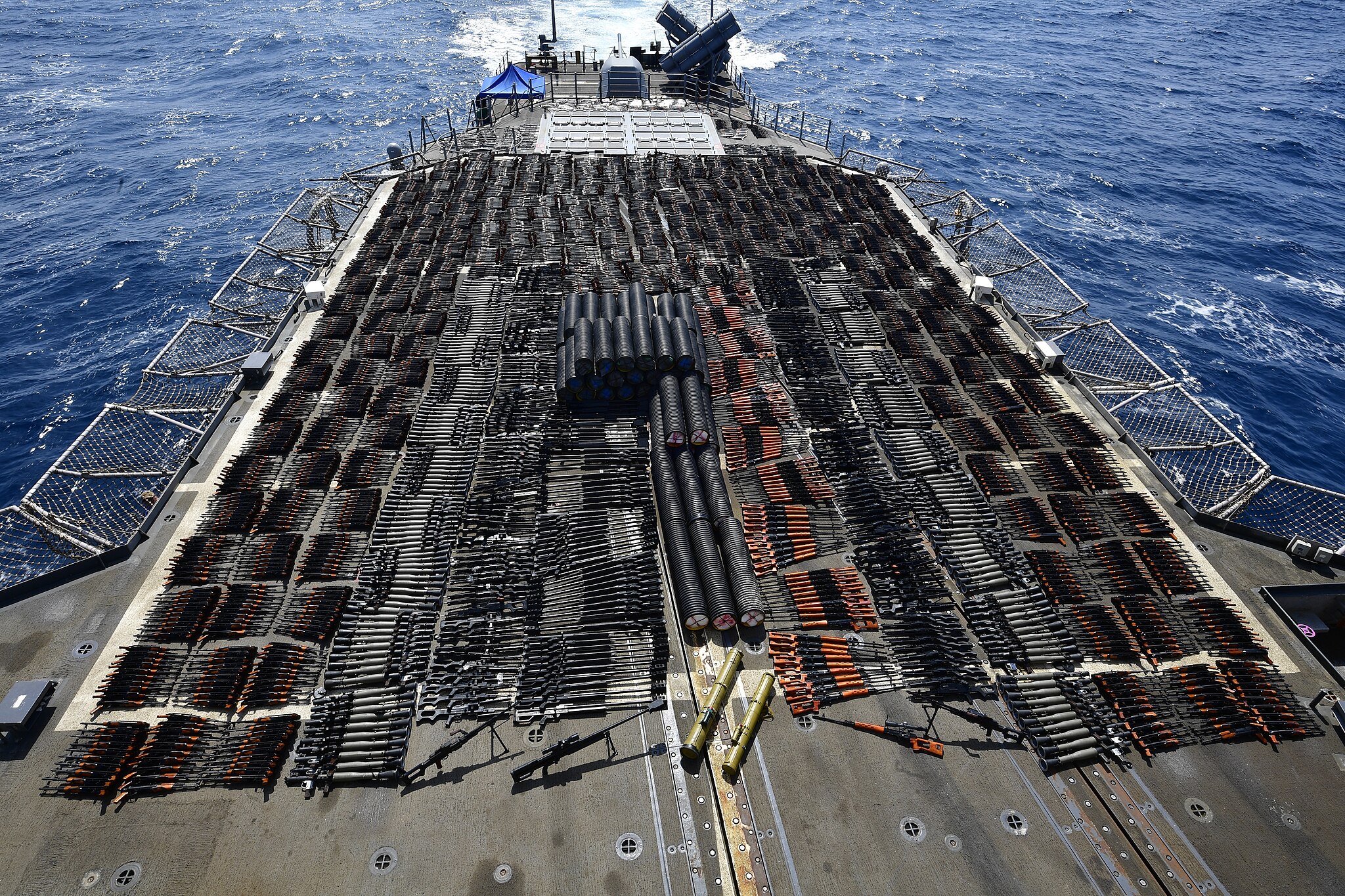
Illicit arms aboard the USS Monterey, of the Fifth Fleet, captured from a stateless dhow on May 8, 2021. Captured items include the Type 56-1 assault rifle, PKM machine gun, as well as other unidentified sniper rifles (clones of Steyr HS-50, likely AM-50 Sayyad owing to lack of Steyr markings and mediocre fit and finish), rocket launchers (RPG 7), and anti-tank guided missiles. United States Navy, Public domain

Share on LinkedInShare on Twitter

This analysis was written by Mr. Miralem Alic. I want to thank him for sharing his perspective and allowing this piece to be published. His work explores how open-source intelligence has reshaped a system once defined entirely by secrecy, exposing the mechanics of the global arms trade in a way few people ever witness firsthand. What follows is a clear, unfiltered look at how the world’s shadow markets are being transformed in real time.

The Collapse of Secrecy

For years I watched the world’s most profitable shadow industry operate with near-total impunity. Arms brokers in Vienna hotel suites, military officers routing money through Cypriot shells, Gulf fixers on Dubai yachts – everyone understood the only real capital was secrecy. Everyone knew the game was rigged in favor of those who controlled information. Information was power, and power was locked behind classification stamps, bribes, and satellite budgets only superpowers could afford.

Then the information democratized.

Not from some noble leak or crusading journalist, but from the coldest force on earth: someone figured out how to make money selling the view from orbit.

When Planet Labs started spitting out daily 3-meter imagery of every square kilometer on Earth, when AIS transponders became fifty-dollar toys, when teenagers in Kharkiv could geolocate a Buk launcher from the blur of a TikTok background, something fundamental snapped in the old order. The arms trade did not end. It mutated.

And it mutated faster than any of us thought possible.

Generals have been heard dismissing OSINT as “amateur hour” inside SCIFs, then two hours later using the exact same slides, pulled from a Dutch kid’s Twitter thread, to brief the Secretary of Defense. I have watched analysts present Maxar imagery and Flightradar24 tracks with a level of seriousness once reserved for classified collection. The truth is uglier and simpler: The black market still moves Kalashnikovs, Igla missiles, SA-18 systems and everything worse, but the old cloak of plausible deniability has been ripped to shreds.


When the World Started Watching

The numbers are merciless.

Between 2018 and 2024, the percentage of confirmed arms lifts to Syria first exposed by non-state OSINT went from roughly one in five to nearly nine in ten. That is not a Langley footnote. That comes from the ledgers of the men who actually unload the crates in Tartus. They know because hazard bonuses started arriving, not for American missiles, but for Bellingcat threads.

Think about what that does to a man.

Il-76, registration RA-78835, lifts off from Chkalovsky. In the old world we waited for a Keyhole pass or a paid source inside cargo handling. Now, before the gear is even up, some kid with the handle IntelCrab has pulled the hex code, matched the callsign history, and posted satellite shots of the same airframe loading 152 mm crates for Wagner in the Central African Republic six weeks earlier.

The plane still lands in Latakia. But now everyone knows.
The seller knows the buyer is being watched.
The insurer triples the war-risk premium.

And somewhere outside Damascus, a senior officer in the region who used to sleep like a baby now wakes in sweat because a bedroom analyst in Rotterdam just tied his offshore company to a small European financial institution that never imagined its Swift messages would end up on ImportGenius.

That is the real revolution. It is not that arms stopped moving. It is that the price of moving them has exploded, and the circle of players still willing to pay 2025 rates has shrunk to a merciless few.


Darkness Leaves Footprints

North Korea adapted first. After OSINT gutted the Cholima Star network in 2022, Pyongyang did not quit. They changed the physics. Ships now kill AIS two hundred miles off Wonsan, run dark for weeks, then reappear off Ust-Luga wearing fresh Panamanian colors and forged manifests for farm equipment.

Beautiful cruelty: darkness itself leaves footprints.
Synthetic aperture radar does not care about your silenced transponder. Umbra and Capella birds caught the ghost convoy in October 2024: six hulls in arrowhead formation, no lights, no signals, eighteen days of empty ocean followed by T-62 turrets peeking from under tarps in Rajin.

The intelligence cycle that once took three months and half a billion dollars now takes a Discord server twenty-four hours and whatever the top Patreon tier costs. I have seen old warriors spit on the phrase crowd-sourced intelligence right up to the day the crowd sourced the believed coordinates of Iran’s new Shahed-136 plant in Isfahan, down to the loading bay where the trucks reverse at 0300 every Tuesday. After that they just started saving the tweets.

A Royal Navy Merlin helicopter provides cover for Royal Marines from Fleet Protection Group Royal Marines(FPGRM) as they board a suspicious dhow.On 25th May 09 HMS CUMBERLAND deployed from Devonport to the Gulf of Aden and Horn of Africa region as part of the United Kingdom’s contribution to maritime security in the region.
These operations included counter-smuggling (arms and drugs), counter-terrorism and counter-piracy. CUMBERLAND’s newly installed Pacific 24 Rigid Hull Inflatable Boats (RHIBs) were key to these roles and allowed the Ship’s embarked Royal Marines and Royal Navy Boarding Teams, in conjunction with the Lynx aircraft, to intercept and board any vessels suspected of being involved in these activities. Photo: POA(PHOT) Sean Clee/MOD, OGL v1.0OGL v1.0

The Old Routes Are Dying

The arms trade is being re-engineered in real time.

Routes that survived forty years – Beirut to Aden via Djibouti, Odessa to Banias via the Bosporus – are now effectively dead. Too many eyes. New corridors open instead: overland through the Nimroz region into Iran, then dhows across the Gulf of Oman disguised as rice shipments. Or the Arctic lane: Murmansk to Sabetta, trans-polar to Petropavlovsk, where six months of ice still disrupts optical satellites.

But the ice is thinning, in every sense.

The new masters are not the traditional brokers. They are the obfuscation engineers: certain offshore structures designed to layer maritime fraud, single-voyage owners in Majuro, smaller regional insurers who never ask, Ukrainian crews who still need the money.

They are very good.
They are also doomed.

Every time they declare construction materials for Conakry, some kid in Auckland runs the deadweight hash through CargoMetrics and spots a two-thousand-one-hundred-ton discrepancy, exactly the float of four hundred containers of suspected 358 loitering munitions.


The Only Thing They Never Expected

The old world is dying in plain sight.
The middlemen who once skimmed eight to twelve percent are being culled like obsolete nobility watching gunpowder make castles irrelevant. The new kings are the data aggregators: Hawkeye 360, exactEarth, Windward, Spire.

And the new currency is no longer dollars wired to Cyprus.
It is the ability to maintain plausible deniability.

Because that, in the end, is what the arms trade has always sold: the luxury of killing at industrial scale while pretending your hands are clean.

OSINT has not stopped the killing.
It has simply made the blood visible from orbit.
And that, more than any sanction regime ever drafted, is the one thing the actors in the illicit arms market never saw coming.

Previous Post

The Iraq War’s Hidden Battle: How Logistics Shaped the Conflict’s Reality

Next Post

ITAR Spotlight: Why USML Categories I, III and VIII Sit At The Heart Of Defense Export Controls

Related Posts

Live firing of the Light Forces Anti-Tank Guided Weapon (LFATGW) Javelin.
Knowledge Base

Common Misconceptions About ITAR: What Organizations Should Actually Know

December 9, 2025
Iraqi Freedom
Knowledge Base

The Iraq War’s Hidden Battle: How Logistics Shaped the Conflict’s Reality

November 17, 2025
Why Blackwater existed: The logic behind outsourcing war and security
Knowledge Base

Why Blackwater existed: The logic behind outsourcing war and security

November 6, 2025
TE_2REI_Afghanistan French Foregin Legion
Knowledge Base

The French Foreign Legion After the Sahel: Where It Fits Now

October 29, 2025
The Montreux Document: Why It Still Matters for Security Work
Knowledge Base

The Montreux Document: Why It Still Matters for Security Work

September 26, 2025
Operation Enduring Freedom
Knowledge Base

What Exactly Is a Private Military Company (PMC)?

September 6, 2025
Next Post
ITAR Spotlight: Why USML Categories I, III and VIII Sit At The Heart Of Defense Export Controls

ITAR Spotlight: Why USML Categories I, III and VIII Sit At The Heart Of Defense Export Controls

  • Trending
  • Comments
  • Latest
Blackwater PMC

After Blackwater: How PMCs Evolved, Professionalized, and Fragmented

September 13, 2025
Blackwater PMC

Inside Iraq’s Security Market: How Private Power Shapes a Fragile State

October 6, 2025
Operation Enduring Freedom

What Exactly Is a Private Military Company (PMC)?

September 6, 2025
Repkon Nammo in Denmark: What This Nordic Ammunition Play Really Signals

Repkon Nammo in Denmark: What This Nordic Ammunition Play Really Signals

August 21, 2025
A Historic $142 Billion Arms Deal: Unpacking the U.S.-Saudi Agreement

A Historic $142 Billion Arms Deal: Unpacking the U.S.-Saudi Agreement

A Silent Revolution on the Battlefield: AI-Enabled Tactical Communication Systems

A Silent Revolution on the Battlefield: AI-Enabled Tactical Communication Systems

Cominf.org, CC BY-SA 3.0 , via Wikimedia Commons

Is Europe Really Reducing Its Dependence on Russian Gas?

What is ITAR? The Invisible Line in Global Defense Trade

What is ITAR? The Invisible Line in Global Defense Trade

Israel’s F-15 News: What Actually Happened, and Why It Matters

Israel’s F-15 News: What Actually Happened, and Why It Matters

January 1, 2026
SDF and HTS: Managing Tension Without Open Conflict in Northern Syria

SDF and HTS: Managing Tension Without Open Conflict in Northern Syria

December 26, 2025
What 2025 Taught Us About Defense and Energy: Five Lessons for 2026

What 2025 Taught Us About Defense and Energy: Five Lessons for 2026

December 24, 2025
The New Taiwan Arms Package and China’s “Stop” Message: What Actually Changed

The New Taiwan Arms Package and China’s “Stop” Message: What Actually Changed

December 19, 2025

Recent News

Israel’s F-15 News: What Actually Happened, and Why It Matters

Israel’s F-15 News: What Actually Happened, and Why It Matters

January 1, 2026
SDF and HTS: Managing Tension Without Open Conflict in Northern Syria

SDF and HTS: Managing Tension Without Open Conflict in Northern Syria

December 26, 2025
What 2025 Taught Us About Defense and Energy: Five Lessons for 2026

What 2025 Taught Us About Defense and Energy: Five Lessons for 2026

December 24, 2025
The New Taiwan Arms Package and China’s “Stop” Message: What Actually Changed

The New Taiwan Arms Package and China’s “Stop” Message: What Actually Changed

December 19, 2025
Drill & Defense

Drill & Defense is an independent platform providing insights into firearms, defense technologies, and energy sectors. We deliver clear, practical content for professionals, enthusiasts, and industry followers worldwide.

Follow Us

Browse by Category

  • Cross-Sector Insights
  • Defense
  • Defense & Energy Strategy
  • Defense Know-How
  • Defense Technologies
  • Energy
  • Energy Insight
  • Energy Technologies
  • Global Security & Trade Analysis
  • History & Legacy
  • Industry News
  • Knowledge Base
  • Legacy Systems & Structures
  • Market Trends & Analysis
  • Military Market Reports
  • Oil & Gas News
  • Resource Wars & Strategy
  • Tech & Innovation Crossover
  • Turning Points in Conflict
  • Weapon & Gear Reviews

Recent News

Israel’s F-15 News: What Actually Happened, and Why It Matters

Israel’s F-15 News: What Actually Happened, and Why It Matters

January 1, 2026
SDF and HTS: Managing Tension Without Open Conflict in Northern Syria

SDF and HTS: Managing Tension Without Open Conflict in Northern Syria

December 26, 2025

© 2025 Drill & Defense. All rights reserved. Independent insights on firearms, defense, and energy. For business inquiries: info@drillanddefense.com | PRIVACY POLICY | COOKIE POLICY | TERMS AND CONDITIONS

Manage Consent

We use cookies to improve your experience. You can accept or refuse cookies; however, some features may not function properly without your consent.

Functional Always active
The technical storage or access is strictly necessary for the legitimate purpose of enabling the use of a specific service explicitly requested by the subscriber or user, or for the sole purpose of carrying out the transmission of a communication over an electronic communications network.
Preferences
The technical storage or access is necessary for the legitimate purpose of storing preferences that are not requested by the subscriber or user.
Statistics
The technical storage or access that is used exclusively for statistical purposes. The technical storage or access that is used exclusively for anonymous statistical purposes. Without a subpoena, voluntary compliance on the part of your Internet Service Provider, or additional records from a third party, information stored or retrieved for this purpose alone cannot usually be used to identify you.
Marketing
The technical storage or access is required to create user profiles to send advertising, or to track the user on a website or across several websites for similar marketing purposes.
  • Manage options
  • Manage services
  • Manage {vendor_count} vendors
  • Read more about these purposes
View preferences
  • {title}
  • {title}
  • {title}
No Result
View All Result
  • Defense
    • Industry News
    • Weapon & Gear Reviews
    • Defense Technologies
    • Military Market Reports
  • Energy
    • Oil & Gas News
    • Energy Technologies
    • Market Trends & Analysis
  • Cross-Sector Insights
    • Defense & Energy Strategy
    • Global Security & Trade Analysis
    • Tech & Innovation Crossover
  • History & Legacy
    • Turning Points in Conflict
    • Legacy Systems & Structures
    • Resource Wars & Strategy
  • Knowledge Base
    • Defense Know-How
    • Energy Insight
  • About
  • Contact
  • Login
  • Register

© 2025 Drill & Defense. All rights reserved. Independent insights on firearms, defense, and energy. For business inquiries: info@drillanddefense.com | PRIVACY POLICY | COOKIE POLICY | TERMS AND CONDITIONS