

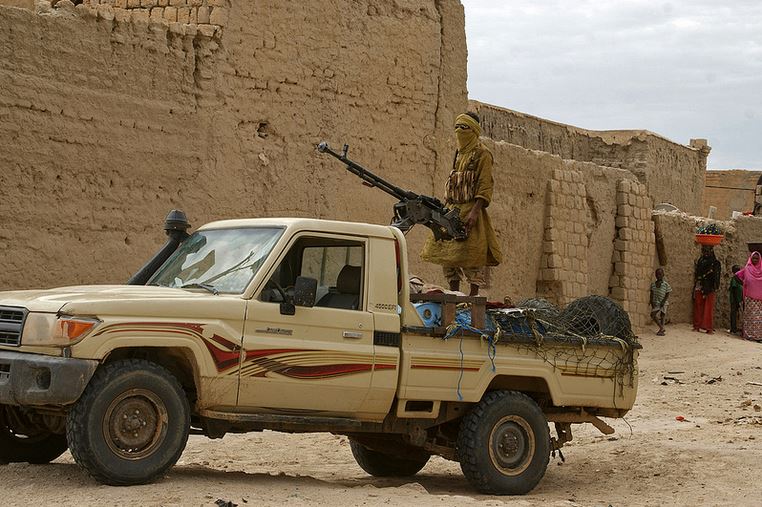
When you scroll through images from almost any modern conflict, one detail repeats itself so often that your brain stops registering it. Somewhere in the frame, behind the dust and the flags and the rifles, there is a familiar silhouette: a Toyota pick-up or Land Cruiser, emblematic of the role of Toyota in modern warzones. In this piece, I want to step back from the memes and clichés and look at why that image is so persistent and what it tells us about the kind of conflicts the world has been fighting for the last forty years.

From “Toyota War” to Today
The story is not just visual; it is historical. In 1986–87, during the conflict often called the “Toyota War,” Chadian forces used light Toyota pick-ups and Land Cruisers to outmaneuver Libyan armored units in the desert. Their mobility allowed them to destroy far more expensive tanks and aircraft across vast areas of northern Chad.
That conflict became a turning point. Instead of slow, heavy armored formations, small groups of fighters using fast civilian vehicles could outmaneuver traditional forces. It marked the rise of what many analysts describe as the global “pickup-truck era of warfare,” where mobile light forces play a decisive role in remote battlefields.
Toyota never designed the Hilux or Land Cruiser for warfare. They were intended for farms, mining sites and remote communities. Yet the very qualities that make them useful for ranchers or humanitarian convoys also make them attractive to armed actors.

Reliability as a Strategic Asset
If you speak with anyone who works in African bush operations, Middle Eastern oilfields or remote areas of Asia, the praise for the Land Cruiser is incredibly consistent.
It starts in the morning. It tolerates bad fuel. It can be repaired with basic tools.
Toyota’s own communication for humanitarian and disaster-relief partners emphasizes these traits. The company openly markets Land Cruisers as vehicles capable of operating in post-disaster areas and conflict-affected regions where roads are damaged and formal maintenance is scarce. When you approach this from a logistics perspective, reliability becomes a strategic resource. A platform that performs day after day under pressure becomes essential to whatever force is using it, whether that is a national army, a peacekeeping mission or a militia.
In regions where infrastructure is limited, the availability of spare parts is a major factor. Across much of Africa and the Middle East, the availability of Toyota parts creates a natural advantage. Entire informal repair networks exist around the Hilux and Land Cruiser, making them even more appealing in conflict zones.

Why Armed Groups Gravitate Toward Toyota
Researchers studying how militias and irregular forces choose vehicles often list several recurring factors.
Cost and Availability
Pick-ups are cheaper than purpose-built military vehicles and can be purchased through normal commercial channels. Investigations into the procurement habits of armed groups in Sudan, Somalia and parts of the Sahel repeatedly show the use of civilian dealerships to acquire large numbers of Toyota pick-ups before converting them into “technicals.”
Flexibility
The open bed of a pick-up is easy to modify. In different conflicts it has been used to carry medical supplies, fuel, wounded personnel, heavy machine guns, anti-aircraft weapons and improvised rocket systems. A single chassis can serve as a convoy escort one week and a mobile firing platform the next.
Mobility and Terrain Access
Four-wheel-drive trucks are light enough to cross weak bridges and narrow tracks, yet strong enough to handle deserts, mountains and savannas. In the dispersed, fast-moving battles that define many modern conflicts, mobility is a decisive advantage.
Another practical factor is visual ambiguity. A pick-up truck blends more easily into civilian traffic than an armored vehicle. This makes it useful for groups that want to operate without drawing unnecessary attention.
Not Just Militias: States and Humanitarians Rely on Them Too
It is important to maintain a balanced view. The same vehicles seen in footage of insurgent operations also appear in the fleets of humanitarian NGOs, medical relief teams, peacekeeping missions and national armies. Land Cruisers are common in UN convoys, disaster-response operations and remote medical outreach. They are equally common in conservation agencies, border patrol units and counter-poaching teams across East Africa. Even conventional state militaries deploy them. In the conflict in Ukraine, for example, pick-ups such as the Hilux have been used to move personnel quickly through dispersed artillery zones.
These vehicles are not symbols of one side or ideology. They are tools adopted across the entire spectrum of conflict and crisis response.

Symbolism and Unwanted Associations
Over time, repeated imagery creates its own narrative. When a brand appears frequently in violent environments, it becomes tied to those environments whether the company intends it or not. Commentators have compared the Toyota pick-up to the AK-47 in the sense that both became visual shorthand for irregular warfare.
Some articles explicitly describe Toyota pick-ups as “unexpected war machines,” highlighting how commercial vehicles take on new and unintended roles once introduced into unstable regions.
From a regulatory or corporate perspective, this raises challenging questions. Civilian vehicles often pass through multi-layered dealer networks, making end-use monitoring difficult. Meanwhile, governments examine how dual-use items like trucks or drones can be diverted into conflict, and what export controls can realistically prevent.
Toyota’s recurring presence in conflict zones therefore becomes a case study in the intersection of commercial markets, regulatory systems and modern warfare.

What the Toyota Phenomenon Reveals About Contemporary Conflict
Seen from a distance, Toyota’s dominance in warzones is less about brand superiority and more about how today’s conflicts are fought.
Modern conflicts are typically fought in remote areas with poor infrastructure, driven by both state and non-state actors, characterized by rapid mobility rather than fixed front lines, and shaped by dispersed units rather than large armored formations.
In such environments, mobility, reliability and improvisation often matter more than armor or advanced electronics. A vehicle that starts reliably, handles rough terrain, accepts low-grade fuel and carries everything from ammunition to evacuees naturally becomes essential.
Toyota built such vehicles at scale, and did so early enough that entire regional ecosystems developed around them. Mechanics, spare-part suppliers, second-hand markets and driver familiarity all reinforce the cycle. Other brands produce capable 4×4 trucks, but in many conflict-affected regions, Toyota is the default option because the support network already exists.
For analysts and observers, the global spread of Toyota pick-ups in warzones is a reminder that war is influenced not just by strategic decisions and weapons systems but also by practical realities. The availability of spare parts, the simplicity of repairs and the resilience of a single truck platform can shape how a conflict unfolds.
Toyota did not choose this role. Yet through a combination of engineering philosophy, global distribution and the logistical demands of modern warfare, it has become one of the defining images of twenty-first-century conflict.
References
Encyclopedic summaries and analysis on the 1986–1987 Chadian–Libyan conflict.
Historical reviews of mobility-based tactics in desert warfare.
Investigative reporting on the procurement of civilian pick-ups by armed groups.
Automotive and regional analyses of Land Cruiser reliability in remote environments.
Reports on humanitarian and state use of Toyota vehicles in conflict-affected areas.
Coverage of pick-up deployment in the Ukraine conflict.