
Drill & Defense
Advertisement
  • Defense
    • Industry News
    • Weapon & Gear Reviews
    • Defense Technologies
    • Military Market Reports
  • Energy
    • Oil & Gas News
    • Energy Technologies
    • Market Trends & Analysis
  • Cross-Sector Insights
    • Defense & Energy Strategy
    • Global Security & Trade Analysis
    • Tech & Innovation Crossover
  • History & Legacy
    • Turning Points in Conflict
    • Legacy Systems & Structures
    • Resource Wars & Strategy
  • Knowledge Base
    • Defense Know-How
    • Energy Insight
  • About
  • Contact
  • Login
  • Register
No Result
View All Result
  • Defense
    • Industry News
    • Weapon & Gear Reviews
    • Defense Technologies
    • Military Market Reports
  • Energy
    • Oil & Gas News
    • Energy Technologies
    • Market Trends & Analysis
  • Cross-Sector Insights
    • Defense & Energy Strategy
    • Global Security & Trade Analysis
    • Tech & Innovation Crossover
  • History & Legacy
    • Turning Points in Conflict
    • Legacy Systems & Structures
    • Resource Wars & Strategy
  • Knowledge Base
    • Defense Know-How
    • Energy Insight
  • About
  • Contact
  • Login
  • Register
No Result
View All Result
Drill & Defense
No Result
View All Result
Home History & Legacy

Operation Urgent Fury: The 1983 Grenada Intervention and the Lessons of a Rapid Military Intervention

March 6, 2026
in History & Legacy, Turning Points in Conflict
Operation Urgent Fury: The 1983 Grenada Intervention and the Lessons of a Rapid Military Intervention

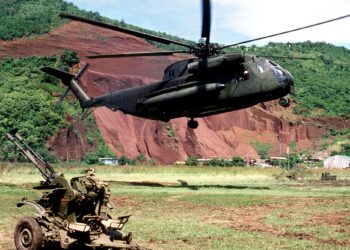
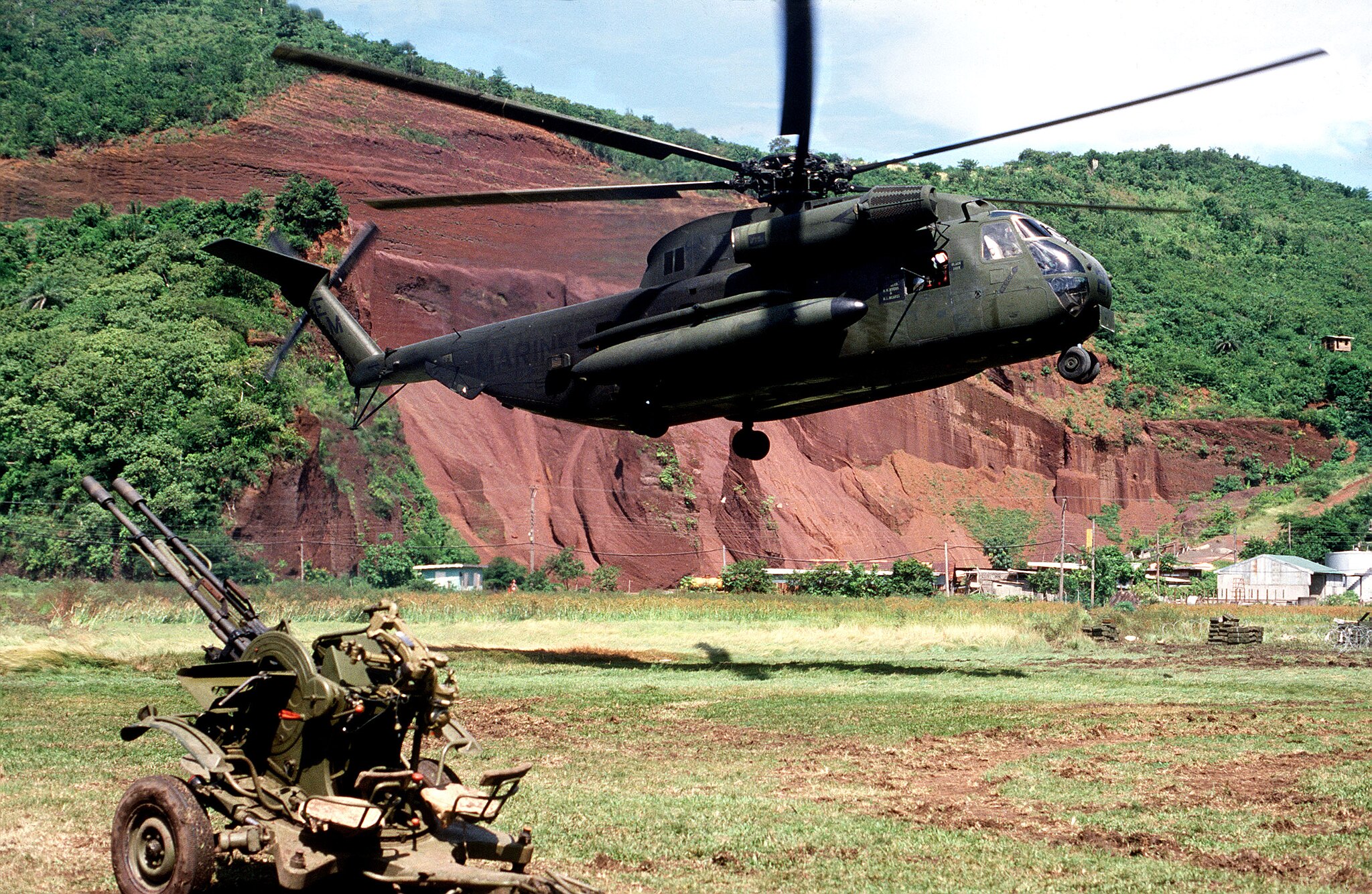
A U.S. Marine Corps Sikorsky CH-53D Sea Stallion helicopter hovers above the ground near a Soviet ZU-23 anti-aircraft weapon prior to picking it up during "Operation Urgent Fury", the U.S. invasion of Grenada in October 1983. The Sea Stallion was from Marine medium helicopter squadron HMM-261 Raging Bulls, which was deployed aboard the helicopter carrier USS Guam (LPH-9).

Share on LinkedInShare on Twitter

In military history, some conflicts reshape entire regions. Others, though far smaller, reveal something equally important: how modern militaries operate, improvise, and adapt under pressure. Operation Urgent Fury, the United States–led intervention in Grenada in October 1983, belongs firmly in the second category.

For analysts and defense observers, it remains one of the most interesting Cold War operations. Not because of its scale, but because of what it exposed about rapid intervention, joint operations, intelligence limitations, and the political realities of military action.

Today, when we examine expeditionary operations and crisis interventions, Grenada still offers useful lessons.

The Crisis That Led to Intervention

Grenada in the early 1980s was a small Caribbean island state, but its political trajectory placed it directly within the Cold War geopolitical landscape. In 1979 the New Jewel Movement, led by Maurice Bishop, overthrew the existing government and established a revolutionary administration that developed close ties with Cuba and the Soviet Union.

For Washington, this raised concerns about the possibility of a Soviet-aligned foothold in the Caribbean. The island’s cooperation with Cuba, including the construction of a large airfield at Point Salines with Cuban assistance, intensified those fears. From a strategic perspective, American policymakers viewed the airport as a potential dual-use facility that could support military operations in the region.

The situation escalated dramatically in October 1983 when internal tensions within the revolutionary government culminated in a coup. Bishop was placed under house arrest and later executed along with several members of his cabinet after a confrontation between factions within the ruling movement. A military council led by General Hudson Austin imposed strict curfews and effectively took control of the island.

Regional governments reacted quickly. Leaders from the Organization of Eastern Caribbean States requested outside assistance to stabilize the situation. Around the same time, several hundred American medical students studying on the island became a major concern for U.S. policymakers.

These factors together created the political and strategic context that led to Operation Urgent Fury.
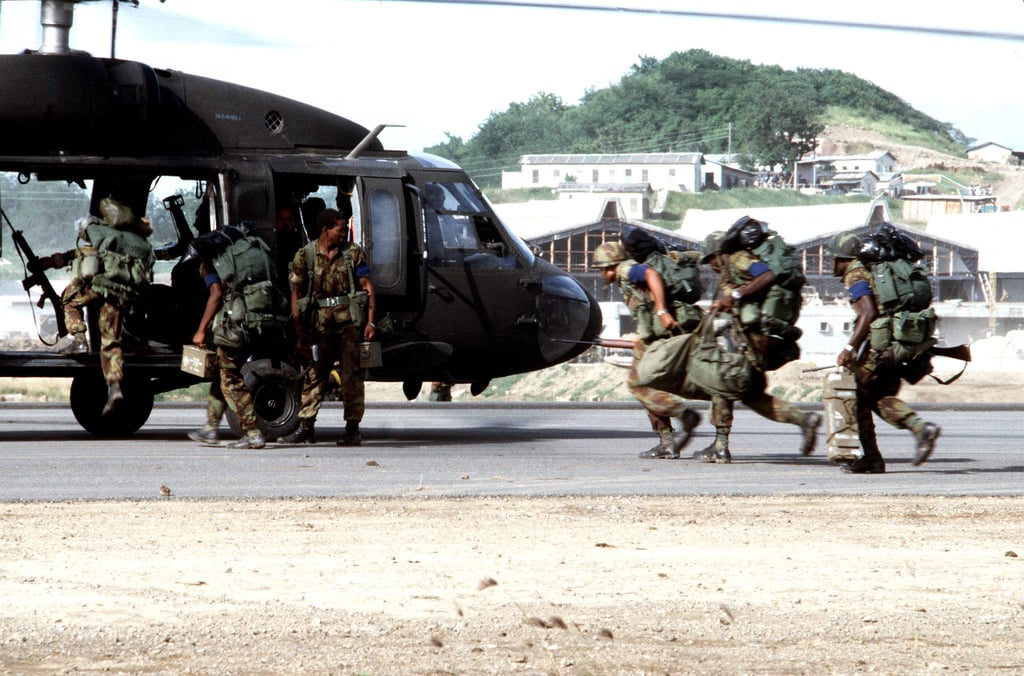
Members of the Eastern Caribbean Defense Force board a UH-60 Black Hawk helicopter during Operation Urgent Fury, on October 25, 1983.

The Launch of Operation Urgent Fury

In the early hours of 25 October 1983, U.S. and Caribbean forces began the intervention. It became the largest American military action since the end of the Vietnam War.

Approximately 7,600 personnel from the United States, supported by several hundred troops from Caribbean states, participated in the operation. The force included Army Rangers, elements of the 82nd Airborne Division, U.S. Marines, Navy SEAL teams, and various special operations units.

The initial objective was straightforward but operationally demanding: secure the island’s airfields and key infrastructure before organized resistance could consolidate.
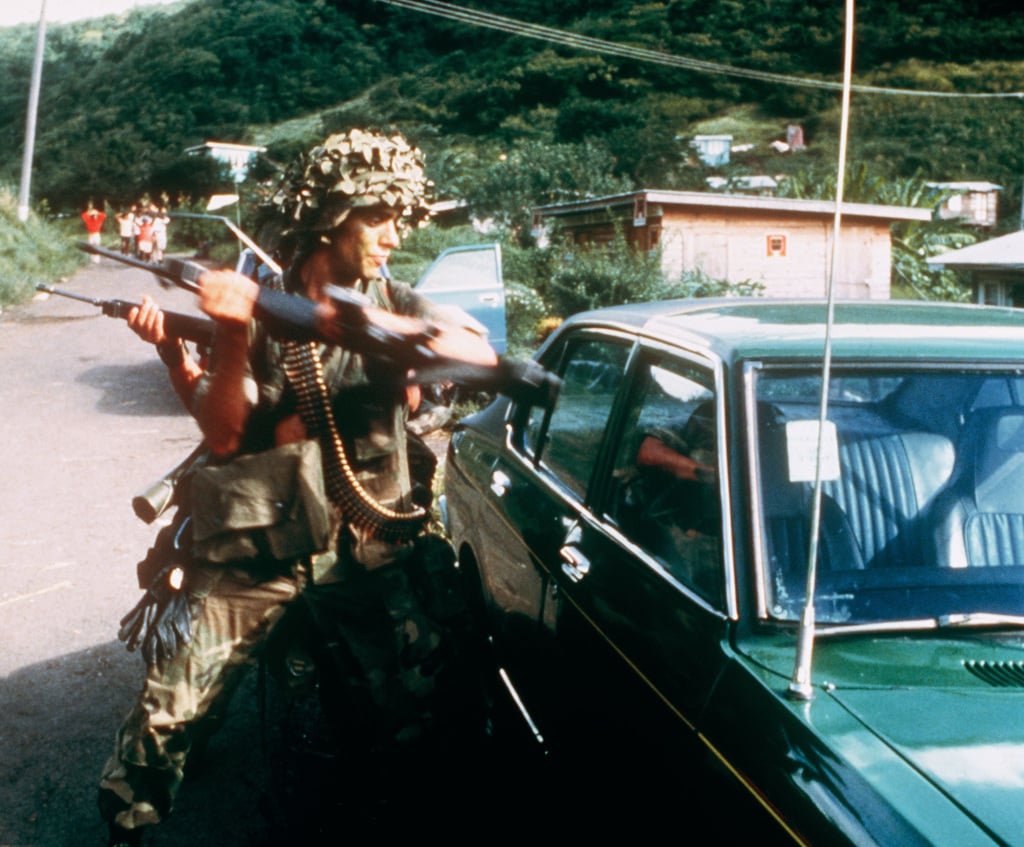
Members of the 82nd Airborne Division using their rifle butts to break into a car in search for bombs during Operation Urgent Fury, on October 25, 1983.

Army Rangers conducted low-altitude parachute assaults on Point Salines Airport, one of the most strategically important targets on the island. At the same time, Marines approached the northern Pearls Airport by helicopter and amphibious insertion. Special operations units carried out missions aimed at securing communications sites and locating Grenada’s governor-general, Sir Paul Scoon.

Within hours, several key installations were under coalition control, allowing follow-on forces from the 82nd Airborne Division to be flown in to reinforce the operation.

Resistance and Unexpected Difficulties

Despite the small size of the island, the operation did not unfold without complications.

Grenadian forces, supported by Cuban personnel present on the island, resisted in several locations. Cuban construction workers and advisers, some of whom were armed, participated in defensive positions near the airfields and other strategic sites. While the defending forces were much smaller in number, their resistance slowed the initial advance in several areas.

Operational challenges also emerged quickly. Intelligence about the island was limited. In some cases, troops reportedly relied on tourist maps rather than detailed military charts. Communications between different branches of the U.S. military were not always compatible, which created coordination problems during the early stages of the operation.

Special operations missions also encountered difficulties. One Navy SEAL insertion faced severe weather conditions, resulting in the loss of several personnel during a maritime insertion attempt.

These moments highlight a recurring reality in military operations: even relatively small conflicts can expose significant logistical and coordination challenges.
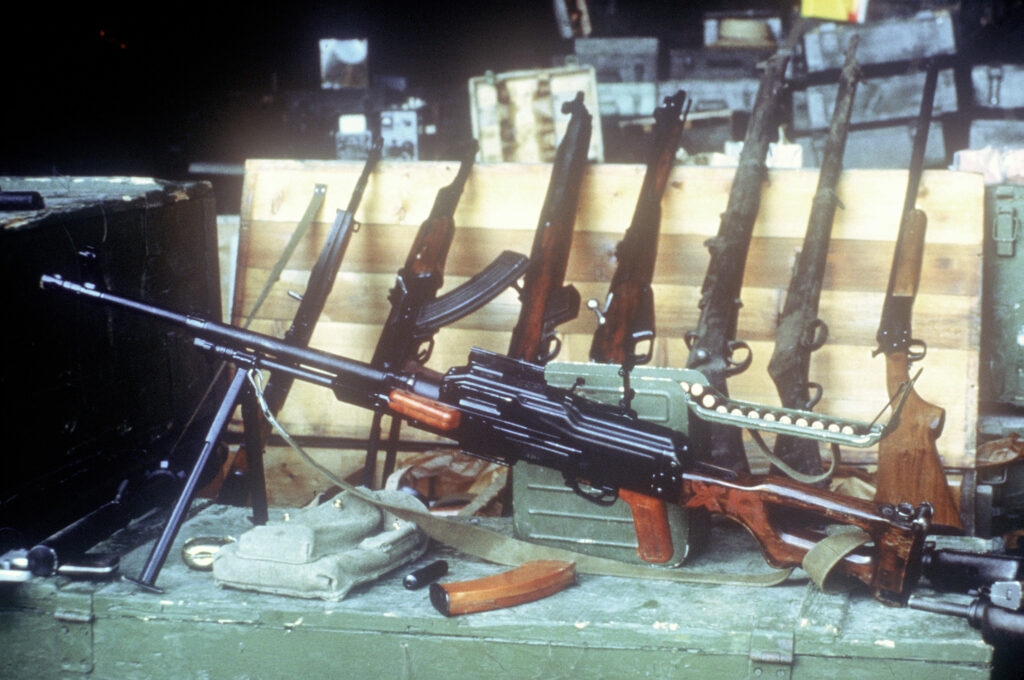
A Soviet-made 7.62mm PKM light machine gun and other weapons seized during Operation Urgent Fury.

Rapid Military Outcome

Despite these complications, the overall military outcome was decided relatively quickly.

Coalition forces maintained overwhelming air and naval superiority, allowing them to reinforce positions and limit the ability of defenders to regroup. Within a few days, organized resistance on the island had largely collapsed.

Grenadian military units began to disperse, and many soldiers abandoned their positions. Cuban personnel who had been captured during the fighting were eventually repatriated.
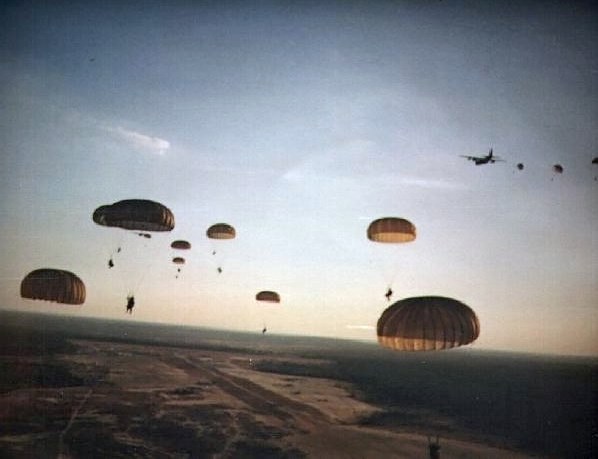
U.S. Army Rangers parachute into Grenada during Operation Urgent Fury

By early November 1983, major combat operations had ended. The military government that had taken power during the coup was removed, and an interim political structure was established until elections could be held the following year.

The casualty figures remained relatively limited compared with many other conflicts. U.S. forces suffered 19 killed and more than 100 wounded. Grenadian and Cuban forces experienced higher casualties, while several civilians were also killed during the fighting.

The operation lasted only a little over a week, yet its strategic consequences would extend far beyond the island itself.

Strategic Lessons from a Small War

Operation Urgent Fury is often remembered as a quick victory, but analysts tend to focus more on what the operation revealed about military organization and coordination.

One of the most significant outcomes was the exposure of serious communication and interoperability problems between different branches of the U.S. armed forces. Units sometimes lacked compatible radio systems, and coordination between services proved more difficult than expected.

These issues contributed to broader discussions within the U.S. defense establishment about joint command structures. In the years following the operation, the lessons from Grenada played a role in the development of reforms designed to improve inter-service coordination.

Another lesson involved intelligence preparation. The lack of accurate maps and situational awareness demonstrated the importance of reliable intelligence and planning even in relatively small operations.

From a broader perspective, Grenada also showed how quickly regional crises can escalate into international military interventions during periods of geopolitical tension.

A Cold War Episode with Lasting Relevance

From a purely military standpoint, Operation Urgent Fury was brief. Yet the operation continues to appear in discussions about expeditionary warfare, crisis response, and joint military operations.

Small conflicts often reveal realities that larger wars obscure. They highlight the practical challenges faced by units on the ground: communication, logistics, intelligence, and coordination.

Grenada in 1983 reminds us that even operations against limited opposition can expose vulnerabilities and trigger institutional change.

For analysts observing modern interventions, that lesson remains just as relevant today.


Sources

Encyclopaedia Britannica
U.S. Army Center of Military History
Army University Press – Military Review

Previous Post

Has Israel Adopted the Pro Active Preventive (PAP) Doctrine?

Related Posts

The Battle of Mogadishu: A Strategic Review of Operation Gothic Serpent
History & Legacy

The Battle of Mogadishu: A Strategic Review of Operation Gothic Serpent

February 26, 2026
The Uzi: Inside the Story of Israel’s Legendary SMG
History & Legacy

The Uzi: Inside the Story of Israel’s Legendary SMG

February 25, 2026
The Cold War and the Strategic Depth of the Space Race
History & Legacy

The Cold War and the Strategic Depth of the Space Race

February 23, 2026
Grozny: When A City Becomes A Test For Modern War
History & Legacy

Grozny: When A City Becomes A Test For Modern War

February 19, 2026
Dwight D. Eisenhower: Strategic Architecture at the Intersection of Defense and Energy Security
History & Legacy

Dwight D. Eisenhower: Strategic Architecture at the Intersection of Defense and Energy Security

February 9, 2026
Kenya 2002: When the Missile Misses
History & Legacy

Kenya 2002: When the Missile Misses

February 5, 2026
  • Trending
  • Comments
  • Latest
Blackwater PMC

After Blackwater: How PMCs Evolved, Professionalized, and Fragmented

September 13, 2025
Blackwater PMC

Inside Iraq’s Security Market: How Private Power Shapes a Fragile State

October 6, 2025
Operation Enduring Freedom

What Exactly Is a Private Military Company (PMC)?

September 6, 2025
FeisalPartyAtVersaillesCopy

T. E. Lawrence: Strategic Influence, Cultural Depth, and the Enduring Architecture of a Legacy

January 26, 2026
A Historic $142 Billion Arms Deal: Unpacking the U.S.-Saudi Agreement

A Historic $142 Billion Arms Deal: Unpacking the U.S.-Saudi Agreement

A Silent Revolution on the Battlefield: AI-Enabled Tactical Communication Systems

A Silent Revolution on the Battlefield: AI-Enabled Tactical Communication Systems

Cominf.org, CC BY-SA 3.0 , via Wikimedia Commons

Is Europe Really Reducing Its Dependence on Russian Gas?

What is ITAR? The Invisible Line in Global Defense Trade

What is ITAR? The Invisible Line in Global Defense Trade

Operation Urgent Fury: The 1983 Grenada Intervention and the Lessons of a Rapid Military Intervention

Operation Urgent Fury: The 1983 Grenada Intervention and the Lessons of a Rapid Military Intervention

March 6, 2026
Has Israel Adopted the Pro Active Preventive (PAP) Doctrine?

Has Israel Adopted the Pro Active Preventive (PAP) Doctrine?

March 5, 2026
2048px-U_S_Forces_Launch_Operation_Epic_Fury_(9542616)

Carrier Strike Power: Super Hornet, Hawkeye, JDAM and the Mechanics of Modern Air Operations

March 4, 2026
The Warfare Doctrine of Eliminations inthe Opening Strikes of Military Conflicts

The Warfare Doctrine of Eliminations inthe Opening Strikes of Military Conflicts

March 3, 2026

Recent News

Operation Urgent Fury: The 1983 Grenada Intervention and the Lessons of a Rapid Military Intervention

Operation Urgent Fury: The 1983 Grenada Intervention and the Lessons of a Rapid Military Intervention

March 6, 2026
Has Israel Adopted the Pro Active Preventive (PAP) Doctrine?

Has Israel Adopted the Pro Active Preventive (PAP) Doctrine?

March 5, 2026
2048px-U_S_Forces_Launch_Operation_Epic_Fury_(9542616)

Carrier Strike Power: Super Hornet, Hawkeye, JDAM and the Mechanics of Modern Air Operations

March 4, 2026
The Warfare Doctrine of Eliminations inthe Opening Strikes of Military Conflicts

The Warfare Doctrine of Eliminations inthe Opening Strikes of Military Conflicts

March 3, 2026
Drill & Defense

Drill & Defense is an independent platform providing insights into firearms, defense technologies, and energy sectors. We deliver clear, practical content for professionals, enthusiasts, and industry followers worldwide.

Follow Us

Browse by Category

  • Cross-Sector Insights
  • Defense
  • Defense & Energy Strategy
  • Defense Know-How
  • Defense Technologies
  • Energy
  • Energy Insight
  • Energy Technologies
  • Global Security & Trade Analysis
  • History & Legacy
  • Industry News
  • Knowledge Base
  • Legacy Systems & Structures
  • Market Trends & Analysis
  • Military Market Reports
  • Oil & Gas News
  • Resource Wars & Strategy
  • Tech & Innovation Crossover
  • Turning Points in Conflict
  • Weapon & Gear Reviews

Recent News

Operation Urgent Fury: The 1983 Grenada Intervention and the Lessons of a Rapid Military Intervention

Operation Urgent Fury: The 1983 Grenada Intervention and the Lessons of a Rapid Military Intervention

March 6, 2026
Has Israel Adopted the Pro Active Preventive (PAP) Doctrine?

Has Israel Adopted the Pro Active Preventive (PAP) Doctrine?

March 5, 2026

© 2026 Drill & Defense. All rights reserved. Independent insights on firearms, defense, and energy. For business inquiries: info@drillanddefense.com | PRIVACY POLICY | COOKIE POLICY | TERMS AND CONDITIONS

Manage Consent

We use cookies to improve your experience. You can accept or refuse cookies; however, some features may not function properly without your consent.

Functional Always active
The technical storage or access is strictly necessary for the legitimate purpose of enabling the use of a specific service explicitly requested by the subscriber or user, or for the sole purpose of carrying out the transmission of a communication over an electronic communications network.
Preferences
The technical storage or access is necessary for the legitimate purpose of storing preferences that are not requested by the subscriber or user.
Statistics
The technical storage or access that is used exclusively for statistical purposes. The technical storage or access that is used exclusively for anonymous statistical purposes. Without a subpoena, voluntary compliance on the part of your Internet Service Provider, or additional records from a third party, information stored or retrieved for this purpose alone cannot usually be used to identify you.
Marketing
The technical storage or access is required to create user profiles to send advertising, or to track the user on a website or across several websites for similar marketing purposes.
  • Manage options
  • Manage services
  • Manage {vendor_count} vendors
  • Read more about these purposes
View preferences
  • {title}
  • {title}
  • {title}
No Result
View All Result
  • Defense
    • Industry News
    • Weapon & Gear Reviews
    • Defense Technologies
    • Military Market Reports
  • Energy
    • Oil & Gas News
    • Energy Technologies
    • Market Trends & Analysis
  • Cross-Sector Insights
    • Defense & Energy Strategy
    • Global Security & Trade Analysis
    • Tech & Innovation Crossover
  • History & Legacy
    • Turning Points in Conflict
    • Legacy Systems & Structures
    • Resource Wars & Strategy
  • Knowledge Base
    • Defense Know-How
    • Energy Insight
  • About
  • Contact
  • Login
  • Register

© 2026 Drill & Defense. All rights reserved. Independent insights on firearms, defense, and energy. For business inquiries: info@drillanddefense.com | PRIVACY POLICY | COOKIE POLICY | TERMS AND CONDITIONS