
Energy has once again become the world’s favorite balancing act — a stage where oil, geopolitics, renewables, and ambitious technological dreams collide. If you’ve been tracking the headlines lately, you’ll know that recent Middle Eastern tensions have sent oil prices back on a steep climb. But beneath the market’s daily swings, something deeper is at play: our collective push toward resilience and cleaner power.

Oil Prices Spike: Why the World Is Watching the Middle East
The renewed conflict between Israel and Iran has shaken traders’ nerves once again. Last month, Brent crude futures jumped more than 4% overnight, hitting prices that hadn’t been seen since early this year. Some estimates suggest that, if the Strait of Hormuz — a vital oil artery — were blocked, the cost per barrel could leap beyond $100, even $110.
It’s not just speculation. Iran’s parliament has openly discussed closing the Strait in response to the strikes on its nuclear sites. For context, about 20% of all seaborne oil moves through that narrow channel. It’s a stark reminder that no matter how much we diversify energy, the global economy is still anchored to fossil fuels when it comes to transport and heavy industry.
Analysts, from Reuters to Business Insider, highlight the same fragile truth: supply remains fairly steady for now, but geopolitics can upset any balance overnight. Inventories have grown this quarter and non-OPEC producers are keeping output solid. Yet fear alone is enough to rattle prices — and rattle governments planning their energy security strategies.
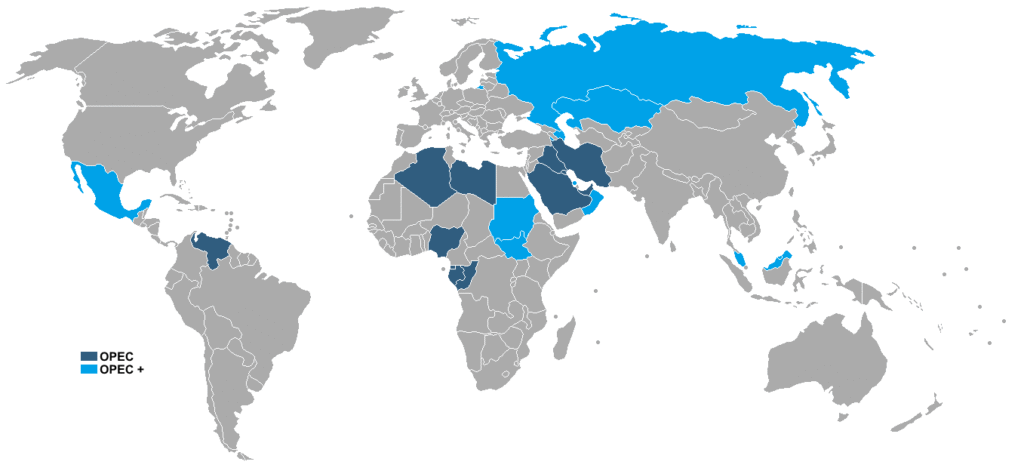
Map of OPEC members and OPEC+ countries. Caspian Delta, CC BY-SA 4.0 https://creativecommons.org/licenses/by-sa/4.0, via Wikimedia Commons
OPEC+ Walks a Tightrope: More Oil, or Not Enough?
Amid this tension, OPEC+ is walking a tightrope. After three consecutive months of output increases, the group has signaled it may push production even higher for August. For energy-hungry regions like Asia, the signs are clear: Saudi Arabia is set to raise its official selling prices to Asia to a four-month high, showing how demand — and competition — stay fierce.
But the market is watching for cracks. According to MarketWatch, the natural decline of older oil wells and a slowdown in U.S. shale output could limit just how much “extra” oil the world can squeeze out. So, the paradox is striking: even as we talk about oversupply, natural declines may quietly balance the books behind the scenes.
It’s a moment where any trader or policy maker can see how fragile the entire setup is. A single pipeline sabotage, a sudden sanction, a surprise embargo — and the conversation shifts overnight. That’s why so many countries now view energy diversification not just as a climate goal, but as a national security priority.
The $3.3 Trillion Question: Can Clean Energy Fill the Gap?
While oil headlines grab the drama, there’s an equally important story shaping the next decade: record-breaking investment in clean energy. According to the International Energy Agency, global energy investment is expected to hit $3.3 trillion this year — the highest ever recorded. What’s more remarkable is that nearly two-thirds of this sum is flowing into low-carbon technologies.
Governments and industries alike are pouring capital into renewables, nuclear, grid upgrades, storage, and low-emission fuels. The reasons are clear. First, renewables are now cost-competitive with fossil fuels in many regions. Second, the war in Ukraine and now the Israel–Iran tensions have reminded policymakers how exposed their economies can be when fossil fuel flows are threatened. And third, customers and investors increasingly demand real sustainability action, not just promises.
But the energy transition isn’t a switch you can flip overnight. Even with historic investment, bridging the gap between legacy infrastructure and future systems will take years — maybe decades. The clean energy surge must be accompanied by smarter grids, flexible storage, and bold new technologies that push us beyond today’s constraints.
Fusion Energy: From Science Fiction to Corporate Strategy
One of the most unexpected developments came from Silicon Valley. Google has just signed what’s being called the largest corporate power purchase agreement for fusion energy, partnering with Commonwealth Fusion Systems. The deal secures a promise of 200 MW of future electricity — from a fusion plant that hasn’t yet been built, and won’t likely switch on until the early 2030s.
Why would Google invest in something so futuristic? It’s partly a bet on zero-carbon, limitless baseload power. But it’s also a hedge. As data centers and AI computing loads explode, Big Tech is racing to secure reliable clean energy sources that won’t blow up their carbon footprints.
It’s worth noting that this is not just a feel-good PR move. Commonwealth Fusion is one of the leading companies in the global race to make fusion commercially viable, supported by major investors and a growing body of successful tests. Still, even the most optimistic scenarios see large-scale fusion power as a reality in the next decade at best. Until then, firms will need to juggle conventional renewables, efficiency upgrades, and interim solutions.
Navigating the Double Reality: Oil Still Matters, but So Does Innovation
For business leaders, policymakers, and anyone working in energy, the message is clear: we’re living in a double reality. Oil isn’t going away tomorrow. Even with the best intentions, the world still needs it to keep wheels turning and factories humming. Geopolitical shocks can send markets into a frenzy overnight, reminding us just how brittle the old system can be.
Yet, at the same time, the shift toward clean, resilient systems is no longer a niche project. It’s a massive global business priority. The companies and governments who plan wisely — diversifying supply chains, investing in new technologies, hedging short-term price swings while building long-term resilience — will come out ahead.
It’s tempting to see this as a conflict: oil vs. renewables, old vs. new. But in reality, they’re running parallel for now. They’ll overlap and interact for decades. That’s why clear-eyed strategy is more valuable than ever.
What Should Your Next Move Be?
If you’re a stakeholder in this complex puzzle — a manufacturer, a trader, an investor, or simply an observer with skin in the game — now is the moment to ask tough questions:
- Are you prepared for sudden supply shocks or price spikes?
- Have you explored new partnerships or technologies that can help your operations adapt?
- Is your energy portfolio balanced between what you need today and what you’ll need tomorrow?
At the same time, look out for opportunities: new cross-border deals, innovative grid projects, and long-term clean energy commitments like Google’s. They may not deliver immediate returns, but they’re the seeds of a more resilient future.
Final Thoughts
When the headlines scream about conflict, oil prices, and shortages, it’s easy to panic. But beneath the noise, the big story is clear: the world is trying to build a more flexible, sustainable energy system, piece by piece. It won’t happen overnight — but every investor, every policy, and every technological leap brings us closer.
As ever, the smartest players won’t just chase the next spike in the market. They’ll hedge, innovate, and plan — because in energy, today’s turbulence is only part of the bigger picture.
References
- Oil price surges amid Israel–Iran conflict
- Iran’s parliament votes to close the Strait of Hormuz
- Reuters on OPEC+ August output hike
- Saudi Arabia’s 4‑month high pricing
- MarketWatch on supply declines versus oversupply doubt