
Drill & Defense
Advertisement
  • Defense
    • Industry News
    • Weapon & Gear Reviews
    • Defense Technologies
    • Military Market Reports
  • Energy
    • Oil & Gas News
    • Energy Technologies
    • Market Trends & Analysis
  • Cross-Sector Insights
    • Defense & Energy Strategy
    • Global Security & Trade Analysis
    • Tech & Innovation Crossover
  • History & Legacy
    • Turning Points in Conflict
    • Legacy Systems & Structures
    • Resource Wars & Strategy
  • Knowledge Base
    • Defense Know-How
    • Energy Insight
  • About
  • Contact
  • Login
  • Register
No Result
View All Result
  • Defense
    • Industry News
    • Weapon & Gear Reviews
    • Defense Technologies
    • Military Market Reports
  • Energy
    • Oil & Gas News
    • Energy Technologies
    • Market Trends & Analysis
  • Cross-Sector Insights
    • Defense & Energy Strategy
    • Global Security & Trade Analysis
    • Tech & Innovation Crossover
  • History & Legacy
    • Turning Points in Conflict
    • Legacy Systems & Structures
    • Resource Wars & Strategy
  • Knowledge Base
    • Defense Know-How
    • Energy Insight
  • About
  • Contact
  • Login
  • Register
No Result
View All Result
Drill & Defense
No Result
View All Result
Home Cross-Sector Insights

Israel’s F-15 News: What Actually Happened, and Why It Matters

January 1, 2026
in Cross-Sector Insights, Global Security & Trade Analysis
Israel’s F-15 News: What Actually Happened, and Why It Matters

Eight Israeli Air Force F-15I Ra'am strike fighter jets of 69 Squadron "Hammers" at Hatzerim Airbase high above Israel on their way to attack Iran in mid June 2025.  / IDF Spokesperson's Unit

Share on LinkedInShare on Twitter

If you have been seeing headlines that sound like “Israel has received F-15s,” you are not alone. The wording has been loose in a lot of social media reposts, and even some commentary has treated this as a near-term delivery event.

What happened is still significant, but it is different in a way that matters for strategy, timelines, and capability planning.

At the end of December 2025, the U.S. Department of Defense announced a major contract tied to Israel’s next F-15 variant, the F-15IA. The announcement describes a program that covers design, integration, testing, production, and delivery of 25 aircraft, with an option for 25 more. The work is expected to run through 2035, and reporting based on official notices indicates deliveries are planned to begin in 2031.

So the real headline is not “jets arrived,” but “the program moved into execution with a funded contract framework and an approved Foreign Military Sales pathway.” That is a quieter sentence, but it is the one that tells you how to read the next decade of Israeli airpower decisions.

The F-15IA in plain terms

The F-15IA is widely described as an Israel-specific version of Boeing’s newest F-15EX line, adapted to Israeli requirements. In other words, this is not a legacy F-15 pulled off a shelf. It is a modernized Eagle-family aircraft, intended to carry heavy payloads at range, and to remain relevant deep into the 2030s.

This matters because Israel already operates multiple F-15 variants, including the F-15I Ra’am strike aircraft. The F-15IA program is best read as a forward-looking recapitalization decision: keeping a heavy strike “Eagle” pillar alive alongside a stealth pillar, rather than betting everything on one aircraft concept.

An F-15EX Eagle II from the 40th Flight Test Squadron, 96th Test Wing out of Eglin Air Force Base, Florida, flies in formation during an aerial refueling operation above the skies of Northern California, May 14. The Eagle II participated in the Northern Edge 21 exercise in Alaska earlier in May. (Air Force photo by Ethan Wagner)

Why a heavy strike fighter still has a seat at the table

There is a recurring assumption in popular defense discussion: stealth equals future, everything else is legacy. In practice, air forces that expect prolonged operational tempo tend to build force mixes, not single-platform solutions.

A heavy strike fighter remains useful for reasons that are bluntly logistical.

First, payload. Not every mission is about being invisible. Some missions are about carrying more munitions per sortie, sustaining pressure, and reducing the number of aircraft needed to achieve an effect.
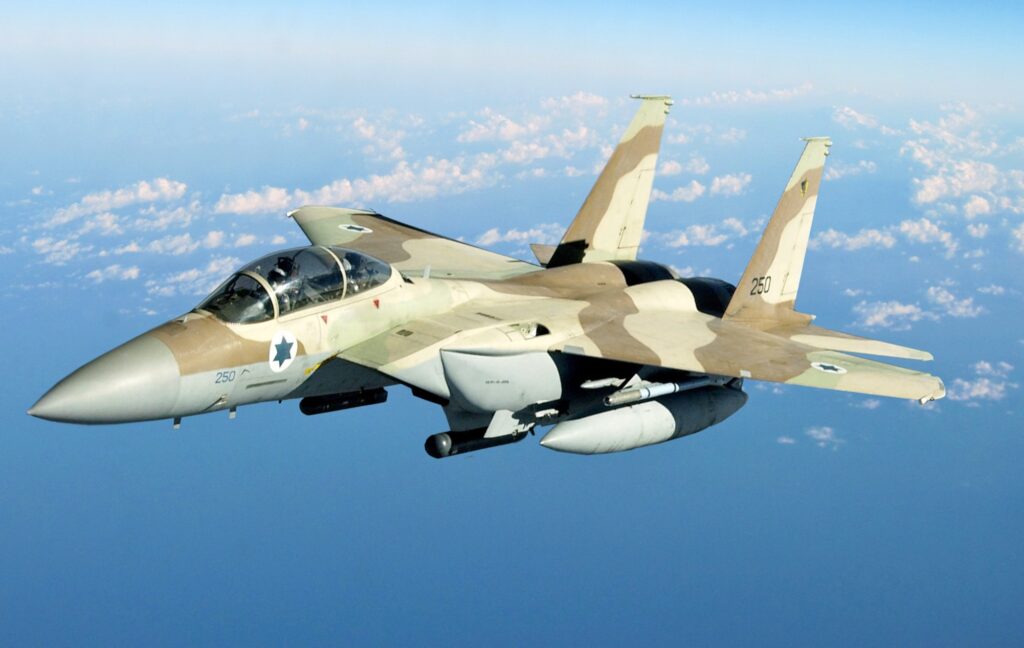
Israeli Defense Force-Air Force F-15I Ra’am aircraft

Second, range and persistence. Long-range profiles, especially when paired with refueling and standoff weapons, reward aircraft that can haul fuel and weapons without compromise.

Third, flexibility under escalation. A force can begin with stealthy penetration, then shift toward volume strike once air defenses are degraded. That sequencing is a well-understood pattern, and it works better when the fleet includes both types of assets.

In that sense, the F-15IA decision aligns with a pragmatic view of airpower as an ecosystem rather than a single silver bullet.

What changes, and what does not, between now and 2031

This is where readers should be careful. The December 2025 announcements point to a program that will shape the Israeli Air Force in the early 2030s, not tomorrow morning.

If deliveries start in 2031 as reported, that implies the near-term operational picture will still be carried by existing fleets: F-15 variants already in service, plus other fighter types, plus weapons integration and support systems.

That does not make the news less important. It makes it more strategic. Programs of this size signal intent, and they shape industrial capacity, training pipelines, and doctrine. They also influence how other regional planners think about long-range strike capacity over the medium horizon.

So if your question is “does this immediately change the balance next month,” the answer is no. If your question is “does this lock in a capability direction for the next decade,” the answer is yes.
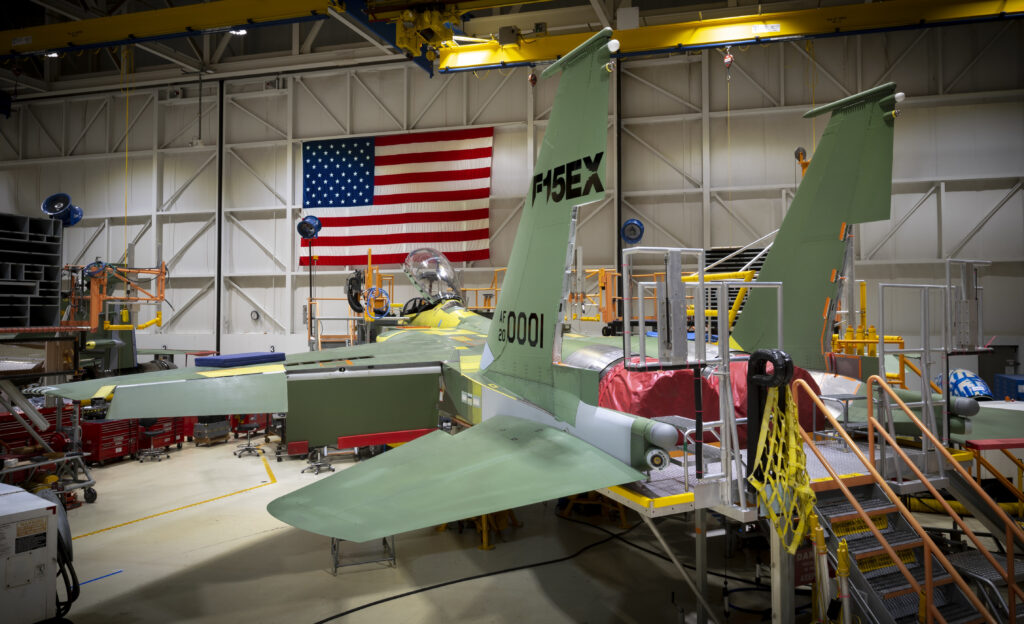
The Department of the Air Force awarded a nearly $1.2 billion contract for its first lot of eight F-15EX fighter aircraft, July 13, 2020. The contract, awarded to Boeing, provides for the design, development, integration, manufacturing, test, verification, certification, delivery, sustainment, and modification of F-15EX aircraft, including spares, support equipment, training materials, technical data, and technical support. (U.S. Air Force courtesy photo)

The U.S.–Israel mechanism: why the contract headline matters

One reason this story moved fast is that it sits at the intersection of two powerful drivers: Foreign Military Sales processes and industrial execution.

The Defense Department contract notice is not just a political signal. It is a real program vehicle with defined scope: design and integration work, testing, production, and delivery.

Separately, the Defense Security Cooperation Agency had previously published a public notice about a potential sale package that included the F-15IA and related equipment, showing that this has been building for some time and is not an improvised, last-minute concept.

For readers who track defense procurement, this sequence is the tell. Once the program is in this lane, the relevant questions become configuration choices, integration priorities, production cadence, and delivery sequencing. The debate moves away from “will it happen” and toward “how will it be shaped.”
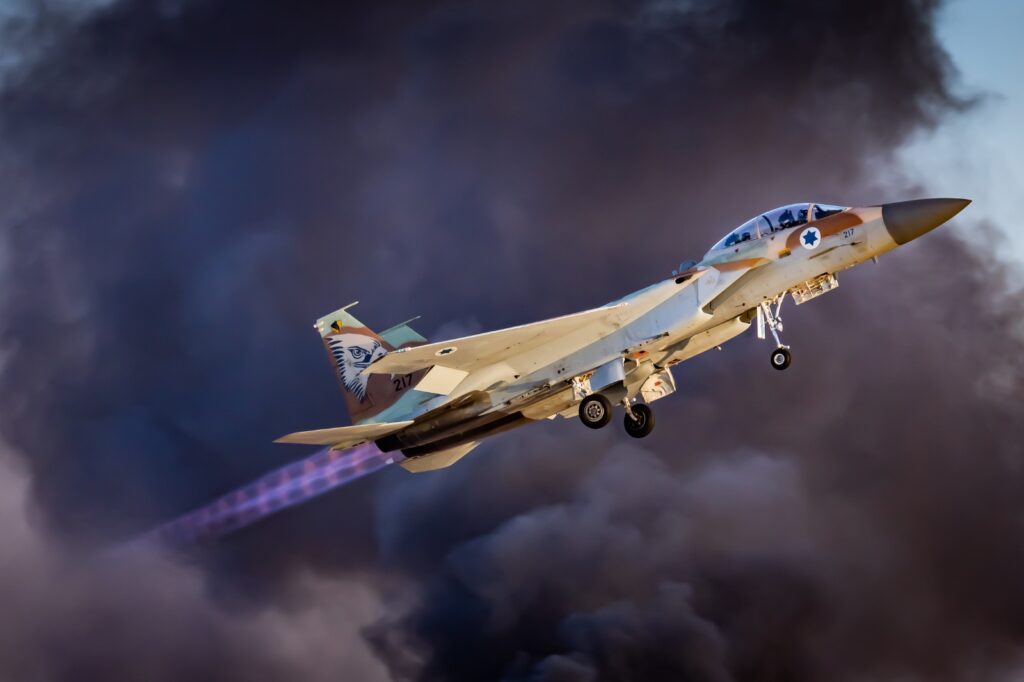
 / IDF Spokesperson’s Unit

What to watch next

If you are following this from a capability and security perspective, there are a few practical indicators worth tracking in 2026 and beyond.

One is configuration clarity. Israel historically customizes avionics, electronic warfare, and weapons integration to fit its operational concepts. The more we learn about what is specifically Israeli in the F-15IA, the more we can infer mission priorities.

Another is delivery cadence. Public reporting suggests the aircraft are expected from 2031 through 2035. That implies a structured ramp, not a one-time arrival.

A third is how the heavy strike pillar is balanced with stealth assets. A mixed-fleet approach only works when training, maintenance, and munitions stockpiles are aligned with the doctrine. Watch procurement choices around weapons, support equipment, and sustainment, because those often tell the deeper story.

Finally, watch regional interpretation. Announcements of long-range capable heavy strike platforms are rarely read in isolation. They are read as a message about contingency planning, and they can trigger counter-investments in air defense, dispersion, hardening, and stand-in systems.

A neutral way to read the signal

From an institutional perspective, the most disciplined takeaway is this.

The end of December 2025 did not bring a sudden arrival of new F-15s into Israel’s operational fleet. It brought confirmation that a large-scale F-15IA program has moved into funded execution under the U.S. Foreign Military Sales framework, with deliveries expected to begin in the next decade.

That is not dramatic in the short term, but it is structurally important. It keeps the heavy strike concept alive, it preserves a production and modernization path, and it gives Israel additional options for long-range, high-payload operations in the 2030s. For readers trying to separate noise from signal, that is the part worth holding onto.


Sources

U.S. Department of Defense, Contracts Notice, “F-15 Israel Program (Boeing)”, December 29, 2025.
Reuters, “Pentagon announces $8.6 billion Boeing contract for F-15 jets for Israel”, December 29, 2025.
FlightGlobal, “US government authorises Foreign Military Sales agreement for up to 50 Boeing F-15IA fighters for Israeli Air Force”, December 30, 2025.
Defense Security Cooperation Agency, “Israel – F-15IA and F-15I+ Aircraft”, public notice, August 13, 2024.


Previous Post

SDF and HTS: Managing Tension Without Open Conflict in Northern Syria

Related Posts

SDF and HTS: Managing Tension Without Open Conflict in Northern Syria
Cross-Sector Insights

SDF and HTS: Managing Tension Without Open Conflict in Northern Syria

December 26, 2025
What 2025 Taught Us About Defense and Energy: Five Lessons for 2026
Cross-Sector Insights

What 2025 Taught Us About Defense and Energy: Five Lessons for 2026

December 24, 2025
The New Taiwan Arms Package and China’s “Stop” Message: What Actually Changed
Cross-Sector Insights

The New Taiwan Arms Package and China’s “Stop” Message: What Actually Changed

December 19, 2025
The Black Sea’s Evolving Battlespace: Ukraine’s Maritime Operations and Shifting Security Dynamics
Cross-Sector Insights

The Black Sea’s Evolving Battlespace: Ukraine’s Maritime Operations and Shifting Security Dynamics

December 12, 2025
The Rise of Commercial Drones in Conflict Zones: A New Layer in Modern Warfare
Cross-Sector Insights

The Rise of Commercial Drones in Conflict Zones: A New Layer in Modern Warfare

December 6, 2025
Black Sea Tanker Explosion: New Details on the Twin Incidents
Cross-Sector Insights

Black Sea Tanker Explosion: New Details on the Twin Incidents

November 29, 2025
  • Trending
  • Comments
  • Latest
Blackwater PMC

After Blackwater: How PMCs Evolved, Professionalized, and Fragmented

September 13, 2025
Blackwater PMC

Inside Iraq’s Security Market: How Private Power Shapes a Fragile State

October 6, 2025
Operation Enduring Freedom

What Exactly Is a Private Military Company (PMC)?

September 6, 2025
Repkon Nammo in Denmark: What This Nordic Ammunition Play Really Signals

Repkon Nammo in Denmark: What This Nordic Ammunition Play Really Signals

August 21, 2025
A Historic $142 Billion Arms Deal: Unpacking the U.S.-Saudi Agreement

A Historic $142 Billion Arms Deal: Unpacking the U.S.-Saudi Agreement

A Silent Revolution on the Battlefield: AI-Enabled Tactical Communication Systems

A Silent Revolution on the Battlefield: AI-Enabled Tactical Communication Systems

Cominf.org, CC BY-SA 3.0 , via Wikimedia Commons

Is Europe Really Reducing Its Dependence on Russian Gas?

What is ITAR? The Invisible Line in Global Defense Trade

What is ITAR? The Invisible Line in Global Defense Trade

Israel’s F-15 News: What Actually Happened, and Why It Matters

Israel’s F-15 News: What Actually Happened, and Why It Matters

January 1, 2026
SDF and HTS: Managing Tension Without Open Conflict in Northern Syria

SDF and HTS: Managing Tension Without Open Conflict in Northern Syria

December 26, 2025
What 2025 Taught Us About Defense and Energy: Five Lessons for 2026

What 2025 Taught Us About Defense and Energy: Five Lessons for 2026

December 24, 2025
The New Taiwan Arms Package and China’s “Stop” Message: What Actually Changed

The New Taiwan Arms Package and China’s “Stop” Message: What Actually Changed

December 19, 2025

Recent News

Israel’s F-15 News: What Actually Happened, and Why It Matters

Israel’s F-15 News: What Actually Happened, and Why It Matters

January 1, 2026
SDF and HTS: Managing Tension Without Open Conflict in Northern Syria

SDF and HTS: Managing Tension Without Open Conflict in Northern Syria

December 26, 2025
What 2025 Taught Us About Defense and Energy: Five Lessons for 2026

What 2025 Taught Us About Defense and Energy: Five Lessons for 2026

December 24, 2025
The New Taiwan Arms Package and China’s “Stop” Message: What Actually Changed

The New Taiwan Arms Package and China’s “Stop” Message: What Actually Changed

December 19, 2025
Drill & Defense

Drill & Defense is an independent platform providing insights into firearms, defense technologies, and energy sectors. We deliver clear, practical content for professionals, enthusiasts, and industry followers worldwide.

Follow Us

Browse by Category

  • Cross-Sector Insights
  • Defense
  • Defense & Energy Strategy
  • Defense Know-How
  • Defense Technologies
  • Energy
  • Energy Insight
  • Energy Technologies
  • Global Security & Trade Analysis
  • History & Legacy
  • Industry News
  • Knowledge Base
  • Legacy Systems & Structures
  • Market Trends & Analysis
  • Military Market Reports
  • Oil & Gas News
  • Resource Wars & Strategy
  • Tech & Innovation Crossover
  • Turning Points in Conflict
  • Weapon & Gear Reviews

Recent News

Israel’s F-15 News: What Actually Happened, and Why It Matters

Israel’s F-15 News: What Actually Happened, and Why It Matters

January 1, 2026
SDF and HTS: Managing Tension Without Open Conflict in Northern Syria

SDF and HTS: Managing Tension Without Open Conflict in Northern Syria

December 26, 2025

© 2025 Drill & Defense. All rights reserved. Independent insights on firearms, defense, and energy. For business inquiries: info@drillanddefense.com | PRIVACY POLICY | COOKIE POLICY | TERMS AND CONDITIONS

Manage Consent

We use cookies to improve your experience. You can accept or refuse cookies; however, some features may not function properly without your consent.

Functional Always active
The technical storage or access is strictly necessary for the legitimate purpose of enabling the use of a specific service explicitly requested by the subscriber or user, or for the sole purpose of carrying out the transmission of a communication over an electronic communications network.
Preferences
The technical storage or access is necessary for the legitimate purpose of storing preferences that are not requested by the subscriber or user.
Statistics
The technical storage or access that is used exclusively for statistical purposes. The technical storage or access that is used exclusively for anonymous statistical purposes. Without a subpoena, voluntary compliance on the part of your Internet Service Provider, or additional records from a third party, information stored or retrieved for this purpose alone cannot usually be used to identify you.
Marketing
The technical storage or access is required to create user profiles to send advertising, or to track the user on a website or across several websites for similar marketing purposes.
  • Manage options
  • Manage services
  • Manage {vendor_count} vendors
  • Read more about these purposes
View preferences
  • {title}
  • {title}
  • {title}
No Result
View All Result
  • Defense
    • Industry News
    • Weapon & Gear Reviews
    • Defense Technologies
    • Military Market Reports
  • Energy
    • Oil & Gas News
    • Energy Technologies
    • Market Trends & Analysis
  • Cross-Sector Insights
    • Defense & Energy Strategy
    • Global Security & Trade Analysis
    • Tech & Innovation Crossover
  • History & Legacy
    • Turning Points in Conflict
    • Legacy Systems & Structures
    • Resource Wars & Strategy
  • Knowledge Base
    • Defense Know-How
    • Energy Insight
  • About
  • Contact
  • Login
  • Register

© 2025 Drill & Defense. All rights reserved. Independent insights on firearms, defense, and energy. For business inquiries: info@drillanddefense.com | PRIVACY POLICY | COOKIE POLICY | TERMS AND CONDITIONS