

Drill & Defense
Advertisement
  • Defense
    • Industry News
    • Weapon & Gear Reviews
    • Defense Technologies
    • Military Market Reports
  • Energy
    • Oil & Gas News
    • Energy Technologies
    • Market Trends & Analysis
  • Cross-Sector Insights
    • Defense & Energy Strategy
    • Global Security & Trade Analysis
    • Tech & Innovation Crossover
  • History & Legacy
    • Turning Points in Conflict
    • Legacy Systems & Structures
    • Resource Wars & Strategy
  • Knowledge Base
    • Defense Know-How
    • Energy Insight
  • About
  • Contact
  • Login
  • Register
No Result
View All Result
  • Defense
    • Industry News
    • Weapon & Gear Reviews
    • Defense Technologies
    • Military Market Reports
  • Energy
    • Oil & Gas News
    • Energy Technologies
    • Market Trends & Analysis
  • Cross-Sector Insights
    • Defense & Energy Strategy
    • Global Security & Trade Analysis
    • Tech & Innovation Crossover
  • History & Legacy
    • Turning Points in Conflict
    • Legacy Systems & Structures
    • Resource Wars & Strategy
  • Knowledge Base
    • Defense Know-How
    • Energy Insight
  • About
  • Contact
  • Login
  • Register
No Result
View All Result
Drill & Defense
No Result
View All Result
Home History & Legacy

Dwight D. Eisenhower: Strategic Architecture at the Intersection of Defense and Energy Security

February 9, 2026
in History & Legacy, Resource Wars & Strategy
Dwight D. Eisenhower: Strategic Architecture at the Intersection of Defense and Energy Security

General of the Army Dwight David Eisenhower when a 4-star General. 31 December 1943

Share on LinkedInShare on Twitter

The mid 20th century presented a unique historical challenge. Nations needed to reconcile the emerging geopolitical rivalry between superpowers with durable frameworks for collective defence and international stability. Few leaders shaped this era more profoundly than Dwight D. Eisenhower, whose legacy extends well beyond military command into the strategic foundations of alliance policy and the geopolitical arrangements that underpin many modern debates on defence and energy security.

Eisenhower’s tenure as Supreme Allied Commander of NATO and later as President of the United States placed him at the center of efforts to build collective security mechanisms at a moment when global energy flows and military alignment were becoming increasingly interconnected. Understanding his approach requires examining both his contribution to alliance strategy and his development of policy instruments aimed at stabilizing regions critical to Western security.

The New Look Strategy and the Foundations of Alliance Policy

When Eisenhower entered the American presidency in 1953, he inherited a geopolitical landscape shaped by the aftermath of World War II, the rise of the Soviet Union as a global competitor, and the complex reconstruction of Europe. At the heart of his national security policy was what came to be known as the New Look, a strategic orientation designed to balance the imperatives of security with broader economic sustainability. This doctrine emphasized deterrence through the threat of overwhelming response, with nuclear capabilities playing a central role, while maintaining a sustainable defence burden.

Underlying the New Look was an understanding that defence arrangements could not be separated from economic and societal resilience. Without a stable economic foundation, alliance members would struggle to maintain credible deterrence. Eisenhower’s effort was to ensure that defence commitments remained achievable, yet strong enough to dissuade adversaries from attempting military coercion.
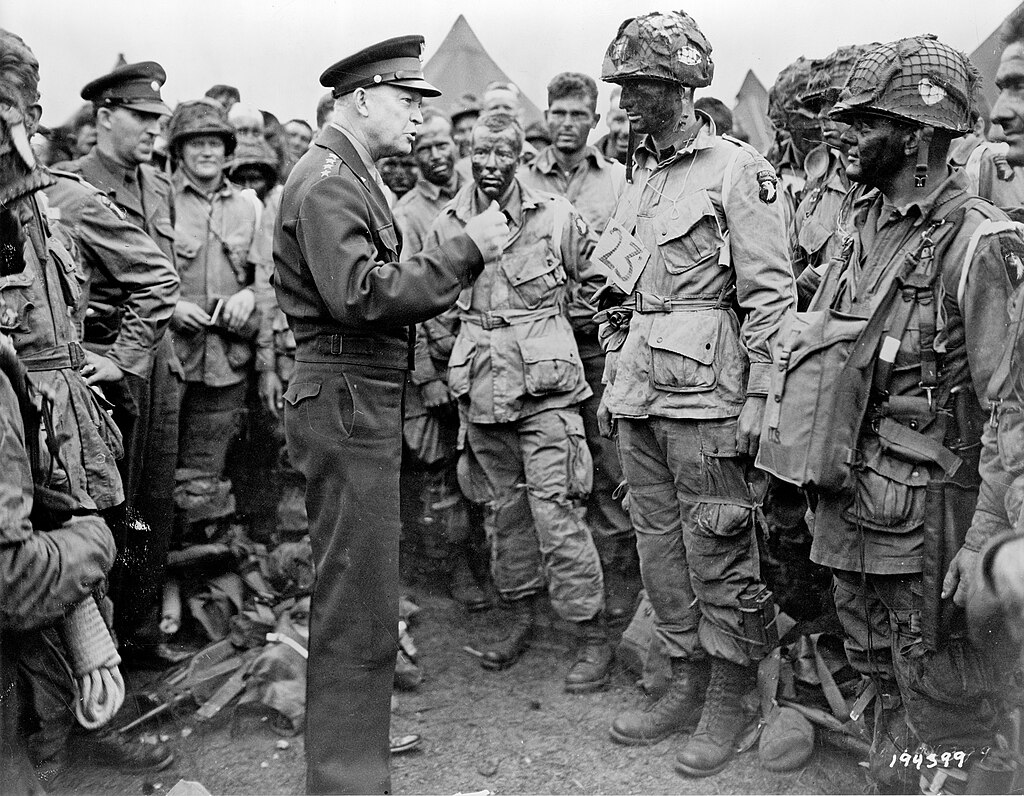
Gen. Dwight D. Eisenhower gives the order of the Day. ‘Full victory-nothing less’ to paratroopers in England, just before they board their airplanes to participate in the first assault in the invasion of the continent of Europe.” Eisenhower is meeting with US Co. E, 502nd Parachute Infantry Regiment (Strike) of the 101st Airborne Division, photo taken at Greenham Common Airfield in England about 8:30 p.m. on June 5, 1944. The General was talking about fly fishing with his men as he always did before a stressful operation (Eisenhower speaks with Hartsock).

Within NATO, this strategic calculus had immediate relevance. The alliance was still in its early stages during the early 1950s, and debates over force structures, burden sharing, and the role of different deterrent mechanisms shaped its evolving doctrine. Eisenhower’s influence was especially visible in discussions around collective defence concepts that emphasized credible deterrence through a combination of conventional and nuclear forces.

NATO Strategy and the Concept of Massive Retaliation

One of the most influential elements of alliance strategy during Eisenhower’s era was the concept of massive retaliation. This idea emerged from the strategic reassessment that followed Project Solarium, a comprehensive national strategy exercise initiated by Eisenhower in 1953. The concept aimed to signal a strong and unified defence posture against potential Soviet aggression. Rather than relying on costly conventional force buildups, it proposed that a robust nuclear response capability, backed by collective commitment, could deter adversaries from initiating conflicts that might escalate into wider war.
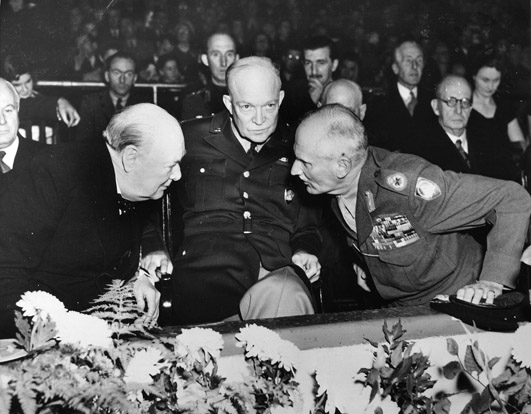
The leaders of NATO’s newly created military arm, the Allied Command Europe, were taken from the ranks of the coalition that had won World War II in the west. The first Supreme Allied Commander, Europe, was American General Dwight D. Eisenhower; his British Deputy was Field Marshal Bernard Law Montgomery. They are shown here at a reunion of the British Eighth Army on October 19, 1951. Churchill, leaning across a seemingly disgruntled Eisenhower, would again become Britain’s Prime Minister five days later.

Within NATO’s early strategic concepts, massive retaliation served two critical purposes. First, it provided a clearly articulated expression of collective defence intentions. Second, it offered a practical way to reconcile alliance commitments with resource constraints. It communicated to both allies and adversaries that the alliance was prepared to defend its territory decisively while allowing member states to sustain economic recovery and growth.

By reinforcing deterrence credibility through collective resolve, the alliance under Eisenhower’s influence was better positioned to engage with global security issues that extended beyond Europe. This included concerns in regions such as the Middle East, where strategic access and political alignment with Western interests were closely tied to broader stability objectives.

The Eisenhower Doctrine and Middle Eastern Dynamics

While NATO’s strategic posture addressed threats on the European continent, Eisenhower recognized that American and Western interests extended far beyond that theatre. A defining moment came after the 1956 Suez Crisis, when declining British and French influence in the Middle East required a recalibration of Western engagement. In response, Eisenhower articulated a policy framework later known as the Eisenhower Doctrine. It pledged military and economic assistance to Middle Eastern nations resisting aggression by forces aligned with rival superpower influence.

Although not framed explicitly in terms of energy security, the doctrine emerged at a time when the Middle East was already understood as central to global energy supplies. The United States’ concerns were not limited to ideological containment of the Soviet Union. They also reflected an understanding that the stability of energy rich regions would significantly impact Western industrial economies and strategic access to vital resources. In this sense, the Eisenhower Doctrine operated at the intersection of defence policy and early energy geopolitical realities.
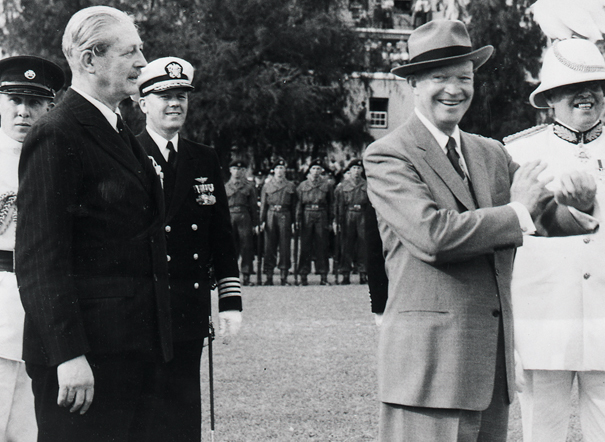
US President Dwight D. Eisenhower and British Prime Minister Harold Macmillan meet for talks in Bermuda, partly to repair Anglo-American relations after the disastrous Suez Crisis of the previous year. March 1957

The doctrine authorized the United States to support nations both militarily and economically, including the deployment of forces if necessary, to uphold their independence and territorial integrity against external threats. While its implementation and reception varied across states, its articulation marked a significant shift in Western engagement outside Europe. It signaled an early recognition that security and economic imperatives are deeply intertwined.

Geopolitical Undercurrents: Energy, Alliances, and Strategic Posture

The period during and after Eisenhower’s leadership demonstrated that geopolitical competition could not be compartmentalized. Regions such as the Middle East, whose economic significance was tied to oil exports and global trade routes, were also arenas of political influence and alliance competition. The interconnectedness of energy demand, particularly in post war European recovery, and strategic alliances was an emerging reality that Eisenhower’s policies implicitly addressed.

By creating mechanisms for collective defence within NATO, advocating credible deterrence, and articulating engagement frameworks such as the Eisenhower Doctrine, Eisenhower’s approach anticipated many of the structural dynamics that continue to inform alliance behavior in the twenty first century. While the doctrine itself was formulated in the context of Cold War bipolarity, its broader implications for engagement in strategically critical regions reflected the recognition that defence and economic interests are inseparable.

Alliance Endurance and Strategic Adaptability

Eisenhower’s contributions to alliance strategy are notable for their lasting institutional effects. NATO’s evolution over subsequent decades has demonstrated an ability to adapt its strategic concepts while preserving the core commitment to collective defence and deterrence. These adaptations have included expanding political consultation mechanisms, institutional development, and the integration of broader security concerns into alliance planning.

The foundational emphasis on credible deterrence and shared responsibility, shaped significantly by Eisenhower’s influence, underpins much of this adaptability. In a world where geopolitical flashpoints often have economic and strategic dimensions, including energy infrastructure and regional stability, the alliance’s capacity to respond collectively remains critical.

References

  • US Department of State, Office of the Historian, “The Eisenhower Doctrine”
  • NATO, Official Strategic Concept Archives, early Cold War defence documents
  • Miller Center, University of Virginia, “Dwight D. Eisenhower: Foreign Affairs”
  • RAND Corporation, research on nuclear deterrence and alliance dynamics

Previous Post

Kenya 2002: When the Missile Misses

Related Posts

Kenya 2002: When the Missile Misses
History & Legacy

Kenya 2002: When the Missile Misses

February 5, 2026
Winston Churchill: War, Intelligence, and Energy Strategy
History & Legacy

Winston Churchill: War, Intelligence, and Energy Strategy

February 4, 2026
FeisalPartyAtVersaillesCopy
History & Legacy

T. E. Lawrence: Strategic Influence, Cultural Depth, and the Enduring Architecture of a Legacy

January 26, 2026
Libya After Gaddafi: Security Fragmentation, Weapons Proliferation, and Energy Challenges
History & Legacy

Libya After Gaddafi: Security Fragmentation, Weapons Proliferation, and Energy Challenges

December 15, 2025
Why Toyota Became The Unofficial Vehicle Of Modern Warzones
History & Legacy

Why Toyota Became The Unofficial Vehicle Of Modern Warzones

November 13, 2025
South_Sudan_022
History & Legacy

The Fall of El Fasher and the Weaponisation of Darfur’s Conflict

November 3, 2025
  • Trending
  • Comments
  • Latest
Blackwater PMC

After Blackwater: How PMCs Evolved, Professionalized, and Fragmented

September 13, 2025
Blackwater PMC

Inside Iraq’s Security Market: How Private Power Shapes a Fragile State

October 6, 2025
Operation Enduring Freedom

What Exactly Is a Private Military Company (PMC)?

September 6, 2025
FeisalPartyAtVersaillesCopy

T. E. Lawrence: Strategic Influence, Cultural Depth, and the Enduring Architecture of a Legacy

January 26, 2026
A Historic $142 Billion Arms Deal: Unpacking the U.S.-Saudi Agreement

A Historic $142 Billion Arms Deal: Unpacking the U.S.-Saudi Agreement

A Silent Revolution on the Battlefield: AI-Enabled Tactical Communication Systems

A Silent Revolution on the Battlefield: AI-Enabled Tactical Communication Systems

Cominf.org, CC BY-SA 3.0 , via Wikimedia Commons

Is Europe Really Reducing Its Dependence on Russian Gas?

What is ITAR? The Invisible Line in Global Defense Trade

What is ITAR? The Invisible Line in Global Defense Trade

Dwight D. Eisenhower: Strategic Architecture at the Intersection of Defense and Energy Security

Dwight D. Eisenhower: Strategic Architecture at the Intersection of Defense and Energy Security

February 9, 2026
Kenya 2002: When the Missile Misses

Kenya 2002: When the Missile Misses

February 5, 2026
Winston Churchill: War, Intelligence, and Energy Strategy

Winston Churchill: War, Intelligence, and Energy Strategy

February 4, 2026
October 7: Understanding Intelligence and Operational Realities

October 7: Understanding Intelligence and Operational Realities

February 3, 2026

Recent News

Dwight D. Eisenhower: Strategic Architecture at the Intersection of Defense and Energy Security

Dwight D. Eisenhower: Strategic Architecture at the Intersection of Defense and Energy Security

February 9, 2026
Kenya 2002: When the Missile Misses

Kenya 2002: When the Missile Misses

February 5, 2026
Winston Churchill: War, Intelligence, and Energy Strategy

Winston Churchill: War, Intelligence, and Energy Strategy

February 4, 2026
October 7: Understanding Intelligence and Operational Realities

October 7: Understanding Intelligence and Operational Realities

February 3, 2026
Drill & Defense

Drill & Defense is an independent platform providing insights into firearms, defense technologies, and energy sectors. We deliver clear, practical content for professionals, enthusiasts, and industry followers worldwide.

Follow Us

Browse by Category

  • Cross-Sector Insights
  • Defense
  • Defense & Energy Strategy
  • Defense Know-How
  • Defense Technologies
  • Energy
  • Energy Insight
  • Energy Technologies
  • Global Security & Trade Analysis
  • History & Legacy
  • Industry News
  • Knowledge Base
  • Legacy Systems & Structures
  • Market Trends & Analysis
  • Military Market Reports
  • Oil & Gas News
  • Resource Wars & Strategy
  • Tech & Innovation Crossover
  • Turning Points in Conflict
  • Weapon & Gear Reviews

Recent News

Dwight D. Eisenhower: Strategic Architecture at the Intersection of Defense and Energy Security

Dwight D. Eisenhower: Strategic Architecture at the Intersection of Defense and Energy Security

February 9, 2026
Kenya 2002: When the Missile Misses

Kenya 2002: When the Missile Misses

February 5, 2026

© 2026 Drill & Defense. All rights reserved. Independent insights on firearms, defense, and energy. For business inquiries: info@drillanddefense.com | PRIVACY POLICY | COOKIE POLICY | TERMS AND CONDITIONS

Manage Consent

We use cookies to improve your experience. You can accept or refuse cookies; however, some features may not function properly without your consent.

Functional Always active
The technical storage or access is strictly necessary for the legitimate purpose of enabling the use of a specific service explicitly requested by the subscriber or user, or for the sole purpose of carrying out the transmission of a communication over an electronic communications network.
Preferences
The technical storage or access is necessary for the legitimate purpose of storing preferences that are not requested by the subscriber or user.
Statistics
The technical storage or access that is used exclusively for statistical purposes. The technical storage or access that is used exclusively for anonymous statistical purposes. Without a subpoena, voluntary compliance on the part of your Internet Service Provider, or additional records from a third party, information stored or retrieved for this purpose alone cannot usually be used to identify you.
Marketing
The technical storage or access is required to create user profiles to send advertising, or to track the user on a website or across several websites for similar marketing purposes.
  • Manage options
  • Manage services
  • Manage {vendor_count} vendors
  • Read more about these purposes
View preferences
  • {title}
  • {title}
  • {title}
No Result
View All Result
  • Defense
    • Industry News
    • Weapon & Gear Reviews
    • Defense Technologies
    • Military Market Reports
  • Energy
    • Oil & Gas News
    • Energy Technologies
    • Market Trends & Analysis
  • Cross-Sector Insights
    • Defense & Energy Strategy
    • Global Security & Trade Analysis
    • Tech & Innovation Crossover
  • History & Legacy
    • Turning Points in Conflict
    • Legacy Systems & Structures
    • Resource Wars & Strategy
  • Knowledge Base
    • Defense Know-How
    • Energy Insight
  • About
  • Contact
  • Login
  • Register

© 2026 Drill & Defense. All rights reserved. Independent insights on firearms, defense, and energy. For business inquiries: info@drillanddefense.com | PRIVACY POLICY | COOKIE POLICY | TERMS AND CONDITIONS