

When discussions turn to modern infantry rifles, two names almost always appear: Mikhail Kalashnikov and Eugene Stoner. Their rifles, the AK-47 and the M16, are not simply pieces of military hardware; over time they became symbols of two different engineering philosophies and two different strategic environments during the Cold War. Yet the story behind these rifles is not only about competition. It is also about how designers interpret battlefield needs, how military doctrine shapes engineering choices, and how small arms evolve through decades of operational experience. Understanding these rifles therefore requires looking not only at the weapons themselves but also at the people and environments that produced them.

Kalashnikov and the Logic of Battlefield Simplicity
Mikhail Kalashnikov’s path into firearms design was far from conventional. Before becoming associated with one of the most recognizable rifles in history, he served as a tank mechanic and soldier in the Soviet Army during the Second World War. After being wounded in 1941 he spent time recovering in a hospital, where he reportedly listened to fellow soldiers discussing the shortcomings of their weapons. Those conversations sparked an interest that eventually led him toward weapon design.
Kalashnikov began experimenting with mechanical concepts while still a young soldier, and although his early prototypes were not immediately successful, Soviet weapons researchers noticed his practical understanding of machinery. Over time he was brought into the Soviet small-arms development program, where he continued refining his ideas and gradually shaping what would later become one of the most influential rifle designs of the twentieth century.
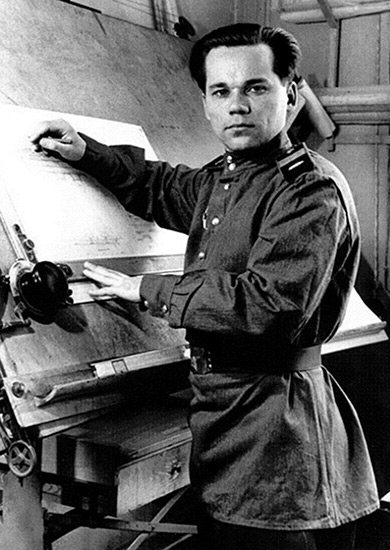
The final outcome of this process appeared in 1947 with the development of the Avtomat Kalashnikova, later known worldwide as the AK-47. The rifle entered Soviet service in 1949 and quickly demonstrated the qualities that would define it for decades: durability, reliability, and mechanical simplicity. These characteristics were not accidental. Soviet military planners expected weapons to function across vast territories and extreme climates, often with limited logistical support, meaning that a rifle requiring delicate maintenance or tight tolerances would struggle under those conditions. Kalashnikov’s design addressed that reality by prioritizing ruggedness and straightforward operation.
As the platform evolved, the AK family expanded through variants such as the AKM and RPK, gradually becoming one of the most widely distributed firearms systems ever produced. What made the design so influential was not necessarily its precision but its ability to function consistently in conditions where other weapons might struggle.
Eugene Stoner and the Aerospace Approach to Small Arms
While Kalashnikov was developing his rifle within the Soviet military system, Eugene Stoner approached firearm design from a very different environment in the United States. Born in Indiana in 1922, Stoner spent much of his early career working in aviation and machining, a background that exposed him to modern manufacturing techniques and lightweight materials that were becoming increasingly important in aerospace engineering.
When he joined the company ArmaLite in the 1950s, those influences began shaping his approach to weapon design. ArmaLite was not a traditional firearms manufacturer; it operated as a division of the Fairchild aviation company and experimented with applying aerospace engineering principles to military equipment. Within this environment Stoner began developing a rifle concept that emphasized lighter weight, improved ergonomics, and more efficient materials.

The design that emerged was the AR-15 platform. Instead of relying heavily on steel components, Stoner incorporated aluminum alloys and synthetic materials, reducing overall weight while maintaining structural strength. The rifle also used a smaller high-velocity cartridge, allowing soldiers to carry more ammunition without significantly increasing their load.
When the system was later adopted and modified for U.S. military service, it became known as the M16 rifle. Compared with earlier American service rifles, the M16 represented a major shift in philosophy. The weapon was lighter, more controllable in automatic fire, and designed to maximize mobility for the infantry soldier.
Different Strategic Environments, Different Solutions
Looking at the AK-47 and the M16 side by side reveals how strongly military strategy influences engineering decisions. Each rifle was developed within a different operational environment and therefore emphasized different priorities.
The Soviet Union expected large-scale land warfare where weapons had to function reliably across difficult terrain and harsh climates. Reliability under adverse conditions was therefore the primary design goal, and loose mechanical tolerances allowed the AK system to continue operating even when exposed to mud, sand, or debris.

The United States approached the problem differently. Military planners increasingly believed that lighter rifles firing smaller high-velocity rounds could improve soldier mobility and effectiveness, which meant that precision, controllability, and reduced weight became central considerations in the M16 design.
Both rifles also reflected broader trends in post-World War II weapons development. During the war the German Sturmgewehr 44 demonstrated the potential of the assault rifle concept, combining automatic fire with an intermediate cartridge. Designers around the world began exploring variations of this idea, and both Kalashnikov and Stoner adapted it according to their respective military requirements.
The Long-Running Debate
For decades discussions about infantry rifles have often centered on comparisons between the AK-47 and the M16. In reality the debate usually reflects different priorities rather than a simple question of superiority.
The AK platform gained a reputation for rugged reliability and ease of maintenance, qualities that allowed the rifle to function even when subjected to significant environmental stress. This characteristic contributed to its widespread adoption across many regions of the world.
The M16 platform, on the other hand, developed a reputation for accuracy, lighter weight, and adaptability. Over time the system evolved into the broader AR-15 family, which continues to serve as a foundation for numerous military and civilian rifle configurations.
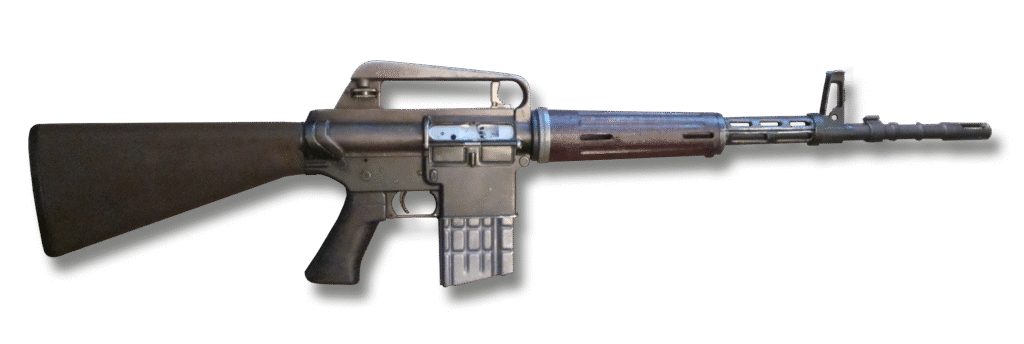
Early reliability issues during the Vietnam War affected the M16’s reputation, largely due to changes in ammunition specifications and maintenance practices. Once these issues were addressed through design modifications and improved procedures, the platform proved capable of long-term service and continued development.
When the Designers Met
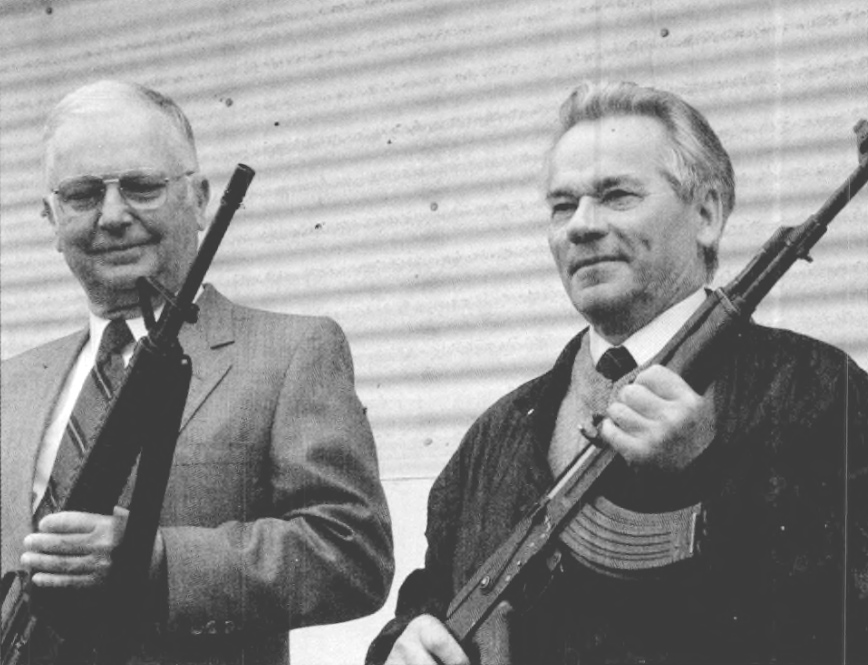
One of the more interesting moments in firearms history occurred in 1990, when Mikhail Kalashnikov and Eugene Stoner met in person in the United States. By that point their rifles had already become globally recognized symbols of military technology.
Despite representing opposing sides of the Cold War, the two designers reportedly approached their meeting with mutual respect. They visited shooting ranges and museums together while discussing design ideas and technical details, a meeting that highlighted how engineers often share common perspectives even when their creations emerge from different political systems.
Enduring Influence
Today, decades after their introduction, both rifle platforms continue to influence modern firearms design. The AK family remains widely produced and used across numerous countries, while the AR-15 and M16 systems have evolved into highly modular platforms supporting optics, accessories, and new calibers.
In many ways the legacy of Kalashnikov and Stoner illustrates how small arms development evolves through a combination of engineering innovation, military doctrine, and real-world operational feedback. Their rifles were products of their time, yet the underlying ideas behind them continue to shape modern weapon design.
For those who follow firearms technology or defense industry developments, the comparison between these two designers remains a useful reminder that effective engineering is rarely about a single perfect solution. Instead it is about designing tools that meet the specific needs of the environment in which they will operate.
Sources
Encyclopaedia Britannica – Mikhail Kalashnikov Biography and AK-47 Development History
Smithsonian Institution – Historical Overview of the AK-47 Rifle
National Firearms Museum – Eugene Stoner and the AR-15 Development
U.S. Army Historical Studies – Development and Early Use of the M16 Rifle