

The southern Syrian city of Suwayda, known for its Druze majority, has once again found itself at the center of an intensifying and unpredictable storm. What began as a series of skirmishes between local Druze defense groups and Bedouin tribes has rapidly spiraled into a multi-front crisis, marked by collapsed ceasefires, government intervention, and foreign military involvement.

This post aims to help readers navigate the complex situation unfolding in Suwayda—not just as another chapter in Syria’s troubled history, but as a window into how local sectarian disputes can trigger regional consequences.
A Conflict Reignited
Suwayda has always stood somewhat apart from the rest of Syria’s civil war narrative. Largely spared from the heaviest fighting during the 2010s, the city has developed its own political and military dynamics, largely controlled by Druze groups with a mix of autonomy and passive government oversight.
This fragile balance broke down this week. A combination of unresolved land disputes, tit-for-tat kidnappings, and revenge attacks between Druze militias and Bedouin factions escalated into full-scale urban combat. The violence has left streets littered with burned vehicles, looted homes, and families mourning the dead. The death toll is reported in the hundreds, with disturbing accounts of targeted executions and reprisals. There are also growing numbers of displaced civilians, and reports of local hospitals operating beyond capacity.
The initial response was rooted in community defense—but as with many conflicts in Syria, it didn’t remain a local issue for long.
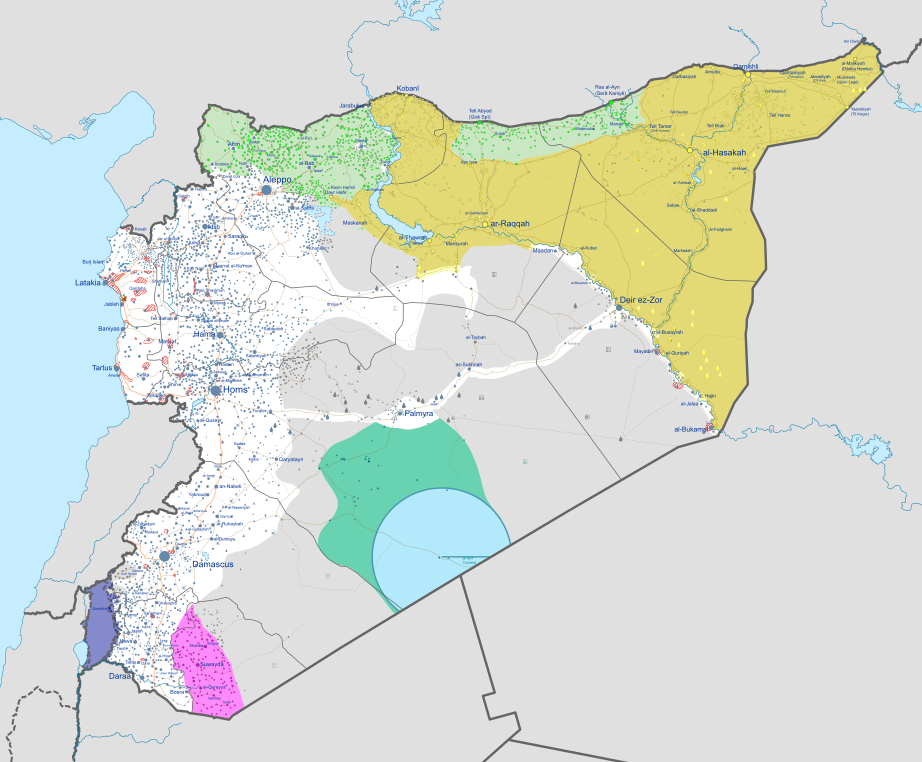
Damascus Steps In
Faced with the collapse of order in Suwayda and fearing a broader tribal insurrection, the Syrian government announced that it would deploy troops to restore calm. This marked one of the first major deployments of state forces to Suwayda in years.
The entry of government troops into the city was met with mixed reactions. While some Druze leaders tentatively welcomed their presence to halt the bloodshed, others viewed it as an intrusion—a threat to the limited self-rule the region has maintained. Tensions flared almost immediately. Gunfire was reported in several neighborhoods, and clashes between state troops and Druze fighters reignited the very violence Damascus had aimed to suppress.
Though a temporary ceasefire was agreed upon, it proved short-lived. Within 24 hours, fighting resumed, with new fronts opening around key infrastructure routes and civilian zones.
Israel Responds from the Sky
The crisis took a dramatic turn when Israeli aircraft launched airstrikes on military positions in and around Suwayda, as well as other strategic points in Syria’s interior. These strikes were framed by Israeli officials as a necessary intervention to prevent massacres against the Druze—a community that holds deep cultural and familial ties with Druze citizens in Israel and the Golan Heights.
While some saw Israel’s actions as a humanitarian gesture, others interpreted them as a calculated power move in a region already teetering on the edge. It is not the first time Israel has used airpower in Syria, but its explicit defense of Druze civilians added a new and highly symbolic dimension to the conflict.
The Syrian government condemned the strikes, branding them violations of national sovereignty and accusing Israel of seeking to inflame sectarian divisions. At the same time, it had to weigh the cost of further deploying troops, knowing the risk of new airstrikes would rise.
External Voices, Complicated Agendas
The United States publicly distanced itself from Israel’s military response, stating that it had not been consulted and did not support uncoordinated foreign interventions inside Syria. Yet Washington also pressed Damascus to withdraw its forces from Suwayda and show restraint in dealing with its minority populations.
Meanwhile, Arab nations including Jordan, Egypt, and Saudi Arabia issued diplomatic statements urging all parties to respect Syria’s territorial integrity and avoid further escalation. These reactions highlight the tightrope regional actors must walk—balancing their opposition to Israeli involvement with their fears of a destabilized Syria.
Behind closed doors, however, international powers likely view the conflict through another lens: control over southern Syria and the Golan frontier. As Suwayda burns, so too does the long-frozen chessboard of Middle Eastern geopolitics begin to move again.
Who Holds the Ground Now?
With the government partially withdrawing under pressure and ceasefires remaining tenuous, the question arises: who is now in control?
Druze community leaders have sought to assert local authority through a mix of civil society networks and armed self-defense groups. New checkpoints have been set up across the city, and informal negotiations are underway to create joint councils that could manage security and coordinate aid distribution. These efforts may offer temporary stability—but they also highlight the absence of a formal, legitimate state structure that enjoys full community trust.
In the meantime, Bedouin factions have largely withdrawn, but their return cannot be ruled out. Some suggest they are simply regrouping outside the city, waiting to strike again when the moment is right.
What’s Next for Suwayda—and Syria?
This crisis is not an isolated flare-up. It is symptomatic of a broader issue plaguing post-war Syria: the absence of a national reconciliation framework. Minority communities like the Druze continue to live in uneasy limbo—marginalized by political power, yet caught in the crosshairs of larger battles over control and identity.
The way forward depends on whether local governance can rise to meet the challenge. Will Druze leaders resist the temptation of revenge and choose dialogue? Will Damascus engage with local structures rather than attempt to impose control through brute force? And will external powers—particularly Israel—show discipline in how they wield their influence?
Perhaps most importantly, the residents of Suwayda themselves will have to decide what kind of future they are willing to fight for: one ruled by fear and factionalism, or one that cautiously builds a new model of coexistence in a fragmented Syria.
This week’s bloodshed is a reminder of just how fragile even the calmest corners of Syria still are. What happens in Suwayda matters—not just for its own people, but for the stability of the region at large.
References
- Reuters, “Syrian forces prepare to redeploy to Sweida city despite Israeli warnings,” July 18 2025
- The Guardian, coverage of Druze–Bedouin clashes, July 18 2025
- Washington Post, “Why did Israel attack Syria – and what does it have to do with the Druze,” July 17 2025