
Written by Ido Kalev.

From Osirak to Scuds, from chemical war to regime collapse, Iraq exposed early the strategic patterns the Middle East would spend decades learning too slowly. What happened in Iraq did not remain confined to Iraq. Many of the region’s later crises appeared there first, in forms that were not yet fully understood.
Iraq did not become strategically important only when Saddam Hussein fell. By the time American forces entered Baghdad in 2003, Iraq had already spent more than two decades forcing the Middle East to confront a set of questions that the region would later meet again and again in different forms. Those questions included preventive action against nuclear development, prolonged war with Iran, the normalization of chemical brutality, ballistic pressure against civilian populations, and the political illusion that removing a ruler is the same thing as restoring a state. That is why Iraq still deserves to be read as more than a dictatorship that eventually collapsed. It was one of the first places in the modern Middle East where several future patterns appeared together, before most outside observers were willing to describe them as part of a larger regional reality.
For Israelis of a certain generation, this was never an abstract matter of files, maps, or diplomatic cables. Iraq entered the home. It entered through sealed rooms, gas masks, atropine injectors, and plastic sheets stretched over windows. It entered through the knowledge that war no longer belonged only to soldiers at the front, and that the strategic rear could be reached directly. The first Scud that struck “Ramat- Gan” did more than destroy a building. It helped destroy an older assumption about the distance between battlefield and civilian life.
That experience belongs to the larger Iraqi story because Iraq was one of the first states in the region to show, at scale, that strategic pressure was no longer defined only by tanks crossing borders or aircraft striking military formations. It could be nuclear, chemical, ballistic, and psychological at the same time. It could force societies to confront dangers that many governments preferred to postpone until those dangers were already too visible to ignore. The most important lesson was never that Iraq was uniquely monstrous, although Saddam’s regime was certainly brutal enough to invite that conclusion. The more serious lesson was that Iraq revealed, earlier than most were prepared to admit, how difficult it would become to separate preventive action from escalation, civilian life from strategy, or military victory from political reconstruction. The region would spend years relearning those same truths elsewhere.
That is why Iraq matters. Not simply as a past war, not simply as a fallen regime, and not simply as an American failure. It matters because it was one of the first places where the Middle East encountered some of its own future realities before it knew how to name them.
Osirak- The First Warning the World Preferred to Oppose
Before Iraq became synonymous with invasion, occupation, and regime change, it was already a nuclear problem.
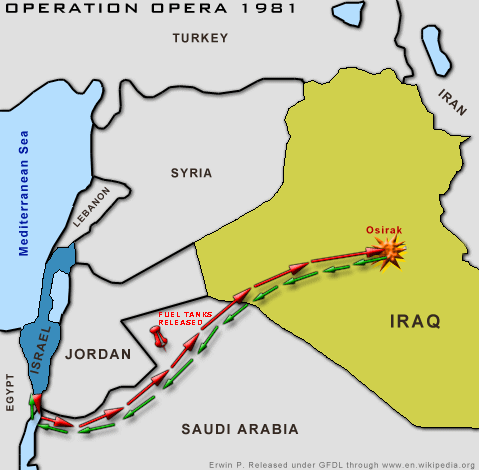
When Israel struck the Osirak reactor outside Baghdad in June 1981, the operation was condemned across much of the international system. The criticism was familiar in tone and broad in scope. Israel was accused of escalation, impatience, and disregard for diplomatic process. The underlying assumption was that a danger of this kind should be managed through time, supervision, and international procedure rather than through direct preventive force. What makes Osirak so important in retrospect is not only that the strike succeeded. It is that the argument made against it has remained remarkably durable in the face of repeated historical challenge. Again and again, states prefer to believe that a hostile capability can be contained more comfortably before it matures than confronted more dangerously after it does. Again and again, preventive action is treated as the greater disruption, even when inaction carries the greater long-term risk.
Osirak exposed that divide very clearly. On one side stood a strategic culture that preferred delay, process, and the hope that danger could still be managed within recognized diplomatic boundaries. On the other stood a culture that judged some capabilities too dangerous to be left for later, especially when pursued by regimes whose intentions were already hostile enough to make future restraint a poor basis for policy. That divide would not disappear with Iraq. It would reappear later in Syria under different operational and political circumstances, but with a strikingly similar underlying logic. Iraq was the earlier case, and in that sense the more formative one. It was the case in which Israel acted not because the world had agreed that the danger was intolerable, but because waiting for such agreement was already judged too risky.
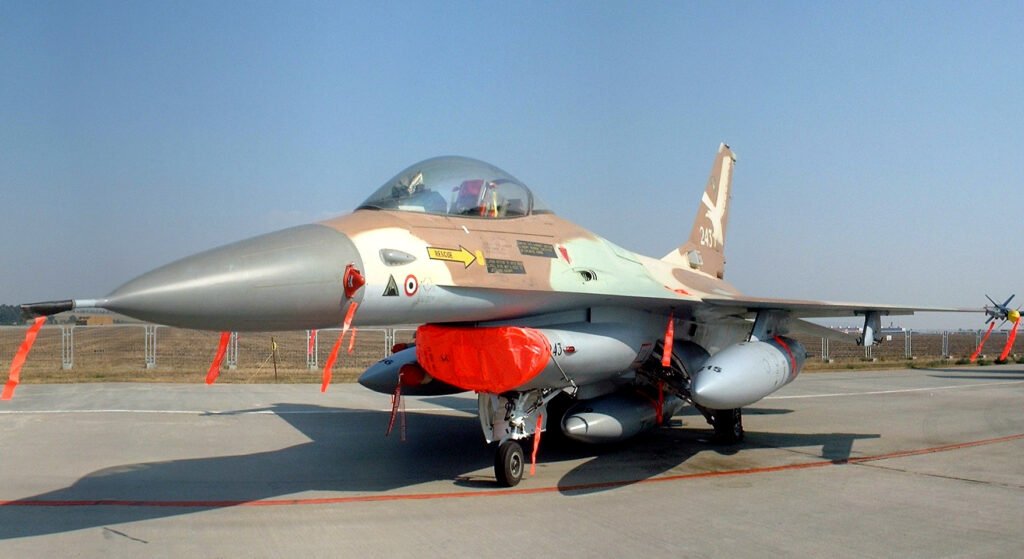
Osirak also mattered because it was not simply one dramatic air operation detached from everything around it. It stood at the visible end of a broader effort to delay and obstruct Iraq’s path, including sabotage, disruption, and covert pressure directed at the infrastructure supporting the project in Europe. That wider context is often forgotten because the strike itself became iconic. It should not be. Serious prevention rarely begins at the moment of impact. It usually begins earlier, in quieter forms, while others are still deciding whether the threat is real enough to justify action.
There is another layer to Osirak that remains unusually significant in Israeli memory. One of the pilots who took part in the strike was Ilan Ramon, who would later become Israel’s first astronaut. The importance of that fact is not sentimental. It lies in what it reveals about the way Israel experienced this period: the same society that sent a young pilot to remove a future strategic danger would later send him to represent it in space. In that sense, Osirak did not remain only a military episode. It entered a broader national story about prevention, consequence, memory, and aspiration.
None of this means that Osirak solved the Iraqi problem in full. It did not. That is precisely why the strike matters as the beginning of the story rather than its conclusion. Destroying a reactor removes a capability. It does not remove the regime that pursued it, the political logic that justified it, or the strategic environment in which related dangers may later return in different forms. One of Iraq’s deepest lessons is that preventing a capability, containing a regime, and rebuilding order after that regime’s collapse are not stages of one seamless process. They are distinct strategic tasks, and success in one does not guarantee success in the others. Osirak deserves to be remembered in two ways at once. It was a successful act of prevention, and it was an early warning that even correct action at one stage of a threat does not spare a region from the harder stages that may come afterward. Iraq would force the Middle East to learn both lessons, and to learn them at considerable cost.
The Iran-Iraq War Changed the Region Before the Region Understood It
If Osirak revealed one future problem early, the Iran-Iraq War revealed several at once.
This was not simply a border war between two rival states. It was an eight-year struggle that reshaped the political imagination of the region. It hardened regimes, normalized prolonged devastation, expanded the acceptable use of brutality, and left behind strategic habits that survived long after the ceasefire. In that sense, the war did not merely damage Iraq and Iran. It altered the wider Middle Eastern environment in which both would continue operating.
For Iran, the war reinforced a political and military culture built around endurance, sacrifice, attrition, ideological mobilization, and the conviction that time itself can become a weapon. A regime that survives prolonged punishment does not emerge from such a war thinking first in terms of elegance or symmetry. It emerges with a deeper belief in persistence, layered deterrence, proxy depth, and the value of exhausting stronger opponents over time. Much of what later became associated with Iranian regional method was not created by the war alone, but it was undeniably deepened by it.
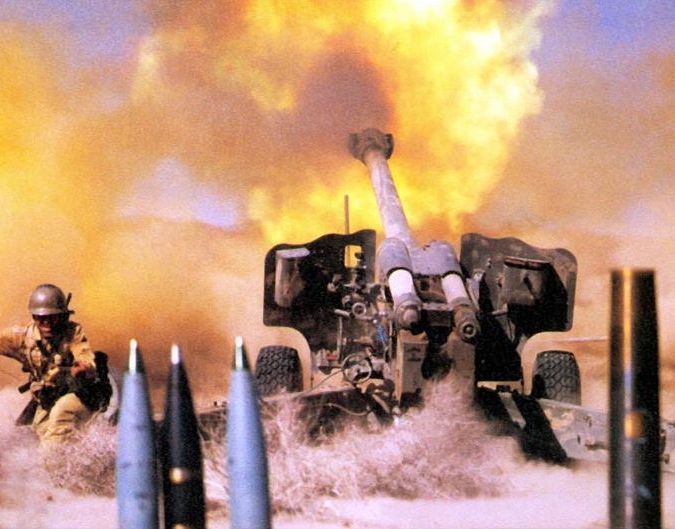
Iraq absorbed a different lesson. Saddam did not interpret survival as a warning against excess. He interpreted it as proof that extreme force remained available to him. The war did not moderate his strategic instincts. It radicalized them. Chemical weapons were used. Scale itself began to substitute for judgment. Human cost ceased to function as a meaningful restraint. One of the most important things the war did to Iraq was strengthen a governing logic in which brutality no longer appeared exceptional, but increasingly normal within the regime’s understanding of what power could do.
That distinction between the two sides matters because the war did not produce one regional doctrine. It intensified two. On the Iraqi side, the result was a more militarized, more coercive, and less restrained conception of state power. On the Iranian side, the result was a deeper commitment to strategic patience, mobilized belief, and the long war of influence. Both models would continue to shape the region after 1988, and both would later appear in altered form far beyond the original battlefield. This is where the usual sectarian summary becomes inadequate. It is true that Saddam was a Sunni Arab ruler of a secular Ba’athist state in a majority-Shi’ite country, and it is true that Iran after 1979 was a revolutionary Shi’ite regime seeking to project a different ideological order. But if the war is reduced to Sunni versus Shi’ite, too much is missed. It was also a struggle between two forms of political organization, two languages of legitimacy, and two ways of converting trauma into doctrine. One relied on centralized Arab nationalist statism sustained through force. The other increasingly fused revolutionary ideology with long-term mobilization and strategic endurance.
The war did not resolve that conflict. It embedded it. That is why its effects did not end with the ceasefire. They moved outward. They reappeared in military practice, in state identity, in proxy organization, in political memory, and eventually in the strategic logic through which both countries would continue shaping the region. The battlefield phase ended in 1988. The afterlife of the war did not.
For Iraq, this mattered in a particularly dangerous way. By the time the war was over, Saddam’s regime had already pursued nuclear capability, normalized chemical brutality, and demonstrated that it was prepared to think in terms of mass pressure rather than limited war. What emerged from the conflict was not a chastened state, but a regime that had learned the wrong lessons too successfully. It had survived. It had inflicted pain. It had endured international complexity. From Saddam’s perspective, that could be read not as a warning, but as validation.
That reading would affect the whole region. It would shape how Iraq thought about coercion, escalation, and symbolic violence. It would influence the logic behind later missile attacks. It would help make the civilian rear a legitimate site of strategic pressure. And it would push neighboring states, including Israel, to confront a more disturbing reality: that the region was no longer dealing only with conventional military threats, but with regimes increasingly prepared to merge fear, range, unconventional means, and political manipulation into one strategic method.
Iraq and Iran did not simply fight each other for eight years. They helped create a regional environment in which attrition, ideological persistence, civilian vulnerability, and strategic overreach would become more common and more interconnected than they had been before. The war changed both states. More importantly, it changed the region’s threshold for what could now be imagined, normalized, and repeated.
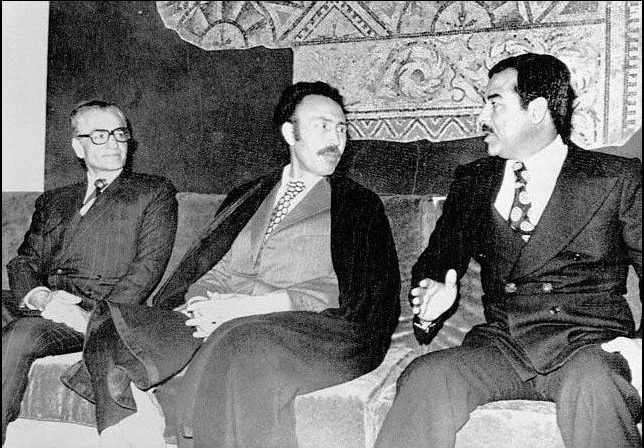
Why Saddam Fired Scuds at Israel – And Why It Was Never Only About Israel
When Saddam fired Scuds at Israel during the Gulf War, he was not trying to defeat Israel in any conventional military sense. He was trying to alter the political structure of the war.
That distinction is essential, because the missile attacks are still too often described either as a gesture of hatred or as an irrational act of escalation. They were hostile, certainly, and Saddam’s hostility toward Israel was real enough. But the attacks were also strategically calculated. Iraq could not reverse the coalition’s military advantage by striking Israel. What Saddam could do, however, was try to reshape the war by turning Israel into a political problem for the coalition arrayed against him.
He understood the regional arithmetic well enough. If Israel responded militarily, Arab governments participating in or supporting the American-led coalition would find themselves in a much more difficult position. The conflict could be emotionally reframed. What had been organized as a campaign to reverse Iraq’s occupation of Kuwait could begin to look, in Arab political and public terms, like a war in which Israel had again entered the center of events. Saddam’s hope was not that missiles alone would win him the war, but that they might fracture the diplomatic and political geometry holding the coalition together.
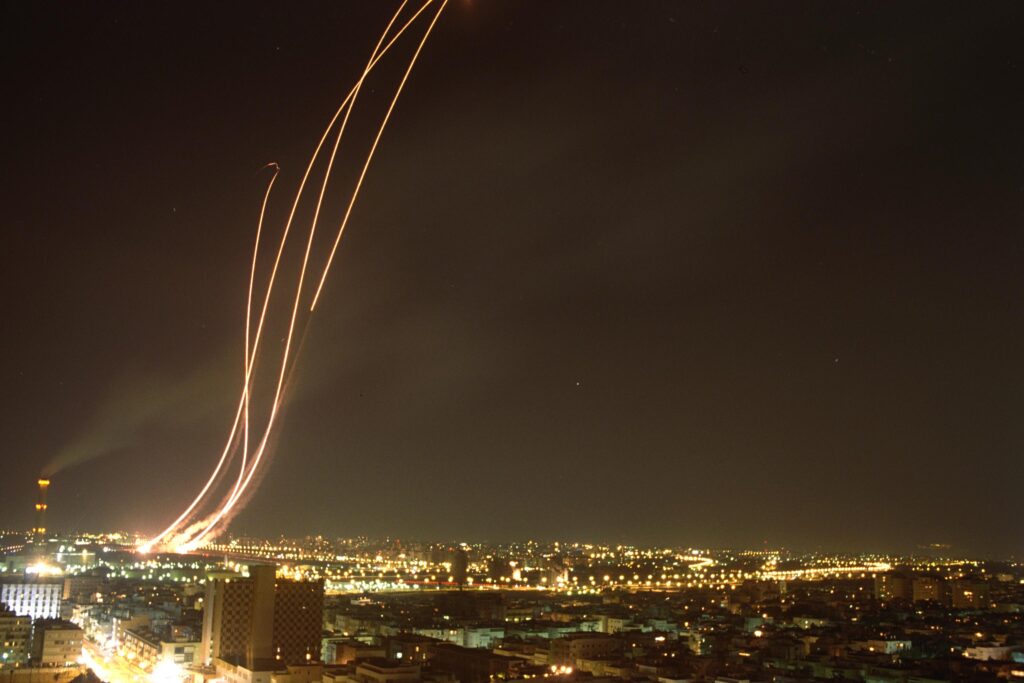
The Scuds therefore mattered not simply as ballistic weapons fired at civilian targets, but as political instruments designed to manipulate relationships between states. Saddam was trying to weaponized Israel’s very presence in the regional imagination in order to force others into a more unstable coalition structure. In that sense, the attacks were directed not only at Israeli cities, but at the cohesion of the war itself.
For Israel, the significance of that moment ran much deeper than the immediate strategic calculation. Iraq demonstrated that a hostile regime did not need physical proximity, or even a realistic path to battlefield victory, in order to reach directly into Israeli civilian life. It could do so through range, fear, symbolism, and the pressure those things placed on political judgment. The missiles did not need to change the military balance to matter. They needed only to change the political and psychological atmosphere.
That was a major shift in the region’s strategic logic. Until then, war had often still been imagined through older categories: armies, fronts, maneuver, territorial depth, air superiority, and conventional escalation. Saddam’s missile campaign did not abolish those categories, but it forced a different reality into view. A state could use long-range fire less to conquer than to manipulate. It could pressure a civilian population not because that population was the decisive military target, but because civilian fear could become part of the larger strategic design.
This is why the Scud campaign should not be reduced to symbolism alone, but neither should it be read through military metrics alone. Its deeper significance lay in the way it anticipated forms of regional warfare that later became far more familiar: long-range attacks intended to influence decision-making, stretch patience, contaminate unrelated fronts, and widen wars politically even when they could not be won operationally.
In the Iraqi case, that logic was already visible. Saddam had emerged from the Iran-Iraq War with a more radicalized view of coercion and a diminished sense of restraint. His regime had already pursued nuclear capability. It had already normalized chemical brutality. It had already learned to think in terms of mass fear and strategic theater. Firing Scuds at Israel was consistent with that worldview. It reflected a regime that increasingly treated escalation not simply as a military option, but as a way of reorganizing political reality around itself.
For Israelis, the consequences were immediate and intimate. The attacks were not experienced primarily as a lesson in coalition politics. They were experienced as sealed rooms, gas masks, atropine injectors, sirens, and the fear that the next missile might carry not only explosives but poison. What mattered in the moment was not the elegance of Saddam’s calculation, but the fact that Iraqi strategy had reached into ordinary domestic life. Yet that very experience helped clarify the larger point: missiles could now be used to act not only on military targets, but on the relationship between governments, publics, and strategic patience.
That lesson did not disappear after 1991. It returned in altered forms through later actors, later doctrines, and different technological means. Iraq was not the last state to understand how long-range fire could be used to influence politics more than territory. But it was one of the first to demonstrate it with enough clarity that the region, had it wished to, might have learned faster from what it had already seen.
Iraq Made the Israeli Home Front Strategic – And Israel Never Fully Returned to the Old Illusion
For Israelis, the most lasting effect of Iraq’s missile campaign was not only the damage it caused, but the change it imposed on the country’s understanding of war itself.
Until then, even after several wars, there remained a powerful assumption that conflict belonged primarily to the front. Soldiers fought, aircraft struck, armies maneuvered, and civilians endured tension, uncertainty, and loss, but the battlefield was still imagined as something that existed at a distance. Iraq helped break that illusion.
The Scuds did not merely strike Israeli territory. They entered Israeli domestic life. Families sealed rooms with plastic sheets, gas masks became household items, and atropine injectors were prepared alongside ordinary necessities. The possibility of chemical attack forced the state to confront something far deeper than emergency planning. It had to reckon with the fact that civilian life itself had become part of the strategic equation.
That change mattered because once the home front became strategic, the meaning of deterrence changed with it. The question was no longer only whether the army could defeat the adversary in battle. It was whether the state could preserve civilian continuity, political confidence, and social discipline while the adversary reached directly into homes, routines, and public consciousness. That was a far more demanding test. It required more than military capability. It required preparation, communication, trust, and a political culture able to absorb fear without allowing fear to reorganize national decision-making.
Iraq was one of the first cases in the region to demonstrate that reality clearly. Saddam understood that a missile did not need to change the military balance in order to change the atmosphere in which political decisions were made. Its purpose was not only destruction. It was uncertainty, anticipation, and the pressure created by waiting for impact while trying to understand what kind of war had now arrived. In that sense, an entire society was forced to think about vulnerability in real time, and that effect had strategic weight even where the physical damage remained limited compared with the scale of the war around it.
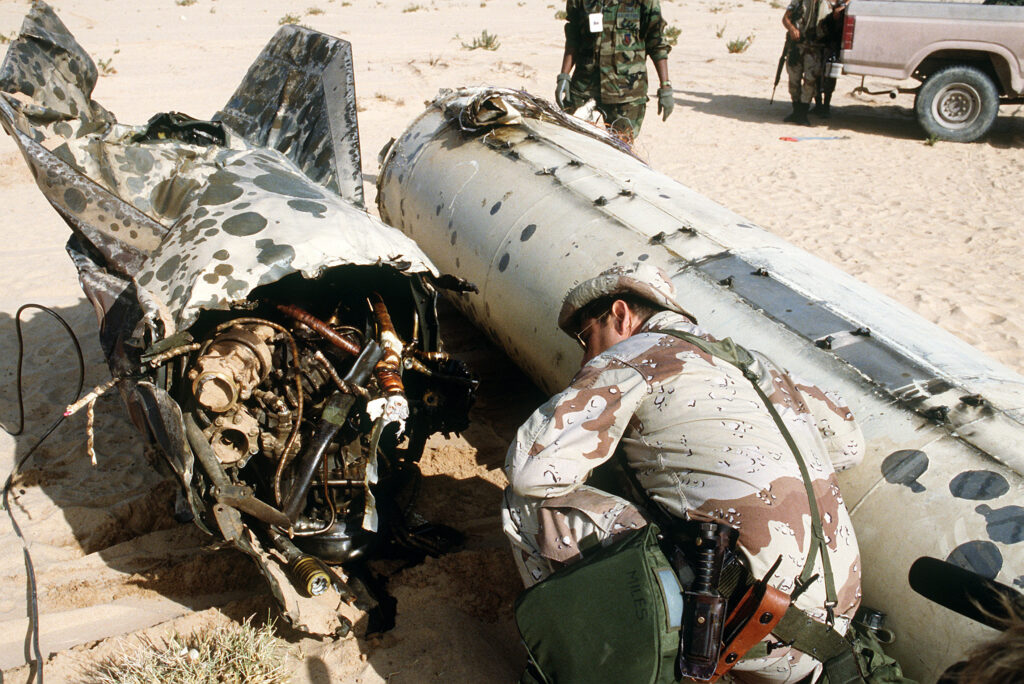
For Israel, the lesson did not disappear with the ceasefire. It entered the country’s long-term strategic memory. Once a society has lived through the possibility that civilians may sit behind sealed windows waiting for the next missile while larger powers debate timing, legitimacy, and political restraint, it does not return easily to the older belief that strategic patience is always safer than early action. Iraq was one of the experiences that helped harden a different conclusion: some threats cannot be left to mature while others decide when the danger has become sufficiently undeniable.
This is one of the reasons Iraq mattered so deeply to Israel beyond the immediate war. It did not only demonstrate vulnerability. It altered doctrine. It reinforced the idea that the rear could no longer be treated as a passive space behind the battlefield. It had become one of the battle’s main targets, and once that became true, the state had to think differently about time, prevention, and the cost of waiting.
That shift would later echo in other theaters and against other actors, but Iraq was one of the first moments in which it appeared with unmistakable force. The civilian rear had entered the war not as an accidental byproduct, but as an intended site of pressure. The Israeli lesson was not simply that missiles could reach farther than before. It was that strategic paralysis at the political level could become a lived civilian condition.
That memory still matters, not because it belongs to nostalgia, but because it marked an early point at which Israel was forced to think of the home front not as sheltered space, but as a domain that had to be protected, prepared, and integrated into the country’s broader strategic logic. In that sense, Iraq did more than fire missiles at Israel. It helped reshape how Israel understood the relationship between civilians, strategy, and time.
Saddam’s Family Was Not a Side Story. It Was the Regime Made Personal
One of the easiest mistakes in writing about Saddam Hussein is to treat his sons as spectacle, as though Uday and Qusay belonged to the margins of the story rather than to its center. In reality, they revealed something essential about the regime itself.
They were not merely the grotesque heirs of a brutal ruler. They were evidence that the Iraqi state, under Saddam, had moved beyond authoritarian control into something more corrosive. Power had become fully personal, fully unaccountable, and increasingly hereditary in its logic. What appeared from the outside as a powerful centralized regime was, from the inside, becoming a state whose core was no longer institutional in any meaningful sense. It was familial, predatory, and deeply unstable beneath its surface of control.
That distinction matters because authoritarian systems do not decay only through military defeat or policy failure. They also decay when the line between public authority and private ownership disappears. Once that happens, the ruler is no longer merely governing the state. He is converting it into an inheritance project. The sons then cease to be only sons. They become political evidence. They show what kind of future the regime imagines for itself and what kind of country it has already become.
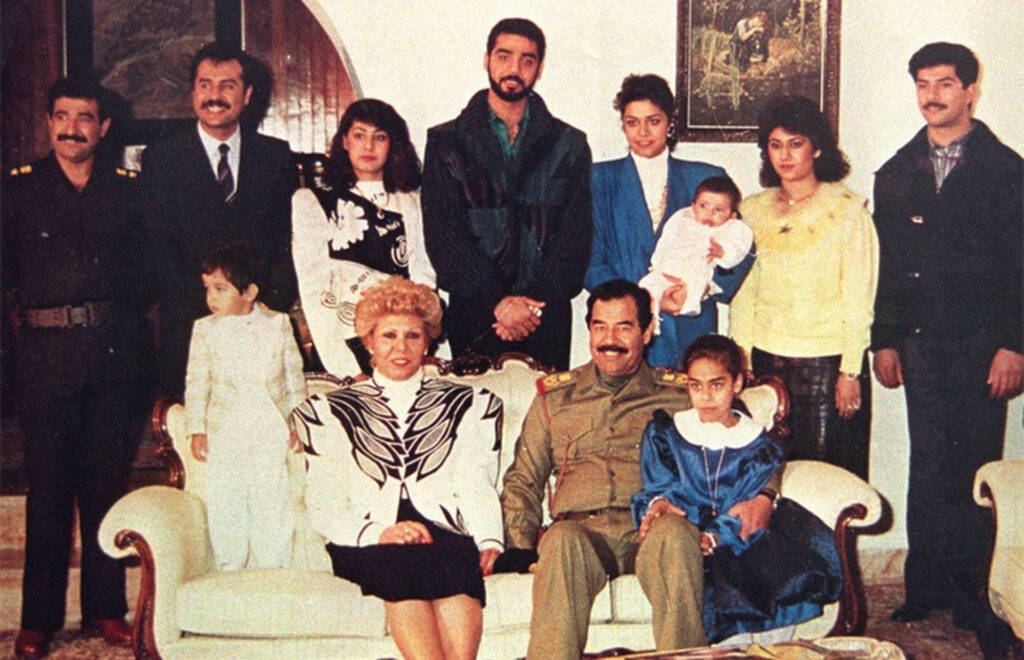
Uday and Qusay represented different faces of the same corruption. Uday embodied excess, humiliation, cruelty, impulsive violence, and the performative enjoyment of unchecked power. Qusay was more controlled, closer to the machinery of security, continuity, and succession. But the difference between them should not be mistaken for a difference between chaos and order in any healthy sense. It was a difference between two forms of regime decay, one theatrical and one administrative.
Taken together, they revealed what Saddam had built. Iraq was no longer simply a dictatorship sustained by fear. It was becoming a state in which fear itself had been personalized and prepared for transfer through bloodline. The next generation was not expected to reform the system, broaden it, or stabilize it. It was expected to inherit its methods more intimately than anyone outside the family ever could.
That is one of the clearest signs that a regime has stopped functioning as a state in the meaningful sense. It may still command armies, prisons, intelligence organs, and ministries, but at its center it is no longer governing public power. It is preserving private control of the country through the language of public authority.
Such systems often look stronger from the outside than they really are. They project control because fear is centralized, opposition is crushed, and succession appears contained. Yet what they are actually building is a hollow state wrapped in an armed shell. The stronger the family becomes, the weaker the country beneath it usually is, because institutions are being reshaped to serve inheritance rather than continuity.
Iraq was a particularly stark example of that pattern. The sons were not an embarrassing appendix to the regime. They were proof of what the regime had become. They showed that Saddam’s Iraq no longer imagined a future beyond itself, only a future in which its methods would continue through inheritance. That matters because when such a system falls, it does not reveal a healthy state waiting underneath the dictator. It reveals how much of the state had already been consumed before the fall ever came.
This is one of the reasons Iraq did not become coherent after Saddam. Too many outside observers treated the dictatorship as though it had simply been imposed upon the country from above. In reality, the regime had been eating the state from within for years. The distortion of succession was part of that process, not a side story beside it. Uday and Qusay mattered because they made visible the deepest truth about Saddam’s Iraq: it had ceased to trust anything beyond fear, and it was preparing to hand that fear to the next generation as though fear itself were a system of government.
Regime Change Removed Saddam – But It Did Not Solve Iraq
The removal of Saddam Hussein solved one problem, but it did not solve Iraq.
That distinction is essential, because much of the outside world treated the regime and the state as though they were effectively the same thing. The assumption was simple enough: once the dictator fell, Iraq would open; once the apparatus of fear was removed, a different political order would emerge; once the center of coercion was broken, the country could be rebuilt on more stable foundations. That assumption was always more hopeful than accurate.
Iraq under Saddam was not a coherent state merely trapped beneath a tyrant. It was a state that had already been deeply deformed by dictatorship. Its institutions had been bent inward, personalized, militarized, sectarianized, and hollowed out long before 2003. That meant regime change could remove the ruler without restoring the structure. In some respects, it did the opposite. It exposed how little durable political coherence remained once the regime’s machinery had been smashed.
That is why the fall of Saddam did not settle the Iraqi question. It clarified it. Once the regime collapsed, the underlying problems were no longer hidden behind the surface of centralized control. The essential questions of statehood reappeared in naked form. Who holds legitimate force? Who defines loyalty? What counts as the state once the old command structure has disappeared? What kind of political order can survive when fear has been removed from above, but no shared center has been rebuilt below?
Those questions proved much harder than toppling the regime itself.
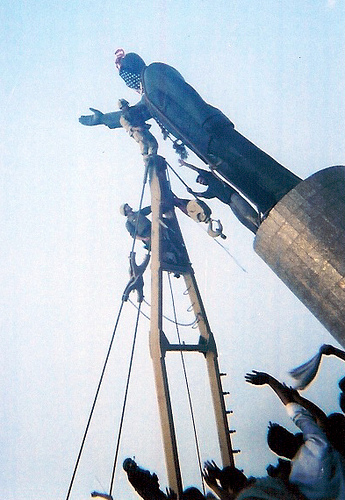
This is one of the hardest lessons Iraq imposed on the region and on the United States in particular. Destroying a dictatorship is not the same thing as rebuilding sovereignty. Eliminating a ruler is not the same thing as reconstructing legitimacy. Removing terror from the top does not automatically create trust underneath it. In many cases, it reveals how much trust had already been destroyed before the regime ever fell.
Iraq became a textbook case of that problem. What followed was not a clean democratic transition, but fragmentation, insurgency, sectarian bloodshed, competing centers of force, institutional weakness, external penetration, and the gradual rise of actors far more comfortable living inside broken sovereignty than repairing it. The fall of Saddam did not close Iraq’s crisis. It opened its next phase.
That is why Iraq matters so much strategically. It demonstrated with unusual clarity that regime change can be operationally easier than political reconstruction. A military campaign can destroy command structures quickly, decapitate a regime, and dismantle an army. What it cannot do by force alone is generate legitimacy, restore shared political identity, rebuild institutional trust, or create a stable balance between communities that have already learned to survive through fear, exclusion, and force. Those things require a different kind of work, and they require a different depth of understanding than military victory by itself can provide.
The failure to understand that difference is one of the reasons Iraq remained unfinished after Saddam. The regime disappeared, but the conditions for durable coherence did not materialize simply because the dictator had been removed. The state had to be rebuilt in a country where institutions had long ceased to serve the public in any meaningful way, where social trust had been damaged over decades, and where new actors were already better positioned to exploit the vacuum than to close it.
The removal of Saddam therefore deserves to be read in two ways at once. It was undeniably the destruction of a brutal regime. It was also the beginning of a second and more difficult struggle over whether Iraq could become something more than the ruins of what had been overthrown.
Post-Saddam Iraq: From Coercion to Fragmentation
The fall of Saddam did not produce a new Iraqi coherence. It produced the collapse of the old one without establishing a stable replacement.
That distinction matters because too much outside analysis treated post-2003 Iraq as though it were simply a failed transition. The problem was deeper than that. Iraq did not move from dictatorship toward a stable pluralist order and then lose its balance. It moved from one form of coercive coherence into a fragmented political landscape in which the state remained formally present, but the deeper habits required for shared sovereignty were never fully rebuilt.
Under Saddam, Iraq was brutal, distorted, and deeply unequal, but it still possessed a center that imposed one political reality on the country. That reality was sustained through force, patronage, surveillance, and fear. It was not healthy coherence, and it was certainly not legitimate, but it was still a structure capable of imposing hierarchy, suppressing alternatives, and maintaining a monopoly, however violent, over the political definition of the state.
Once that structure fell, Iraq did not discover an already prepared civic order waiting underneath it. It discovered how little had been built outside the regime’s machinery. That is where the post-Saddam story becomes much harder than the language of democratization or transition usually allows.
A country does not become coherent simply because its dictator is removed. If generations were formed under fear, sectarian imbalance, ideological manipulation, exclusion, and state violence, then the fall of the ruler does not automatically produce a common political culture. It often reveals the absence of one. Constitutions can be rewritten, ministries can be repopulated, elections can be organized, and slogans can be replaced, but if the deeper habits of trust, legitimacy, and shared belonging remain weak, the state continues to exist more on paper than in lived political reality.
That is what happened in Iraq. The regime collapsed. The center broke. But the country did not suddenly acquire a common civic grammar strong enough to carry the state beyond the dictatorship that had deformed it. Into that vacuum came competing identities, unresolved grievances, militia power, clerical influence, external patrons, and fragmented legitimacy. What should have been the work of rebuilding sovereignty became, in practice, a struggle over who would inhabit the vacuum first and most effectively.
This is why post-2003 Iraq cannot be understood only as a failed American project, though American failures were real and consequential. It must also be understood as a country in which the previous coherence had been so brutal, narrow, and unsustainable that its removal exposed not a suppressed national unity, but a deep political incompleteness. Once that incompleteness was exposed, the absence of a shared center became the defining fact of the new Iraq.
That is also where the Iranian dimension becomes decisive. Saddam had ruled as a Sunni Arab strongman over a majority-Shi’ite country through a secular Ba’athist structure built on coercion and centralized control. Once that structure was broken, Iraq did not simply become post-Saddam. It became open terrain. Shi’ite political forces rose, militias expanded, and Iranian influence moved more deeply into a state whose previous barriers had been removed without being meaningfully replaced.
That is one of the deepest ironies in Iraq’s modern history. The ruler who had fought revolutionary Iran for eight years, and who understood himself as a barrier against its expansion, ultimately left behind a broken Iraq far more penetrable to Iranian influence than the state he once controlled. In that sense, the war he fought did not end with his survival, and his fall did not end with his removal. The strategic contest returned through Iraq itself.
The phrase “post-Saddam Iraq” is therefore not sufficient. It describes a chronology, but not a condition. Iraq after Saddam did not simply become something new. It became a country in which the old form of coercive order had been destroyed without a durable replacement being consolidated in its place. There were institutions, but not enough trust. There were elections, but not enough coherence. There was a government, but not a full monopoly of force. There was a state in form, but not always in the deeper sense that serious sovereignty requires.
That is what makes Iraq so important to read carefully. It was not only a dictatorship that fell. It was a state that revealed how much more difficult it is to restore coherence after the collapse of coercive order than it is to destroy that order in the first place.
Saddam’s End and Its Limits
Saddam’s capture was dramatic, and his execution was historic, but neither event resolved Iraq. What they resolved was narrower, even if the images themselves encouraged a broader interpretation.
The ruler who had once embodied fear, spectacle, and absolute control was eventually found hiding near Tikrit, reduced to a fugitive in a hole in the ground. The symbolism was powerful, and it was intended to be. A regime that had projected permanence was shown to be mortal. A ruler who had shaped the country through terror was placed before a court and later hanged. In legal and symbolic terms, this mattered greatly. In strategic terms, it solved much less than many hoped.
The removal of the man did not remove the forces that had shaped Iraq under him, around him, and against him. It did not erase the sectarian imbalance the regime had manipulated for years. It did not rebuild institutions weakened by decades of fear. It did not settle the question of sovereignty. And it did not prevent Iraq from becoming the arena through which older regional conflicts returned in altered form.
For Iraqis, Saddam’s end did not mean the same thing to everyone. For some it was justice, delayed but necessary. For others it was humiliation, victor’s justice, or the violent closing of one order without any confidence in what would replace it. For many, it was less an ending than another proof that Iraq would continue to be fought over long after the dictator himself was gone. That ambiguity matters because it shows how limited the symbolism of removal can be once the underlying political order remains unresolved.
For Iran, Saddam’s end carried its own strategic meaning. It marked the disappearance of the man who had once led the long war against the Islamic Republic. Yet his removal did not simply close that history. It altered its terrain. The Iraq that remained after him was weaker, more fragmented, and more penetrable. In that sense, the ruler who fought for years to contain revolutionary Iran ultimately left behind a country far more open to Iranian influence than the one he had once controlled.
For the United States, Saddam’s removal was both achievement and warning. It demonstrated extraordinary capacity to reach, destroy, and depose. But it also revealed the limits of military success when regime destruction is not followed by restored coherence. Iraq showed that toppling a dictator, difficult as it may be, can still prove easier than building a state in the ruins that remain. That lesson would outlast the operation itself.
Saddam’s death should therefore not be treated as the end of the Iraqi story. It closed a trial. It ended a ruler. It punctured the illusion of his permanence. But it did not answer the question that had become more important than Saddam himself: what kind of Iraq was left once the regime had been destroyed, but the conditions for coherence had not been restored? That question survived him. In many ways, it became sharper after he was gone.