
Drill & Defense
Advertisement
  • Defense
    • Industry News
    • Weapon & Gear Reviews
    • Defense Technologies
    • Military Market Reports
  • Energy
    • Oil & Gas News
    • Energy Technologies
    • Market Trends & Analysis
  • Cross-Sector Insights
    • Defense & Energy Strategy
    • Global Security & Trade Analysis
    • Tech & Innovation Crossover
  • History & Legacy
    • Turning Points in Conflict
    • Legacy Systems & Structures
    • Resource Wars & Strategy
  • Knowledge Base
    • Defense Know-How
    • Energy Insight
  • About
  • Contact
  • Login
  • Register
No Result
View All Result
  • Defense
    • Industry News
    • Weapon & Gear Reviews
    • Defense Technologies
    • Military Market Reports
  • Energy
    • Oil & Gas News
    • Energy Technologies
    • Market Trends & Analysis
  • Cross-Sector Insights
    • Defense & Energy Strategy
    • Global Security & Trade Analysis
    • Tech & Innovation Crossover
  • History & Legacy
    • Turning Points in Conflict
    • Legacy Systems & Structures
    • Resource Wars & Strategy
  • Knowledge Base
    • Defense Know-How
    • Energy Insight
  • About
  • Contact
  • Login
  • Register
No Result
View All Result
Drill & Defense
No Result
View All Result
Home Defense

Iran’s Expanding Missile Arsenal: Symbol of Power or Strategic Overreach?

June 15, 2025
in Defense, Defense Technologies
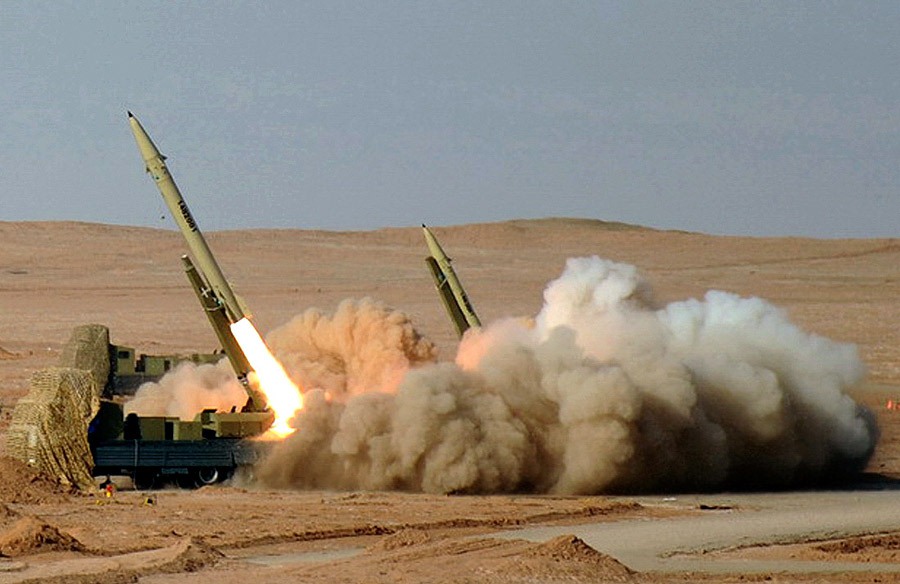
Fateh-110 Missile

Hossein Velayati, CC BY 4.0 , via Wikimedia Commons

Share on LinkedInShare on Twitter

In June 2025, the Middle East was once again reminded of the region’s fragile balance when Iran launched a series of missiles in retaliation to ongoing hostilities with Israel. Among them, a newly developed ballistic missile, known as Haj Qassem, took center stage. Its use—both technically and politically—marks an evolution in Iran’s strategic signaling. But beneath the surface of technical advancement lies a series of contradictions.

From Tactical Range to Strategic Messaging

Over the past two decades, Iran has steadily built a vast missile arsenal aimed at compensating for its limited air force and restricted access to international defense markets. The strategy is straightforward: use missile technology to deter regional adversaries, project power, and maintain an edge in asymmetric warfare.

What began with short-range ballistic missiles like the Fateh‑110 and Zolfaghar—systems capable of targeting military installations within a 500–700 km radius—has evolved into a broader doctrine that includes medium-range ballistic missiles (MRBMs) and even hypersonic technologies.

This shift is not just about range or payload. It’s about crafting a narrative of self-reliance and deterrence. The Haj Qassem missile, named after the slain IRGC general Qasem Soleimani, is a continuation of that narrative. But in trying to tell the world “we are not to be underestimated,” Iran risks investing in tools that may escalate tensions more than they stabilize them.
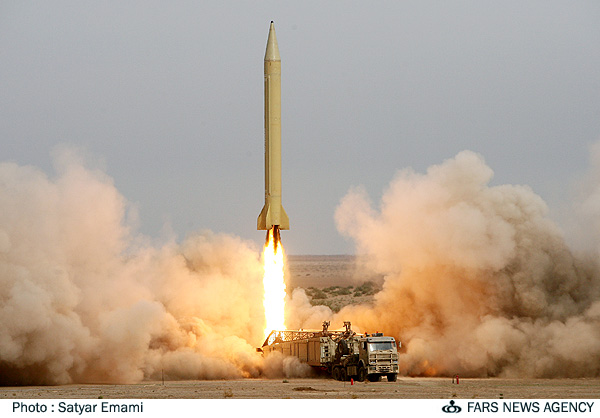
Fars Media Corporation, CC BY 4.0 https://creativecommons.org/licenses/by/4.0, via Wikimedia Commons

Technical Capabilities and the “Haj Qassem” Profile

According to international sources, the Haj Qassem missile boasts a range of 1 400 km, a solid-fuel engine, and a warhead exceeding 500 kg. Reports indicate that it achieves speeds in excess of Mach 8, possibly reaching hypersonic thresholds in its terminal phase. The missile is reportedly maneuverable, capable of bypassing systems like Israel’s Iron Dome and David’s Sling.

These features suggest a system designed not just for reach but for survivability in contested airspaces—a necessity given Iran’s awareness of the region’s dense missile defense coverage.

However, many of these performance claims remain difficult to verify. Open-source satellite imagery and intercepted telemetry are limited, and Iran’s state media is not known for transparency. What can be confirmed is that missiles like Haj Qassem have increased regional alert levels, but whether they genuinely redefine deterrence remains an open question.

Gaps in Precision and Overshadowed Infrastructure

Despite public claims of high precision and advanced navigation, Iran’s missile program still struggles with consistency in targeting accuracy. Past launches, particularly those during the Iraq base strikes in 2020 and operations in Syria, revealed a significant variation in impact zones, suggesting limitations in satellite coordination and inertial guidance.

Additionally, Iran’s manufacturing infrastructure, while robust in quantity, lacks the quality assurance protocols seen in peer military powers. Many of its designs, though indigenized, are derived from North Korean or Soviet-era systems, raising doubts about long-term reliability.

The focus on missile development also comes at a cost: neglected air force modernization, reliance on aging fighter jets, and limited drone-to-missile integration. While the missiles can fly fast and far, they are still heavily dependent on static launch systems, making them more vulnerable to pre-emptive strikes.

The Strategic Cost of Escalation

Iran’s growing missile capabilities may empower its geopolitical posture, but they also risk deeper isolation. As these systems are deployed more frequently—whether against state or non-state targets—the threshold for retaliation lowers. More importantly, the transfer of missile systems to proxies such as Hezbollah, the Houthis, and various Iraqi militias raises alarm among neighboring states and global actors alike.

Such transfers may enhance influence, but they also blur accountability, potentially drawing Iran into conflicts it cannot fully control. The result is a security dilemma: each show of strength forces its adversaries to expand their own arsenals, making diplomacy harder to sustain.

Moreover, the reliance on missiles like Haj Qassem reinforces a military-first narrative in Iranian policy circles. It downplays the importance of internal economic stability, international engagement, and diplomatic de-escalation—areas where Iran remains under heavy sanctions and struggling with inflation and unrest.

A Regional Power With Strategic Limits

Missiles are a tool. Whether they serve as shields or spears depends on how they are used—and why.

Iran’s expanding ballistic and hypersonic programs demonstrate ingenuity under pressure and technical resilience. But they also reflect a strategic culture that continues to prioritize confrontation over integration, and symbolism over transparency.

The Haj Qassem missile may indeed bypass defense systems. But the larger question remains: can it overcome the structural weaknesses and diplomatic isolation that have long defined Iran’s regional posture?


Sources:

CSIS Missile Threat – Center for Strategic and International Studies:
“Iran’s Missile Arsenal,” missilethreat.csis.org.
https://missilethreat.csis.org/country/iran

Army Technology – Global Defence Technology:
“Fateh-110 Tactical Ballistic Missile,”
https://www.army-technology.com/projects/fateh-110

Reuters:
“Iran unveils new hypersonic missile Fattah,”
https://www.reuters.com/world/middle-east/iran-unveils-hypersonic-missile-2023-06-06

Al Monitor:
“Iran claims to have developed hypersonic missile,”
https://www.al-monitor.com/originals/2023/06/iran-claims-have-developed-hypersonic-missile

Wikipedia (cross-verified with defense sources):
Pages on Fateh-110, Zolfaghar, Kheibar Shekan, Fattah-1, Shahab-3, and Haj Qassem missiles
https://en.wikipedia.org/wiki/List_of_missiles_of_Iran

Previous Post

World Bank’s Strategic Pivot: Nuclear Energy Joins the Clean Power Mix

Next Post

A Historic $142 Billion Arms Deal: Unpacking the U.S.-Saudi Agreement

Related Posts

USSPACECOM_Joint_Operations_Center_(7804714)
Defense

Deepfake Deception: The Phantom Siege Reshaping Espionage

December 3, 2025
ITAR Spotlight: Why USML Categories I, III and VIII Sit At The Heart Of Defense Export Controls
Military Market Reports

ITAR Spotlight: Why USML Categories I, III and VIII Sit At The Heart Of Defense Export Controls

November 26, 2025
Africa Partnership Station AK 47
Defense

The AK-47 Legacy in Africa

October 20, 2025
K2_(7445555272)_(cropped)
Defense

Hanwha Aerospace and South Korea’s Quiet Surge in Global Defense

October 8, 2025
F-35 Demo Team performs at the Defenders of Liberty Air & Space Show
Defense

Turkey and the F-35 Question: Is a Return to the Program Realistic?

October 1, 2025
DynCorp International: What It Does, Where It Operates, and Why It Matters
Defense

DynCorp International: What It Does, Where It Operates, and Why It Matters

September 29, 2025
Next Post
A Historic $142 Billion Arms Deal: Unpacking the U.S.-Saudi Agreement

A Historic $142 Billion Arms Deal: Unpacking the U.S.-Saudi Agreement

  • Trending
  • Comments
  • Latest
Blackwater PMC

After Blackwater: How PMCs Evolved, Professionalized, and Fragmented

September 13, 2025
Blackwater PMC

Inside Iraq’s Security Market: How Private Power Shapes a Fragile State

October 6, 2025
Operation Enduring Freedom

What Exactly Is a Private Military Company (PMC)?

September 6, 2025
Repkon Nammo in Denmark: What This Nordic Ammunition Play Really Signals

Repkon Nammo in Denmark: What This Nordic Ammunition Play Really Signals

August 21, 2025
A Historic $142 Billion Arms Deal: Unpacking the U.S.-Saudi Agreement

A Historic $142 Billion Arms Deal: Unpacking the U.S.-Saudi Agreement

A Silent Revolution on the Battlefield: AI-Enabled Tactical Communication Systems

A Silent Revolution on the Battlefield: AI-Enabled Tactical Communication Systems

Cominf.org, CC BY-SA 3.0 , via Wikimedia Commons

Is Europe Really Reducing Its Dependence on Russian Gas?

What is ITAR? The Invisible Line in Global Defense Trade

What is ITAR? The Invisible Line in Global Defense Trade

Israel’s F-15 News: What Actually Happened, and Why It Matters

Israel’s F-15 News: What Actually Happened, and Why It Matters

January 1, 2026
SDF and HTS: Managing Tension Without Open Conflict in Northern Syria

SDF and HTS: Managing Tension Without Open Conflict in Northern Syria

December 26, 2025
What 2025 Taught Us About Defense and Energy: Five Lessons for 2026

What 2025 Taught Us About Defense and Energy: Five Lessons for 2026

December 24, 2025
The New Taiwan Arms Package and China’s “Stop” Message: What Actually Changed

The New Taiwan Arms Package and China’s “Stop” Message: What Actually Changed

December 19, 2025

Recent News

Israel’s F-15 News: What Actually Happened, and Why It Matters

Israel’s F-15 News: What Actually Happened, and Why It Matters

January 1, 2026
SDF and HTS: Managing Tension Without Open Conflict in Northern Syria

SDF and HTS: Managing Tension Without Open Conflict in Northern Syria

December 26, 2025
What 2025 Taught Us About Defense and Energy: Five Lessons for 2026

What 2025 Taught Us About Defense and Energy: Five Lessons for 2026

December 24, 2025
The New Taiwan Arms Package and China’s “Stop” Message: What Actually Changed

The New Taiwan Arms Package and China’s “Stop” Message: What Actually Changed

December 19, 2025
Drill & Defense

Drill & Defense is an independent platform providing insights into firearms, defense technologies, and energy sectors. We deliver clear, practical content for professionals, enthusiasts, and industry followers worldwide.

Follow Us

Browse by Category

  • Cross-Sector Insights
  • Defense
  • Defense & Energy Strategy
  • Defense Know-How
  • Defense Technologies
  • Energy
  • Energy Insight
  • Energy Technologies
  • Global Security & Trade Analysis
  • History & Legacy
  • Industry News
  • Knowledge Base
  • Legacy Systems & Structures
  • Market Trends & Analysis
  • Military Market Reports
  • Oil & Gas News
  • Resource Wars & Strategy
  • Tech & Innovation Crossover
  • Turning Points in Conflict
  • Weapon & Gear Reviews

Recent News

Israel’s F-15 News: What Actually Happened, and Why It Matters

Israel’s F-15 News: What Actually Happened, and Why It Matters

January 1, 2026
SDF and HTS: Managing Tension Without Open Conflict in Northern Syria

SDF and HTS: Managing Tension Without Open Conflict in Northern Syria

December 26, 2025

© 2025 Drill & Defense. All rights reserved. Independent insights on firearms, defense, and energy. For business inquiries: info@drillanddefense.com | PRIVACY POLICY | COOKIE POLICY | TERMS AND CONDITIONS

Manage Consent

We use cookies to improve your experience. You can accept or refuse cookies; however, some features may not function properly without your consent.

Functional Always active
The technical storage or access is strictly necessary for the legitimate purpose of enabling the use of a specific service explicitly requested by the subscriber or user, or for the sole purpose of carrying out the transmission of a communication over an electronic communications network.
Preferences
The technical storage or access is necessary for the legitimate purpose of storing preferences that are not requested by the subscriber or user.
Statistics
The technical storage or access that is used exclusively for statistical purposes. The technical storage or access that is used exclusively for anonymous statistical purposes. Without a subpoena, voluntary compliance on the part of your Internet Service Provider, or additional records from a third party, information stored or retrieved for this purpose alone cannot usually be used to identify you.
Marketing
The technical storage or access is required to create user profiles to send advertising, or to track the user on a website or across several websites for similar marketing purposes.
  • Manage options
  • Manage services
  • Manage {vendor_count} vendors
  • Read more about these purposes
View preferences
  • {title}
  • {title}
  • {title}
No Result
View All Result
  • Defense
    • Industry News
    • Weapon & Gear Reviews
    • Defense Technologies
    • Military Market Reports
  • Energy
    • Oil & Gas News
    • Energy Technologies
    • Market Trends & Analysis
  • Cross-Sector Insights
    • Defense & Energy Strategy
    • Global Security & Trade Analysis
    • Tech & Innovation Crossover
  • History & Legacy
    • Turning Points in Conflict
    • Legacy Systems & Structures
    • Resource Wars & Strategy
  • Knowledge Base
    • Defense Know-How
    • Energy Insight
  • About
  • Contact
  • Login
  • Register

© 2025 Drill & Defense. All rights reserved. Independent insights on firearms, defense, and energy. For business inquiries: info@drillanddefense.com | PRIVACY POLICY | COOKIE POLICY | TERMS AND CONDITIONS