
Drill & Defense
Advertisement
  • Defense
    • Industry News
    • Weapon & Gear Reviews
    • Defense Technologies
    • Military Market Reports
  • Energy
    • Oil & Gas News
    • Energy Technologies
    • Market Trends & Analysis
  • Cross-Sector Insights
    • Defense & Energy Strategy
    • Global Security & Trade Analysis
    • Tech & Innovation Crossover
  • History & Legacy
    • Turning Points in Conflict
    • Legacy Systems & Structures
    • Resource Wars & Strategy
  • Knowledge Base
    • Defense Know-How
    • Energy Insight
  • About
  • Contact
  • Login
  • Register
No Result
View All Result
  • Defense
    • Industry News
    • Weapon & Gear Reviews
    • Defense Technologies
    • Military Market Reports
  • Energy
    • Oil & Gas News
    • Energy Technologies
    • Market Trends & Analysis
  • Cross-Sector Insights
    • Defense & Energy Strategy
    • Global Security & Trade Analysis
    • Tech & Innovation Crossover
  • History & Legacy
    • Turning Points in Conflict
    • Legacy Systems & Structures
    • Resource Wars & Strategy
  • Knowledge Base
    • Defense Know-How
    • Energy Insight
  • About
  • Contact
  • Login
  • Register
No Result
View All Result
Drill & Defense
No Result
View All Result
Home Defense

FN FAL: The Right Arm of the Free World

March 31, 2026
in Defense, Weapon & Gear Reviews
FN FAL: The Right Arm of the Free World

Hybrid FN FAL made of metric and inch-pattern parts of various origins. Bouillant Achille, CC BY-SA 4.0 .

Share on LinkedInShare on Twitter

The FN FAL did not appear as a finished solution. It emerged from a period where militaries were still experimenting with what an infantry rifle should actually be. The Second World War had already changed expectations, but the balance between firepower, control, and mobility was still unresolved.

Developed by Fabrique Nationale in Belgium, the rifle was originally designed around an intermediate cartridge concept. That direction, however, did not last. Once NATO standardized the 7.62×51mm round, the FAL was adapted to meet that requirement. This was not just a technical adjustment. It fundamentally reshaped the rifle’s role and how it would be used across different armies.

At that point, the FN FAL stopped being just a design project. It became part of a larger system, one defined by alliance structures, logistics, and shared operational frameworks. Its rise cannot be separated from that context.

Who Actually Designed the FN FAL?

When discussing the FN FAL, it is often tempting to associate it with a single name, as is the case with many well-known firearms. However, the reality is slightly more complex. The rifle was developed by FN Herstal, and while there is a key figure behind its design, the process itself was not the work of one individual alone.

The central name associated with the FN FAL is Dieudonné Saive. Saive was one of the most important firearms designers of his time and had already played a significant role in earlier projects, including the development of the Browning Hi-Power. His experience and design approach were instrumental in shaping the early concepts of the FAL.

At the same time, it is important to recognize that the FN FAL was the result of a broader engineering effort. The rifle went through multiple stages of development, adaptation, and testing, particularly as it transitioned from an intermediate cartridge design to one chambered in 7.62×51mm NATO. These changes required input beyond a single designer, involving a team working within FN Herstal’s structure.

This distinction matters because it reflects how most successful military systems are developed. While individual designers provide direction and vision, large-scale adoption and refinement depend on institutional capability. The FN FAL follows that pattern closely, combining the influence of a leading designer with the resources and continuity of an established manufacturer.

In that sense, attributing the FN FAL to a single person would be incomplete. It is more accurate to see it as a system shaped by both individual expertise and collective development.

Why It Became “The Right Arm of the Free World”

The nickname is often repeated, but it carries a specific meaning when you look at the numbers behind it. The FN FAL was adopted by more than 90 countries, many of them within Western or NATO-aligned spheres. That kind of spread is rarely explained by performance alone.

What made the difference was alignment. Countries adopting the FAL were also aligning with a broader logistical system. Ammunition compatibility simplified supply chains. Training could be standardized more easily. Maintenance practices began to converge across different forces.
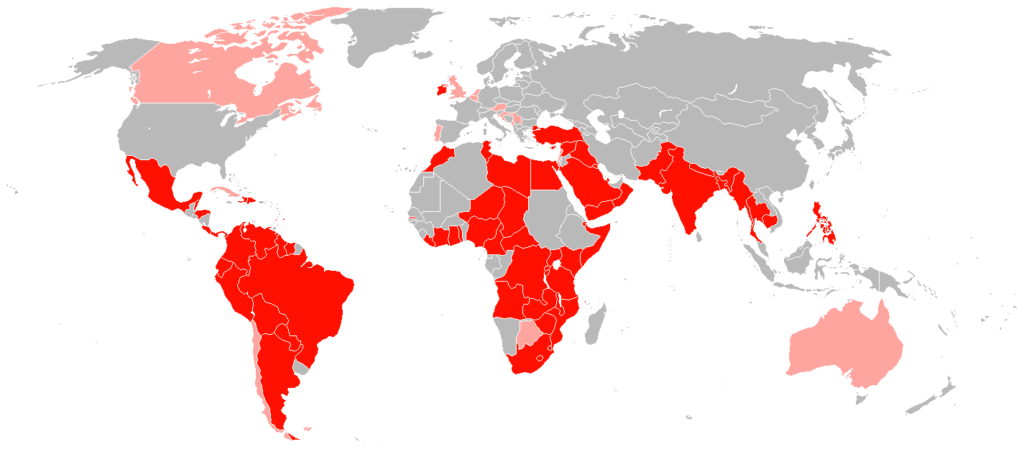
World map of operators of the FN :Bright Red = Operator Pink = Former operator.
Own work, derivative of image:BlankMap-World.png., CC BY-SA 4.0 https://creativecommons.org/licenses/by-sa/4.0.

Over time, this created a kind of informal standardization. Even without a single unified rifle across NATO, the FN FAL became a common reference point. Soldiers from different countries operated with similar systems, which reduced friction in joint environments.

There is also a strategic layer here. A shared platform does more than simplify logistics. It reinforces cooperation, predictability, and interoperability. The FN FAL fit into that structure almost perfectly.

Design Philosophy: Power First, Control Second

The FN FAL is built around a clear priority. Power and range come first.

Chambered in 7.62×51mm NATO, the rifle offers strong ballistic performance and effective engagement at longer distances. In open terrain, this made practical sense, especially within the assumptions of mid-century warfare. The expectation was that infantry would need to engage targets beyond close-range encounters.

But that decision introduced trade-offs that became more visible over time.

Recoil is the most obvious one. In automatic mode, the rifle becomes difficult to control in real conditions. This is not just a technical observation, it directly affected how the weapon was used in practice. Many forces effectively treated it as a semi-automatic rifle, despite its full-auto capability.

This creates an interesting gap between design intent and actual use. The rifle was built to do more than what was realistically practical in most engagements.
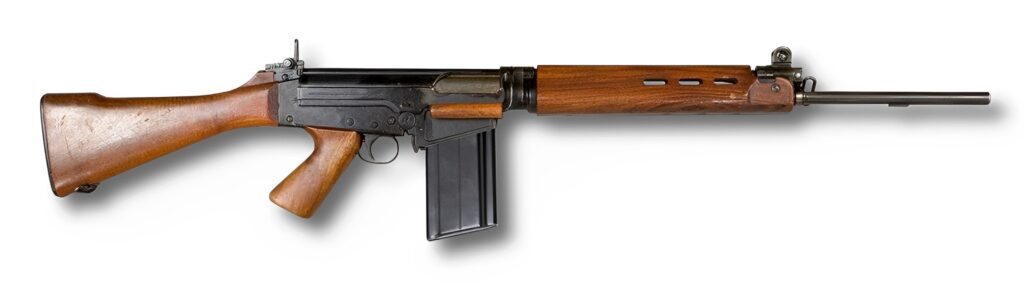
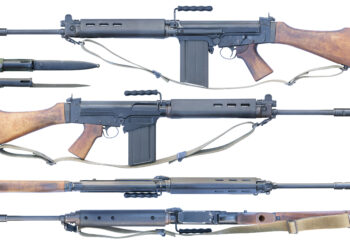
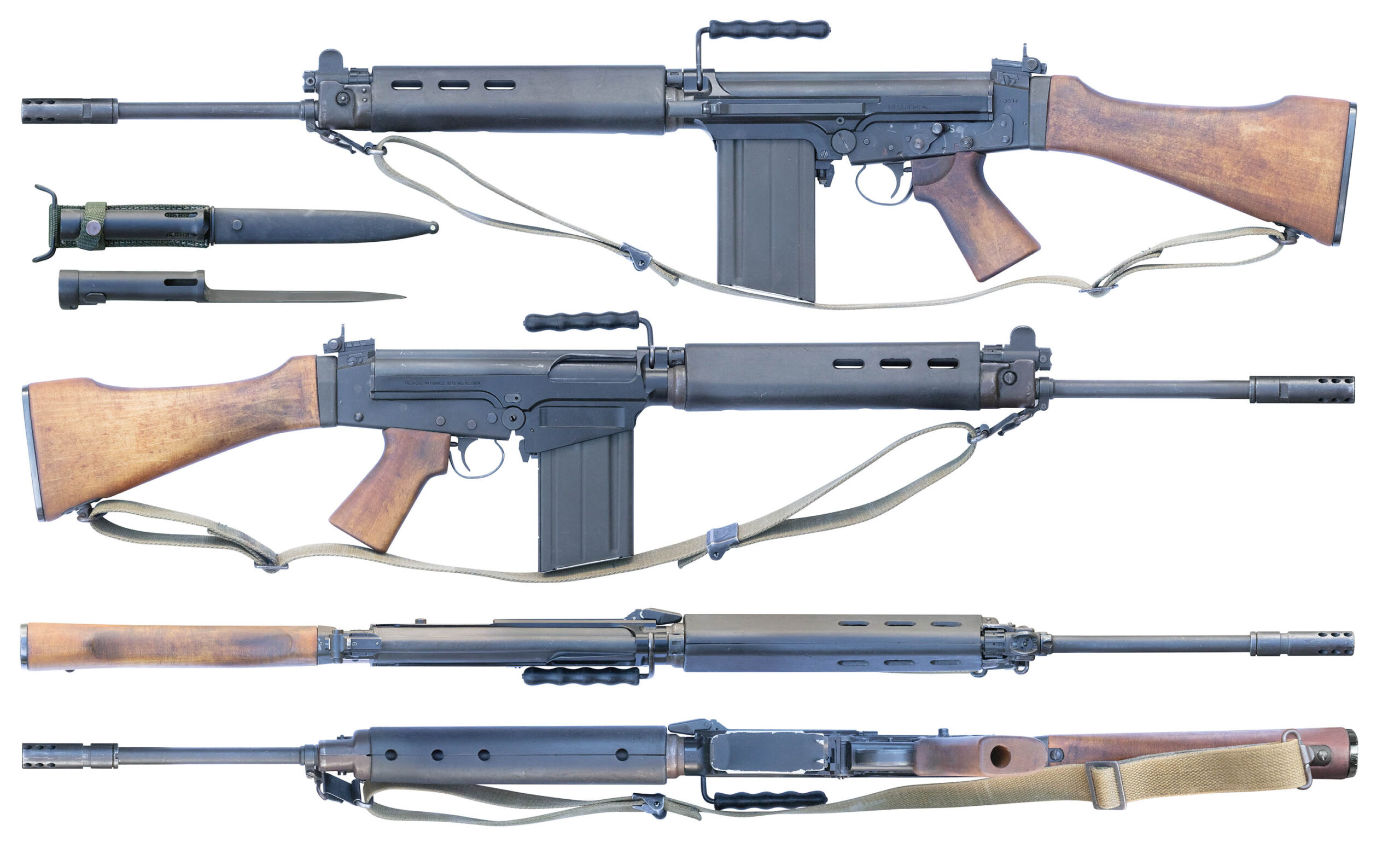
FN FAL rifle. photo: Snark and Armémuseum, compilation: Sumek101, CC BY-SA 4.0 https://creativecommons.org/licenses/by-sa/4.0.

Reliability and Adaptability

If there is one area where the FN FAL consistently maintains its reputation, it is reliability.

The adjustable gas system plays a central role here. It allows the rifle to be tuned based on environmental conditions and ammunition variations. This might seem like a small feature, but in operational terms, it makes a significant difference.

The rifle was used in a wide range of environments, from arid regions to humid and unpredictable climates. In such conditions, consistency matters more than theoretical performance. The FN FAL proved capable of maintaining function even when conditions were far from ideal.

That reliability contributed directly to its global adoption. A system that continues to work under stress becomes easier to trust, and that trust tends to spread across units and countries.

A modern re-enactor, Stefan Melander, simulates a Rhodesian Light Infantry soldier from 1979, wearing appropriate uniform and carrying appropriate gear. Photograph taken by Samu Hupli. Samu Hupli and Stefan Melander, CC BY-SA 4.0 https://creativecommons.org/licenses/by-sa/4.0.

A Rifle That Spread Beyond Its System

One of the most notable aspects of the FN FAL is how far it moved beyond its original context.

It was used across multiple continents, in both conventional and irregular conflicts. In some cases, it even appeared on both sides of the same war. This reflects not just its popularity, but the extent of its distribution.

Once a platform reaches that level of spread, control becomes impossible. It stops being tied to a single doctrine or alliance. Instead, it becomes part of the global environment, shaped by availability rather than origin.

This transition is important. It shows how systems can evolve beyond the structures that initially supported them.
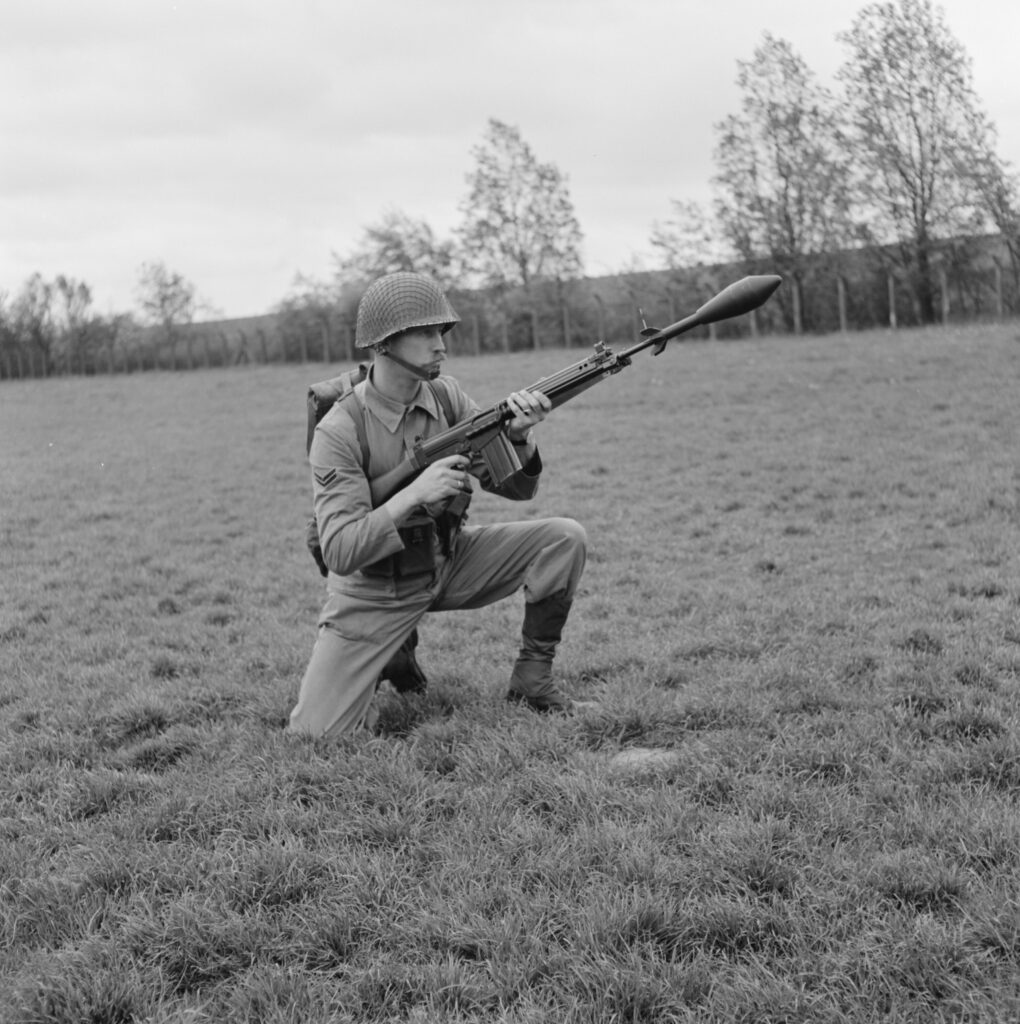
A Marine Corporal (Kplmarns) as a rifle grenade gunner on the grounds of the Van Ghent Barracks (VGKAZ) at Toepad in Rotterdam. Audiovisuele Dienst Koninklijke Marine (AVDKM), CC BY-SA 4.0 https://creativecommons.org/licenses/by-sa/4.0.

The Shift That Replaced It

By the late twentieth century, the assumptions behind rifles like the FN FAL began to change.

Military priorities shifted toward mobility, ammunition capacity, and controllability. Engagement distances were often shorter than previously expected, and the need for sustained automatic fire became more relevant.

This is where smaller calibers and lighter platforms gained ground. Rifles chambered in 5.56×45mm NATO allowed soldiers to carry more ammunition and maintain better control under rapid fire conditions.

The transition was gradual but consistent.

The FN FAL did not become obsolete overnight. It simply became less aligned with the evolving demands of the battlefield. Its strengths remained, but the context that made those strengths dominant had changed.
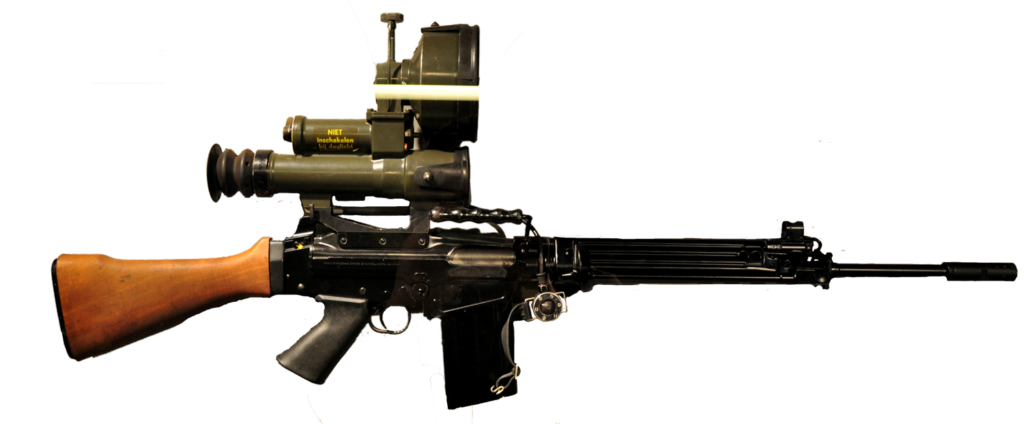
FN FAL with an infrared light and scope, exhibited at the Legermuseum in Delft. Dunee, CC BY-SA 3.0 https://creativecommons.org/licenses/by-sa/3.0.

What It Represents Today

Today, the FN FAL still appears in limited roles and in certain regions where durability continues to be valued. In some cases, it has been adapted or modernized, but it is no longer a primary service rifle in most modern armies.

Its real relevance now is analytical.

The FN FAL demonstrates how a system can achieve global reach when it aligns with a broader structure. Its success was not only about engineering, but about compatibility with logistics, alliances, and operational expectations.

If you look at modern defense systems through that lens, a pattern becomes visible.

Platforms that integrate well tend to spread further. Those that do not remain limited, regardless of their technical quality. The FN FAL followed the first path, and that is why it remains a useful reference point even today.

A fighter of the Siddiq Battalions fire a scoped FN FAL at Syrian government forces in the town of Otaybah, eastern Ghouta. Al-Siddiq Battalions, CC BY 3.0 https://creativecommons.org/licenses/by/3.0.

Sources

  • Warfare History Network – The FN FAL Rifle: NATO’s Right Arm
  • Shooting Illustrated (NRA) – The History of the FN FAL
  • Small Arms Survey – FN FAL & Derivatives (Technical Profile)

Previous Post

The Evolution of War: What Changed, What Didn’t, and Why It Still Matters

Related Posts

A-10 Thunderbolt II: A Platform Built Around Purpose
Defense

A-10 Thunderbolt II: A Platform Built Around Purpose

March 24, 2026
Merkava Barak: The Evolution of Armored Warfare
Defense

Merkava Barak: The Evolution of Armored Warfare

March 17, 2026
2048px-U_S_Forces_Launch_Operation_Epic_Fury_(9542616)
Defense

Carrier Strike Power: Super Hornet, Hawkeye, JDAM and the Mechanics of Modern Air Operations

March 4, 2026
“Iron Swords” – The Continuing War Born from the Tunnels
Defense

“Iron Swords” – The Continuing War Born from the Tunnels

February 18, 2026
Stealth Technology’s Mathematics: How Low Observability Is Actually Engineered
Defense

Stealth Technology’s Mathematics: How Low Observability Is Actually Engineered

February 11, 2026
ITAR Spotlight: Why USML Categories I, III and VIII Sit At The Heart Of Defense Export Controls
Military Market Reports

ITAR Spotlight: Why USML Categories I, III and VIII Sit At The Heart Of Defense Export Controls

November 26, 2025
  • Trending
  • Comments
  • Latest
Blackwater PMC

After Blackwater: How PMCs Evolved, Professionalized, and Fragmented

September 13, 2025
Blackwater PMC

Inside Iraq’s Security Market: How Private Power Shapes a Fragile State

October 6, 2025
Operation Enduring Freedom

What Exactly Is a Private Military Company (PMC)?

September 6, 2025
FeisalPartyAtVersaillesCopy

T. E. Lawrence: Strategic Influence, Cultural Depth, and the Enduring Architecture of a Legacy

January 26, 2026
A Historic $142 Billion Arms Deal: Unpacking the U.S.-Saudi Agreement

A Historic $142 Billion Arms Deal: Unpacking the U.S.-Saudi Agreement

A Silent Revolution on the Battlefield: AI-Enabled Tactical Communication Systems

A Silent Revolution on the Battlefield: AI-Enabled Tactical Communication Systems

Cominf.org, CC BY-SA 3.0 , via Wikimedia Commons

Is Europe Really Reducing Its Dependence on Russian Gas?

What is ITAR? The Invisible Line in Global Defense Trade

What is ITAR? The Invisible Line in Global Defense Trade

FN FAL: The Right Arm of the Free World

FN FAL: The Right Arm of the Free World

March 31, 2026
The Evolution of War: What Changed, What Didn’t, and Why It Still Matters

The Evolution of War: What Changed, What Didn’t, and Why It Still Matters

March 30, 2026
Six-Day_War._IDF_14th_Armored_Brigade

Victory Before Exit Strategy

March 27, 2026
Yalta_summit_1945_with_Churchill,_Roosevelt,_Stalin

Yalta: The Conference That Divided the Post-War World

March 25, 2026

Recent News

FN FAL: The Right Arm of the Free World

FN FAL: The Right Arm of the Free World

March 31, 2026
The Evolution of War: What Changed, What Didn’t, and Why It Still Matters

The Evolution of War: What Changed, What Didn’t, and Why It Still Matters

March 30, 2026
Six-Day_War._IDF_14th_Armored_Brigade

Victory Before Exit Strategy

March 27, 2026
Yalta_summit_1945_with_Churchill,_Roosevelt,_Stalin

Yalta: The Conference That Divided the Post-War World

March 25, 2026
Drill & Defense

Drill & Defense is an independent platform providing insights into firearms, defense technologies, and energy sectors. We deliver clear, practical content for professionals, enthusiasts, and industry followers worldwide.

Follow Us

Browse by Category

  • Cross-Sector Insights
  • Defense
  • Defense & Energy Strategy
  • Defense Know-How
  • Defense Technologies
  • Energy
  • Energy Insight
  • Energy Technologies
  • Global Security & Trade Analysis
  • History & Legacy
  • Industry News
  • Knowledge Base
  • Legacy Systems & Structures
  • Market Trends & Analysis
  • Military Market Reports
  • Oil & Gas News
  • Resource Wars & Strategy
  • Tech & Innovation Crossover
  • Turning Points in Conflict
  • Weapon & Gear Reviews

Recent News

FN FAL: The Right Arm of the Free World

FN FAL: The Right Arm of the Free World

March 31, 2026
The Evolution of War: What Changed, What Didn’t, and Why It Still Matters

The Evolution of War: What Changed, What Didn’t, and Why It Still Matters

March 30, 2026

© 2026 Drill & Defense. All rights reserved. Independent insights on firearms, defense, and energy. For business inquiries: info@drillanddefense.com | PRIVACY POLICY | COOKIE POLICY | TERMS AND CONDITIONS

Manage Consent

We use cookies to improve your experience. You can accept or refuse cookies; however, some features may not function properly without your consent.

Functional Always active
The technical storage or access is strictly necessary for the legitimate purpose of enabling the use of a specific service explicitly requested by the subscriber or user, or for the sole purpose of carrying out the transmission of a communication over an electronic communications network.
Preferences
The technical storage or access is necessary for the legitimate purpose of storing preferences that are not requested by the subscriber or user.
Statistics
The technical storage or access that is used exclusively for statistical purposes. The technical storage or access that is used exclusively for anonymous statistical purposes. Without a subpoena, voluntary compliance on the part of your Internet Service Provider, or additional records from a third party, information stored or retrieved for this purpose alone cannot usually be used to identify you.
Marketing
The technical storage or access is required to create user profiles to send advertising, or to track the user on a website or across several websites for similar marketing purposes.
  • Manage options
  • Manage services
  • Manage {vendor_count} vendors
  • Read more about these purposes
View preferences
  • {title}
  • {title}
  • {title}
No Result
View All Result
  • Defense
    • Industry News
    • Weapon & Gear Reviews
    • Defense Technologies
    • Military Market Reports
  • Energy
    • Oil & Gas News
    • Energy Technologies
    • Market Trends & Analysis
  • Cross-Sector Insights
    • Defense & Energy Strategy
    • Global Security & Trade Analysis
    • Tech & Innovation Crossover
  • History & Legacy
    • Turning Points in Conflict
    • Legacy Systems & Structures
    • Resource Wars & Strategy
  • Knowledge Base
    • Defense Know-How
    • Energy Insight
  • About
  • Contact
  • Login
  • Register

© 2026 Drill & Defense. All rights reserved. Independent insights on firearms, defense, and energy. For business inquiries: info@drillanddefense.com | PRIVACY POLICY | COOKIE POLICY | TERMS AND CONDITIONS